

Tech
These Are the Best Vibrators to Get Your Groove On

Vibrators are some of the most approachable sex toys on the market, but there are so many types of vibrators that it can make even a long-term vibrator owner go a bit mad. From bullet vibrators and the iconic rabbit vibrator to all those funny-shaped but deliciously potent vibrators in between, shopping for one can get overwhelming. Luckily, I have a few tips and tricks to help you narrow things down.
First, look at the materials. For vibrators, you want them made from 100 percent platinum-cured silicone and/or ABS plastic. Hard glossy plastic is OK for parts that don’t touch your genitals, but platinum silicone is nonporous, easy to clean, and body-safe. Unlike lesser grades of silicone, platinum silicone doesn’t give off any weird smells or compounds that may be unpleasant or even harmful to your genitals. That’s because it’s chemically different from other kinds of silicone. Surgical steel (also called 316 stainless steel) and borosilicate glass are just as body-safe, durable, and nonporous, but less common in vibrators and more common in dildos.
Second, look at the charger the vibrator comes with. Is it USB-A, USB-C, or a proprietary AC adapter? I try to keep things simple and stick with USB rechargeable vibrators either with USB-A or USB-C. It’s way too easy to lose the charger, and there’s comfort in knowing you can use any charging cable you have lying around. There’s nothing worse than a toy that dies on you mid-use.
Thirdly, when you get your new vibrator, test its vibration strength on the tip of your nose first. You should feel it tickling your nostrils and sinuses, giving you an idea of how deep into your genital tissue it can stimulate. Remember, about 90 percent of the clitoris can’t be stimulated directly because it’s under the skin, so deep vibes are important. The same goes for the phallus—the erectile tissue goes deep into your body, and stimulating it with a vibrator can provide a new and exhilarating experience.
Lastly, consider price—especially if you’re on a budget. Some vibrators can be really expensive based on the features they offer. For example, long-distance devices and suction toys can cost a couple hundred dollars. While a high-quality, body-safe vibrator shouldn’t be cheap, you also want to make sure you’re getting your money’s worth. Make sure to read the specs so you know you’re making a financially wise decision. If a vibrator only has a battery life of one hour, but it’s going to set you back $200, keep looking.












Today, Apple announced its new budget MacBook. At $599, it looks seriously impressive. While I haven’t tested its performance, battery life, or display just yet, it may end up being hard to beat at that price based on some of the specs alone.
But that doesn’t mean the competition isn’t there. I want to recommend a couple of Windows laptops deals that offer various advantages over the MacBook Neo, showing where the Neo has both strengths and weaknesses.
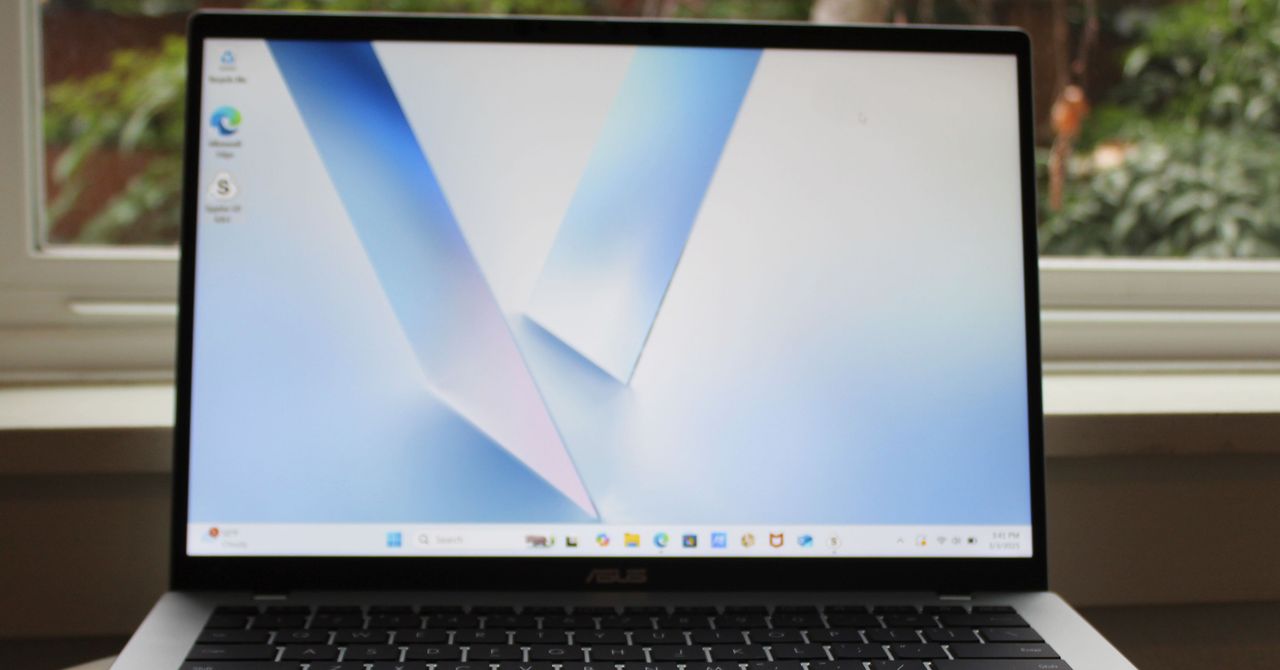
First, check out this Asus Vivobook 14, a laptop I’ve been happy to recommend as a budget computer for the past year. In many ways, this is the Windows version of a laptop like the MacBook Neo. It uses a highly-efficient ARM chip, the Qualcomm Snapdragon X, meaning it gets great battery life and performs admirably in daily tasks. It’s not quite as thin or light as the MacBook Neo, but it’s fairly portable for a laptop at this price.
Unlike the MacBook Neo, the Vivobook 14 comes with 16 GB of RAM and 512 GB of storage. That’s twice what you get in the MacBook Neo’s starting configuration. Right now, this configuration of the Vivobook 14 is on sale for $539. That’s a killer deal for those specs. It even comes with a healthier mix of ports, including HDMI, two USB-A, one USB-C, and a headphone jack. That also means it can support two external displays unlike the MacBook Neo, which can only handle just one.
Don’t get me wrong—I’m not at all saying the Vivobook 14 is a slam dunk over the MacBook Neo. Based on specs alone, I know the Vivobook 14 is a serious step down when it comes to the display. It’s less sharp, stretched across a larger screen, and the color performance isn’t so good. The Vivobook 14 maxes out at 280 nits, whereas Apple says the MacBook Neo can go all the way up to 500 nits. I have a hunch that the MacBook Neo will deliver a much better display in just about every regard.
There’s also the touchpad. It’s a little clunky to use, which is typical of budget Windows laptops. This is just a guess—but the touchpad on the MacBook Neo will likely feel smoother. It’s a mechanical trackpad (unlike the MacBook Air’s haptic feedback trackpad), but Apple has almost never made a bad trackpad.
If you’re not convinced by the Asus Vivobook 14, I’d also recommend the HP OmniBook 5, which is currently on sale for $500 and uses the same Snapdragon X chip. While it only has 256 GB of storage, it has a much better screen than the Vivobook 14, using an OLED display. It’s not any brighter than the Vivobook 14, but it gives you far better color performance and contrast. It’s also just 0.50 inches thick, matching the MacBook Neo exactly in portability.
Other Good USB Hubs to Consider
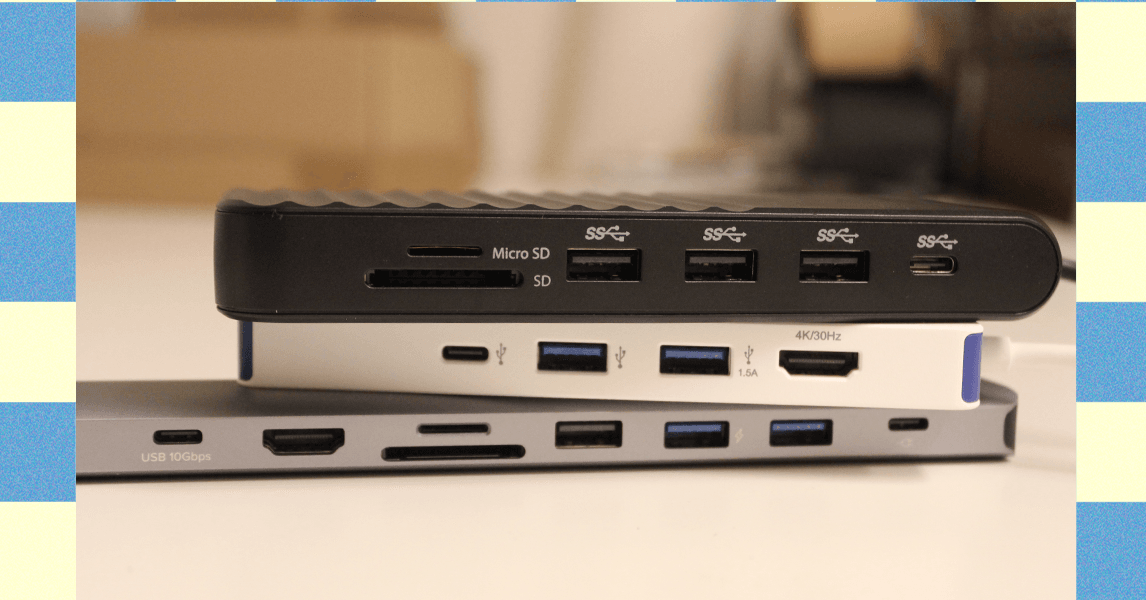
Ugreen Revodok Pro 211 Docking Station for $64: Most laptop docking stations are bulky gadgets that often require a power source, but this one from Ugreen straddles the line between dock and hub. It has a small, braided cable running to a relatively large aluminum block. It’s a bit hefty but still compact, and it packs a lot of extra power. It has three USB ports (one USB-C and two USB-A) that each reached up to 900 MB/s of data-transfer speeds in my testing. That was enough to move large amounts of 4K video footage in minutes. The only problem is that using dual monitors on a Mac is limited to only mirroring.
Photograph: Luke Larsen
Hyper HyperDrive Next Dual 4K Video Dock for $150: This one also straddles the line between dock and USB hub. Many mobile docks lack proper Mac support, only allowing for mirroring instead of full extension. The HyperDrive Next Dual 4K fixes that problem, though, making it a great option for MacBooks (though it won’t magically give an old MacBook Air dual-monitor support). Unfortunately, you’ll be paying handsomely for that capability, as this one is more expensive than the other options. The other problem is that although this dock has two HDMI ports that can support 4K, though only one will be at 60 Hz and the other will be stuck at 30 Hz. So, if you plan to use it with multiple displays, you’ll need to drop the resolution 1440p or 1080p on one of them. I also tested this Targus model, which is made by the same company, which gets you two 4K displays at 60 Hz but not on Mac.
.png)
Anker USB-C Hub 5-in-1 for $20: This Anker USB hub is the one I carry in my camera bag everywhere. It plugs into the USB-C port on your laptop and provides every connection you’d need to offload photos or videos from camera gear. In our testing, the USB 3.0 ports reached transfer speeds over 400 MB/s, which isn’t quite as fast as some USB hubs on this list, but it’s solid for a sub-$50 device. Similarly, the SD card reader reached speeds of 80 MB/s for reading and writing, which isn’t the fastest SD cards can get, but adequate for moving files back and forth.—Eric Ravenscraft
Kensington Triple Video Mobile Dock for $83: Another mobile dock meant to provide additional external support, this one from Kensington can technically power up to three 1080p displays at 60 Hz using the two HDMI ports and one DisplayPort. It’s a lot of ports in a relatively small package, though the basic plastic case isn’t exactly inspiring.
Power up with unlimited access to WIRED. Get best-in-class reporting and exclusive subscriber content that’s too important to ignore. Subscribe Today.

Global oil and gas prices have skyrocketed following the US attack on Iran last weekend. But another key global supply chain is also at risk, one that may directly impact American farmers who have already been squeezed for months by tariff wars. The conflict in the Middle East is choking global supplies of fertilizer right before the crucial spring planting season.
“This literally could not be happening at a worse time,” says Josh Linville, the vice president of fertilizer at financial services company StoneX.
The global fertilizer market focuses on three main macronutrients: phosphates, nitrogen, and potash. All of them are produced in different ways, with different countries leading in exports. Farmers consider a variety of factors, including crop type and soil conditions, when deciding which of these types of fertilizer to apply to their fields.
Potash and phosphates are both mined from different kinds of natural deposits; nitrogen fertilizers, by contrast, are produced with natural gas. QatarLNG, a subsidiary of Qatar Energy, a state-run oil and gas company, said on Monday that it would halt production following drone strikes on some of its facilities. This effectively took nearly a fifth of the world’s natural gas supply offline, causing gas prices in Europe to spike.
That shutdown puts supplies of urea, a popular type of nitrogen fertilizer, particularly at risk. On Tuesday, Qatar Energy said that it would also stop production of downstream products, including urea. Qatar was the second-largest exporter of urea in 2024. (Iran was the third-largest; it’s also a key exporter of ammonia, another type of nitrogen fertilizer.) Prices on urea sold in the US out of New Orleans, a key commodity port, were up nearly 15 percent on Monday compared to prices last week, according to data provided by Linville to WIRED. The blockage of the Strait of Hormuz is also preventing other countries in the region from exporting nitrogen products.
“When we look at ammonia, we’re looking at almost 30 percent of global production being either involved or at risk in this conflict,” says Veronica Nigh, a senior economist at the Fertilizer Institute, a US-based industry advocacy organization. “It gets worse when we think about urea. Urea is almost 50 percent.”
Other types of fertilizer are also at risk. Saudi Arabia, Nigh says, supplies about 40 percent of all US phosphate imports; taking them out of the equation for more than a few days could create “a really challenging situation” for the US. Other countries in the region, including Jordan, Egypt, and Israel, also play a big role in these markets.
“We are already hearing reports that some of those Persian Gulf manufacturers are shutting down production, because they’re saying, ‘I have a finite amount of storage for my supply,’” Linville says. “‘Once I reach the top of it, I can’t do anything else. So I’m going to shut down my production in order to make sure I don’t go over above that.’”
Conflict in the strait has intensified in the early part of this week, as the Islamic Revolutionary Guard Corps have reportedly threatened any ship passing through the strait. Traffic has slowed to a crawl. The Trump administration announced initiatives on Tuesday meant to protect oil tankers traveling through the strait, including providing a naval escort. Even if those initiatives succeed—which the shipping industry has expressed doubt about—much of the initial energy will probably go toward shepherding oil and gas assets out of the region.
“Fertilizer is not going to be the most valuable thing that’s gonna transit the strait,” says Nigh.


Canada’s Gildan posts $3.6 bn 2025 sales, growth supported by Hanes

Harry Styles shares marriage plans amid rumoured romance with Zoe Kravitz

China to build ‘birth-friendly society’, refine social security system

India Us Trade Deal: Fresh look at India-US trade deal? May be ‘rebalanced’ if circumstances change, says Piyush Goyal – The Times of India

What are Iran’s ballistic missile capabilities?

US arrests ex-Air Force pilot for ‘training’ Chinese military

-
Business6 days ago
India Us Trade Deal: Fresh look at India-US trade deal? May be ‘rebalanced’ if circumstances change, says Piyush Goyal – The Times of India
-
 Politics7 days ago
What are Iran’s ballistic missile capabilities?
-
 Politics1 week ago
US arrests ex-Air Force pilot for ‘training’ Chinese military
-
 Business1 week ago
Households set for lower energy bills amid price cap shake-up
-
 Business6 days ago
Attock Cement’s acquisition approved | The Express Tribune
-

 Fashion1 week ago
OECD GDP growth slows to 0.3% in Q4 amid mixed trends
-

 Fashion6 days ago
Policy easing drives Argentina’s garment import surge in 2025
-

 Fashion6 days ago
Texwin Spinning showcasing premium cotton yarn range at VIATT 2026