

Fashion
What legal challenges does the fashion industry face in the age of generative AI?


Published
December 10, 2025
From safeguarding intellectual property to securing their own use of artificial intelligence, the fashion industry is still finding its feet with AI. Unsurprisingly, the topic took centre stage at the Assises Juridiques de la Mode, du Luxe et du Design, held in Paris on December 9 and organised by Lexposia.
“In 2024, we submitted 2.5 million reports of counterfeit content to platforms,” explained Nicolas Lambert, LVMH’s director of online brand protection. “That’s nothing new, but AI has made it increasingly easy to generate infringing content. At the moment, for example, we’re seeing a proliferation of online ads for counterfeit Advent calendars from Sephora, Dior and other group brands.”
Alexandre Menais, general counsel for the L’Oréal group, was also on hand to bear witness to this acceleration. In his view, the growing presence of this new technology calls for fresh thinking about interactions between the company and the machine, and in particular how those interactions are used.
“With an intelligent agent, the question arises of who owns that interaction,” stressed the legal expert. “One of the risks I see is that the rules companies set, which mandate the use of closed AI, will be widely flouted. Many employees will be tempted to test AI outside the established framework.”
Christiane Féral-Schuhl, a lawyer specialising in this field, identified this risk as well. For the former bar chair and former president of the Conseil National des Barreaux, it is urgent to raise employees’ awareness of the differences between a closed AI, trained on creations and data for which rights‑holders have given their consent, and an open AI system. The latter dispenses with rights‑holders’ consent by relying on the “text and data mining” (TDM) exception.

“These AIs are ogres that swallow up all this ‘training data’, and to counter this you can build your own AI system, using protected data within a controlled framework. If an employee prefers to use an open system, they feed the machine and, in effect, share their work and creations with others — including their competitors — who may exploit it to produce infringing works.”
Féral-Schuhl also emphasised the questions to be asked of AI tool suppliers. Some stipulate in their terms that a customer’s work may be used to improve the service for all customers — which, in a creative context, should obviously be prohibited.
Frédéric Rose runs IMKI, which designs bespoke generative AI for brands such as The Kooples and G-Star. The specialist notes that AI is becoming more sophisticated. “It will soon be able to draft patterns and technical execution files,” he estimates. “It’s already getting more and more precise, and is becoming capable of specifying materials, fabric weights (grammage) or stitching types.”
This level of detail now makes it possible to spot counterfeits — for rights‑holders and consumers alike.
“Some AIs have safeguards and refuse to respond, but others give you suggestions on where to find the best dupes,” said Lambert. “Between the AI and the customer, it’s a private channel that I can’t investigate. But maybe tomorrow AI will be able to identify suspicious behaviour. Perhaps we need to imagine, as with YouTube, a DMCA‑style mechanism (a rights‑holder takedown mechanism, editor’s note) preventing an AI from pointing users to a counterfeit product.”
“And if AI is exploited for creative purposes, we also need to define red lists of iconic elements, specific signatures, which could lead a creation to resemble that of an established brand,” said Féral-Schuhl.
She also points to the emergence of “watermarking” (or digital tattooing) of data used to train AI, which could in time be subject to copyright protection and prevent its use in AI agents’ creative processes. This comes on top of “information tagging” that records the date and place of AI‑generated creations.
The vice‑president of French unicorn Mirakl, which develops marketplaces for major retailers, Hugo Weber, for his part, spoke about the contribution AI could make to already highly efficient algorithms.
“Amazon Prime is not a logistics issue: if you’re delivered the next day, it’s because in 95% of cases your purchase was already in shipping, because the algorithm is very efficient,” summarised the specialist.
He also cautioned against turning the Shein case into a trial of marketplaces, pointing out that European, American and Chinese players all have different notions of responsibility.
The Shein case was also raised by Benoît Loutrel, chair of the online platforms working group at ARCOM (Autorité de Régulation de la Communication Audiovisuelle et Numérique).
“We’re moving from preventive action by regulators to enforcement action by the courts. I think that the next stage will involve civil law, particularly in the case of artificial intelligence,” said the specialist.
Faced with the rise of ARCOM equivalents in other European countries, he hopes to see French digital sovereignty anchored within the broader European Union framework now taking shape.
This article is an automatic translation.
Click here to read the original article.
Copyright © 2025 FashionNetwork.com All rights reserved.










The pivot is urgent because the old model is under pressure. April **** looked strong: Ready-Made Garment (RMG) exports rose **.** per cent year on year to $*.** billion. But the ten-month picture is weaker. From July-April FY****–**, apparel exports stood at $**.** billion, down *.** per cent. Knitwear fell *.** per cent to $**.** billion; woven fell *.** per cent to $**.** billion. The rebound is real, but so is the drag underneath.
AWARE is the sharpest EU-facing signal: blockchain-backed product data for Digital Product Passport (DPP) readiness. Open Supply Hub adds the factory-identity layer, pushing production information into an open platform. GIZ brings the longer reform spine, from May **** to February ****, covering energy efficiency, circularity, chemical management, renewable-energy skills and textile-waste transparency.
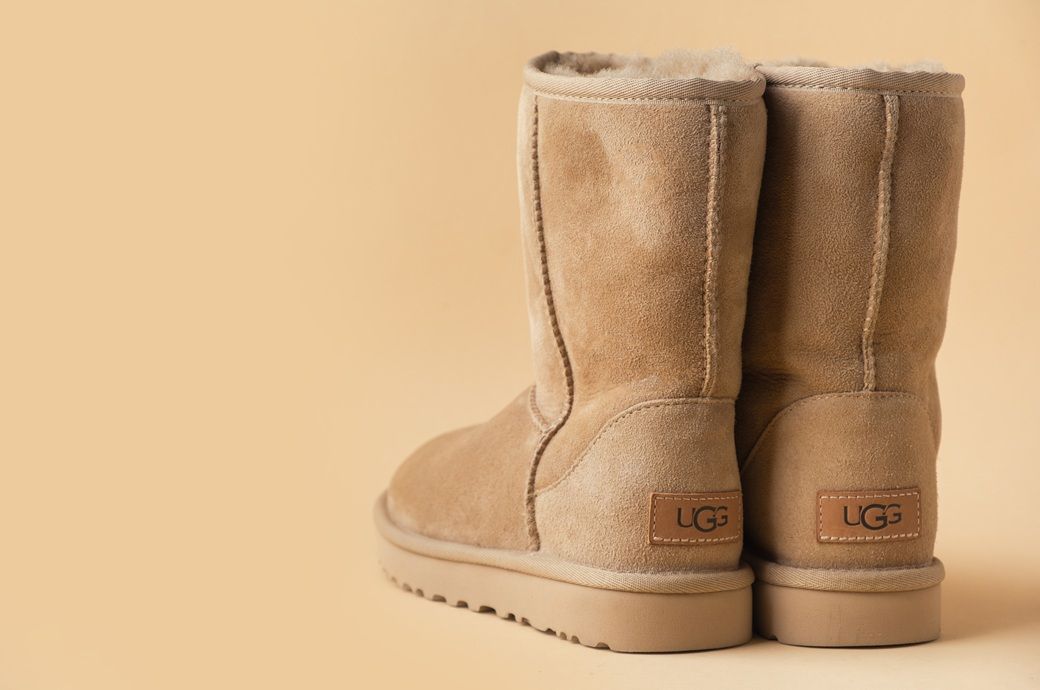
Kenneth Straka, Senior Product Development Manager at Deckers Outdoor Corporation, said that Deckers places strong emphasis on sustainability, noting that founder John Luke often reminded the team that the French word for sustainability is durability. This idea aligned with discussions at the Global Fashion Summit, where the theme centred on “Building Resilient Futures” in the sustainable and circular economy.
Durability has helped UGG become one of the most sought-after boot brands and a key sales driver for Deckers, alongside its sportswear brand Hoka. “One of the things we think about in terms of circularity is making products that last a long time and remain with consumers throughout their lives. We want products that consumers can wear for ** or ** years,” Straka said in an interview with Fibre*Fashion on the sidelines of the Global Fashion Summit in Copenhagen.

In the Tiruppur market, cotton yarn prices increased by ****;*–* per kg in this week despite sluggish local demand. Prices were quoted higher because of limited supply from spinning mills. A trader from the Tiruppur market told Fibre*Fashion, “Domestic demand remained limited, but spinning mills are not relying solely on the domestic market for cotton yarn sales. They are focusing more on exports, where demand and prices remain attractive. Mills have raised yarn prices following higher ICE cotton prices and the CCI’s increase in auction base prices, although ICE cotton has witnessed a sharp decline over the past two days.”
In Tiruppur, knitting cotton yarn prices were noted as: ** count combed cotton yarn at ****;***–*** (~$*.**–*.**) per kg (excluding GST), ** count combed cotton yarn at ****;***–*** (~$*.**–*.**) per kg, ** count combed cotton yarn at ****;***–*** (~$*.**–*.**) per kg, ** count carded cotton yarn at ****;***–*** (~$*.**–*.**) per kg, ** count carded cotton yarn at ****;***–*** (~$*.**–*.**) per kg, and ** count carded cotton yarn at ****;***–*** (~$*.**–*.**) per kg.


Bangladesh apparel reset: Compliance edge or energy trap?

Military jets’ crew members safely eject after Idaho air-show collision

Pete Davidson’s friends support comic against ex Elsie Hewitt allegations

-

 Entertainment5 days ago
Conan O’Brien hat tricks as Oscar host
-

 Tech1 week ago
Could Contact-Tracing Apps Help With the Hantavirus? Not Really
-

 Tech1 week ago
I Tried the Best Captioning Smart Glasses, and Only One Leads the Pack
-

 Fashion5 days ago
Italy’s Zegna Group’s Q1 growth boosted by strong organic performance
-

 Sports1 week ago
Bobby Cox, legendary Atlanta Braves manager who led 1995 World Series champions, dead at 84
-

 Entertainment1 week ago
Martin Short: Facing tragedy with joy
-

 Entertainment1 week ago
Tom Brady gets back at Kevin Hart during Netflix roast
-

 Entertainment1 week ago
Martha Stewart: How to make an omelet