

Business
ECC okays increase in profit margins for petroleum dealers and OMCs – SUCH TV


The Economic Coordination Committee (ECC) of the Cabinet on Tuesday approved revising the profit margins of oil marketing companies (OMCs) and petroleum dealers on petrol and high-speed diesel. The meeting was chaired by Finance Minister Senator Muhammad Aurangzeb.
The adjustments, linked to the National CPI for 2023–24 and 2024–25, have been capped between 5% and 10%. The ECC decided that half of the approved increase will be implemented immediately, while the remaining half will depend on digitisation progress, with the Petroleum Division to report back by June 1, 2026.
According to sources, the margin for OMCs on petrol has been increased by Rs1.22 per litre, while the dealers’ commission has risen by Rs1.34 per litre. The same increases apply to high-speed diesel.
New vehicle-import scheme
The ECC endorsed amendments to the vehicle import procedure, retaining only the transfer-of-residence and gift schemes. Under the revised framework, commercial-import safety and environmental standards will apply, the allowable import gap has been extended from two to three years, and imported vehicles will remain non-transferable for one year.
Restrictions on chloroform imports
The ECC also approved restrictions on imports of Trichloromethane (chloroform) due to its carcinogenic and toxic properties. Going forward, chloroform may only be imported by pharmaceutical companies and only with a DRAP-issued NOC.
On a summary submitted by M/s Ghani Glass seeking a concessionary gas/RLNG tariff, the committee ruled the request untenable, noting that such subsidies are no longer allowed and that broader export-support measures are already underway.
Power sector and circular debt
The committee reviewed the Circular Debt Management Plan for FY 2025–26 presented by the Power Division.
The ECC directed the Power and Finance Divisions to prepare a medium-term strategy aimed at gradually reducing fiscal support.
It also instructed the Power Division to establish a monitoring mechanism with distribution companies to ensure compliance with targets committed to the government.
Technical grants and institutional reforms
The ECC approved a technical supplementary grant of Rs1.28 billion for the Pakistan Digital Authority (PDA) to support digital transformation across government departments.
It also authorised additional development funds for the Cabinet Division for FY26, as proposed by the Interior and Narcotics Control Division.
In addition, the committee approved allocating Rs5 billion to the Housing and Works Division through a technical supplementary grant for the current fiscal year.
On a summary by the Ministry of National Food Security and Research, the ECC endorsed the creation of a special-purpose company to wind up Passco and settle its outstanding liabilities.
It authorised the company’s incorporation, administrative and financial arrangements, and necessary regulatory exemptions, along with appointing initial subscribers and interim management.
The company will be dissolved once its mandate is fulfilled.
Additionally, the committee accorded in-principle approval for the release of budgetary allocation for PIA Holding Company Ltd (PIAHCL) to meet pension and medical related expenses of the PIACL employees.
The meeting was attended by Minister for Petroleum Ali Pervaiz Malik, Minister for Power Sardar Awais Ahmad Khan Leghari, Minister for Investment Board Qaiser Ahmed Sheikh, along with federal secretaries and senior officials from the concerned ministries, divisions and regulatory bodies.





Business
Sugarcane price hike: Govt raises FRP to Rs 365/quintal for 2026-27, farmers to benefit from higher returns – The Times of India
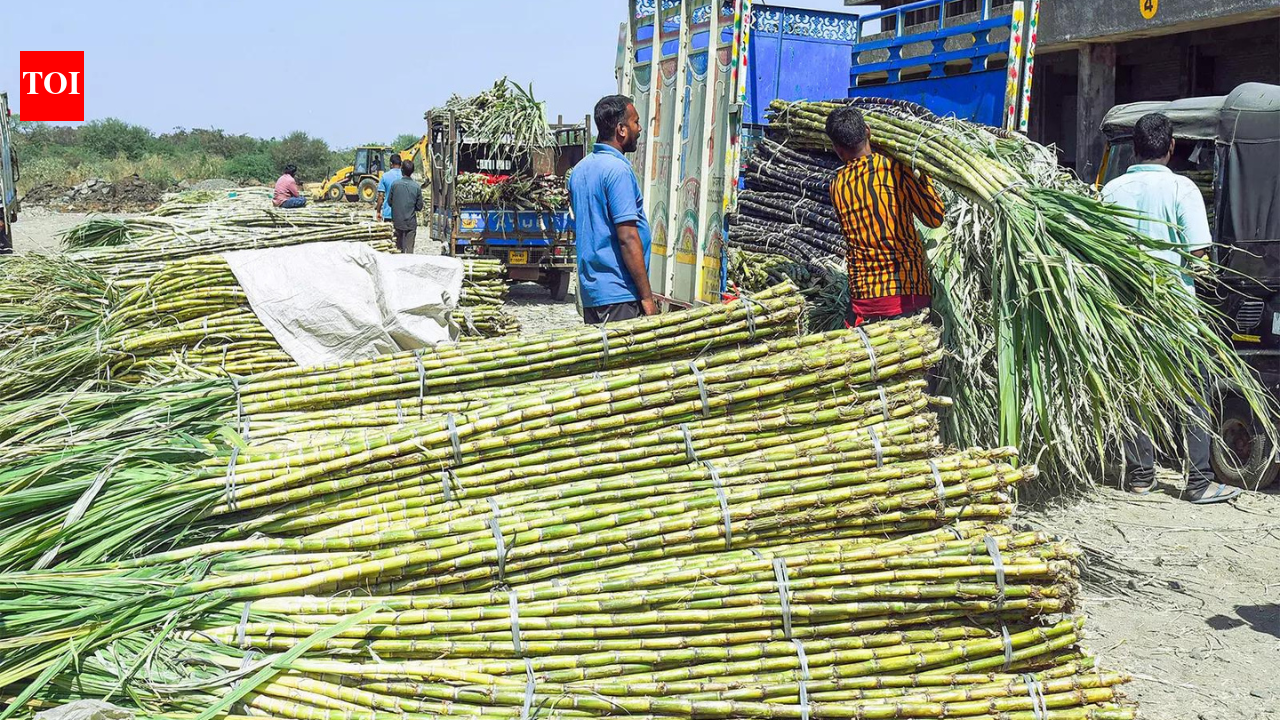
The government has increased the fair and remunerative price (FRP) of sugarcane by Rs 10 to Rs 365 per quintal for the 2026-27 season beginning October, PTI reported.The decision was approved by the Cabinet Committee on Economic Affairs (CCEA), chaired by Prime Minister Narendra Modi.“The FRP will be Rs 365/quintal for a basic recovery rate of 10.25 per cent,” Union Minister Ashwini Vaishnaw said after the meeting.The revised FRP is 2.81 per cent higher than the current rate of Rs 355 per quintal for the 2025-26 season.For every 0.1 per cent increase in sugar recovery above 10.25 per cent, the FRP will rise by Rs 3.56 per quintal, providing an incentive to mills for higher efficiency.To safeguard farmers supplying to mills with lower recovery rates, the government has decided that there will be no deduction in FRP for recovery below 9.5 per cent. In such cases, farmers will receive Rs 338.3 per quintal in the 2026-27 season.The production cost of sugarcane for 2026-27 has been estimated at Rs 182 per quintal, making the FRP 100.5 per cent higher than the cost.“Farmers are expected to get more than Rs 1 lakh crore,” Vaishnaw said.The move is expected to benefit nearly one crore sugarcane farmers, along with farm labourers and workers engaged in sugar mills.The FRP has been fixed based on recommendations of the Commission for Agricultural Costs and Prices (CACP) and consultations with state governments and stakeholders.The sugar sector supports the livelihoods of around five crore farmers and their families, and about five lakh workers directly employed in sugar mills, besides those involved in related activities such as transportation.Sugar mills are required to purchase sugarcane from farmers at the FRP or higher.Vaishnaw said the FRP has been increased every year over the past decade, and the latest revision will also support ethanol production from surplus sugarcane.On cane dues, he said that in the 2024-25 season, about Rs 1,02,209 crore, or nearly 99.5 per cent, of the total payable dues of Rs 1,02,687 crore had been cleared as of April 20, 2026.For the ongoing 2025-26 season, Rs 99,961 crore, or 88.6 per cent, has been paid out of total dues of Rs 1,12,740 crore.

Downing Street would not deny reports that Chancellor Rachel Reeves rowed with her US counterpart during a visit to Washington DC earlier this year.
Ms Reeves had an argument with Scott Bessent when she visited the US capital for the International Monetary Fund’s spring meetings, according to the Financial Times.
The Chancellor publicly criticised the US-led war against Iran before travelling across the Atlantic, prompting Mr Bessent to berate her on the sidelines of the gathering, the newspaper reported.
Ms Reeves reportedly hit back that she did not work for the US treasury secretary, and disliked how he had spoken to her, before reiterating her argument that America lacked clear goals going into the conflict and was not making the world safer.
On Tuesday, the Prime Minister’s official spokesman was asked if he would steer away from the reports, and appeared not to.
He did however insist Ms Reeves and her US counterpart have had “constructive” engagements since the Washington DC visit.
The spokesman said: “We would not get into private conversations. The Chancellor and the US treasury secretary have a good relationship.
“They have had constructive conversations together since the Chancellor’s visits to Washington.
“I think there is a readout from the US Department of Treasury, which made clear the productive nature of their relationship.”
The Chancellor emerged as one of the most outspoken UK Government critics of the US decision to go to war in Iran before travelling to the IMF meetings in April.
At the time, she described the war as a “folly” and said: “This is a war that we did not start. It was a war that we did not want.
“I feel very frustrated and angry that the US went into this war without a clear exit plan, without a clear idea of what they were trying to achieve.”
Business
Govt lists 40 sub-sectors for faster FDI clearance from border nations-check details – The Times of India

The government has identified 40 sub-sectors, including rare earth magnets and printed circuit boards, for expedited clearance of foreign direct investment (FDI) proposals from countries sharing land borders with India, PTI reported.Under the revised framework, proposals from countries such as China, Pakistan, Bangladesh, Nepal, Bhutan, Myanmar and Afghanistan in these sectors will be processed within 60 days, as per the updated standard operating procedure (SOP).The move follows a decision taken in March to fast-track FDI approvals in specified manufacturing sectors from these countries.However, the government has clarified that majority ownership and control of the investee entity must remain with resident Indian citizens or Indian-owned entities at all times.The 40 identified sub-sectors fall under six broad categories –capital goods manufacturing, electronic capital goods and electronic components, polysilicon and ingot-wafer production, advanced battery components, rare earth permanent magnets, and rare earth processing.These include manufacturing of insulation items, castings and forgings for thermal, hydro and nuclear power plants, machine tools, display components such as LCD and LED panels, camera modules, electronic capacitors, speakers and microphones, lithium-ion batteries, wearables, and rare earth metal and magnet processing facilities.The SOP also introduces detailed reporting norms for investments involving entities with direct or indirect ownership from land-bordering countries.“The reporting under these guidelines will be governed under the Foreign Exchange Management (Mode of Payment and Reporting of Non-debt Instruments) Regulations, 2019, and the information will be accessible by the Reserve Bank of India (RBI),” the DPIIT said.The responsibility for reporting lies with the Indian investee company, which must submit required details to the DPIIT before receiving foreign capital.“The reporting is to be made prior to the inward remittance of foreign capital. In cases which do not involve foreign capital inward remittances, the reporting is to be made prior to execution of the relevant transactions, including issuance/transfer of capital instruments, as the case may be,” it added.Investors will be required to disclose details such as shareholding patterns, beneficial ownership, organisational structure, promoters, board composition, key managerial personnel and control rights.The Indian entity will also need to provide incorporation details and disclose existing or proposed shareholding linked to entities from land-bordering countries.


Pakistan ‘hopeful’ efforts will lead to early resolution of US-Iran conflict: DPM Dar
Sugarcane price hike: Govt raises FRP to Rs 365/quintal for 2026-27, farmers to benefit from higher returns – The Times of India

Climate is now in the cost sheet

-

 Tech1 week ago
A Brain Implant for Depression Is About to Be Tested in Humans
-

 Sports1 week ago
Pro wrestling star Steph De Lander reveals how colleague’s advice helped lead her to title triumph at ACW
-

 Tech1 week ago
Almost 90% of women leave tech industry within 10 years | Computer Weekly
-
 Business1 week ago
‘I had £20,000 stolen and had to fight a 13-month fraud reporting rule to get it back’
-

 Entertainment1 week ago
Norway joins Type 26 Frigate Programme to boost NATO naval power
-

 Entertainment1 week ago
Melania Trump says ABC should ‘take a stand’ on late-night host Kimmel
-
 Business6 days ago
PSX plunges over 4,800 points | The Express Tribune
-

 Tech1 week ago
This Ambitious Laptop Doesn’t Leave Much Room for Your Hands