Connect with us

Business

IMF Forecasts Slower Export Growth – SUCH TV

Published

on

IMF Forecasts Slower Export Growth – SUCH TV


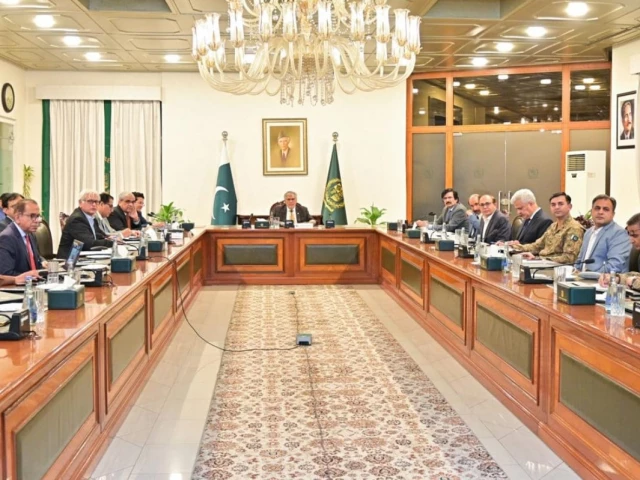
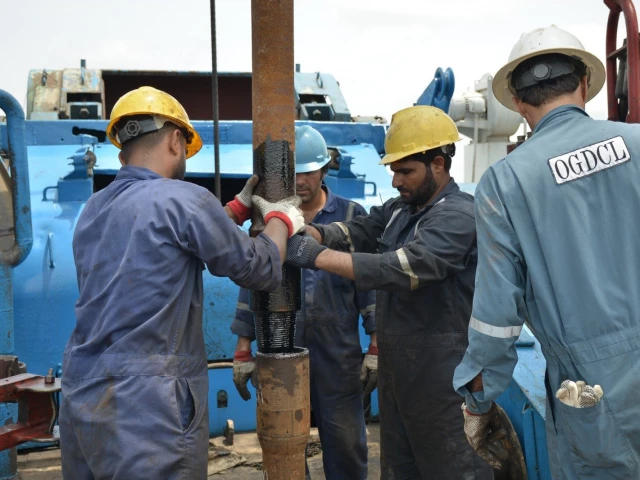
The International Monetary Fund (IMF) forecasts that Pakistan’s exports will grow by $13.79 billion over the next four years, a projection that falls short of the government’s ambitious goals.

The Shehbaz Sharif government has set a target to raise the country’s total exports to $60 billion by 2030.

However, the IMF projects that Pakistan is likely to achieve exports of only around $46 billion by 2030, significantly below the government’s target.

According to the IMF, Pakistan’s total exports are expected to rise to $36.46 billion next year.

Exports are projected at $40 billion in fiscal year 2028 and approximately $43 billion in fiscal year 2029, before increasing to $46 billion by fiscal year 2029-30.

On the imports side, the IMF has estimated an increase of $18.7 billion in Pakistan’s total imports by 2030.

The Fund projects that imports will exceed $64 billion in the current fiscal year, rise to $66.86 billion in 2027, and reach $72.9 billion in 2028.

Imports are expected to stand at $77 billion in 2029 and increase further to $82.81 billion by 2030.

The government had initially set a $60 billion export target, which it would achieve in three years.

However, it later revised the timeline, extending the time from three years to five years.



Source link

Business

Medical supply firm Medline jumps more than 30% in debut after biggest IPO of 2025

Published

on

Medical supply firm Medline jumps more than 30% in debut after biggest IPO of 2025


Shares of U.S. medical supplies giant Medline jumped more than 30% in its debut on the Nasdaq on Wednesday after the biggest initial public offering of the year globally.

The stock opened at $35, up from its $29 IPO price.

The private equity-owned company sold a little over 216 million shares on Tuesday, raising $6.26 billion in an upsized offering that finished off a strong year for new listings and bolstered optimism about the IPO market in 2026. Shares of Medline will trade under the symbol MDLN. 

That IPO pricing gives Medline a market value of at least $37 billion, based on the shares listed in its regulatory filings.

“Historically, we’ve done very little advertising, very little marketing, and this gives us a way to amplify our voice and actually expand really the receptivity of who we are,” Medline CEO Jim Boyle told CNBC’s “Squawk Box” earlier Wednesday. “We are the largest company you’ve never heard of, and we happen to be everywhere. And that’s a really interesting thing.”

The U.S. IPO market has held steady despite market volatility in the spring, driven by President Donald Trump’s sweeping tariffs, and the longest U.S. government shutdown in history in the fall. Just over 200 IPOs have priced this year, including Medline, which is the largest U.S. listing since Rivian‘s $13.7 billion deal in November 2021, according to data compiled by CNBC.

But Medline’s IPO is also among the biggest private equity-backed listings. Three private equity firms — Blackstone, Carlyle and Hellman & Friedman — acquired a majority stake in the company in 2021 for a whopping $34 billion. At the time, the deal was the biggest leveraged buyout since the financial crisis. 

CEO Jim Boyle celebrates with others as medical supplies giant Medline (MDLN) holds it’s IPO at the Nasdaq stock market site in Times Square in New York, Dec. 17, 2025.

Shannon Stapleton | Reuters

Medline, founded in 1966, is based in Northfield, Illinois. The company manufactures and distributes roughly 335,000 different medical and surgical supplies — from gloves, masks and scalpels to wheelchairs. Medline has customers in more than 100 countries and, as of the end of 2024, employed more than 43,000 workers worldwide. 

Medline’s total debt was around $16.8 billion as of late September 2025. The company raked in $25.5 billion in net sales in 2024.

Medline’s earlier plans to go public this year were postponed due to uncertainty around tariffs affecting products from Asia. The majority of the company’s products are sourced or manufactured in Asian nations, particularly China. 

Medline expects a $150 million to $200 million hit from tariffs to income before taxes in fiscal 2026.

The company competes with names like McKesson and Cardinal Health

— CNBC’s Gina Francolla contributed to this report


Source link

Continue Reading

Business

Stocks rise as inflation dips and oil price rebounds

Published

on

Stocks rise as inflation dips and oil price rebounds


The FTSE 100 made strong headway on Wednesday, supported by a larger-than-expected cooling in inflation and a spike in the oil price.

The FTSE 100 index closed up 89.53 points, 0.9%, at 9,774.32. It had earlier traded as high as 9,853.13.

The FTSE 250 ended 123.78 points higher, 0.6%, at 22,164.76, and the AIM All-Share ended up 2.07 points, 0.3%, at 751.48.

The soft UK inflation data sealed the Bank of England’s (BoE) expected interest rate cut on Thursday and increased the likelihood of further reductions in 2026, analysts said.

Barclays said it “removes the final hurdle that could likely have, in our view, dissuaded the BoE from cutting bank rate tomorrow”.

The headline Consumer Prices Index (CPI) rose 3.2% year-on-year in November, slowing from 3.6% in October, and well below FXStreet-cited consensus of 3.5%, according to data published by the Office for National Statistics.

On a monthly basis, CPI fell by 0.2%, compared with a 0.1% increase a year earlier.

November’s figure was below the 3.4% forecast in the recent BoE Monetary Policy Report. Similarly, core CPI inflation, which excludes energy, food, alcohol and tobacco, slowed to 3.2% from 3.4% against expectations for it to remain unchanged.

In addition, closely watched CPI services inflation cooled to 4.4% from 4.5% in October, compared with forecasts for it to remain unchanged. CPI goods inflation slowed to 2.1% from 2.6%.

“UK price pressures are rapidly easing amid persistent softness in demand growth. We expect headline inflation to fall towards the BoE’s 2% target over the course of next year,” said Peel Hunt chief economist Kallum Pickering.

Mr Pickering thinks the risk now is that the BoE has “fallen behind the curve and may need to play catch-up in 2026”.

“We will be paying careful attention to the voting pattern and forward guidance which accompany tomorrow’s BoE decision for a signal that the bank is ready to lean harder against downside risks,” he explained.

“Do not be surprised if the BoE sends dovish signals that it stands ready to lean against downside risks next year – implying cuts at successive meetings.”

The BoE is forecast to reduce the bank rate to 3.75% from 4.0% on Thursday, after voting for the status quo at meetings in September and November.

Mr Pickering said that, following the inflation surprise, money market bets for a BoE cut on Thursday jumped to 97% from 92%, while expectations for the total number of cuts over the next year increased to 2.7 from 2.4.

Money markets now put a 65% chance on a cut in the first quarter of 2026, up from 45% prior to Wednesday’s data, he noted.

The pound was quoted lower at 1.3359 dollars at the time of the London equities close on Wednesday, compared with 1.3429 dollars on Tuesday.

Rate-sensitive housebuilders were in vogue, with Barratt Redrow up 3.7% and Persimmon up 2.3%.

A rebound in the oil price also provided support in London, with Shell up 1.4% and BP up 0.7%.

Brent oil was quoted at 59.91 dollars a barrel at the time of the London equities close on Wednesday, up from 59.01 dollars late Tuesday.

Kathleen Brooks, at XTB, said the reversal in prices came after US President Donald Trump announced a “total and complete blockade of all sanctioned oil tankers” going in and out of Venezuela.

“This is an unusual move, typically blockades need to be agreed by Congress, so this is a serious escalation of events. Venezuela holds the world’s largest share of oil reserves, hence why this blockade has caused ructions in the energy market,” Ms Brooks pointed out.

In Europe on Wednesday, the CAC 40 in Paris closed down 0.3%, while the DAX 40 in Frankfurt ended 0.5% lower.

The euro stood at 1.1749 dollars, down against 1.1775 dollars. Against the yen, the dollar was trading higher at 155.55 yen compared with 154.79 yen.

Stocks in New York were lower at the time of the London equity close on Wednesday.

The Dow Jones Industrial Average was down 0.2%, the S&P 500 index was 0.7% lower, while the Nasdaq Composite declined 1.1%.

The yield on the US 10-year Treasury was quoted at 4.17% flat from Tuesday. The yield on the US 30-year Treasury was at 4.83%, also unchanged from Tuesday.

Back in London, insurer Phoenix Group rose 3.3% after UBS upgraded it to ‘buy’ from ‘neutral’, while an upgrade from Berenberg supported miner Glencore, which rose 1.5%.

Bunzl fell 2.0% after backing its 2025 guidance but cautioned that its operating margin is expected to be slightly down in the coming year.

In response, JPMorgan analyst Jane Sparrow lowered 2026 earnings per share forecasts by 4% and revenue estimates by 1%, with the bulk of the EPS downgrade being margin-driven, reflecting continued operating expenditure inflation but without price inflation to offset.

On the FTSE 250, Serco climbed 7.4% after upgrading guidance for underlying operating profit for this year, citing growth in the defence sector.

The Hampshire-based government services outsourcing provider said it now expects 2025 underlying operating profit of around £270 million, up 3.8% from previous guidance of £260 million but 1.5% lower than £274 million in 2024.

“We believe Serco is well positioned, with rising defence budgets, attractive fundamentals, and strong balance sheet optionality,” analysts at Peel Hunt said.

But Ceres Power’s woes continued, down a further 6.1%, after last week’s critical note from Grizzly Research.

Hunting was knocked down 4.6% as Jefferies downgraded to ‘hold’ from ‘buy’.

Gold was quoted at 4,326.25 dollars an ounce on Wednesday, higher against 4,304.60 dollars.

The biggest risers on the FTSE 100 were Barratt Redrow, up 13.30 pence at 375.00p, Phoenix Group, up 23.00p at 719.00p, Convatec, up 7.40p at 242.20p, HSBC Holdings, up 30.00p at 1,141.80p and United Utilities, up 30.00p at 1,203.00p.

The biggest fallers on the FTSE 100 were DCC, down 181.00p at 4,924.00p, Bunzl, down 44.00p at 2,176.00p, ICG, down 32.00p at 2,024.00p, Weir, down 44.00p at 2,814.00p and IMI, down 34.00p at 2,434.00p.

Thursday’s economic calendar has interest rate decisions in the UK, Europe, Norway and Sweden, plus US inflation data.

Thursday’s UK corporate calendar has half-year results from electricals retailer Currys.

– Contributed by Alliance News


Source link

Continue Reading

Business

Push made to sell Mossmorran site but no ‘viable offer’ received, say bosses

Published

on

Push made to sell Mossmorran site but no ‘viable offer’ received, say bosses


Efforts have been made to sell the Mossmorran plant which is due to close early next year but a “viable offer” has not been received, bosses have said.

The Fife Ethylene Plant will close in February, putting more than 400 jobs at risk in the area, with owners ExxonMobil claiming it is not economically viable due to, in part, UK Government policy.

Appearing before the Scottish Affairs Committee at Westminster on Wednesday, ExxonMobil UK chairman Paul Greenwood said there had been both “formal and informal” discussions about a potential sale of the site.

“We did not find anybody who is able to offer us a viable offer of taking it over,” he told MPs.

“Clearly, we would obviously sell the plant if we could, it’s clearly a much better option for everybody involved – including us – than shutting the plant down.

“We worked extremely hard.”

In the discussions the firm had with potential buyers, Mr Greenwood said, none saw the potential of continuing operations as an ethylene plant – which creates a key component in plastics.

“Nobody sees that as being economically viable,” he said.

“Therefore, we will shut this plant and we will do that in February.

“You then have a period, which could be up to about two years, to effectively demolish the site and return the land back to a kind of greenfield basis during all of that period.

“If there’s anybody who wishes to come and talk to us… around potential use of that site, potential ways in which they can take over ownership of that and do something, then we’re open to all of that.”

He added: “Clearly, we – along with everybody else – would like to see this site continue, would like to see it be valuable, would like to see it provide economic value to the community.”

Around 180 ExxonMobil staff face redundancy as a result of the decision, with 250 contractors also at risk.

Of the firm’s own staff, about 110 people will face redundancy next spring with the remainder continuing their employment to work on what is expected to be the demolition of the current site.

Mr Greenwood appeared after Bob MacGregor, the industrial officer for the Unite trade union, questioned the contentions of the company that it was not economically viable.

Mr MacGregor pointed to a £120 million UK Government investment announced on Wednesday for an ethylene plant in Grangemouth as proof of viability.

He pushed for the closure of the plant to be paused to allow for a buyer to be found.

The union official also criticised both governments, claiming they have not supported workers on the site enough.

The Scottish Government, he said, has attempted to organise events as part of its partnership action for continuing employment (Pace) scheme, which aims to help those facing redundancy.

“Other than that, I don’t see any support that’s been offered by either government,” he said.

“I can see a lot of kind words and soundbites, but I don’t see any real, tangible evidence of any practical support, financial support.”

Governments should be stepping in to offer retraining to workers in the hopes of securing work elsewhere, he said.

Speaking on BBC Radio Scotland on Wednesday, Scottish Secretary Douglas Alexander said the closure of the plant is “a great regret to me”.

He added: “I sat with the Mossmorran leadership with an open heart and an open mind to see if there was a way forward.

“Despite repeated contact with the British Government, they weren’t able to come forward with proposals.”

Scottish Deputy First Minister Kate Forbes said: “Our priority is to secure a sustainable future for the site at Mossmorran and workers at the plant.

“After being informed of ExxonMobil’s decision to market its plant on November 11, we activated our Pace initiative to provide workers with skills development and employability support.

“Since learning about the announcement, my officials and Scottish Enterprise have been working to secure new opportunities for the Fife Ethylene Plant and its workforce.

“However, the UK Government holds the levers for an industrial intervention as we have seen in England and Wales and the ability to address high energy costs.”


Source link

Continue Reading

Trending