

Business
Wall Street banked on a flurry of deals under Trump in 2025. It wasn’t that simple


The Wall Street Bull statue covered in snow on Nov. 15, 2018.
Erik Mcgregor | Lightrocket | Getty Images
Wall Street expected U.S. mergers and acquisitions to roar back in 2025. The reality was something closer to fits and starts.
Following the election of President Donald Trump more than a year ago, executives and bankers prepared for a looser regulatory environment and a robust pipeline for mergers and acquisitions. Instead, they were met with tariff uncertainty, high interest rates, and an unpredictable process for winning over the Trump administration and getting deal approval.
While the year saw high-profile megadeals inked — Union Pacific’s proposed acquisition of Norfolk Southern for $85 billion; Netflix’s proposed takeover of Warner Bros. Discovery’s streaming and studio assets for $72 billion; the pending take-private of Electronic Arts for roughly $50 billion — generally, U.S. deal volume was down year over year, according to Pitchbook data.
“When you read the headlines they seem to suggest there has never been a better M&A market in the history of the planet. And while that’s true in some ways, when you get underneath the front page headlines and these massive transactions … you see a less active market,” said Benjamin Sibbett, co-head of the Americas M&A practice at Clifford Chance.
Through Dec. 15 this year, there were roughly 13,900 transactions in the U.S., compared with 15,940 deals during the same period in 2024, the last year of the Biden administration, according to Pitchbook data.
Deal value, however, was up, boosted by high-dollar-figure agreements: The 2025 deals tracked by Pitchbook totaled roughly $2.4 trillion in value, compared with roughly $1.83 trillion in 2024. The data represents both corporate M&A and private equity buyout activity and considers both announced and closed transactions.
In particular, middle-market deal volume was low this year with those large M&A transactions padding the stats, according to a S&P Global analysis of deal-making as of November.
“This has been a decade-high level of megadeals, double the number of deals from last year. When you look at the importance of scale, it’s been an all-time record in terms of the premium that the market has given to scale,” said Anu Aiyengar, JPMorgan‘s global head of advisory and M&A, on a recent JPMorgan podcast episode.
Over the last 10 years, 2021 remains the biggest year on record for U.S. deal activity, a reflection of low interest rates at the time. By this point in the year in 2021, there were 19,666 deals recorded with a total valuation of roughly $5.55 trillion, according to Pitchbook.
Executives, lawyers and bankers like Aiyengar note that the sluggishness in deal-making this year took place primarily in the first half of the year as Trump’s rolling tariff announcements roiled the financial markets and industry leaders tried to make sense of the effects.
Uncertain times
U.S. President Donald Trump delivers remarks at the White House in Washington, D.C., on April 2, 2025.
Brendan Smialowski | Afp | Getty Images
Early in the year, consultants and bankers across sectors agreed that the Trump administration would make for smoother deal-making and a friendlier regulatory environment after a number of big consumer deals were squashed by President Joe Biden’s Federal Trade Commission.
Then came Trump’s trade war and his so-called liberation day tariffs.
Trump’s April announcement of “reciprocal tariffs” on more than 180 countries left executives with an unclear path forward. “Macroeconomic uncertainty” became an often-used phrase in company updates and on investor calls as executives were hesitant to make plans or offer guidance without a clear understanding of how the future with tariffs would play out.
“We knew there was going to be some disruption with tariffs, but probably not to the extent that sort of slowed things down,” KPMG partner and U.S. automotive leader Lenny LaRocca told CNBC of deal-making in that sector. “With all that uncertainty around where things were going to land, I think it just put a big pause on M&A in general.”
In addition to automakers, retail and consumer companies bore the brunt of the uncertainty as they navigated whether and how to pass on undetermined higher costs to already-burdened shoppers.
Overall deal value in the consumer space was 17% lower during the first three quarters of 2025 than the same period a year prior, according to an October report from Boston Consulting Group. Meanwhile transactions by deal value grew in the industrials, energy and health-care sectors, the study found.
Through mid-December, there were 227 U.S. deals in the retail space, compared with 296 in the prior year period, according to Pitchbook. The combined valuation of deals, however, was more than $40 billion year to date, compared with roughly $28.4 billion at the same point in 2024, Pitchbook found.
Add in the rise of artificial intelligence, which has commanded major spending by companies across the board, and still-high Federal Reserve interest rates that make borrowing more expensive, and the deal-making equation was even trickier for much of the year.
“That has felt like a bit of a roller-coaster ride,” said Kevin Foley, JPMorgan’s global head of capital markets, on its recent podcast. “We went through that six-week pause post-liberation day … and then after that, the level of uncertainty, at least the perception of it, started to fade.
“The sentiment became more positive, benefiting from the fact that you’ve got the secular tail winds of what’s happening with AI investments, the anticipation of the Fed being more supportive, along with a pro-business fiscal policy out of this administration,” Foley said. “All of that had a very positive impact on sentiment in both the equity and debt markets.”
Last week the Fed approved its third rate cut this year, but the central bank committee’s vote signaled a tougher road ahead for more reductions.
While Trump continues to pressure the Fed to bring rates down further, he’s also exerting his influence in other arenas and keeping industries guessing.
Policy playbook
Ahead of Trump taking office for his second term, automotive industry insiders and onlookers believed the auto supplier industry was ripe for consolidation. The sector was coming off years of turmoil due to parts shortages and an industrywide move toward electrification.
But the end of federal tax credit programs for all-electric vehicles caused many companies to reverse course on EVs and redesign their lineups yet again. Ford Motor on Monday said it would take a $19.5 billion write-down tied to changing plans on electric vehicles.
That policy shift and need for automakers to adjust to tariffs and higher costs slowed transactions in the sector.
There were more than 8,800 deals globally last year involving industrial manufacturing, which includes automotive, totaling $303.7 billion, according to advisory firm KPMG. The number of deals increased 3.1% from the prior year but notably fell during the fourth quarter of last year – a trend that continued into 2025.
Through the third quarter of this year, deals in the automotive industry represented the largest decline by volume of KPMG’s industrial manufacturing sectors, off 19.9% year over year compared with a 3.6% decline in the broader category, which also includes aerospace, transportation and logistics and other manufacturing sectors.
LaRocca said he believes the broad pullback in EVs, as well as slowing industry sales and a need for diversification, will drive an uptick in deals in the coming year following this year’s lull.
“If volumes aren’t growing, you can’t sit still, you’ve got to think about what other deals you can do,” LaRocca said. “Everybody needs to, I think, be thinking very strongly around consolidation to continue to grow.”
In media, it’s a similar story.
Media companies are antsy for consolidation but have faced choppy seas in trying to get deals approved by the Trump administration.
Broadcast stations owner Nexstar Media Group is awaiting federal regulation changes (or substantial waivers) to complete its proposed $6.2 billion acquisition of Tegna. While Federal Communications Commission Chairman Brendan Carr has shown support for removing the decades-old rules, change has been slow to come, and Trump has more recently come out against broadcast tie-ups.
Earlier in the year, Trump’s crusade against diversity, equity and inclusion programs also appeared to play a role in winning regulatory approvals.
Verizon ended its DEI policies to usher through FCC approval of its $20 billion acquisition of broadband provider Frontier Communications.
David Ellison, chairman and chief executive officer of Paramount Skydance Corp., center, outside the New York Stock Exchange (NYSE) in New York, US, on Monday, Dec. 8, 2025.
Michael Nagle | Bloomberg | Getty Images
The merger of Paramount Skydance closed this summer after nearly a year in limbo. In the official blessing of approval from the FCC, Carr noted that Skydance didn’t have any DEI programs and had agreed not to establish any such initiatives as a new company. Paramount had previously ended its DEI politics due to Trump’s executive order to ban such initiatives.
The Paramount Skydance deal also notably received regulatory approval shortly after Paramount agreed to pay $16 million to Trump after he sued the company’s CBS over the editing of a “60 Minutes” interview with former Vice President Kamala Harris.
Paramount Skydance is now endeavoring another tie-up, this time with Warner Bros. Discovery. Paramount launched a hostile bid for WBD shortly after Netflix announced a deal to buy the legacy media company’s streaming and studio assets after a monthslong bidding war.
Paramount Skydance has argued it has a higher likelihood of receiving regulatory approval from the Trump administration than Netflix. WBD told shareholders to reject the offer this week.
‘The window is open’
In the second half of the year, deal activity picked up and Wall Street leaders appeared to settle into a new normal under the Trump administration.
Even in the biotech and pharmaceutical industry — which spent most of the year reeling from various Trump administration policies, including tariffs and a sweeping upheaval of federal agencies under Robert F. Kennedy Jr. — there was more activity in middle-market transactions into the final months of 2025.
Tim Opler, a managing director in Stifel’s global health-care group, noted more buyouts of smaller biotech firms by large drugmakers. And while activity didn’t reach the frenzied heights of 2021, several factors have driven a resurgence in deal-making. That includes big pharma’s need to fill revenue gaps from expiring drug patents toward the end of the decade, strong company cash reserves and promising innovation.
Many of the “big uncertainties” around geopolitical issues also “seem to be all priced in now to a large extent,” Arda Ural, EY’s Americas life sciences leader, told CNBC.
US Secretary of Health and Human Services Robert F. Kennedy Jr. speaks in the Oval Office during an event with President Donald Trump at the White House in Washington, DC on Nov. 6, 2025.
Andrew Caballero-Reynolds | AFP | Getty Images
Pharmaceutical companies have also shown an increased interest in deals with Chinese biotechs, even as Trump and U.S. policymakers pursue protectionist policies in technology like AI and semiconductors.
Pfizer, for example, struck an up to $6 billion deal with Chinese biotech 3SBio to license its cancer drug.
Meanwhile, pharmaceutical companies are keen to expand in red-hot areas such as obesity, including the drugmakers that already dominate that space. Pfizer recently won a takeover war with Novo Nordisk over the obesity biotech Metsera, whose pipeline includes potential once-monthly treatments.
A busier end to the year is leading many to predict a more active 2026 for M&A across the board. This is particularly true of the banking sector, which showed the most signs of life outside of megadeal activity.
“Clients began the year with cautious optimism, quickly adapting to persistent tariff, macroeconomic and geopolitical uncertainties,” said Dorothee Blessing, JPMorgan’s global head of investment banking coverage on a recent podcast. “But as the year progressed, uncertainty became more part of the business-as-usual environment.”
The number of announced deals among banks surged by 88% in the second half of this year, while the total size of transactions nearly quadrupled to $39 billion, according to Stephens banker Frank Sorrentino, who cited S&P Global Market Intelligence data.
A consolidation in regional banks especially has been driven in part by the arrival of activist investors like HoldCo, who this year has taken on lenders with more than $200 billion in combined assets so far, CNBC has reported. The hedge fund pressured Comerica to find a buyer in the weeks before it agreed to sell itself to rival Fifth Third for $10.9 billion in the biggest bank merger of the year.
“There was a lot of enthusiasm at the end of last year that the regulatory environment was finally going to loosen up, and that absolutely happened,” Sorrentino said. “The time it takes to get a deal approval has probably been cut in half; I’ve never seen anything like it.”
The window for healthy deal activity could last another year or two, according to Sorrentino, who said that he expects some banks will even pull off two or three acquisitions over the next 12 months.
“Deals are getting approved at record speed, and the types of deals getting approved now would never have gotten approval under the last administration,” he said.
Investors are now wondering if big banks will announce deals of their own, either to plug holes in their product offerings, or even attempting the combination of two large institutions, said Truist analyst Brian Foran.
“The window is open,” Foran said. “It feels like everyone’s looking at their options right now.”
— CNBC’s Gabrielle Fonrouge, Michael Wayland, Annika Kim Constantino and Hugh Son contributed to this article.






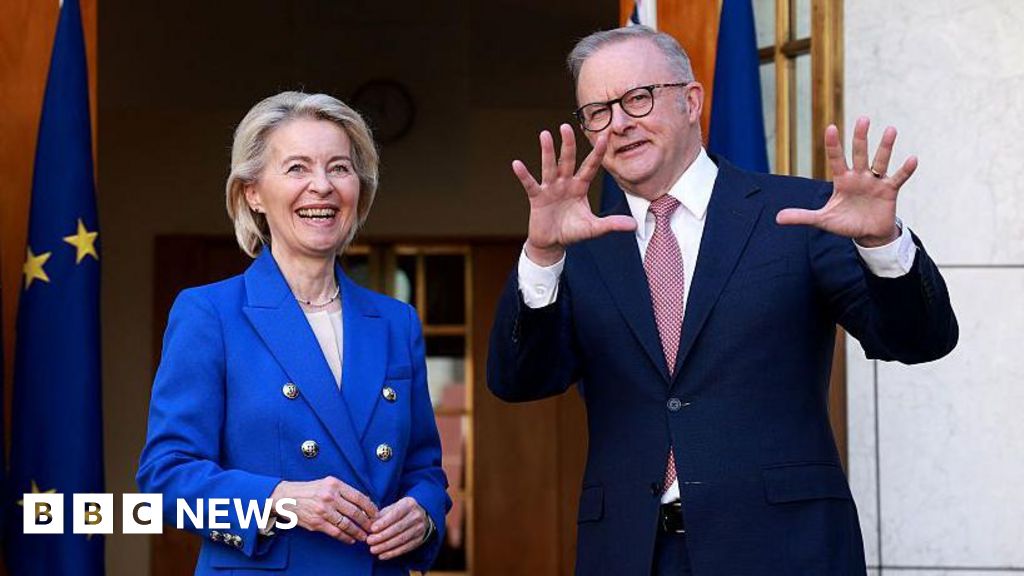
Australia and the EU sign sweeping trade and security deals after years of negotiations.
Source link

Vets will be legally bound to prescription fee caps and publishing price lists among new measures which will start coming into force later this year, the competition watchdog has announced.
The Competition and Markets Authority (CMA) said its final reforms for the sector will help pet owners better navigate the vet services market.
Other legally binding measures will include a price comparison website and mandatory branding by the large groups to boost competition and drive down prices.
The CMA said pet owners using a vet practice that is part of a larger chain can expect to see changes before Christmas, including standard price lists.
The measures follow the CMA finding that fees have risen at almost twice the rate of inflation, with pet owners not being given enough information about their vet and the prices of treatments.
Martin Coleman, chairman of the independent Inquiry Group, said: “This is the most extensive review of veterinary services in a generation, and today’s reforms will make a real difference to the millions of pet owners who want the best for their pets but struggle to find the practice, treatment and price that meets their needs.
“Too often, people are left in the dark about who owns their practice, treatment options and prices – even when facing bills running into thousands of pounds.
“Our measures mean it will be made clear to pet owners which practices are part of large groups, which are charging higher prices, and for the first time, vet businesses will be held to account by an independent regulator.
“Our changes put pet owners at the centre but also help vets by enhancing trust in the profession and protecting clinical judgment from undue commercial pressure – and that is important to ensure our pets continue to get the best care.”
The CMA said practices must publish a comprehensive price list for standard services, including consultations, common procedures, diagnostics, written prescriptions and cremation options under its new rules.
Prescriptions – for which “many” practices charge £30 or more for each – are to be capped at £21 for the first medicine and £12.50 for any additional medicines.
Practices must also provide a written estimate in advance for any treatment expected to cost £500 or more, including aftercare costs, as well as an itemised bill.
Emergency care will be the only exception for written estimates.
Prices and information about who owns the surgery are to be made available to pet owners through the Royal College of Veterinary Surgeons (RCVS) ‘Find a Vet’ service, which will share the data with third-party comparison sites.
Vet businesses must make it clear whether they are part of a group or an independent business, with details of group ownership to be displayed on signs at the surgery and online.
British Veterinary Association president Rob Williams said: “The majority of the CMA’s measures focus on increasing transparency and information, which will help pet owners make more informed choices and support competition, which is a really positive step.”
He added: “Delivering highly skilled veterinary medicine is costly and whilst we recognise prices have risen sharply in recent years this is due to a number of factors, including the higher costs all businesses are experiencing – and vet practices are not immune.
“Plus, thanks to advances in diagnostics and medical technology over the last 20 years, vets can now do much more to manage disease and injury in animals, whereas in the past the only option available may have been to euthanase.
“Owners today also have a greater expectation of their vet, with many expecting human quality healthcare for their pets and whilst this is possible to deliver, it comes at a cost.”
Business
Gold price prediction today: Pressure on gold prices to continue on March 24, 2026 amid US-Iran war? Check outlook – The Times of India

Gold price prediction today: Gold prices are likely to remain range-bound in the near future, says Praveen Singh, Head Currencies and Commodities, Mirae Asset ShareKhan
Source link


South Korea’s Misto Holdings’ 2025 profit jumps 31.6% on steady growth
Australia and EU agree sweeping trade deal in face of global uncertainty

How Jaxon Smith-Njigba’s contract extension impacts Seahawks

Strategic oil stocks to be released ‘immediately’ in Asia and Oceania: IEA

New Income Tax Act 2025 To Take Effect From April 1: 10 Key Changes That Will Affect Your Money

Transfer rumors, news: Real Madrid open to Camavinga exit, as Premier League clubs circle

-
 Entertainment1 week ago
Strategic oil stocks to be released ‘immediately’ in Asia and Oceania: IEA
-
Business1 week ago
New Income Tax Act 2025 To Take Effect From April 1: 10 Key Changes That Will Affect Your Money
-
 Sports1 week ago
Transfer rumors, news: Real Madrid open to Camavinga exit, as Premier League clubs circle
-
 Business7 days ago
Stocks and pound rise as US rate call approaches
-

 Tech1 week ago
Early Deals From the Amazon Spring Sale That Passed Our BS Test
-

 Tech6 days ago
Justice Department Says Anthropic Can’t Be Trusted With Warfighting Systems
-

 Sports6 days ago
March Madness 2026 – How to watch in SA, start time, schedule, TV channel for NCAA championship basketball tournament
-

 Tech1 week ago
Our Favorite Red Light Hair Growth Device Is Currently on Sale