

Business
The NBA is pursuing ownership groups for a potential basketball league in Europe


NBA Commissioner Adam Silver speaks during a news conference following a meeting of the NBA’s board of governors at the Thomas & Mack Center in Las Vegas, July 15, 2025.
Chase Stevens | Las Vegas Review-journal | Getty Images
The NBA is looking to Europe for its next stage of growth.
The league announced on Monday that it will move forward with a joint exploration of a new professional men’s league in Europe, in partnership with the International Basketball Federation, also called FIBA. The NBA said it plans to start the process of engaging with prospective teams and ownership groups in January.
Franchise values could be upward of a $1 billion, according to a person familiar with the matter who requested anonymity to speak about details that haven’t been made public yet.
At the NBA Cup last week in Las Vegas, NBA Commissioner Adam Silver said JPMorgan and the Raine Group have been actively meeting with interested parties in Europe and that there is a lot of “positive interest” in moving forward.
The bankers have met with at least 70 potential investors, sources told CNBC. Discussions began about a year and a half ago. The goal is to take nonbinding bids next month and vote on green-lighting the league at the board of governors meeting in March, sources said.
NBA Deputy Commissioner Mark Tatum has said previously that the league is contemplating potential ownership by sovereign wealth funds. The NBA is also engaging current European soccer club owners.
The league first announced the exploration of a men’s basketball league in Europe last March.
“Our conversations with various stakeholders in Europe have reinforced our belief that an enormous opportunity exists around the creation of a new league on the continent,” Silver said in a release Monday. “Together with FIBA, we look forward to engaging prospective clubs and ownership groups that share our vision for the game’s potential in Europe.”
The NBA said it will also provide financial support and resources to European basketball. It plans to invest in domestic leagues and development across FIBA’s existing programs to create a pipeline of coaches, players and referees, according to the Monday release.
The NBA estimates there are 270 million potential basketball fans in Europe, calling it an “untapped market.” This year, on opening night, the NBA had 71 European-born players. Some of league’s biggest stars — Victor Wembanyama, Giannis Antetokounmpo, Nikola Jokić and Luka Dončić — hail from Europe.
Victor Wembanyama of the San Antonio Spurs celebrates after a 131-121 victory against the Washington Wizards at Capital One Arena in Washington, Feb. 10, 2025.
Greg Fiume | Getty Images
The NBA said basketball is the fastest-growing sport in Europe and the No. 2 sport behind only soccer. The league said the timing is perfect, as last season was the NBA’s most watched across the league’s social and digital channels.
The NBA believes the current European basketball market is undervalued and lacks teams in marquee cities, according to a source familiar with the matter. Two-thirds of teams in the already established EuroLeague lose money, according to the Wall Street Journal.
The NBA would be looking to bring teams to Berlin, Paris, Rome and London, according to the source. It is also considering Spain, Turkey and Greece.
If the NBA moves forward with the league, it could begin bringing exhibition teams to play in Europe in the near term. Eventually, there could even be NBA teams competing against European teams in a cup-style or all-star type event.
FIBA Secretary General Andreas Zagklis said the announcement is great news for European basketball and its fans.
“The project is conceived in a way that will improve the sustainability of the entire European basketball ecosystem, including players, clubs, leagues and national federations, by generating a knock-on effect that will strongly benefit basketball fans throughout Europe,” he said in a statement.
The NBA just completed the fifth season of its African League, also in partnership with FIBA. The league said it has grown every year in attendance, merchandise sales and social engagement.
Correction: This story has been updated to reflect the potential franchise value of teams.





Experts say Mythos potentially has an unprecedented ability to identify and exploit cybersecurity weaknesses.
Source link
Business
Anthropic’s new AI model exposes fresh risks, flaws for cybersecurity, IT services – The Times of India
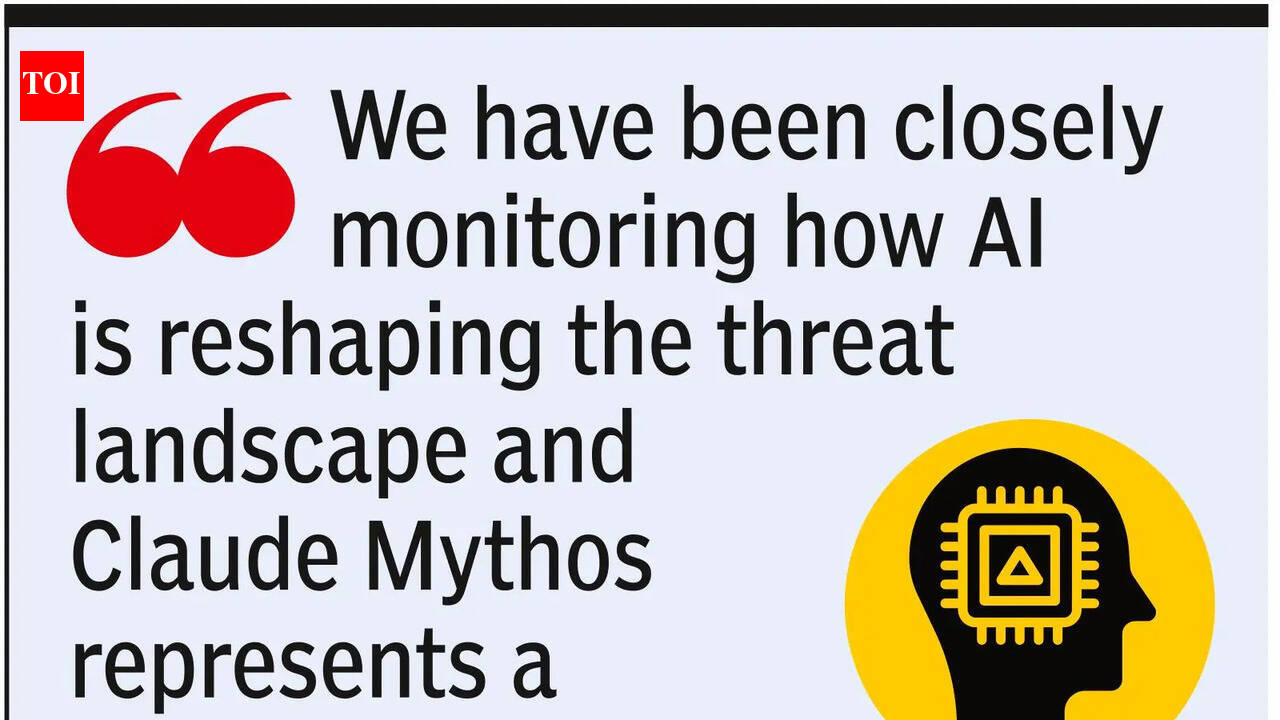
New Delhi: A powerful new AI model is forcing govts, banks, and technology firms to rethink the rules of cybersecurity – and in India, the stakes may be even higher.Claude Mythos, developed by Anthropic, has demonstrated the ability to autonomously detect and exploit software vulnerabilities, including flaws that have persisted for decades. Early tests revealed that the model could identify long-standing weaknesses and simulate complex, multi-step cyberattacks, prompting the company to restrict its wider release. Anthropic CEO Dario Amodei highlighted the shift, noting that AI systems are now capable of finding vulnerabilities “that humans have missed”, a signal of how quickly the cybersecurity landscape is changing.US Treasury Secretary Scott Bessent reportedly convened a meeting with top bank executives – including leaders from JPMorgan Chase, Goldman Sachs, Citigroup, BoA, and Morgan Stanley – to assess the risks posed by such advanced AI systems.That concern is not theoretical. According to Jaydeep Singh, GM for India at Kaspersky, the emergence of such systems represents a turning point not just for security professionals, but for everyday users. “We have been closely monitoring how AI is reshaping the threat landscape, and Claude Mythos represents a moment that every user, not just the cybersecurity industry, needs to understand,” Singh said.The dual-use nature of AI is at the heart of the concern. The same capability that strengthens defences can just as easily be weaponised. “The same capability that finds a 27-year-old vulnerability in hardened infrastructure is the capability that, in the wrong hands, turns every unpatched system into an open door,” Singh added.Cybersecurity firm Check Point Software Technologies echoed the warning. Sundar Balasubramanian, MD, India and South Asia, for Check Point, says, AI is “dramatically lowering the barrier to entry for cyber attackers,” enabling even less-skilled actors to identify and exploit vulnerabilities. He added that defensive tools can be repurposed offensively, compressing the traditional gap between attackers and defenders. Jayant Saran, partner, Deloitte India, described this as a “changed reality,” where organisations must prepare for risks that were previously invisible. He called AI a “double-edged sword…that cannot be reversed,” highlighting an accelerating race between those securing systems and those attempting to break them.In India, the risks are amplified by scale. From UPI to banking and govt platforms, millions depend on digital infrastructure – much of it built on legacy systems. These systems are often slower to patch, harder to monitor, and lack continuous threat intelligence, creating what Saran called an “asymmetric risk exposure.” Singh pointed out that this gap is especially critical in India, where legacy infrastructure serves hundreds of millions.Beyond cybersecurity, ripple effects could reach financial markets. Analysts say models like Mythos could automate parts of software development, testing, and security – core functions of IT services industry. While disruption may be gradual, labour-intensive outsourcing models could face pressure, while firms embracing AI may benefit.

Firms say digital twins make staff more productive, but are they a potential legal minefield?
Source link


Italy’s apparel export-import plunge after positive trend in 2025
Finance ministers and top bankers raise serious concerns about Mythos AI model
Anthropic’s new AI model exposes fresh risks, flaws for cybersecurity, IT services – The Times of India

-

 Entertainment1 week ago
Queen Elizabeth II emotional message for Archie, Lilibet sparks speculation
-

 Tech1 week ago
Azure customers up in arms over ‘full’ UK South region | Computer Weekly
-

 Tech1 week ago
As the Strait of Hormuz Reopens, Global Shipping Will Take Months to Recover
-

 Fashion1 week ago
CII submits 20-pt agenda to Indian govt to back firms hit by Iran war
-

 Tech1 week ago
This AI Button Wearable From Ex-Apple Engineers Looks Like an iPod Shuffle
-

 Politics7 days ago
Indian airlines hit hardest after Dubai limits foreign flights until May 31
-

 Entertainment4 days ago
Palace left in shock as Prince William cancels grand ceremony
-
Uncategorized1 week ago
[CinePlex360] Please moderate: “Trump considers