

Business
Apollo Techno Industries IPO Last Day: Issue Receives 50.63x Subscription; GMP Rises To 9.23%


Last Updated:
Unlisted shares of Apollo Techno Industries are trading at Rs 136 apiece in the grey market, which is 4.6% premium over the issue price of Rs 130, indicating weak listing.
Apollo Techno Industries IPO.
Apollo Techno Industries IPO GMP: The initial public offering (IPO) of Apollo Techno Industries Ltd (ATIL) has been closed today, Friday, December 26. The price band of the Rs 47.96-crore IPO has been fixed in the range of Rs 123 and Rs 130. On the final day of bidding on Friday, the IPO received a total of 50.63x times subscription, garnering bids for 12,42,53,000 shares as against 24,54,000 shares on offer.
Its retail category got a 44.81x subscription, while its non-institutional investor (NII) quota got a 98x subscription. Its qualified institutional buyer (QIB) category has received a 25.26x subscription.
ATIL is a manufacturer specialising in trenchless technology and foundation equipment for the construction industry
Apollo Techno Industries IPO GMP Today
According to market observers, unlisted shares of Apollo Techno Industries Ltd are currently trading at Rs 142 apiece in the grey market, which is a 9.23 per cent premium over the issue price of Rs 130. It indicates a weak listing. Its listing will take place on December 31, Wednesday.
The GMP had stood at 4.62 per cent in the morning.
The GMP is based on market sentiments and keeps changing. ‘Grey market premium’ indicates investors’ readiness to pay more than the issue price.
Apollo Techno Industries IPO: More Details
The Apollo Techno Industries Limited IPO is a book-built issue worth ₹47.96 crore, comprising only a fresh issue of 0.37 crore equity shares. There is no offer-for-sale component in the issue.
The IPO opened for subscription on December 23, 2025, and will close on December 26, 2025. The basis of allotment is expected to be finalised on December 29, 2025, while the shares are scheduled to list on the BSE SME platform on December 31, 2025, subject to approvals.
The price band for the issue has been fixed at Rs 123 to Rs 130 per share. The lot size is 1,000 shares. Retail investors are required to apply for a minimum of 2 lots (2,000 shares), translating into an investment of Rs 2.60 lakh at the upper end of the price band. For HNIs, the minimum application size is 3 lots (3,000 shares), amounting to Rs 3.90 lakh.
Beeline Capital Advisors Pvt Ltd is the book running lead manager to the issue, while MUFG Intime India Pvt Ltd is acting as the registrar. The market-making duties will be handled by Spread X Securities Pvt Ltd.
Apollo Techno Industries reported strong financial growth in FY25. The company’s revenue rose 44 percent, while profit after tax (PAT) surged 327 percent for the year ended March 31, 2025, compared with the previous financial year.
Incorporated in 2016, Apollo Techno Industries operates in the manufacturing and technology space, with a focus on equipment used in the construction and infrastructure sector.
The company specialises in trenchless technology and foundation equipment, catering to complex construction requirements. Its product portfolio includes Horizontal Directional Drilling (HDD) rigs, Diaphragm Drilling Rigs, Rotary Drilling Rigs, along with associated spare parts.
 Click here to add News18 as your preferred news source on Google.
December 26, 2025, 10:51 IST
Read More
Business
Leave, holidays and encashment: What India’s changing labour laws mean for employees – The Times of India

Leave is often seen as a simple workplace benefit – an approved absence from work. In reality, it is one of the more structured and regulated aspects of employment in India. With the implementation of new labour codes, questions around leave entitlement, holidays and leave encashment have drawn renewed attention. This matters because these rules affect not just everyday working life, but also what happens when an employee leaves an organisation.For employers and employees, understanding how leave works today is not always straightforward. This is because two legal systems operate side by side: the new central labour codes and the older State-level Shops and Establishments (S&E) laws. While the intent is to move towards a simpler and more uniform system, the actual position still depends on job role, location and which law applies.Different types of statutory leaveIndian labour laws recognise several types of statutory leave. The most important is earned leave (also called privilege leave). This leave builds up over time based on how many days an employee works. In addition, there are provisions for sick leave, casual leave, and national and festival holidays.Earned leave is different from other types of leave because it has both time-off value and financial value. If it is not used, it can build up and may be paid out in cash – either during employment or when the employee leaves, subject to carry forward limits – depending on the applicable law and company policy.Sick leave and casual leave, on the other hand, are meant for short-term or urgent needs and are usually not designed to be encashed.National and festival holidays form a separate category. These ensure paid holidays on important national or regional days, based on State notifications and local rules.Labour codes vs Shops and Establishments lawsA frequent point of confusion is the interface between the labour codes and State Shops and Establishments Acts.The Occupational Safety, Health and Working Conditions Code introduces a common framework for leave, but for people classified as “workers” under that law. At the same time, State S&E laws continue to apply to many salaried employees working in offices, shops and service-sector businesses.Because of this, uniformity has not fully arrived yet. Different State laws and leave rules may still apply for employees depending on where they are employed and work. Those who fall under the labour code framework move towards a more standard national system. Where both laws could apply, guidance from authorities suggests that the more beneficial provision would generally continue to apply.
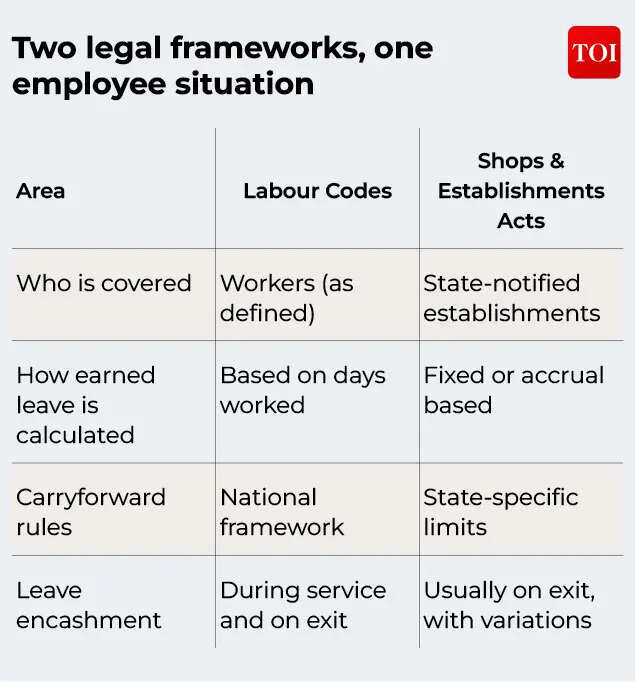
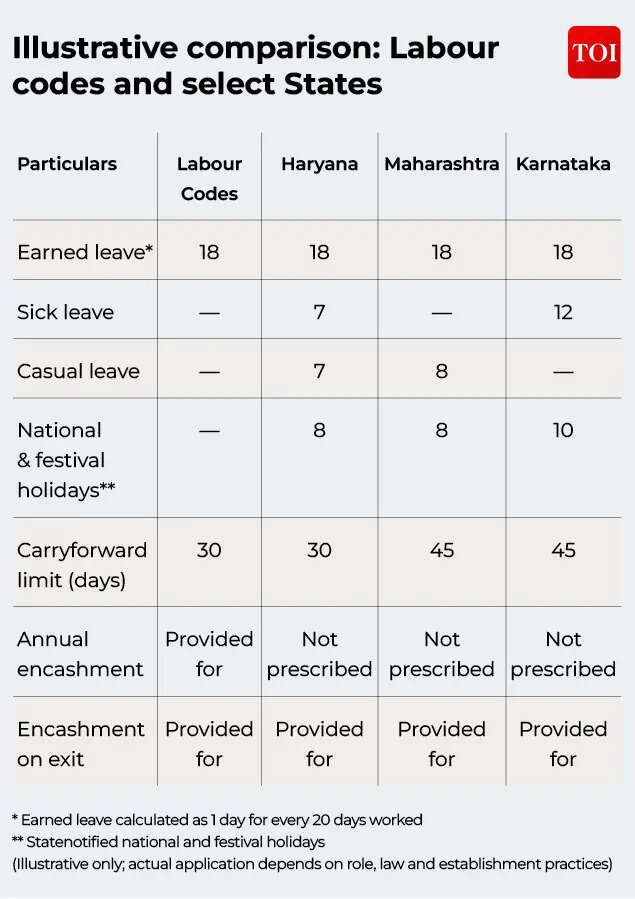
Employers are expected to apply these frameworks together and ensure consistency as the new system takes shape.How earned leave builds upEarned leave generally depends on how long an employee has worked.Under the labour codes, earned leave accrues at a standard rate of one day for every twenty days of work, subject to certain eligibility conditions. This is meant to create a common reference point across the country.State Shops and Establishments laws, however, follow different approaches. Some States grant a fixed number of leave days each year, while others link leave closely to days worked. States also differ on how much unused leave can be carried forward.Sick leave, casual leave and holidaysSick leave and casual leave are mainly meant for short-term protection rather than long-term accumulation. Sick leave helps employees during illness, while casual leave allows flexibility for sudden personal needs.These types of leave are mostly governed by State law and internal company policy, with limited direct impact from the labour codes. Usually, unused sick or casual leave does not carry forward.National and festival holidays are largely decided at the State level. Employers are expected to follow notified holiday lists or compensate employees who work on those days, as per State rules.Carrying forward unused earned leaveHow unused earned leave is treated is one area where the labour codes bring more structure.Earlier, State laws allowed different levels of leave accumulation. Under the labour code approach, carry-forward is subject to clear limits, after which settlement mechanisms may apply. This is intended to avoid unlimited build-up of leave while still protecting employee interests.If leave could not be taken because of work requirements, safeguards exist to ensure such leave is not lost automatically.Annual leave encashment under labour codesAnother change under the labour codes is clearer recognition of leave encashment during ongoing employment.Earlier, in many States, leave was typically encashed only when an employee resigned, retired or was terminated. Under the new labour codes framework, employees may be entitled to encash leave exceeding permissible carry forward limits even while they remain in service. As per provisions under labour codes, a worker shall be entitled on his / her demand for encashment of leave at the end of calendar year. Worker shall be entitled, where the total number of leave exceeds 30 days, to encash such exceeded leave.Leave encashment when employment endsAcross Indian labour laws, one position has remained largely consistent. Unused earned leave is expected to be settled when employment comes to an end, whether the employee resigns, retires, is retrenched or is terminated.How this amount is calculated depends on the applicable law. State S&E laws refer to specific wage definitions, while the labour codes require calculation using the definition of “wages” under the Code. This may differ from earlier practice.
What employees and employers should keep in mindFor employees, the key point is that leave is not only a company benefit but part of a legal framework. How it applies depends on role, location and legal coverage.For employers, the focus remains on aligning internal policies with both Central and State laws, while ensuring smooth implementation. Clear communication and regular policy reviews will continue to be important during this transition.Leave rules may not attract the same attention as pay or job security, but they play a quiet role in work-life balance and financial certainty. As India’s labour framework evolves, earned leave is increasingly seen not just as time away from work, but as a regulated employment benefit with defined outcomes.(The author, Puneet Gupta is Partner, People Advisory Services Tax at EY India)
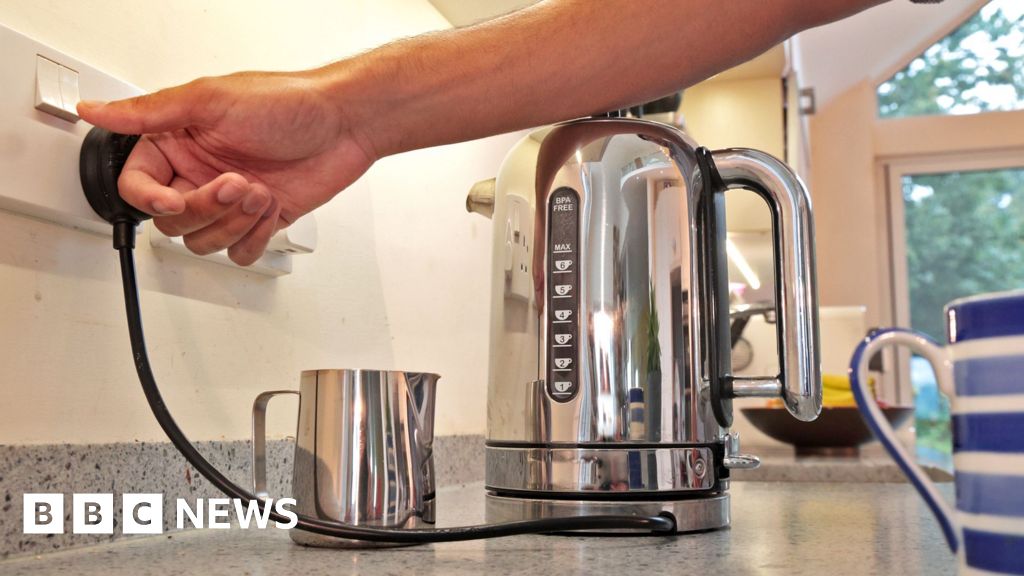
The war in the Middle East has brought renewed attention to Britain’s vulnerability to energy price shocks.
Source link
Business
Gadkari urges shift to 100% ethanol blending, flags energy security and import risks – The Times of India
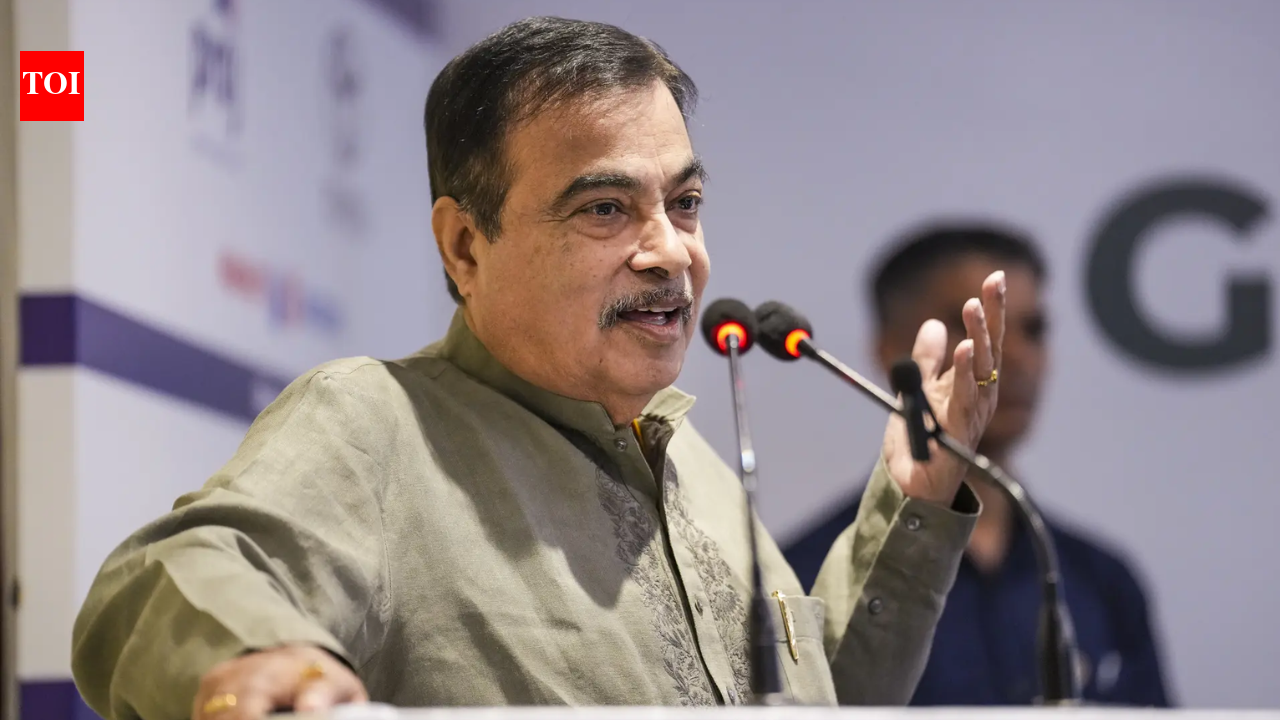
India should aim for 100 per cent ethanol blending in the near future to strengthen energy self-reliance, road transport and highways minister Nitin Gadkari said on Tuesday. He said that vulnerabilities in oil supplies due to the ongoing crisis in West Asia have made it essential for the country to reduce dependence on imports.Speaking at the Indian Federation of Green Energy’s Green Transport Conclave, Gadkari said, “In the near future, India should aspire to achieve 100 per cent ethanol blending… Today, we are facing an energy crisis due to the war in West Asia, so it is necessary for us to become self-reliant in the energy sector,” as quoted by PTI.India currently allows vehicles to run on E20 petrol, which contains 20 per cent ethanol, with minor engine modifications to avoid corrosion and related issues. In 2023, PM Modi launched petrol blended with 20 per cent ethanol. Countries such as Brazil have already achieved 100 per cent ethanol blending.Gadkari noted that India imports 87 per cent of its oil requirements, adding, “We import fossil fuels worth Rs 22 lakh crore, which is also causing pollution… so we need to work on increasing production of alternative fuel and bio-fuel.”On future energy solutions, he stressed the importance of green hydrogen but pointed out challenges in cost and transport. “Transport of hydrogen fuel is a problem. Also, we need to produce 1 kg of hydrogen at $1 dollar, to make India an exporter of energy,” he said, adding that hydrogen production from waste should be explored.The minister also emphasised the role of a circular economy in generating employment opportunities. While calling for reduced reliance on petrol and diesel vehicles, he clarified, “But we can not force people to stop buying petrol and diesel vehicles.”Addressing concerns about E20 fuel, Gadkari said the petroleum sector is lobbying against the move. He also urged automobile manufacturers to prioritise quality over cost to expand into new markets.Last year, Gadkari dismissed criticism against E20 (ethanol-blended petrol), saying a “paid” social media campaign is being run to “target me politically.” He said Society of Indian Automobile Manufacturers and Automotive Research Association of India have shared their findings on ethanol blending in petrol. He added that India’s ethanol programme has benefited farmers, noting that ethanol made from maize has helped them get better prices and led to gains of Rs 45,000 crore.


Soccer’s incredible shrinking shin guards could be a big problem
Leave, holidays and encashment: What India’s changing labour laws mean for employees – The Times of India

Here’s full list of airlines hit by cancellations, reroutes, delays

-

 Fashion5 days ago
France’s LVMH Q1 revenue falls 6%, shows resilience amid Iran war
-

 Sports1 week ago
The case for Man United’s Fernandes as Premier League’s best
-

 Entertainment1 week ago
Palace left in shock as Prince William cancels grand ceremony
-
 Business1 week ago
UK could adopt EU single market rules under new legislation
-

 Entertainment6 days ago
Is Claude down? Here’s why users are seeing errors
-

 Fashion1 week ago
Energy emerges as biggest cost driver in textile margins
-
 Business1 week ago
Delta Air Lines unveils first new Delta One suite in premium cabin arms race
-

 Fashion1 week ago
Asia claims largest share of markets on Kearney FDI Confidence Index