

Business
Trading at PSX turns choppy as investors lock in gains | The Express Tribune

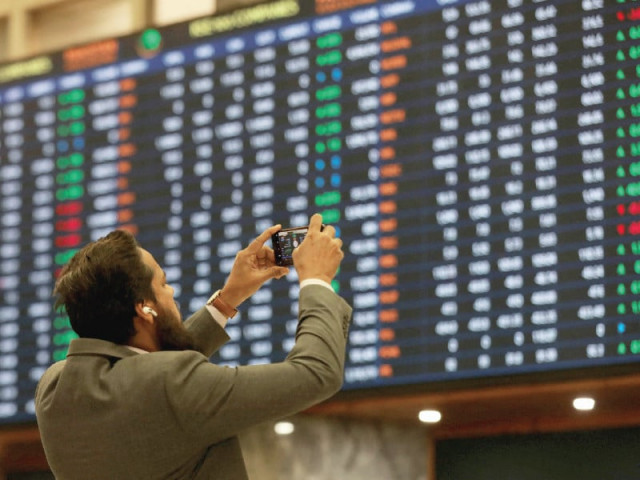
Trading at the Pakistan Stock Exchange remained choppy on Wednesday as early optimism faded in the face of mounting profit-taking. This volatile performance came after a sustained rally over recent sessions, prompting investors to adopt a cautious stance.
The benchmark KSE-100 index kicked off the session on a bullish footing, racing to an intra-day peak of 175,232.90 and briefly breaching the landmark 175,000-point level for the first time. However, the momentum could not be sustained. As the session progressed, investors chose to lock in gains, prompting a gradual retreat from the day’s highs. As a result, the index slipped to an intra-day low of 173,564.33 amid broad-based selling.
Pressure was most evident in heavyweight sectors such as automobile assemblers, commercial banks, power generation, and refineries, which collectively dragged the market lower. By the close, the KSE-100 index ended in negative territory, shedding 418.47 points, or 0.24%, to settle at 174,054.32.
Meanwhile, the broader market outlook remains constructive despite near-term volatility. The KSE-100 index emerged as the second-best performing frontier market in CY25, delivering a robust 51% return and closing the year at a fresh record high, Arif Habib Limited (AHL) reported.
This performance extends its three-year streak of double-digit gains, following returns of 55% in CY23 and an exceptional 84% in CY24, with only Romania outperforming Pakistan among frontier markets.
Over the past three years, the index has generated an average annual return of 64%, placing it among the top-performing equity markets globally. In dollar terms, cumulative returns reached 249%, a level unmatched by any other market over the same three-year period, AHL wrote.
Overall trading volume increased to 957.2million shares compared with Tuesday’s tally of 851milion. Value of traded shares stood at Rs44.2 million. Shares of 481 companies were traded. Of these, 221 closed higher, 223 fell and 37 remained unchanged. K-Electric was the volume topper with trading in 95.9 million shares, gaining Rs0.21 to close at Rs5.93.








Business
Stocks to buy: What’s the outlook for Nifty for April 20-April 24 week? Check list of top stock recommendations – The Times of India
Stock market recommendations: APL Apollo Tubes, and HDFC Asset Management Company are Sudeep Shah, Head – Technical Research and Derivatives, SBI Securities’ top stock picks for this week. Below are his stock picks and also views on Nifty.Nifty ViewThe benchmark index Nifty continues to inch higher; however, this phase of the rally is notably different, as the spotlight has shifted away from the headline index. While Nifty has extended its pullback rally for the second consecutive week and closed in the green, the real strength is emerging beneath the surface. The broader markets have taken the lead, with Nifty Midcap 100 and Nifty Smallcap 100 delivering a robust rally and clearly outperforming the frontline index. Both indices have decisively moved above their key moving averages, signalling trend strength, whereas Nifty is still trading below its 100day and 200day EMA. Most importantly, Nifty Midcap 100 is now just a short distance away from its alltime high, suggesting that the next leg of opportunity may be unfolding beyond the conventional largecap space.Focusing back on Nifty, the index has been sustaining above its 50day EMA for the last three trading sessions, while the 20day and 50day EMA have started to edge higher, reflecting improvement in the shortterm trend. Meanwhile, the downward momentum in the 100day and 200day EMA has slowed considerably, indicating a stabilisation in the mediumterm structure. Momentum indicators further support the constructive bias, with the daily RSI trading above the 57 mark and moving higher, and the daily MACD histogram signalling strong bullish momentum.Collectively, these technical factors suggest that the pullback rally is likely to continue in the short term. On the upside, the 24650–24700 zone is expected to act as a crucial hurdle for the index. A sustainable breakout above 24700 could lead to an extension of the pullback rally towards 25000, followed by 25200 in the near term. On the downside, the 24050–24000 zone will serve as immediate support, and as long as the index remains above the 24000 mark, the ongoing pullback rally is likely to stay intact.Bank Nifty ViewThe banking benchmark Bank Nifty also ended the week on a positive note, indicating the continuation of its ongoing pullback rally. However, over the last three trading sessions, the index has struggled to decisively cross its 200day EMA, suggesting a phase of consolidation near a key long-term resistance zone. This price behaviour reflects hesitation at higher levels and points towards a pause in momentum after the recent recovery.This consolidation largely indicates a degree of caution among market participants, as investors appear to be awaiting clarity on the Q4 earnings outcome of major banking heavyweights, namely ICICI Bank and HDFC Bank. With both results scheduled over the weekend, the index is likely to witness a directional move post the earnings announcements, depending on earnings performance and management commentary.From a technical perspective, the index continues to maintain a constructive short-term setup, as it is trading above its 20day and 50day EMA, reflecting underlying strength. Momentum indicators remain supportive, with the daily RSI placed above the 55 level and trending higher, suggesting improving buying momentum and positive shortterm bias.Looking ahead, the 57000–57100 zone is expected to act as a crucial resistance area, as it coincides with both the prior swing high and the 100day EMA, making it an important supply zone. A sustainable move above 57100 could lead to a further extension of the pullback rally towards 57800, followed by 58500 in the short term. On the downside, the 55800–55700 zone is placed as an important support band, and any dip towards this region is likely to attract buying interest as long as the structure remains intact.Stock recommendations:APL Apollo TubesAPL Apollo Tubes has shown strong bullish intent after a 14.5% pullback from its early April lows near the 200-day EMA, indicating solid support at lower levels. The recent consolidation between 2072–1961 acted as a base, with the stock now delivering a decisive breakout on strong footing. A positive DI crossover on ADX signals clear buyer dominance, while the MACD nearing a move above the zero line with rising histogram bars points to strengthening momentum.The overall setup suggests the stock is well-positioned to extend its uptrend in the near term. Hence, we recommend to accumulate the stock in the zone of 2110-2090 with a stoploss of 2020. On the upside, it is likely to test the level of 2255 in the short term.HDFC Asset Management CompanyHDFC Asset Management Company has exhibited strong bullish momentum, closing Friday’s session with an impressive 4.89% gain. The stock has surged nearly 26% from its March lows, indicating robust buying interest. Momentum indicators remain firmly supportive, with RSI sustaining above 60, reflecting strength. Additionally, a positive DI crossover on ADX highlights clear buyer dominance, while rising MACD histogram bars with the MACD line above the zero mark further reinforce the ongoing uptrend. The overall structure suggests the stock is well-positioned to extend its upward trajectory. Hence, we recommend to accumulate the stock in the zone of 2800-2770 with a stoploss of 2690. On the upside, it is likely to test the level of 2990 in the short term.(Disclaimer: Recommendations and views on the stock market, other asset classes or personal finance management tips given by experts are their own. These opinions do not represent the views of The Times of India)
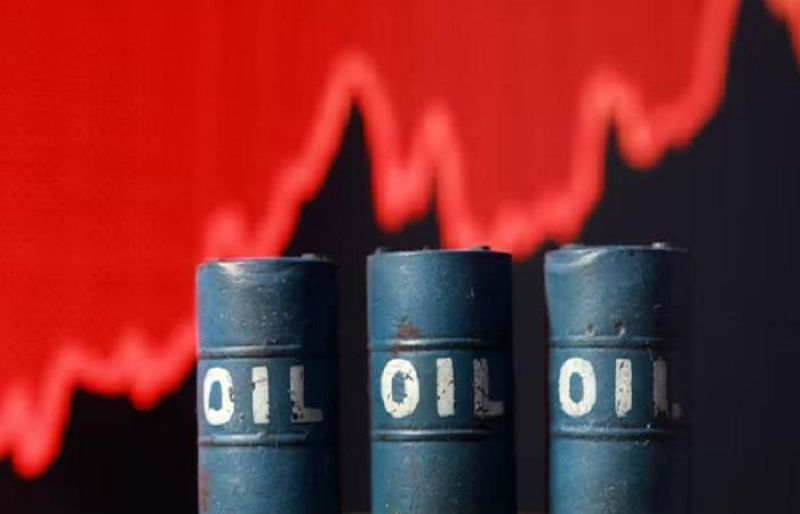
Oil prices jumped, the US dollar rose, and stock futures fell on Monday as investors dealt with conflicting messages about the Iran war and news that the Strait of Hormuz was closed again.
In early Asian trading, Brent crude futures jumped about 7% to $96.85 a barrel, and S&P 500 futures fell about 0.9%.
The euro was down 0.3% at $1.1735, and the yen eased around 0.2% to 158.95 per dollar.
Iran rejected new peace talks with the United States, its state news agency reported on Sunday, hours after US President Donald Trump said he was sending envoys for talks in Pakistan and would launch new strikes on Iran unless it accepts his terms.
Tensions also rose after the US said it seized an Iranian cargo ship that tried to run its blockade.
The dollar’s rise took it from lows it hit on Friday when Iran’s announcement that it would open the strait sent stocks up and oil prices tumbling.
“Although clearly the news on the Strait of Hormuz closing again is not good, ships being attacked is not good, Trump again with his threats towards Iranian infrastructure is not good, the market is very much looking at this as a case of: when you boil it down, the two sides are still talking,” said Michael Brown, senior research strategist at Pepperstone in London.
“From an equity perspective, I’d probably be saying we unwind a decent chunk of the gains that we saw on Friday, which in hindsight was the market getting a little bit ahead of itself.”
Iran’s announcement that it would open the Strait had sent stocks and bonds surging on Friday and oil prices down as investors bet on an end to a seven-week war that shut the Strait of Hormuz, a vital artery for global crude and gas shipments.
“Now that Hormuz is closed again after about 12 hours of being open, you’d probably expect most of the move that we saw on Friday (in bonds) to unwind,” Brown said.
“If it is indeed firmed up that Iran aren’t going to attend (the talks), you’re going to see a much more risk-averse reaction than we’re seeing now.”
Markets rallied last week
Wall Street indexes touched record highs on Friday while bonds, which, unlike stocks, are still far from recovering their losses since the war, surged as oil prices fell and investors pared bets on rate hikes from the European Central Bank and Bank of England.
US stocks have been supported through the past week by expectations of robust first-quarter earnings, the bulk of which come this week.
The benchmark US 10-year Treasury yield touched its lowest since mid-March on Friday.
The dollar dropped as the shine came off safe-haven assets late last week, driving the dollar index, which measures the greenback against a basket of currencies including the yen and the euro, to its lowest in seven weeks. It was 0.2% higher early on Monday in Asian trading.
“The risk is that the market is getting ahead of itself … The 13-day rally in the Nasdaq is an extreme. The dollar index has fallen for nine of the past 10 sessions,” Marc Chandler of Bannockburn Capital Markets said in a note on Sunday.
Business
Stock market today (April 20, 2026): Nifty50 recovers from losses, goes above 24,400; BSE Sensex up over 300 points – The Times of India
Stock market today: Sensex and Nifty opened in red on Monday on weak global cues as the closure of Strait of Hormuz led to an increase in oil prices. However the market quickly revered losses to move in green territory. While Nifty50 went above 24,400, BSE Sensex was up over 300 points. At 11:00 AM, Nifty50 was trading at 24,430.50, up 77 points or 0.32%. BSE Sensex was at 78,805.37, up 312 points or 0.40%.A key factor to watch will be the next round of diplomatic talks between the US and Iran, particularly as the April 22 ceasefire deadline draws closer.Dr. VK Vijayakumar, Chief Investment Strategist, Geojit Investments Limited says, “With the deescalation- escalation drama in the West Asian conflict continuing, the market will remain volatile in the near-term. With Iran hardening its position again, closing the Strait of Hormuz and threatening to retaliate to US’ seizure of an Iranian ship ‘violating the US blockade’, there is potential for a flare up of the conflict when the ceasefire ends on 22nd April. However, the market signals do not reflect renewed concern and flare up of the conflict. Even though Brent crude has spiked back to $95 levels from below $90 on Friday, there is no panic in the crude market.” “A significant trend in the market now is the outperformance of the broader market. Nifty Midcap and Nifty Smallcap indices are back to pre-war levels. This is in contrast to the Nifty which is still 4% below pre-war levels. The market is responding positively to good results from the broader market space. Even with the uncertainty of the West Asia tensions weighing on the market, particular stocks will respond to good results, particularly when the results beat expectations.“At the start of the new week, oil prices climbed, the US dollar rebounded from recent lows, and global equities showed mixed movement as tensions in the Middle East disrupted shipping flows in and out of the Gulf. Even so, market participants continued to anticipate a possible resolution.Early Monday trends indicated declines in US equity futures, with S&P 500 futures down 0.6% by mid-morning in Tokyo. In Asia, Hang Seng futures rose 1.2%, Nikkei 225 futures edged up 0.3%, Japan’s Topix gained 0.5%, while Australia’s S&P/ASX 200 remained largely unchanged. In Europe, Euro Stoxx 50 futures slipped 1.2%.Crude oil prices rebounded by more than 6% on Monday after plunging over 9% on Friday, as reports emerged that the Strait of Hormuz had been shut again following mutual accusations by the US and Iran of ceasefire violations involving attacks on vessels over the weekend.Gold prices declined by over 1% on Monday as the strengthening dollar weighed on the metal, while uncertainty surrounding US-Iran negotiations pushed oil prices higher and reignited concerns about inflation.(Disclaimer: Recommendations and views on the stock market, other asset classes or personal finance management tips given by experts are their own. These opinions do not represent the views of The Times of India)


Indian reforms strengthen DGFT norms committees’ functioning: Ministry

The Weird, Twisting Tale of How China Spied on Alysa Liu and Her Dad

‘Saturday Night Live’ alum Tina Fey admits past jokes missed the mark

-

 Fashion4 days ago
France’s LVMH Q1 revenue falls 6%, shows resilience amid Iran war
-

 Sports1 week ago
The case for Man United’s Fernandes as Premier League’s best
-

 Entertainment1 week ago
Palace left in shock as Prince William cancels grand ceremony
-
 Business1 week ago
UK could adopt EU single market rules under new legislation
-

 Entertainment5 days ago
Is Claude down? Here’s why users are seeing errors
-

 Sports1 week ago
Lamar Jackson hits back at critics with faithful message on social media
-

 Fashion1 week ago
Energy emerges as biggest cost driver in textile margins
-
 Business1 week ago
Road accidents: a massive economic challenge | The Express Tribune