Connect with us

Sports

Wetzel: How college basketball ended up signing NBA draft picks

Published

on

Wetzel: How college basketball ended up signing NBA draft picks
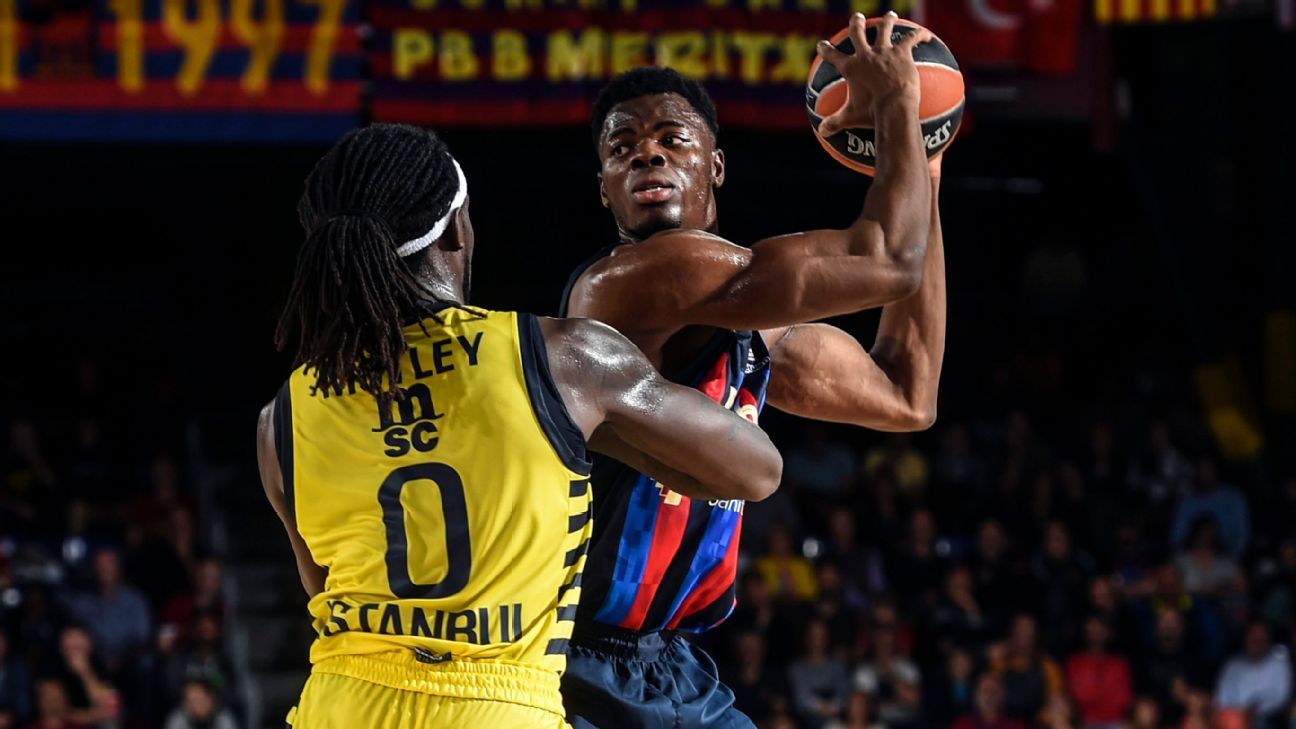

Ideally, college basketball would have organized itself so that teams weren’t adding dudes from European pro leagues in the middle of the season.

Your roster on, say, Nov. 1, is your roster. Is that too much to ask? They have trade deadlines and signing windows in the NBA and NFL, after all. How about this: If you enter the NBA draft, you can’t still play college ball.

Of course, ideally, the NCAA and college sports’ leadership — from conference commissioners to high powered athletic directors to famed coaches — would have, at least by the late 2010s, recognized that change was inevitable and begun planning for it.

Instead, they pouted, complained and in an enduring effort for control (especially of the money), clung to losing arguments, waged losing fights and let confusion engulf them.

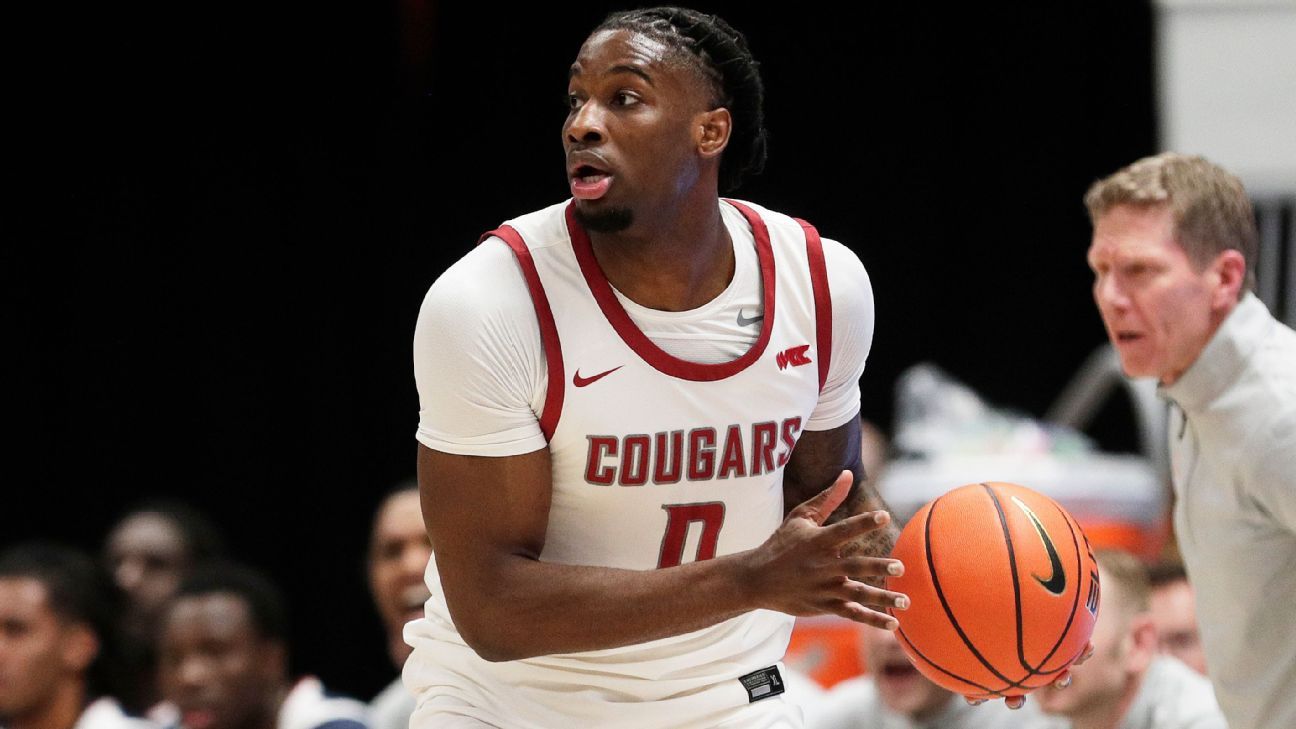
That’s how Baylor got a stocking (and hoop) stuffer on Christmas Eve, when it announced it had signed James Nnaji, a 21-year-old, 7-foot center. You might remember him as the 31st selection of the 2023 NBA draft.

Detroit picked him that night. He was later traded to Charlotte and then the New York Knicks. Nnaji has never seen NBA minutes (other than in the summer league) but has been playing pro ball in Europe since 2020.

Somehow, Nnaji has four years of college eligibility remaining. Sure, why not? What’s LeBron’s status?

Nnaji is expected to join the Bears on the court next week in time for Big 12 play.

“Santa Claus is delivering mid season acquisitions,” Connecticut coach Dan Hurley quipped on social media.

“I just know they told us he can play, so I’m happy,” Baylor coach Scott Drew said.

Don’t blame Drew. He didn’t make the rules. It’s all perfectly legal. Drew has an obligation to his players, not to mention his school, to surround them with the best talent he can. So he did.

Besides, Baylor isn’t the only team bringing in pros from Europe, even at midseason. Oklahoma just signed a Russian center. Dayton, BYU and others, including Kansas State women’s hoops, have done similar.

It might be jarring, but the world is not ending. Nnaji, for all the attention, has averaged just 3.4 points a game as a pro. Set up with thought and structure, granting guys like him eligibility isn’t even an entirely bad idea — college hockey is packed with NHL draft picks.

Done this way though?

“This s— is crazy!!” Hurley wrote.

It certainly feels that way.

The fault falls to college sports’ “leadership,” which spent the past few decades trying to hold the line on amateurism, a dated concept that was almost assuredly doomed in the face of legal challenges.

The first came way back in 2009, when former UCLA men’s basketball player Ed O’Bannon sued to argue the NCAA was selling his name, image and likeness in a video game (which they were, as a judge ruled in 2014). The writing was on the wall. Public sentiment quickly shifted against the NCAA.

Yet instead of accepting the need for a new way of doing business, the NCAA just got more entrenched. Rather than share the revenue from the video game, the game was canceled.

College sports embraced a hard line, continuing to pour millions into ill-fated legal defenses and, later, Washington lobbyists who gladly cashed checks and sold the pipe dream that Congress would save them.

The NCAA, for example, argued in front of the United States Supreme Court that the Sherman Antitrust Act should not apply to college athletics because fans would tune out if an athlete was ever compensated for anything, even cash awards won via academic contests or legitimate endorsement opportunities.

Apparently Caitlin Clark’s State Farm commercial wasn’t a marketing boon for women’s basketball, but an existential threat.

“That argument is circular and unpersuasive,” Justice Brett Kavanaugh wrote in 2021, in a concurring opinion to a 9-0 decision against the NCAA. “… Nowhere else in America can businesses get away with agreeing not to pay their workers a fair market rate on the theory that their product is defined by not paying their workers a fair market rate.”

With the courts almost universally against them, the NCAA turned to Congress, seeking antitrust exemptions. Lobbyists were hired. Senators were courted. A few dog and pony show hearings were held.

No legislation ever came even close to passing. It was a completely predictable waste of time and money.

O’Bannon just wanted a fair cut, but being in opposition to the Sherman Antitrust Act (which has been around since 1890) has left the NCAA on the losing side of numerous eligibility fights, which has changed the way the games are actually played.

In the simplest of terms, the NCAA can’t stop someone from earning a living, which means it can rarely stop someone from playing for them and thus — earn a living.

That reality opened the floodgates to immediate eligibility for all transfers, caused junior college seasons to no longer count, flooded rosters with mid-20s grad students and, yes, even allowed for a once NBA-drafted, twice NBA-traded, European pro to join up in January.

Rather than pursuing outdated legal strategies and transparently one-sided legislation, the NCAA should have recognized the players as employees and then negotiated with what would almost assuredly be a weak union. If needed, it could have asked Congress for limited, common sense, antitrust carve-outs that might have stood a bipartisan chance of passing.

Then maybe compromises would’ve been reached on, say, the transfer portal or postdraft eligibility or whatever else comes up.

“To me, until we get to collective bargaining, there’s not going to be a solution,” Drew said.

He’s right, but that has also been obvious for years now.

The old guard of college sports just couldn’t accept it though. It was the old way, or no way.

So the lawyers and the lobbyists got paid.

And college basketball got midseason EuroLeague signings.


Source link

Continue Reading
Click to comment

Leave a Reply

Your email address will not be published. Required fields are marked *

Sports

The NHL is back at the Olympics! Everything you need to know about hockey in Milan-Cortina

Published

on

The NHL is back at the Olympics! Everything you need to know about hockey in Milan-Cortina


For the first time since 2014, NHL players will be competing in the Olympic Games — minus those who call Russia home.

On the women’s side, the best players have been participating without restriction this whole time.

You might have several questions based on those two sentences.

ESPN reporters Ryan S. Clark and Kristen Shilton are here with answers to those — and many more about the format, favorites, etc. — as the start of the Milan-Cortina Games approaches in early February.


When do the tournaments begin?

As pop poet laureate Taylor Swift would say: Baby, let the Games begin!

In this 25th iteration of the iconic winter sports showcase, hockey’s best will compete over 18 days. The women’s side kicks things off Feb. 5, with round-robin action extending to Feb. 10. The men get started Feb. 11 with their own round-robin going until Feb. 18.

Quarterfinals for the women will open Feb. 13, and the men will have qualification playoff games starting Feb. 17. Further quarterfinal and semifinal matchups will follow, leading into medal rounds slated for Feb. 19 (both bronze and gold on the women’s end) and then Feb. 21 (bronze) and Feb. 22 (gold) for the men. — Shilton


Which countries are competing?

Twelve nations will compete in the men’s division, while 10 nations will comprise the women’s division.

Men’s hockey was first introduced as an Olympic sport during the 1920 Summer Olympics, but was then made a permanent sport at the 1924 Winter Games.

Canada was the first nation to win gold in men’s hockey, winning four consecutively; in total, Canada has won gold nine times — the most of any nation. The U.S. is tied for third all time with two gold medals, while its eight silver medals are the most of any nation in men’s hockey.

Finland enters the tournament as the reigning men’s champion, with the nation winning its first-ever gold in 2022. The Finns are seeking to become the first country since Canada in 2010 and 2014 to win consecutive gold medals. It’ll try to pull off that achievement in a field that will also feature Canada, Czechia, Denmark, France, Germany, Italy, Latvia, Slovakia, Sweden, Switzerland and the U.S.

Women’s hockey was introduced at the 1998 Winter Games in Nagano, Japan.

The U.S. was the first country to win gold in women’s hockey when it defeated Canada. Since then, there has been just one Olympics (2006 Torino) in which the gold medal game hasn’t been played between the two North American rivals. The Canadians won their first gold in 2002, and kept those gold medals coming until they were defeated by the U.S. in 2018 in Pyeongchang, South Korea. Canada would strike back in 2022 to win its fifth gold medal in six tries.

Both Canada and the U.S., which are the only countries to win a gold medal in women’s hockey, are back in 2026. They’ll be joined by Czechia, Finland, France, Germany, Italy, Japan, Sweden and Switzerland. — Clark


Why is it a big deal that NHL players are participating on the men’s side?

The NHL is back competing at the Olympics for the first time since the 2014 event in Sochi. There had been league players participating at the Winter Olympics since 1998, but the NHL eventually had a change of heart about being involved. The NHL opted to stop taking Olympic breaks, disallowing its athletes from going to the 2018 showcase.

There were a number of reasons for that choice cited by NHL officials, ranging from pricing and cost issues with the International Olympic Committee and International Ice Hockey Federation (particularly when it came to insurance, travel and lodging). Furthermore, there was consideration for the impact of shutting down for a month on the NHL’s bottom line, not to mention the logistical gymnastics involved in a shortened season. Basically, the NHL owners didn’t think there was enough benefit to seeing their players suit up for their countries.

It wasn’t until the NHLPA pushed back at the collective bargaining table and worked Olympic participation back into the labor laws that it became an option once again. NHL players were slated to return for the 2022 Games, but because of widespread COVID-19 outbreaks at that time, the league stepped in and barred its players again — this time for health reasons — from heading to Beijing.

Those days are behind us now though. The NHL is all-in, and ready to build on the best-on-best momentum from last February’s 4 Nations Face-Off — Shilton


What is the format of the tournament, and what rules are different from the NHL’s?

The tournament is straightforward for the women: 10 countries will be represented, spread across two groups of five teams each. All teams will play each other once in preliminary action. From there, all five teams from Group A and the top three teams from Group B will advance to the quarterfinals. Standard knockout rules apply once the round-robin is done.

The men’s situation is a tad more complex.

We’ve already covered some of the basics: There are 12 teams competing, seeded across three groups of four. Each team will play three round-robin games. When that preliminary round ends, all 12 clubs will be reranked according to a specific system: Which team had the higher position in the group, which had more points, which had the better goal differential, which had the higher number of goals scored and which had a higher IIHF ranking in 2020.

At that point, teams rated 1-4 will have a bye into the quarterfinals. Teams 5-12 will participate in a qualifying round that pits 5 vs. 12, 6 vs. 11, 7 vs. 10 and 8 vs. 9. The four winners from that mini tournament will advance to the quarterfinals, where the matchup system (highest vs. lowest seed) will carry on. Ditto into the semifinals, and then the gold and bronze medal games will be played by the winners and losers of the semis. The team with the higher preliminary round ranking will be considered the home squad in each final round game.

There will also be some differences from what rules and procedures govern the NHL.

The Olympic event’s outcomes will be run by a points system: three for the winning team in regulation, zero for the losing team in regulation, two for the winning team in overtime or a shootout and one for the losing team in overtime or a shootout. During the preliminary action, overtime will last five minutes before the sides go to a shootout. At the Olympics, there will be five preliminary shooters per side instead of the NHL’s usual three. In qualifying, quarterfinal and semifinal games, there will be a 10-minute overtime followed by a shootout. In medal rounds, overtime periods will last 20 minutes until someone scores.

Intermissions will also be shorter — 15 minutes, as opposed to 18 in the NHL. Men’s teams can bring 25 skaters (including three goalies) and ice a game-day roster of 20 players.

Oh, and as always, there is no fighting allowed at the Olympics (or any IIHF hockey events). Sorry, Tkachuk brothers! — Shilton


What’s the latest on the construction of a new rink?

Creating the space where both male and female players will compete has been an arduous process ahead of these Games. Various delays put laborers behind schedule, and by mid-December — just seven weeks from when the women’s hockey teams are slated to start playing — the ice surface inside Milano Santagiulia Ice Hockey Arena had not been installed.

The IOC executive board has made assurances that the arena will be ready by February, even though previously planned pre-Olympic events to test out the pending ice surface had to be canceled. There are reported to be thousands of workers on site around the clock each day to ensure the final deadlines are made.

NHL commissioner Gary Bettman has repeatedly said the NHL had nothing to do with the arena construction process, and deputy commissioner Bill Daly reiterated recently that the safety of NHL players remains the league’s primary concern when it comes to any arena setbacks. — Shilton


What happens if the rink isn’t finished? Is there a deadline for a decision?

Officially, there is no Plan B if the Milano Santaguila rink isn’t finished in time and deemed safe for the athletes. In order for the NHL to make that designation, there has to be some kind of hockey played in the arena so that ice can be tested on its own and when the 16,000-person capacity venue has actual people inside. Bettman and Daly have both stated that if the league doesn’t feel the rink is adequately prepared and vetted they will not send players as planned.

NHL officials have been on the ground in Milan to see what progress there has been, and on one of those trips discovered the size of the ice surface will measure 196.85 feet by 85.3 feet, something the IIHF agreed upon but was a surprise to the league (which has its own standard rinks at 200 feet by 85 feet). International tournaments have been played on smaller ice surfaces than that in the past, but this will be shorter and wider than what athletes have experienced before. The IIHF defended itself against any backlash while moving ahead with their plans.

“While these dimensions differ slightly from a typical NHL rink, they are consistent with IIHF regulations, match the rink size used at the Beijing 2022 Olympic Winter Games and are fully consistent with the dimensions the NHL requires as part of its Global Series Game arena specifications,” the federation said in a statement. “All involved — the IIHF, the organizing committee, NHL, NHLPA, International Olympic Committee and the relevant venue authorities — agree that the differences in rink specifications are insignificant and should not impact either the safety or quality of game play.”

Still, it’s yet another wrench in an increasingly stressful situation for both Olympic organizers and men’s and women’s league executives who want to see their players properly showcased but without risking their health in the process.

“We have offered [to help with the construction] and they are utilizing our ice experts and technicians and outside providers,” Daly said. “We’re basically moving everybody there to try to help get this done in a way that is acceptable for NHL athletes.”

There has been no publicly announced cut-off date as of yet that would indicate how much runway the organizers have before the NHL or any of the women’s teams would drop out of the tournament. — Shilton


Who are some of the top women’s players who I need to know?

Canada is expected to be led by its established stars, and that starts with its captain Marie-Philip Poulin. She’s a three-time Olympic gold medalist, a four-time women’s world champion, the reigning IIHF Women’s Player of the Year, and is considered to be one of the greatest players of all time.

Poulin is just one of two Player of the Year recipients who are expected to play for Canada. Natalie Spooner won the award in 2024 and has won two Olympic golds and three world championships. Canada’s bid for a consecutive gold medal is also likely to be heavily bolstered by other stars such as Erin Ambrose, Renata Fast, Sarah Fillier, Brianne Jenner, Sarah Nurse and Blayre Turnbull.

The U.S. has its own collection of stars who will be led by captain Hilary Knight. She is a four-time Olympic medalist who was part of the U.S. team that won gold in 2018 and is also a 10-time world champion. Knight was the first recipient of the IIHF Women’s Player of the Year back in 2023.

America’s path for a gold is also expected to feature Alex Carpenter, Kendall Coyne Schofield, Britta Curl-Salemme, Aerin Frankel and Lee Stecklein. Laila Edwards and Caroline Harvey, teammates at the University of Wisconsin, are also expected to be on the roster.

Outside of the North American powers, there’s Finland duo Jenni Hiirikoski and Michelle Karvinen, who are considered to be two of the best players in the world. Switzerland’s Alina Muller might be a familiar name, with the forward winning a bronze medal when she was 15 at the 2014 Olympics.

Another country to watch is Czechia, which has been among the top four women’s teams over the past four years because of players such as Kristyna Kaltounkova, Natalie Mlynkova, Katerina Mrazova and Aneta Tejralova. — Clark


Who are the key non-NHL players to know on the men’s side?

The U.S., Canada, Finland and Sweden are expected to field rosters that exclusively feature NHL players. Although it’s possible Finland could have to rely on skaters playing elsewhere considering how many expected roster players are out because of injury, led by Florida Panthers star Aleksander Barkov.

Czechia, Germany and Switzerland will have NHL players on their respective rosters but will need players from leagues beyond the NHL in order to field a full team. Czechia is expected to rely on Ondrej Beranek, Roman Cervenka and Jakub Flek, along with other players who have previous NHL experience like Libor Hajek, Michal Kempny and Dominik Kubalik.

Switzerland could be an under-the-radar medal threat. In addition to NHL players like Nico Hischier and Timo Meier, it also has players who either have NHL experience or have played in North American leagues. It’s a group that consists of Sven Andrighetto, Dean Kukan and Denis Malgin. There are also players who’ve stayed in Europe for their whole careers such as Swiss goalie Leonardo Genoni, a veteran of nearly 90 games for his country at the senior level. — Clark


Who are the medal favorites?

Part of what made the 4 Nations Face-Off intriguing is that it was seen as a dress rehearsal for the Olympics. Canada and the U.S. were the heavy favorites and showed why with Canada winning in overtime in the final. The tight margins between those two teams is more evidence that either could win the men’s tournament. That narrative was enhanced by the U.S. winning its first men’s world championships gold medal since 1960 this past spring.

That said, Czechia, Finland and Sweden all have a strong history of finding cohesion at numerous international tournaments en route to either winning gold or being somewhere on the podium. And as noted above, Switzerland could build upon its consecutive second-place finishes at the two most recent men’s world championships and parlay that into a place on the medal stand.

On the women’s side, the U.S. and Canada are considered to be the two strongest nations when it comes to talent and infrastructure, and they enter the tournament as the favorites for gold.

That’s not to suggest that others won’t force the issue and give the Olympics its second-ever gold medal game that isn’t played between Canada and the U.S.; the two most likely candidates to do so appear to be Finland and Czechia.

Finland has won bronze in three of the four most recent Olympics. The Finns have also won bronze in the two most recent women’s world championships.

Both of those third-place finishes for Finland were against a surging Czechia. The 2022 Olympics was Czechia’s first time at the Games, and they finished seventh. They were the bronze medalists at the women’s world championships in 2022 and 2023, losing the bronze to Finland the past two years. — Clark


Why isn’t Russia in the tournament?

The IOC is continuing its ban on teams from Russia (and Belarus) competing in both men’s and women’s hockey at the 2026 Games. This will be the second straight Olympics where those countries won’t be represented in group sports, although certain individual athletes will be allowed to compete as Individual Neutral Athletes.

The IOC initially had its executive board call for sanctions against Russia in response to their invasion of Ukraine — with Belarus’ support — in 2022. Those recommendations were made in 2023, and consequently Russia and Belarus were barred from the summer 2024 Games in Paris. The IOC asked the IIHF for a projected schedule and groupings in May for the 2026 Games, making their decision to uphold the previous recommendations against Russia and Belarus at the end of that month.

This isn’t the first time the IOC has taken a stance against Russia. When a state-sponsored doping program was exposed there in 2016, the IOC and World Doping Agency determined as punishment that Russia’s name, flag and anthem be banned from all upcoming Games. As such, Russia’s last two Olympic teams competed as “Olympic Athletes from Russia” in 2018 and “Russia Olympic Committee” in 2022. — Shilton


Source link

Continue Reading

Sports

Women’s tennis legend Martina Navratilova defends JK Rowling in debate over males in women’s spaces

Published

on

Women’s tennis legend Martina Navratilova defends JK Rowling in debate over males in women’s spaces


NEWYou can now listen to Fox News articles!

Women’s tennis legend Martina Navratilova stepped into a social media debate in defense of famed “Harry Potter” author J.K. Rowling over biological males in women’s spaces on Thursday. 

Rowling responded to an X thread by English columnist Dan Hodges, who was condemning what he considered “hostile” treatment of biological male transgender people who enter women’s spaces. 

Rowling sarcastically wrote in response to Hodges, “A man explaining to women that they should pretend some of his fellow men are women because that’s ‘respectful’ is exactly what this debate needed. Thanks for your bravery.”

CLICK HERE FOR MORE SPORTS COVERAGE ON FOXNEWS.COM

“Harry Potter” author J.K. Rowling said on X this week she’s not keen on reconciling with actress Emma Watson over their political differences. (SOPA Images/Getty)

Rowling later wrote, “What you, and many other men, fail to grasp, possibly because you’re so used to women coddling men’s feelings you see it as the natural order of things, is that while a trans-identified man is absolutely and rightly free to dress and refer to himself however he likes in our society, that doesn’t give him rights over women’s beliefs and speech.

“I don’t believe a man literally becomes a woman when he identifies as one, and as I have freedom of speech, I have the right to call him a man. The verifiable truth of sex forms the legal basis for women’s rights and for safeguarding. Nothing reveals your inability to grasp this issue, or your fundamental sexism, more than the fact that you, a man, are assuming the right to dictate to women how they should speak about men.” 

Another user then responded to Rowling, arguing that the topic of trans people invading women’s spaces is a “fringe issue.” 

Navratilova then entered the debate in defense of Rowling. 

“Fringe for you maybe. Not so fringe for the women who are affected by males in women’s sex based spaces . Compelled speech is not ok either,” Navratilova wrote. 

AOC RIPPED BY WOMEN’S SPORTS ACTIVISTS IN RESPONSE TO ‘TRANSGENDER AWARENESS WEEK’ POST 

Martina Navratilova points

Tennis legend and female rights activist Martina Navratilova blasted The New York Times for a controversial description of biological women. (Angel Martinez/Getty Images for Laureus)

Navratilova has been a polarizing figure on social media for her conflicted support for liberals and opposition of Trump. She regularly slams Democrats for allowing biological males in women’s sports.

Last December, she said she was “mad” Republicans have tackled the nationwide controversy of trans athletes in women’s sports instead of the Democrats. 

“And I am so mad that the Republicans captured this issue – shame on all the elected Democrats who keep silent on this!!! #whataboutthewomen,” she wrote on X.

The tennis legend appeared at the Independent Women’s Forum’s Take Back Title IX rally in June to address the issue.

“Initially, being the Democrats and the women that we are for the most part, we in this group were trying to find every single possible way to include trans-identified men, males who identify as women, into women’s sports,” she said. “And the more we try to find a way to mitigate the advantage, to handicap, to somehow to include, the more we figured out it’s not possible. It’s not possible to do it in a fair way, and here we are in a much different position.

“As I got deeper into the issue, I also saw the connection between women’s sex-based spaces and women’s sports. They are totally interconnected, and I’m sure the swimmers at Penn could tell you all about that. You heard about Lia Thomas, right?

CLICK HERE TO DOWNLOAD THE FOX NEWS APP

Martina Navratilova in Queens

Martina Navratilova in September 2022 in Flushing, Queens, New York City. (Tim Clayton/Corbis via Getty Images)

“Now, it’s, ‘Oh, you’re a homophobe.’ Go figure. I’ve been out since ’81. Yeah, I’m a homophobe,” she said, rolling her eyes. “‘You’re a bigot, you’re a transphobe, you’re a Nazi, you’re a fascist, you’re a communist,’ everything and everything in between. And this is coming from the left. I am the left! My people are turning on me. They’re turning on us women who speak up for women’s sex-based rights.”

Follow Fox News Digital’s sports coverage on X, and subscribe to the Fox News Sports Huddle newsletter.


Source link

Continue Reading

Sports

Don’t expect Chelsea to hire an elite coach after Maresca split

Published

on

Don’t expect Chelsea to hire an elite coach after Maresca split


It’s one of the biggest jobs in football, a club that has — as their supporters sing at every game — won it all, but to be head coach at Chelsea, top-level experience and a proven track record are not required, so don’t expect an elite managerial name to replace Enzo Maresca. If you think that makes no sense — a view taken by many confused Chelsea fans right now — it is the reality of the “new” Chelsea under the control of Todd Boehly and Behdad Eghbali’s Clearlake Capital.

So don’t be surprised that former Hull City manager Liam Rosenior, now coaching Chelsea’s Ligue 1 partner club Strasbourg, is a leading candidate to take over from Maresca at Stamford Bridge. Rosenior is talented and well-regarded, but his last job in English football ended with the sack at Hull, so his appointment is unlikely to be well-received by the Chelsea fan base, just as Maresca’s arrival was met with a lukewarm reception in 2024.

Maresca parted company with Chelsea on New Year’s Day after just 18 months in charge, despite delivering success in last season’s UEFA Conference League and FIFA Club World Cup, and also securing UEFA Champions League qualification with a fourth-place finish in last season’s Premier League.

But winning is no longer the primary consideration at Chelsea. It is also about fitting in with the ownership’s blueprint, and that involves young coaches with potential just as much as it revolves around recruiting the best emerging playing talent from all over the world.

It is a club with two owners, two sporting directors — Paul Winstanley and Laurence Stewart — and a raft of other prominent figures in its so-called “integrated football leadership structure,” including former Liverpool director of scouting and recruitment Dave Fallows and talent scouts Sam Jewell and Joe Shields. It is also a team that requires the head coach to heed the advice of medical staff rather than merely take it under consideration, so managing the team at Chelsea is a job that would likely lead an experienced manager to say, “Thanks, but no thanks” if an offer came his way.

But that’s Chelsea, and whether it is working or not is another matter. Measuring success at the modern Chelsea is no longer as straightforward as it used to be, and that is a big reason why Maresca is no longer in a job.

For almost 20 years, under the ownership of Russian billionaire Roman Abramovich, Chelsea were all about big spending and ambition to match, with José Mourinho, Carlo Ancelotti, Antonio Conte and Thomas Tuchel some of the blue-chip coaches hired by Abramovich.

Abramovich demanded success, and he recruited the biggest names in coaching to deliver it. And it was an approach that worked, with Chelsea winning two Champions Leagues and five Premier Leagues during the Abramovich era (2003-2022) before U.K. government sanctions forced the oligarch to sell the club in May 2022.

Maresca would never have been hired by Abramovich, so his arrival as head coach at Stamford Bridge defined the changes at the club. At the time of his appointment, the 45-year-old had been a head coach for less than 18 months: six months with Parma in Italy’s Serie B before being fired for failing to put the team in contention for promotion, and then a full season with Leicester City, guiding the Foxes to the EFL Championship title and a return to the Premier League.

By hiring Maresca, Boehly and Clearlake reverted back to their original plan of identifying a bright, young coach who would develop a team of equally bright and hungry players.

The first attempt with Graham Potter, who replaced Tuchel just seven games into the new regime’s first season, was a short-lived failure, while the more experienced Mauricio Pochettino lasted just one season before leaving his post due to his call for older, more season players being rejected by the ownership group. But when Chelsea turned to Maresca, after considering the similarly inexperienced but highly rated Kieran McKenna from Ipswich Town, it signaled the determination of the club to do it their way.

An Abramovich-era coach would quickly push back on the requirements of the integrated football leadership structure and demand to be given the tools with which to do the job of winning. But by giving a young coach a huge opportunity ahead of his time, the thinking would be that he would be so grateful to have the chance of managing an elite club such as Chelsea that the frustrations of a more senior coach would not be aired, and he would happily embrace the collegiate approach laid down by the owners.

That works for only a short time, though, and Maresca perhaps felt emboldened enough by last season’s successes to push a little bit harder for the players that he felt he needed to take the team into title contention. That was what ultimately led to Pochettino leaving the club, just as Tuchel was gone within weeks of a chaotic summer transfer window that resulted in him urging the club not to make a move for Cristiano Ronaldo.

So when Chelsea hire a new coach, young, up-and-coming and malleable will be the key criteria for the successful candidate. The days of Chelsea hiring the cream of coaching are firmly in the past.


Source link

Continue Reading

Trending