

Business
‘I had no electricity for six months’: American families struggle with soaring energy prices


Danielle KayeBusiness reporter
 Kristy Hallowell
Kristy Hallowell had just lost her job when her energy bill unexpectedly tripled to $1,800 a month.
Unable to pay, her gas and electricity were cut off and she, her two children and her mother spent six months of last year relying on a generator to light and heat their house.
The 44-year-old is one of millions of Americans who have fallen behind on their energy bills as prices have soared over the past year.
The electricity is now back on at her home in Greenwood Lake, New York, after a local non-profit helped reach an agreement with the utility to accept a partial payment.
But the gas is still off and electricity bills keep mounting this winter, leaving her in fear of another shut-off. She said she now had about $3,000 in utility debt.
“This has been traumatic, to say the least,” she said.
Nearly one in 20 households are at risk of having their utility debt sent to collections heading into the winter months, according to a recent report.
The number of households with severely overdue utility debt rose by 3.8% in the first six months of Trump’s second term, the analysis of consumer credit data, compiled by the Century Foundation and Protect Borrowers, found.
Residential energy bills have emerged as a key cost-of-living concern among American consumers, as many buckle under the weight of rising prices and sour on US President Donald Trump’s handling of the economy.
Official economic data from November shows electricity prices rose 6.9% from the year before – much faster than overall inflation.
Trump, who during his campaign said he would cut energy bills in half, has claimed that costs are falling. “Costs under the TRUMP ADMINISTRATION are tumbling down, helped greatly by gasoline and ENERGY,” he posted on social media in November.
The White House blames former President Joe Biden and US central bank interest rates for the lingering economic pain.
But in the wake of Democratic wins in recent state and city elections and polls showing waning consumer confidence, the Trump administration has shifted its messaging to focus on affordability, in a bid to allay voter anxiety about the cost of living in the US.
At the same time, the federal government has proposed slashing the funds it gives to states to help low-income residents pay their utility bills.
Experts also warn that the Trump administration’s rollback of clean energy projects – including its recent decision to pause leases for offshore wind energy projects being built near the Atlantic coastline – could drive electric bills even higher.
“This is going to be a huge deal, both as a policy matter and a political matter,” said Alex Jacquez, chief of policy and advocacy at the Groundwork Collaborative, a progressive economic think tank.
Laurie Wheelock, executive director of the Public Utility Law Project of New York, said many of her clients – low-income utility customers in New York state seeking help with their bills – have let utilities fall to the side as rent, health insurance and other costs keep getting more expensive.
In 2025, the non-profit saw an increase in utility account terminations for unpaid bills, Ms Wheelock said.
Before the pandemic, clients who approached the organisation typically owed $400 to $900 in utility debt. Now, people often owe upwards of $6,000, she said.
“There’s been this difficult mix of increased costs and financial instability,” she added.
Winter heating costs are expected to jump 9.2% this season, according to the National Energy Assistance Directors Association, driven by rising electricity and natural gas prices and unusually cold weather.
Energy bills tend to be among the highest in the northeast US, the report shows. But households from California to Georgia to South Dakota are also feeling the strain of rising costs over the past year.
Power-hungry tech companies
There are several reasons for rising residential energy costs, analysts say.
For one, the price of natural gas, which is a crucial component of nearly half of electricity generation in the US, has jumped over the past year. The natural gas industry is pushing more and more production overseas, contributing to higher domestic prices.
Electricity generation is “being saddled with ever-increasing costs of fuel”, said John Quigley, a senior fellow at the Kleinman Center for Energy Policy at the University of Pennsylvania.
Recent shifts away from clean energy investments could also be at play. A report from the climate advocacy group Climate Power cites the Trump administration’s cancellation of projects that would have produced enough electricity to power the equivalent of 13 million homes.
The gutting of clean energy projects has contributed to a 13% jump in electricity bills since Trump returned to the White House, the report found, as the US increases its dependence on foreign oil.

 AFP via Getty Images
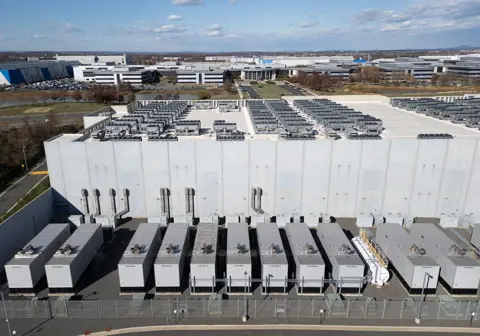
Another key factor: energy demand from the artificial intelligence boom is straining the power grid.
Technology companies from Alphabet to Amazon are ramping up their investments in AI infrastructure, and data centres require massive amounts of electricity.
Continued and increasing electricity demand for data centres is pushing up prices for everyone, Quigley said.
‘You can deal with people’s frustrations’
Treasury Secretary Scott Bessent told ABC News in November that electricity prices were a “state problem”.
“There are things that the federal government can control. Local electricity prices are not one of them,” he said.
But some analysts argue that if the federal government were to embrace clean energy, it would help lower prices.
On the state level, some lawmakers have proposed requiring large data centres to supply their own power, so families don’t shoulder the costs.
In Virginia, where data centres have proliferated, governor-elect Abigail Spanberger has announced plans to ensure tech companies are “paying their fair share”, encouraging clean on-site and off-site generation and storage at data centres.
Virginia utility regulators recently authorised a separate rate category for the biggest electricity customers, like data centres, requiring them to pay a larger share to shield other ratepayers.
“You can deal in the near term with people’s frustrations around prices while dealing with these long-term structural fixes,” said Groundwork Collaborative’s Alex Jacquez.
But any relief for consumers will take time. Residential energy prices are likely to stay elevated in the coming months.
 Ibrahim Awadallah
Last year, Ibrahim Awadallah, 30, installed solar panels on his home in Charlotte, North Carolina in the hopes of reducing his energy costs.
His plan largely worked. His electricity bills tend to be lower than his neighbours’, even taking into account the $180 he pays per month on his solar panel loan.
Still, in October, Awadallah noticed his bill from his utility company getting more expensive – a roughly 10% increase – even though he was out of town much of the month.
A telecommunications developer has proposed building a data centre nearby in east Charlotte. Awadallah is concerned that the project, if approved, will drive up electric costs even more.
“I don’t think things are getting better anytime soon,” he said.

Now one of the biggest sportswear firms, Anta’s rise follows a playbook adopted by many Chinese giants.
Source link
Business
Gold price prediction today: Will gold prices continue to be volatile? Key levels to watch out for April 27, 2026 week – The Times of India

Gold price prediction today: Gold prices will closely track movements on the rate decisions by several central banks, including the US Federal Reserve, this week, says Manav Modi, Senior Analyst, Commodity Research at Motilal Oswal Financial Services Ltd.Gold is currently consolidating after sharp swings in a broad range, indicating a pause rather than a reversal. Price action shows a higher-high structure intact, but the recent sideways movement suggests indecision near the upper supply zone around 158,000–160,000. The formation resembles a short-term flag/triangle continuation pattern, where a breakout on either side will define the next directional move. Volume has tapered slightly, reinforcing the consolidation narrative.Gold prices recently moved from the upper band toward the mid-band (20 DMA), and are now attempting to stabilize. The bands have started to contract, signaling a potential volatility expansion ahead. Sustaining above the mid-band (~150,500–151,000 zone) keeps bullish bias intact, while a breakdown below this could trigger a deeper mean reversion toward the lower band.For the week, immediate support for gold prices is placed at around Rs 150,500, which is followed by stronger support near Rs 148,500. On the upside, the resistance stands at around Rs 155,500, and after that the key supply zone is at Rs 158,000. A decisive close for gold above Rs 158,000 levels can then resume the broader uptrend. However, a break in gold prices below levels of Rs 148,500 may shift the momentum to bearish in the near term.The economic docket is filled with data points and events this week as the focus will be on FED, BOJ, ECB and ECB policy meetings. US consumer confidence, GDP, inflation and durable goods orders data will also be in radar.(Disclaimer: Recommendations and views on the stock market, other asset classes or personal finance management tips given by experts are their own. These opinions do not represent the views of The Times of India)

British families tell BBC Panorama how the Iran war is affecting their monthly budgets.
Source link


UNCTAD, Maritime and Port Authority of Singapore launch partnership

Lexie Brown denies Klay Thompson cheated on Megan Thee Stallion with her

Strait of Hormuz disruption ‘systemic shock’ threatening SE Asia: ERIA

-

 Sports1 week ago
WWE WrestleMania 42 Night 2: Live match results and analysis
-

 Sports1 week ago
NCAA men’s gymnastics championship: All-time winners list
-

 Fashion1 week ago
UK’s Sosandar returns to profitability amid robust FY26 performance
-

 Politics6 days ago
UK’s Starmer seeks to deflect blame over Mandelson appointment
-

 Entertainment1 week ago
Ruby Rose old essay resurfaces detailing night of alleged Katy Perry assault
-

 Entertainment7 days ago
Lee Anderson, Zarah Sultana kicked out of UK Parliament for calling PM ‘liar’
-
 Business1 week ago
No fuel shortage: Govt assures 100% domestic LPG, PNG, CNG supply amid Hormuz energy crunch – The Times of India
-
 Business7 days ago
How Trump’s psychedelics executive order could unlock stalled cannabis reform