

Business
‘I had no electricity for six months’: American families struggle with soaring energy prices

Danielle KayeBusiness reporter
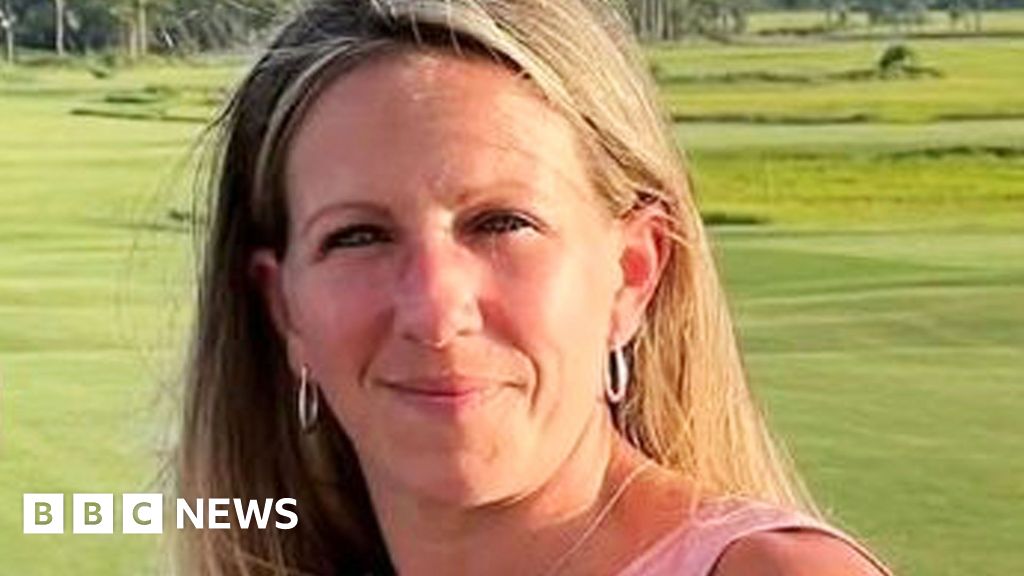
 Kristy Hallowell
Kristy Hallowell had just lost her job when her energy bill unexpectedly tripled to $1,800 a month.
Unable to pay, her gas and electricity were cut off and she, her two children and her mother spent six months of last year relying on a generator to light and heat their house.
The 44-year-old is one of millions of Americans who have fallen behind on their energy bills as prices have soared over the past year.
The electricity is now back on at her home in Greenwood Lake, New York, after a local non-profit helped reach an agreement with the utility to accept a partial payment.
But the gas is still off and electricity bills keep mounting this winter, leaving her in fear of another shut-off. She said she now had about $3,000 in utility debt.
“This has been traumatic, to say the least,” she said.
Nearly one in 20 households are at risk of having their utility debt sent to collections heading into the winter months, according to a recent report.
The number of households with severely overdue utility debt rose by 3.8% in the first six months of Trump’s second term, the analysis of consumer credit data, compiled by the Century Foundation and Protect Borrowers, found.
Residential energy bills have emerged as a key cost-of-living concern among American consumers, as many buckle under the weight of rising prices and sour on US President Donald Trump’s handling of the economy.
Official economic data from November shows electricity prices rose 6.9% from the year before – much faster than overall inflation.
Trump, who during his campaign said he would cut energy bills in half, has claimed that costs are falling. “Costs under the TRUMP ADMINISTRATION are tumbling down, helped greatly by gasoline and ENERGY,” he posted on social media in November.
The White House blames former President Joe Biden and US central bank interest rates for the lingering economic pain.
But in the wake of Democratic wins in recent state and city elections and polls showing waning consumer confidence, the Trump administration has shifted its messaging to focus on affordability, in a bid to allay voter anxiety about the cost of living in the US.
At the same time, the federal government has proposed slashing the funds it gives to states to help low-income residents pay their utility bills.
Experts also warn that the Trump administration’s rollback of clean energy projects – including its recent decision to pause leases for offshore wind energy projects being built near the Atlantic coastline – could drive electric bills even higher.
“This is going to be a huge deal, both as a policy matter and a political matter,” said Alex Jacquez, chief of policy and advocacy at the Groundwork Collaborative, a progressive economic think tank.
Laurie Wheelock, executive director of the Public Utility Law Project of New York, said many of her clients – low-income utility customers in New York state seeking help with their bills – have let utilities fall to the side as rent, health insurance and other costs keep getting more expensive.
In 2025, the non-profit saw an increase in utility account terminations for unpaid bills, Ms Wheelock said.
Before the pandemic, clients who approached the organisation typically owed $400 to $900 in utility debt. Now, people often owe upwards of $6,000, she said.
“There’s been this difficult mix of increased costs and financial instability,” she added.
Winter heating costs are expected to jump 9.2% this season, according to the National Energy Assistance Directors Association, driven by rising electricity and natural gas prices and unusually cold weather.
Energy bills tend to be among the highest in the northeast US, the report shows. But households from California to Georgia to South Dakota are also feeling the strain of rising costs over the past year.
Power-hungry tech companies
There are several reasons for rising residential energy costs, analysts say.
For one, the price of natural gas, which is a crucial component of nearly half of electricity generation in the US, has jumped over the past year. The natural gas industry is pushing more and more production overseas, contributing to higher domestic prices.
Electricity generation is “being saddled with ever-increasing costs of fuel”, said John Quigley, a senior fellow at the Kleinman Center for Energy Policy at the University of Pennsylvania.
Recent shifts away from clean energy investments could also be at play. A report from the climate advocacy group Climate Power cites the Trump administration’s cancellation of projects that would have produced enough electricity to power the equivalent of 13 million homes.
The gutting of clean energy projects has contributed to a 13% jump in electricity bills since Trump returned to the White House, the report found, as the US increases its dependence on foreign oil.

 AFP via Getty Images
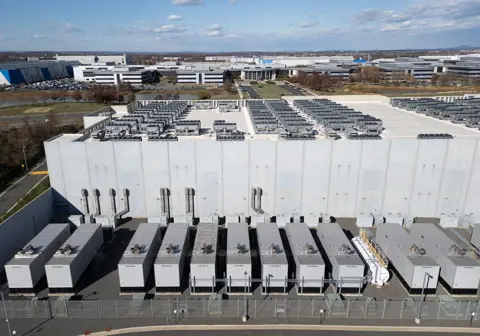
Another key factor: energy demand from the artificial intelligence boom is straining the power grid.
Technology companies from Alphabet to Amazon are ramping up their investments in AI infrastructure, and data centres require massive amounts of electricity.
Continued and increasing electricity demand for data centres is pushing up prices for everyone, Quigley said.
‘You can deal with people’s frustrations’
Treasury Secretary Scott Bessent told ABC News in November that electricity prices were a “state problem”.
“There are things that the federal government can control. Local electricity prices are not one of them,” he said.
But some analysts argue that if the federal government were to embrace clean energy, it would help lower prices.
On the state level, some lawmakers have proposed requiring large data centres to supply their own power, so families don’t shoulder the costs.
In Virginia, where data centres have proliferated, governor-elect Abigail Spanberger has announced plans to ensure tech companies are “paying their fair share”, encouraging clean on-site and off-site generation and storage at data centres.
Virginia utility regulators recently authorised a separate rate category for the biggest electricity customers, like data centres, requiring them to pay a larger share to shield other ratepayers.
“You can deal in the near term with people’s frustrations around prices while dealing with these long-term structural fixes,” said Groundwork Collaborative’s Alex Jacquez.
But any relief for consumers will take time. Residential energy prices are likely to stay elevated in the coming months.
 Ibrahim Awadallah
Last year, Ibrahim Awadallah, 30, installed solar panels on his home in Charlotte, North Carolina in the hopes of reducing his energy costs.
His plan largely worked. His electricity bills tend to be lower than his neighbours’, even taking into account the $180 he pays per month on his solar panel loan.
Still, in October, Awadallah noticed his bill from his utility company getting more expensive – a roughly 10% increase – even though he was out of town much of the month.
A telecommunications developer has proposed building a data centre nearby in east Charlotte. Awadallah is concerned that the project, if approved, will drive up electric costs even more.
“I don’t think things are getting better anytime soon,” he said.

Tesco Pet Insurance, who provided the cover, says “the cost of claims is one of a number of factors that can affect the price of a policy at renewal” and also noted Tilly’s age had been reflected in the quote. It says the couple had a more comprehensive policy, which typically costs more than basic levels of cover, and that alternative options were presented to Fawcett and Neild.

The UK must not “cut ourselves off” from trade opportunities in China despite security and business risks, the head of the Confederation for British Industry has warned.
CBI chief Rain Newton-Smith highlighted that British businesses see increased trade with Chinese firms as an opportunity to drive growth.
Her remarks came as business leaders were questioned by MPs on Parliament’s Business and Trade Select Committee regarding the UK’s economic relationship with China.
Last December, Prime Minister Sir Keir Starmer admitted China poses security threats to the UK but urged for greater business ties.
Ms Newton-Smith, chief executive of one of the UK’s largest business groups, was positive about the Government’s engagement with China.
“You can’t have a growth strategy without a strategy for China,” she said.
“China has the biggest contribution to global growth, is the third largest trading partner, and the world’s largest consumer market.
“The UK is second largest exporter of trade and services.
“We are mindful as all businesses are of security risks but it is really important that we have a strategy towards China.
“This Government has increased the economic engagement with China and including business within this does help us as a country.”
She added: “If we think about the future economy, there is a huge market in China and I think we mustn’t cut ourselves off from some of the opportunities there, even if in some areas there are difficult conversations and negotiations that need to be had.”
Peter Burnett, chief executive of the China-Britain Business Council, told the committee: “There are risks associated with technology advancement, AI, industrial development that they need to assess.
“Increasingly you will find them saying that they need to engage more in China to understand those risks and to develop some of the technologies along some of those risks themselves.”
Business
Trump says he’d be disappointed if Fed pick doesn’t cut rates; Warsh vows to be ‘independent actor’ – The Times of India
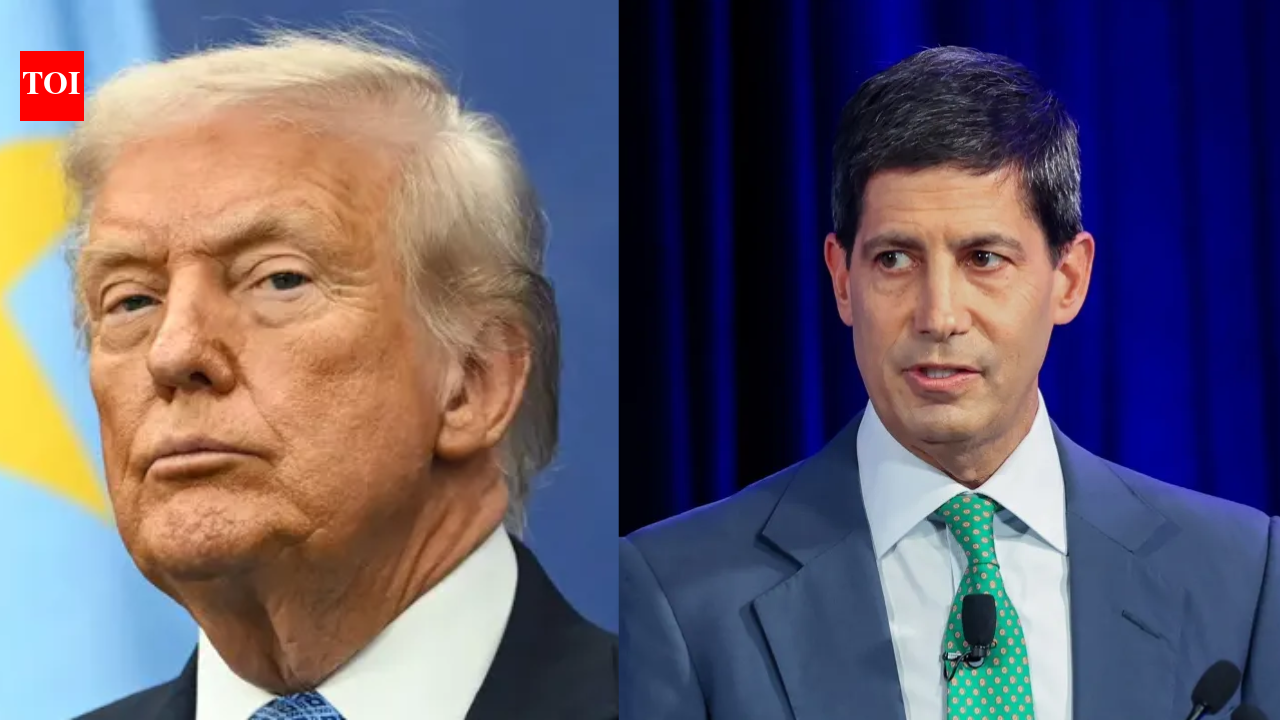
US President Donald Trump on Tuesday said he would be disappointed if his nominee for Federal Reserve chair, Kevin Warsh, does not cut interest rates right away after taking office if confirmed by the Senate. Trump, during an interview with CNBC’s “Squawk Box,” also said “we have to find out” about the construction costs of the new Federal Reserve building.Warsh, a former Federal Reserve official and financier, is currently facing Senate confirmation hearings where he has stressed his independence from political pressure.“The president never once asked me to commit to any particular interest rate decision, and nor would I agree to it if he had,” Kevin Warsh said under questioning by the Senate Banking Committee, as quoted by LA Times. “I will be an independent actor if confirmed as chair of the Federal Reserve.”Warsh told lawmakers that fighting inflation would be one of his main priorities if confirmed.“Congress tasked the Fed with the mission to ensure price stability, without excuse or equivocation, argument or anguish,” Warsh said. “Inflation is a choice, and the Fed must take responsibility for it.”The comments come as investors closely watch his confirmation hearing, with inflation remaining at 3.3% annually and global tensions, including the war in Iran pushing up gas prices, adding pressure on the economy. Higher inflation typically leads the Federal Reserve to keep interest rates steady or raise them rather than cut them, as rate changes affect mortgages, auto loans, and business borrowing.Democrats on the Senate Banking Committee accused Warsh of shifting his stance on interest rates over time, supporting higher rates under Democratic presidents and lower rates during Trump’s presidency.Warsh, if confirmed, would take over at a time when inflation pressures make it difficult for the Federal Reserve to cut rates, even as Trump continues to push for lower borrowing costs. Trump has repeatedly urged rate cuts and has long clashed with current Fed chair Jerome Powell over monetary policy. Powell has also been the subject of a Department of Justice criminal probe after refusing Trump’s requests for faster rate cuts. Trump told CNBC that he does not plan to pressure the Justice Department to end that probe.


Blake Lively reveals what she lost due to Justin Baldoni’s smear campaign

Trump repeats call for Congress to rein in college sports

Eli Manning fires back amid debate comparing ex-Giants star to Falcons great Matt Ryan

-

 Fashion6 days ago
France’s LVMH Q1 revenue falls 6%, shows resilience amid Iran war
-

 Sports1 week ago
The case for Man United’s Fernandes as Premier League’s best
-

 Entertainment1 week ago
Palace left in shock as Prince William cancels grand ceremony
-
 Business1 week ago
UK could adopt EU single market rules under new legislation
-

 Entertainment6 days ago
Is Claude down? Here’s why users are seeing errors
-

 Fashion1 week ago
Energy emerges as biggest cost driver in textile margins
-
 Business1 week ago
Delta Air Lines unveils first new Delta One suite in premium cabin arms race
-

 Fashion1 week ago
Asia claims largest share of markets on Kearney FDI Confidence Index