

Business
India’s New Income Tax To Be Effective From April 1 To Simplify Provisions: All You Need To Know


Last Updated:
India is set to usher in a new era of direct taxation from April 1, when the Income Tax Act, 2025, comes into force, formally replacing the six-decade-old Income Tax Act, 1961.



New Income Tax Act, 2025.
India is set to usher in a new era of direct taxation from April 1, when the Income Tax Act, 2025, comes into force, formally replacing the six-decade-old Income Tax Act, 1961. The new legislation is aimed squarely at simplification, clarity and ease of compliance, without altering existing tax rates.
Crucially, the new law is revenue-neutral. There is no change in personal or corporate tax rates. Instead, the focus is on rewriting the law in simpler language, removing ambiguities and cutting down the scope for litigation. Compared with the 1961 Act, the new legislation reduces the overall volume of text and sections by nearly 50%, making it far more accessible for taxpayers.
Why was the 1961 Income Tax Act replaced?
The Income Tax Act, 1961, was enacted when India was a young republic with a vastly different economic structure. Over the last 64 years, the economy, technology, and ways of earning income have changed dramatically. While successive governments amended the law to keep pace, the result was a bulky and complex statute filled with cross-references, provisos and obsolete sections.
With hundreds of amendments layered over decades, the law became difficult even for professionals to navigate, let alone ordinary taxpayers. The overhaul was driven by the need to modernise the framework and make it understandable in today’s economic and technological context.
What does the new Income Tax Act aim to achieve?
The Income Tax Act, 2025, is designed to be leaner and reader-friendly. The government’s objective is to allow taxpayers to clearly understand how their tax liability is computed, reduce interpretational disputes, and lower the volume of tax litigation. By removing redundant provisions and simplifying structure and language, the new law seeks to bring certainty and transparency to direct taxation.
How is the new law leaner?
The 1961 Act covered multiple direct taxes, including personal income tax, corporate tax, securities transaction tax, wealth tax and gift tax. Over time, several levies — such as wealth tax, gift tax, fringe benefit tax and banking cash transaction tax — were abolished, but many related sections continued to clutter the statute.
The old Act comprised around 298 sections across 23 chapters, many of which became obsolete or irrelevant. The new law cleans up this legacy, removing outdated provisions and presenting a consolidated, amendment-free statute that reflects the current tax regime.
No change in tax rates, but Budget changes will apply
Any changes in tax rates or slabs are typically announced through the Finance Act as part of the Union Budget presented every year on February 1. Accordingly, all tax proposals announced in the Union Budget for 2026-27 — covering individuals, corporates, HUFs and other taxpayers — will be incorporated into the new Income Tax Act, 2025.
This ensures continuity while allowing the simplified law to remain fully aligned with the latest policy decisions.
Key structural changes taxpayers should note
One of the most important reforms is the simplification of the tax timeline. The long-standing distinction between the “previous year” and the “assessment year” has been removed. The new law introduces a single ‘tax year’ concept, making compliance easier and more intuitive.
Another significant relief is on TDS refunds. Under the new framework, taxpayers will be able to claim refunds of tax deducted at source even if they file their income tax returns after the due date, without facing penal consequences, an important change for delayed filers.
Rules and return forms to follow Budget 2026-27
While the Act itself takes effect from April 1, the rules for implementing the new law are currently being framed. These are expected to be notified after the presentation of the FY27 Union Budget. Subsequently, various procedural forms — such as those for advance tax payments, TDS and income tax returns — will also be notified in line with the new framework.
Legislative journey of the new law
The Income Tax Act, 2025, was approved by Parliament on August 12, 2025, after scrutiny by a Parliamentary committee. It became law after receiving the assent of Droupadi Murmu on August 21, 2025.
Have such reforms been attempted earlier?
This is not the first attempt to replace the 1961 Act. In 2010, the Direct Taxes Code Bill was introduced in Parliament and referred to a Standing Committee, but it lapsed following a change in government in 2014. Later, in November 2017, the government constituted a six-member committee to redraft the income tax law, which submitted its report to the finance minister in August 2019. The Income Tax Act, 2025 is the culmination of that long reform process.
From April 1, India’s direct tax regime will become simpler, clearer and more modern legal foundation. While taxpayers will not see immediate changes in tax rates, they can expect easier compliance, reduced confusion and fewer disputes. With Budget-driven changes seamlessly integrated into the new law, the Income Tax Act, 2025, marks a structural shift aimed at making taxation more transparent and taxpayer-friendly.
(With PTI Inputs)
 Click here to add News18 as your preferred news source on Google.
January 11, 2026, 13:45 IST
Read More





The federal government announced a Rs26.77 per litre hike in the price of petrol and high-speed diesel each on Friday, according to a notification issued by the Petroleum Division.
The new prices will be effective from April 25, 2026 for a week, the notification stated.
Following the increase, the price of HSD has jumped from Rs353.42 to Rs380.19, while the petrol price now stands at Rs393.35.
The government has been reviewing petroleum prices every Friday night following the now-paused US-Israel war on Iran, which began on February 28.
In the previous weekly review, the prime minister announced a reduction of Rs32.12 per litre in the price of high-speed diesel, while the petrol price remained unchanged.
The government jacked up petrol and diesel prices despite oil prices falling globally on Friday after it appeared a second round of Middle East talks was back on, bolstering prospects for an end to a war that has crippled energy shipments from the Gulf.
Oil prices had been climbing earlier as investors worried about a lack of progress in ending the Middle East crisis, with Tehran keeping the Strait of Hormuz closed and the US maintaining a blockade of Iranian ports.
But they dropped on reports that Iran’s Foreign Minister Abbas Araghchi was to arrive in Islamabad on Friday night.
Brent crude, the international benchmark contract, fell back below $100 a barrel.
facebook twitter
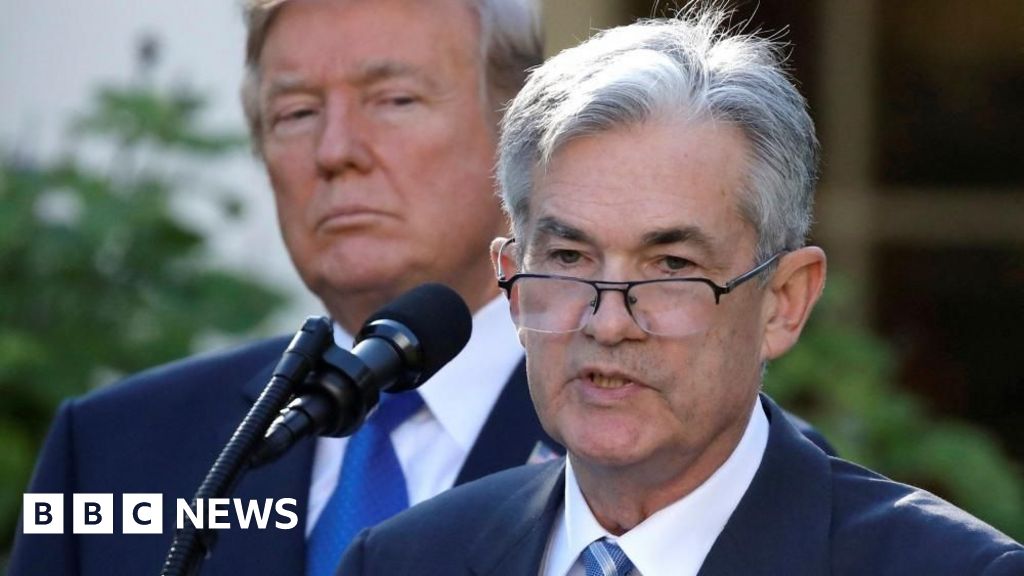
Powell’s term is nearing its end and the US Senate is considering Trump’s nominee for his replacement, Kevin Warsh. A key Republican, Thom Tillis, has withheld his support for Warsh unless the Trump administration would drop its investigation into Powell.
Business
Intel bags big gains! Chipmaker’s shares jump 26% on blockbuster results; how Trump admin benefits – The Times of India
Intel share price soared sharply on Friday after the chipmaker delivered a first-quarter performance that exceeded market expectations. And the win was not just for the chipmaker, but also the whole of US!The stock climbed 26.7% during trading on Friday, marking what could be its strongest single-day gain since 1987. Momentum continued after the closing bell, with shares rising a further 20% in after-hours trading as investors reacted to signs of a sustained turnaround driven by artificial intelligence.Intel reported revenue of $13.58 billion (€11.6bn) for the quarter, ahead of the $12.3 billion (€10.5 bn) forecast and up 7.2% from a year earlier. Adjusted earnings per share came in at $0.29, far exceeding expectations of $0.01.A key contributor to this performance was the company’s Data Centre and AI (DCAI) division, which delivered revenue of $5.05 billion (€4.2bn), up 22.4% year-on-year and well above analyst estimates of $4.41 billion (€3.77bn). The results indicate strong demand for Intel’s Xeon 6 processors and Gaudi 3 AI accelerators, particularly among enterprise clients and cloud service providers.Chief executive Lip-Bu Tan pointed to a broader shift in artificial intelligence usage as a major factor behind the growth. He said, “the next wave of AI will bring intelligence closer to the end user, moving from foundational models to inference to agentic.” He added, “This shift is significantly increasing the need for Intel’s CPUs and wafer and advanced packaging offerings.”The company also issued an upbeat outlook for the second quarter, forecasting revenue in the range of $13.8 billion (€11.8billion) to $14.8 billion (€12.6billion), surpassing investor expectations of $13 billion (€11.1billion).
But how is Washington winning?
The rally has had a direct impact on the US administration’s investment in Intel. In 2025, during a period of severe financial strain for the company, the administration of Donald Trump acquired a 9.9% stake in a move aimed at stabilising the business. The government invested $8.9 billion (€7.8bn) at a share price of $20.47 (€18.01), with $5.7 billion (€5bn) of that amount coming from previously approved but unpaid grants, according to the Euro News.At the time, Intel was facing multi-billion dollar losses and operational challenges, prompting concerns over its viability. As part of the intervention, the company cancelled planned factory projects in Germany and Poland, redirected focus towards US-based manufacturing, and reduced its global workforce by 25%, cutting around 25,000 jobs.Following the latest jump, Intel’s shares are now trading at $81.3 (€71.5), representing an increase of nearly 300% since the government first took its stake. The sharp rise highlights how the company’s improved financial performance has translated into substantial gains for the US administration.


Charlie Sheen updates on relationship with old pal Jon Cryer

Iranian FM Abbas Araghchi lands in Pakistan ahead of renewed US talks
Govt hikes petrol, diesel prices by nearly Rs27 per litre – SUCH TV

-

 Fashion1 week ago
France’s LVMH Q1 revenue falls 6%, shows resilience amid Iran war
-

 Tech1 week ago
CYBERUK ’26: UK lagging on legal protections for cyber pros | Computer Weekly
-

 Sports5 days ago
WWE WrestleMania 42 Night 2: Live match results and analysis
-

 Sports1 week ago
Faheem Ashraf backs Islamabad United’s push, calls league a ‘career-changing platform’
-

 Sports5 days ago
NCAA men’s gymnastics championship: All-time winners list
-
 Business1 week ago
PepsiCo earnings beat estimates as North American food business improves
-

 Tech1 week ago
Anthropic Plots Major London Expansion
-

 Entertainment4 days ago
Lee Anderson, Zarah Sultana kicked out of UK Parliament for calling PM ‘liar’