

Business
Mining companies hold FTSE back in quiet end to the week

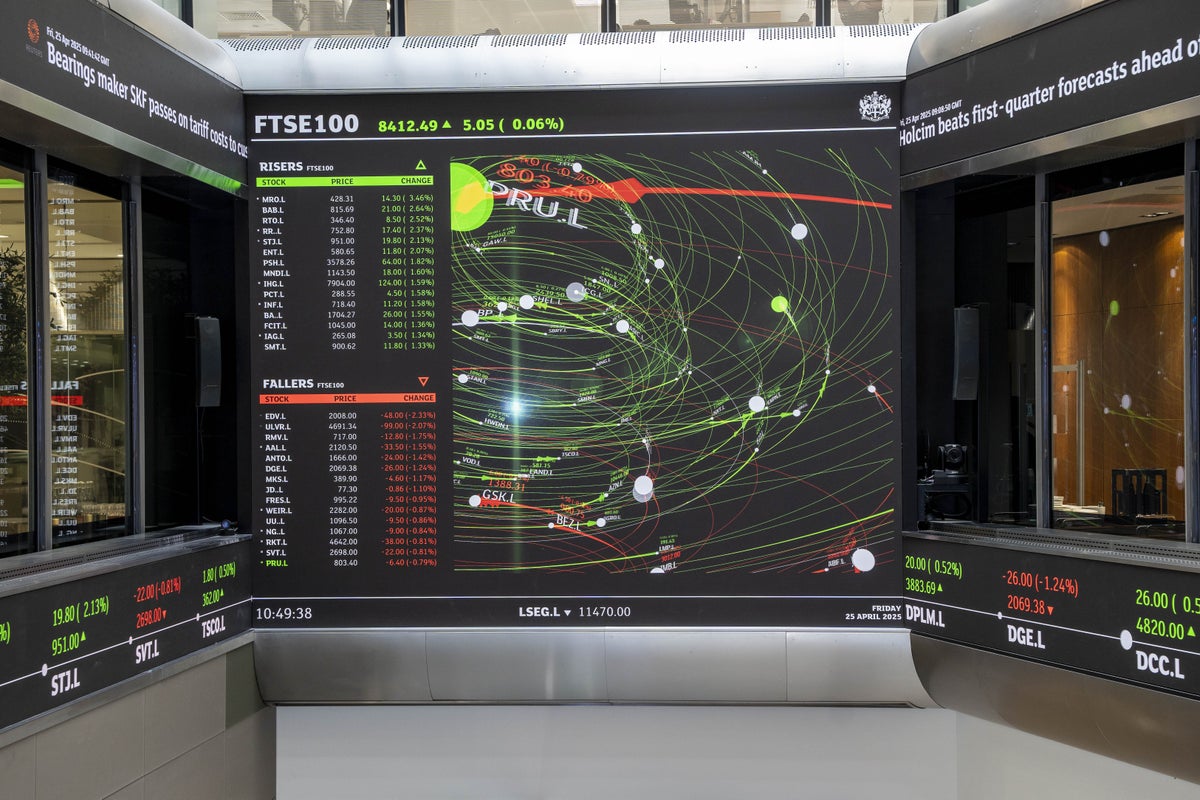
Stocks in London ended little changed on Friday, with blue chips edging lower after notching another record as investors held fire ahead of the long weekend in the US.
“Investors have been kept on their toes year-to-date with non-stop geopolitical issues, and mixed messages from the business world. A quieter day on the corporate reporting calendar gave investors a chance to catch their breath and take stock of events,” said Dan Coatsworth, head of markets at AJ Bell.
The FTSE 100 index closed down just 3.65 points at 10,235.29. It had earlier hit a new intra-day best level of 10,257.75.
The FTSE 250 ended up 31.39 points, 0.1%, at 23,311.37, and the AIM All-Share closed just 0.27 of a point higher at 804.75.
For the week, the FTSE 100 rose 1.1%, the FTSE 250 climbed 1.2%, and the AIM All-Share advanced 2.1%.
In European equities on Friday, the CAC 40 in Paris closed down 0.7%, while the DAX 40 in Frankfurt ended 0.2% lower.
“There was a slightly negative tone across European stock indices on Friday,” commented David Morrison, senior market analyst, at Trade Nation. “It appeared that investors were more comfortable taking some risk off the table, no doubt mindful that US markets will be closed on Monday for Martin Luther King Day.”
In London, the FTSE 100 was pegged back by weak mining stocks, a key factor behind recent index strength.
The price of copper fell 3.0%, and silver slumped 3.7%, giving up some recent gains, while gold nursed less severe falls.
Gold was quoted at 4,594.24 dollars an ounce on Friday, down from 4,616.76 on Thursday.
In response, Endeavour Mining fell 2.7%, Anglo American declined 2.4%, Antofagasta dipped 2.9%, and Glencore fell 2.5%.
Strategists at Bank of America downgraded the mining sector to ‘underweight’ and lifted energy to ‘market weight’.
“After sharp outperformance for mining, the potential downside risks stemming from the sector’s macro drivers are becoming hard to ignore,” BofA said.
BofA noted that a historical divergence in commodity prices has led to a decoupling among European resources with a surge in metal prices over recent months, including a 50% rally in copper, alongside a “roll-over” in energy prices, with the oil price down 30% to four-year lows recently.
As a result, the copper-to-oil ratio has risen close to a 40-year high, which in turn has led to significant divergence between European resources sectors, with mining outperforming by 40% since April, while energy has underperformed by nearly 15%.
“Resources sector pricing looks stretched in both directions,” BofA added.
Brent oil traded higher at 64.48 dollars a barrel on Friday, up from 63.55 late on Thursday.
Pearson ended a miserable week for investors, with a further 4.1% decline.
The educational publisher has seen its shares fall 12% this week after a poorly received trading update.
A previously undisclosed contract loss for US student assessment in New Jersey, which will drag on first-half growth, was blamed for the stock fall, although analysts note Pearson is confident that the loss of the contract will have no bearing on other renewals in the coming years.
Heading higher were property companies British Land and Land Securities, up 1.4% and 1.3% respectively, on hopes lower interest rates will spark a sector upturn, while BAE Systems, up 2.3%, remained in favour amid geopolitical jitters.
Stocks in New York were little changed. The Dow Jones Industrial Average was slightly lower, while the S&P 500 index was up 0.1%, as was the Nasdaq Composite.
Economic data showed that US industrial production rose faster than expected in December.
The Federal Reserve said that on a monthly basis, industrial production increased by 0.4% in December, the same pace as in November, which was revised up from 0.2%. It was better than the FXStreet-cited consensus of a 0.1% uptick.
On an annual basis, total industrial production was 2.0% higher in December than a year prior.
Shannon Glein, analyst at Wells Fargo, said the underlying details show a “key theme from last year – everything high-tech and AI related outperformed”.
“We expect this trend to persist going forward, but it’s also worth noting that the slow yet steady ascent in all other industrial production on a year-ago basis is a sign that broader activity may be starting to recover,” she added.
The pound was quoted lower at 1.3382 dollars at the time of the London equities close on Friday, compared to 1.3388 on Thursday.
The euro stood at 1.1596 dollars, lower against 1.1607.
The yield on the US 10-year Treasury was quoted at 4.21%, widening from 4.16%. The yield on the US 30-year Treasury was quoted at 4.82%, stretched from 4.78%.
Back in London, Genus led the FTSE 250 risers, advancing 7.8%, after reporting that adjusted pretax profit for the six months to December 31 would be about £50 million, ahead of expectations.
Berenberg pointed out it was “the second guidance raise in the past three months, making it one of the standout performers within our coverage”.
“Importantly, the upgrades are being driven by strong trading in the PIC (pigs) business, which reflects the benefits of the group’s shift towards a royalty-driven model. This is increasing the defensiveness and predictability of earnings and sets a very positive tone for a year that we believe has more positive catalysts to come”, the bank added.
The biggest risers on the FTSE 100 were BAE Systems, up 47.0 pence at 2,088.0p, NatWest, up 13.8p at 652.8p, Smiths Group, up 50.0p at 2,612.0p, Schroders, up 8.6p at 467.0p and National Grid, up 20.5p at 1,201.5p.
The biggest fallers on the FTSE 100 were Pearson, down 39.6p at 939.0p, Entain, down 23.8p at 703.0p, Antofagasta, down 105.0p at 3,560.0p, Endeavour Mining, down 110.0p at 3,996.0p and Glencore, down 12.4p at 478.6p.
Monday’s global economic calendar features a slew of data from China, including GDP, retail sales, and industrial production.
In Canada, inflation figures will be published, while US financial markets are closed for Martin Luther King Jr Day.
Monday’s UK corporate calendar has a trading statement from building materials firm Marshalls.
Later in the week, trading statements are due from luxury goods retailer Burberry, sports retailer JD Sports Fashion and miner Rio Tinto.
Contributed by Alliance News.
Business
Stock markets outlook: Dalal Street braces for swings as RBI MPC decision, war risks weigh on sentiment–Check key triggers – The Times of India

Domestic equities are expected to remain volatile this week as investors track the Reserve Bank’s monetary policy decision, global macroeconomic cues and evolving developments in the West Asia conflict, analysts said, according to PTI.Market participants will also keep a close watch on crude oil price movements and foreign fund flows, which continue to influence sentiment.Vinod Nair, Head of Research at Geojit Investments Ltd, said the RBI’s Monetary Policy Committee (MPC) meeting will be the key domestic trigger, with investors focusing on the central bank’s stance on inflation and growth.“A rate pause is near-certain consensus, the central bank walks a tightrope between crude-driven inflation risks and a four-year low Manufacturing PMI signalling a softening growth impulse. The governor’s commentary on the rate cycle trajectory and FY27 projections will be closely monitored.“Globally, the US March CPI reading will carry significant importance, as it buries residual Fed rate-cut hopes, strengthens the dollar and tightens financial conditions for emerging markets, including India,” Nair said.He added that geopolitical developments in West Asia will remain the dominant factor shaping market direction.“Indian markets return after a three-day gap and remain acutely vulnerable to weekend war developments, with crude trajectory and any credible ceasefire signal being the decisive variable that could either trigger a sharp relief rally or extend the current sell-on-rise mode,” he said.In the previous holiday-shortened week, the BSE Sensex declined 263.67 points, or 0.35%, while the NSE Nifty fell 106.5 points, or 0.46%.Siddhartha Khemka, Head of Research (Wealth Management) at Motilal Oswal Financial Services Ltd, said investor sentiment will remain closely linked to developments in the West Asia conflict.Brent crude prices have stayed elevated near $107 per barrel, fuelling concerns around imported inflation. Currency pressures have also intensified, with the rupee weakening sharply before recovering towards Rs 93 against the US dollar following RBI intervention, he noted.Foreign institutional investor (FII) outflows remain a key overhang, with March witnessing heavy selling of Rs 1.2 lakh crore, among the highest monthly outflows in recent years.“Investors will monitor the US Federal Open Market Committee (FOMC) meeting minutes, GDP data, and initial jobless claims for further cues on growth and the policy trajectory.“Overall, markets are expected to remain volatile as geopolitical developments, crude price movements, FII flows and global macro data continue to drive sentiment,” Khemka said.Analysts said any signs of de-escalation in the West Asia conflict could ease crude prices and stabilise the currency, offering relief to markets, while further escalation may prolong risk aversion and keep pressure on foreign flows.

One elderly couple had to find £1,000 for an oil delivery and suppliers are not giving quotes, a councillor says.
Source link
Business
Middle East conflict may hit India’s exports beyond region if prolonged, says government – The Times of India

A prolonged conflict in Middle East could begin to hurt India’s exports not just to the region but also to other global markets, as disrupted supply chains ripple outward, commerce secretary Rajesh Agrawal said on Saturday, He also urged the pharmaceutical industry to reduce dependence on imported raw materials and build more resilient export and import linkages.Speaking on the sidelines of ‘Chintan Shivir – Scaling Up Pharma Exports’ in Hyderabad, Agrawal said the government has already seen an impact on both imports and exports over the past month because of the Middle East crisis, with energy imports and regional trade flows under pressure.
“Middle East is also an important market. Around 12-13 per cent of our exports go to the region. So, that will directly get impacted. And if it goes on for long, maybe our exports to other parts of the world will also get impacted as some of the value chains will rotate back. We are cognizant of it,” Agrawal told reporters, as per news agency PTI.He said the exact impact of the conflict on India’s trade would become clearer in the next couple of weeks, but indicated that both exports and imports could see some decline.“And I assume, it will not only be a one-way traffic, in terms of export going down, but it will also be imports having some downfall,” he said.Agrawal cautioned that even if the war ends soon, the disruption may linger for months or even years, depending on the extent of damage to supply chains and infrastructure.“So, at this juncture, it will be very difficult to take a very long-term view on it,” he said.He said the Centre is trying to ensure that supply chains face the minimum possible disruption, while acknowledging that some trade numbers may soften in the near term.
Pharma sector already feeling supply pressure
The commerce secretary said the pharmaceutical sector has already seen some impact in the availability of key intermediates and solvents because supply chains are getting affected by the regional crisis.Agrawal said all arms of the government are working to prioritise limited LPG supply and are attempting to ease the situation by diversifying imports and sourcing from alternative suppliers.“So, as we are able to resolve that overall supply, we will try to alleviate some of the pain in every sector. The Pharma sector will be one of the priority sectors,” he said.He added that the government and industry are jointly working on ways to make supply chains more resilient.
Call for self-reliance in APIs, bulk drugs and intermediates
At the same event, Agrawal asked the pharmaceutical industry to use the current geopolitical uncertainty as a trigger to reduce dependence on critical imported inputs and strengthen domestic capacity.Addressing industry stakeholders in Hyderabad, he stressed “the importance of ensuring greater self-reliance by meeting 80-90 per cent (or higher) of domestic pharmaceutical requirements through indigenous production, while reducing critical import dependencies in APIs, bulk drugs, and intermediates”.He also emphasised the “importance of insulating import supply chains in a geopolitically fragmented world, where availability may be important”.Agrawal called for a broader strategic repositioning of India as a global hub for quality, affordable pharmaceuticals, saying that quality would remain the decisive factor in healthcare. He urged the sector to build a stronger quality ecosystem to enhance global trust and align with emerging areas such as biologics and biosimilars.He also encouraged the industry to shift from a volume-driven to a value-driven model, with greater focus on innovation and new patents, while maintaining India’s strength in generics.
Exports remain on positive path despite uncertainty
Despite the geopolitical overhang, Agrawal said India’s exports in the last financial year were expected to remain on a positive trajectory.The broader pharmaceutical export picture remains resilient. India’s pharma exports stood at $30.47 billion in 2024-25, up 9.4 per cent over the previous year.During April–February 2025-26, pharma exports reached $28.29 billion, registering growth of over 5 per cent compared with the corresponding period of the previous year.India remains the third-largest producer of pharmaceuticals globally by volume and 14th by value, underscoring both the sector’s scale and the stakes involved in insulating it from external shocks.


The sublime perfection of Raphael

Taylor Swift plans to reunite with Sabrina Carpenter, Sombr at Coachella
Stock markets outlook: Dalal Street braces for swings as RBI MPC decision, war risks weigh on sentiment–Check key triggers – The Times of India

-

 Sports1 week ago
USMNT handed reality check by Doku, Belgium ahead of World Cup
-

 Sports1 week ago
2026 NCAA men’s hockey tournament: Schedule, results
-

 Fashion1 week ago
China rolls out tariff cuts on Congo imports from April 1
-

 Fashion1 week ago
EU apparel imports slump 15.48% YoY in Jan; Bangladesh hardest hit
-
Uncategorized6 days ago
[CinePlex360] Please moderate: “Further tariff
-

 Entertainment1 week ago
The Avett Brothers’ bassist explains why he wrote a book about John Quincy Adams
-

 Sports1 week ago
Man City show why they are worthy WSL title winners as tired United wilt
-
Uncategorized1 week ago
[CinePlex360] Please moderate: “Apple scrapping