

Politics
what is really behind the look

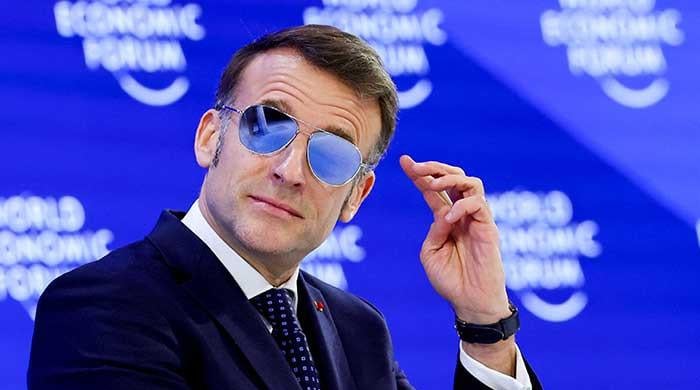
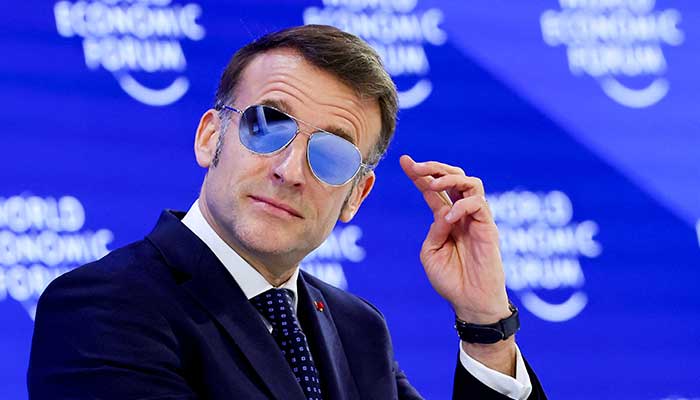
French President Emmanuel Macron drew attention at the World Economic Forum (WEF) in Davos, Switzerland, when he took the stage wearing distinctive aviator sunglasses during his appearance on Tuesday.
The French president has been battling an eye condition that he has described as “completely harmless”.
Macron wore the sunglasses during his Davos speech to protect his eyes after suffering a burst blood vessel, the Elysee Palace said.
Macron had addressed the issue several days earlier after he was seen wearing sunglasses during an outdoor troop inspection at a military base in Istres, in southern France.
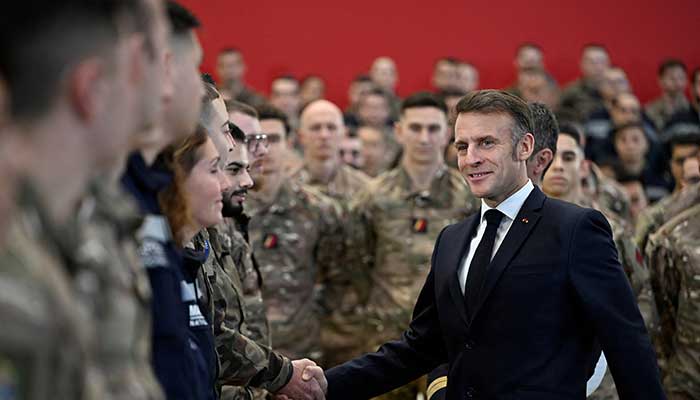
Speaking at the time, he opened his New Year’s address to France’s armed forces by referring directly to his appearance. “Please pardon the unsightly appearance of my eye. It is, of course, something completely harmless,” he said.
He went on to add with humour: “Simply see an unintentional reference to the ‘Eye of the Tiger’ … For those who catch the reference, it is a sign of determination,” an apparent nod to the hit song by American rock band Survivor from the 1982 film Rocky III, starring Sylvester Stallone, according to The Independent.
At Davos, Macron struck a firmer tone on global politics and trade. “We do prefer respect to bullies,” he said, adding: “And we do prefer rule of law to brutality.”
He described the United States’ “endless accumulation” of new tariffs as “fundamentally unacceptable”, particularly when used “as leverage against territorial sovereignty”.
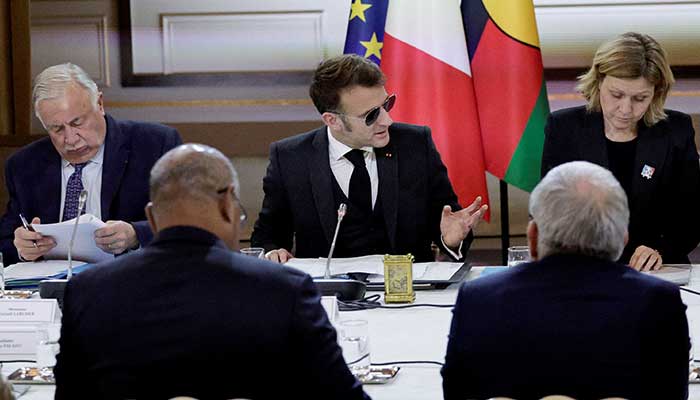
Macron said the European Union should not bend to “the law of the strongest”, calling it “crazy” that the bloc was being forced to consider using its “anti-coercion instrument” against the United States.
The speech came after Donald Trump threatened steep tariffs on French wine and champagne and published private messages exchanged with Macron, an unusual breach of diplomatic convention. Trump shared screenshots of the exchange on his Truth Social account.
In the messages, which a source close to Macron said were authentic, Macron told Trump: “I do not understand what you are doing on Greenland,” and offered to host a G7 meeting, inviting Russia and others. Neither Trump nor the French source disclosed when the messages were sent.
Trump had earlier vowed to impose a wave of escalating tariffs from February 1 on several European allies, including France, until the Washington is allowed to acquire Greenland — a move that major EU states have condemned as blackmail.
— Additional input from Reuters.
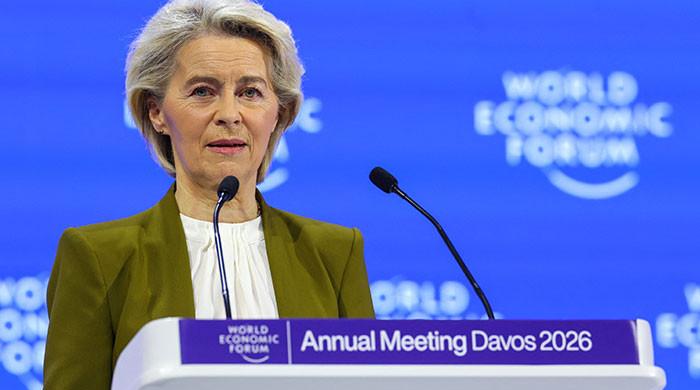
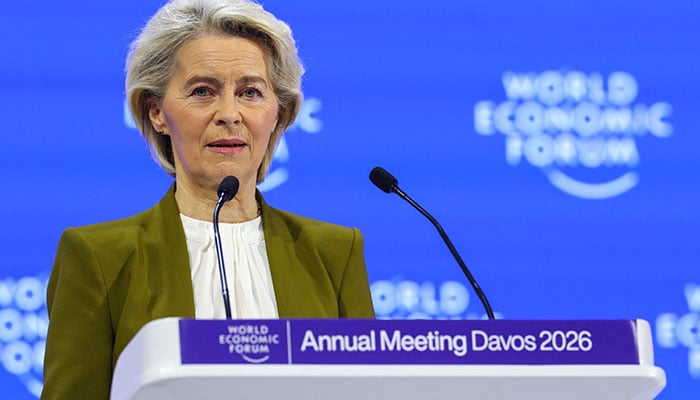
DAVOS: European leaders drew a clear line over Greenland on Tuesday, vowing an “unflinching” response to Washington’s threats even as US President Donald Trump said he was ready to hold a meeting in Davos about his plans to take the autonomous Danish territory.
Asked hours before he was to head to the World Economic Forum in Davos, Switzerland, how far he would go, Trump replied only: “You’ll find out.”
“We have a lot of meetings scheduled on Greenland, and I think things are going to work out pretty well,” Trump told reporters about his Davos meetings.
Leaders at the World Economic Forum (WEF) in the Swiss ski resort closed ranks against Trump’s increasingly aggressive America First agenda, while Greenland’s prime minister said his tiny population of 57,000 must be prepared for military force.
European Commission President Ursula von der Leyen led the European rejoinder, cautioning that Trump risked plunging US ties with the European Union into a “downward spiral”.
France’s Emmanuel Macron warned against US attempts to “subordinate Europe”, and blasted as “unacceptable” Trump’s threats to impose tariffs of up to 25 per cent on countries opposed to his Greenland plans.
Trump had earlier insisted Greenland was “imperative” for security. “There can be no going back – on that, everyone agrees!” he posted on his Truth Social platform.
The US president, who will address the annual gathering of global elites on Wednesday, has put the transatlantic alliance to the test with his demand to take over Greenland.
Europe is weighing countermeasures after he threatened levies on eight European countries, though Washington has said any retaliatory levies would be “unwise”.
US Commerce Secretary Howard Lutnick told European countries “to keep the pressure and temperature low” with regards to threats of retaliatory tariffs, while the US trade envoy Jamieson Greer told journalists in Davos that it would “not be wise” for European nations to use its “bazooka” trade measures.
Von der Leyen branded the US tariffs a “mistake”, telling the meeting of world business and political leaders they could start a spiral that would only aid Europe’s adversaries.
“So our response will be unflinching, united and proportional,” she said.
Nato at stake
Trump has pressed on with his Greenland campaign on Truth Social, writing that he had a “very good” call with Nato secretary-general Mark Rutte in which he agreed to meet with “various parties” in Davos.
Rutte’s predecessor Anders Fogh Rasmussen warned that the Republican’s Greenland gambit had ignited the biggest crisis in Nato’s history, and said the time for “flattering” the US leader was over.
“It is the future of Nato and the future of the world order that are at stake,” he told AFP in an interview at Davos.
Greenland’s Prime Minister Jens-Frederik Nielsen agreed, telling a press conference in Nuuk that while military force was “unlikely” it could not be ruled out.
“That’s why we must be ready for all possibilities, but let’s emphasise this: Greenland is part of Nato and, if there were to be an escalation, it would also have consequences for the rest of the world.”
Trump argues he wants to protect mineral-rich Greenland from perceived Russian and Chinese threats – although Washington already has a base there and security agreements through Nato, while analysts suggest Beijing is a small player in the region.
EU leaders will hold an emergency summit on Greenland in Brussels on Thursday.
‘Law of the jungle’
Other prominent foreign leaders addressing the WEF on Tuesday included Chinese Vice Premier He Lifeng, whose country has been locked in a trade war with Trump.
“A select few countries should not have privileges based on self-interest, and the world cannot revert to the law of the jungle where the strong prey on the weak,” He said, without naming names.
Canadian Prime Minister Mark Carney, who has sought to reduce his country’s reliance on the United States in its own tariffs feud with Trump, also voiced his support for Greenland at Davos.
Canada had benefited from an era of “American hegemony”, he said, but now had to pivot to defend the existing international order.
Other flashpoints on the WEF agenda include the crises in Venezuela, Gaza, Iran – and Ukraine.
Europe, which is ramping up defence spending to break its security reliance on the United States, still needs Washington’s help to end the Ukraine war and deter the looming Russian threat to its east.
But Ukraine’s President Volodymyr Zelensky warned on Tuesday that he worried the furore over Greenland could divert attention, warning of a “loss of focus during a full-scale war”.
Macron, wearing sunglasses because of a broken blood vessel, sent a message to Trump to propose a G7 summit in Paris on Thursday on Greenland as well as Ukraine, with Copenhagen, Moscow and Kyiv attending on the sidelines.
But he later clarified to AFP that no such meeting was yet scheduled and Trump said that he wouldn’t join the meeting.
The Kremlin said Russian envoy Kirill Dmitriev plans to meet members of the US delegation in Davos – the first to attend since Russians were excluded from the gathering following Moscow’s invasion of Ukraine in 2022.
- Grossi says IAEA inspected all sites, not bombed ones.
- Says not feasible to inspect during social unrest.
- Stresses Iran must meet its nuclear obligations.
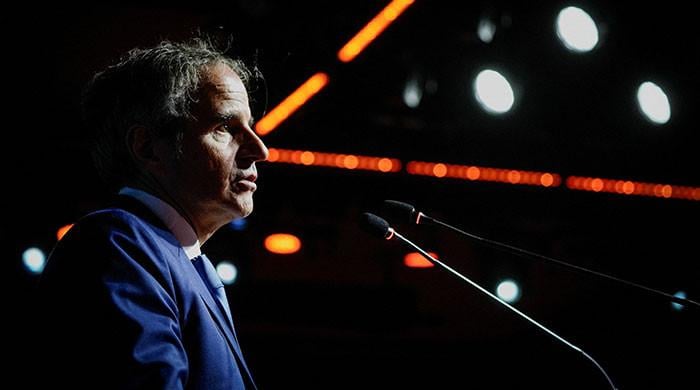
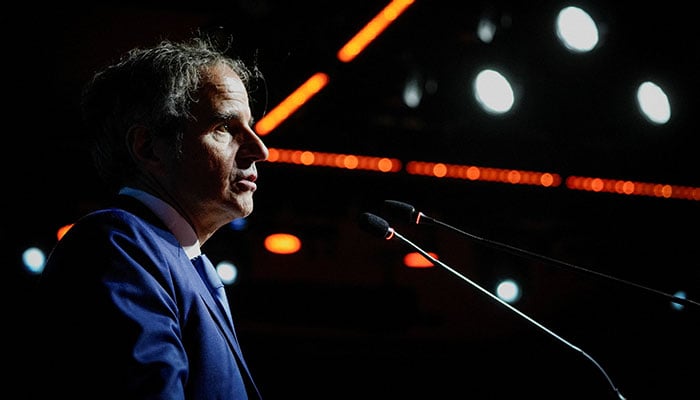
DAVOS: The standoff with Iran over accounting for its stock of highly enriched uranium and inspecting nuclear facilities bombed by the United States and Israel cannot go on forever, UN nuclear watchdog chief Rafael Grossi said on Tuesday.
The International Atomic Energy Agency has inspected all 13 declared nuclear facilities in Iran that were not bombed, but has been unable to inspect any of the three key sites that were bombed in June – Natanz, Fordow or Isfahan – Grossi told Reuters in an interview at the World Economic Forum in Davos.
Iran must first file a report to the IAEA on what happened to those sites and material, including an estimated 440.9 kg of uranium enriched to up to 60% purity, close to the roughly 90% weapons-grade level. That is enough material, if enriched further, for 10 nuclear bombs, according to an IAEA yardstick.
No ‘a la carte’ option
Iran has not submitted that special report to the IAEA.
“This cannot go on forever because at some point, I will have to say, ‘Well, I don’t have any idea where this material is,’” which would mean there was no guarantee the material had not been diverted or hidden, Grossi said.
“I do not have that conviction or conclusion at the moment, but what we are saying to Iran is that they need to engage.”
Iran says it is fully co-operating with the IAEA. Its government could not immediately be reached for comment.
It is now at least seven months since the IAEA last verified Iran’s stock of highly enriched uranium. Its own guidance is that it should be done monthly.
Grossi said he was exercising “diplomatic prudence”, but that Iran had to meet its obligations as a party to the Nuclear Non-Proliferation Treaty.
“This cannot go on like this for a long time without me, unfortunately, having to declare them in non-compliance,” he said, noting that parties to the NPT do not have an “a la carte” option where they can pick and choose what to comply with.
Asked if the issue could be resolved this spring, he said: “That is a reasonable time frame.”
Latest inspections were in December
One of the “real world” realities Grossi said he must face is the influence of diplomatic efforts aimed at reaching a broader agreement between Iran and the United States that have been spearheaded by US special envoy Steve Witkoff.
“I cannot ignore it, and I wish it well so that there can be an understanding without the looming threat of new military activity over there or something of the sort,” he said.
The IAEA said in November it had inspected most of Iran’s nuclear facilities that were not struck in the US and Israeli attacks. It has since carried out further inspections until late December, Grossi said.
It was not possible, however, to carry out inspections during civil unrest, he said, referring to recent protests. Iranian officials have indicated the unrest has stopped, he said.
“They said that things are calm and they are in control, etc.,” Grossi said. “If this is the situation, shouldn’t we resume (inspections)?”
Grossi said he would meet Iranian Foreign Minister Abbas Araqchi in “a matter of days, weeks”.
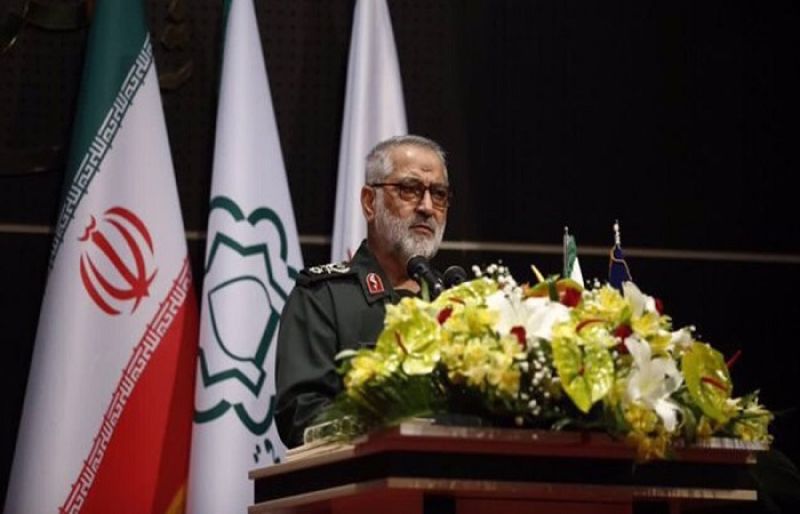

A top-ranking Iranian military official has dismissed recent rhetorical threats from US President Donald Trump, warning that any hostile action directed toward Leader of the Islamic Revolution Ayatollah Seyyed Ali Khamenei would result in a devastating military retaliation.
General Abolfazl Shekarchi, the spokesperson for the General Staff of the Armed Forces, made the remarks at a meeting in Tehran on Tuesday.
General Shekarchi rejected recent threats by Trump, in which he said Iran’s leadership must change, as part of a broader psychological warfare campaign.
“We do not attach significant importance to Trump’s clamor,” he said.
“Trump knows that if a hand of aggression is extended toward our Leader, we will not only sever that hand, and this is not a mere slogan, but we will set their world on fire and leave them no safe haven in the region,” General Shekarchi stated.
“The enemies are aware of this, yet they continue their cognitive warfare. They know that if even a corner of our territory is violated, we will neutralize the threat before it can expand,” he added, citing the 12-day war of June 2025 as a historical precedent to this capability.
Bazaar’s resistance hailed
General Shekarchi also commented on the failure of the foreign-backed riots aimed at destabilizing Iran’s economy.
He specifically lauded the resilience of the Iranian bazaar and trade unions, noting they refused to participate in coordinated efforts to create chaos during recent unrest.
“One of the major scenarios during the 12-day war was to provoke turmoil in the market simultaneously with military pressure,” the general explained, saying that the strategy was a failure.
The Iranian general stated that the enemy attempted this strategy again during the recent riots, but it was once again defeated.
“As soon as the merchants and guilds realized that the enemy was seeking to exploit the situation, they did not delay for even a single minute. On the night of January 9, all evil groups and parties united and entered the scene in an organized manner. However, the merchants and guilds once again showed self-sacrifice here and disappointed the enemy.”
Manufacturing casualties
Addressing the nature of recent deadly riots in the country, Shekarchi said the terrorist elements employed a “bloody strategy” aimed at maximizing casualties regardless of the victims’ backgrounds.
He stated that more than two-thirds of those killed by the terrorist groups were innocent civilians, including youth and children.
The general highlighted the restraint shown by Iranian security forces, including the Police, Basij, and the Islamic Revolution Guards Corps (IRGC).
According to Shekarchi, security personnel often entered the field without firearms to prevent accidental harm to citizens, frequently placing themselves at extreme personal risk.
“Our forces were subjected to brutal attacks… They act as shields to protect the youth from being killed… our forces were dismembered, and burned with gasoline,” Shekarchi stated.
Iran was the scene of highly violent riots exploiting concerns about the rising cost of living earlier this month.
Authorities have acknowledged the legitimacy of economic grievances and vowed to address them, which are directly linked to unilateral, illegal US sanctions targeting Iran’s central bank and oil exports.
But they vowed to deal decisively with terrorists wreaking havoc across the country; terrorists supported by the United States and the Israeli regime.
Donald Trump has repeatedly threatened military action against Iran under the guise of supporting armed mercenaries, which he has termed “peaceful protesters”.
Last week, he called for an end to Ayatollah Khamenei’s leadership.
“It’s time to look for new leadership in Iran,” Trump told the Politico website.
On Tuesday, the national security commission of the Iranian Parliament said in a statement that any attack on Ayatollah Khamenei would trigger a declaration of jihad.
“Any attack on the Leader means a declaration of war with the entire Islamic world and must await the issuance of a Jihad decree by Islamic scholars and the response of Islam’s soldiers in all parts of the world,” the parliamentary commission said.


Tiffany & Co. names David Ponzo as deputy CEO

Carlos Beltran, Andruw Jones elected to Baseball Hall of Fame
[CinePlex360] Please moderate: “Selena Gomez sh

-

 Tech1 week ago
New Proposed Legislation Would Let Self-Driving Cars Operate in New York State
-

 Entertainment1 week ago
X (formerly Twitter) recovers after brief global outage affects thousands
-
 Sports6 days ago
Pak-Australia T20 series tickets sale to begin tomorrow – SUCH TV
-
 Politics4 days ago
Saudi King Salman leaves hospital after medical tests
-
 Business5 days ago
Trump’s proposed ban on buying single-family homes introduces uncertainty for family offices
-

 Tech5 days ago
Meta’s Layoffs Leave Supernatural Fitness Users in Mourning
-

 Tech6 days ago
Two Thinking Machines Lab Cofounders Are Leaving to Rejoin OpenAI
-
 Fashion4 days ago
Bangladesh, Nepal agree to fast-track proposed PTA