

Sports
Ice dance controversy: Inside French scoring, allegations

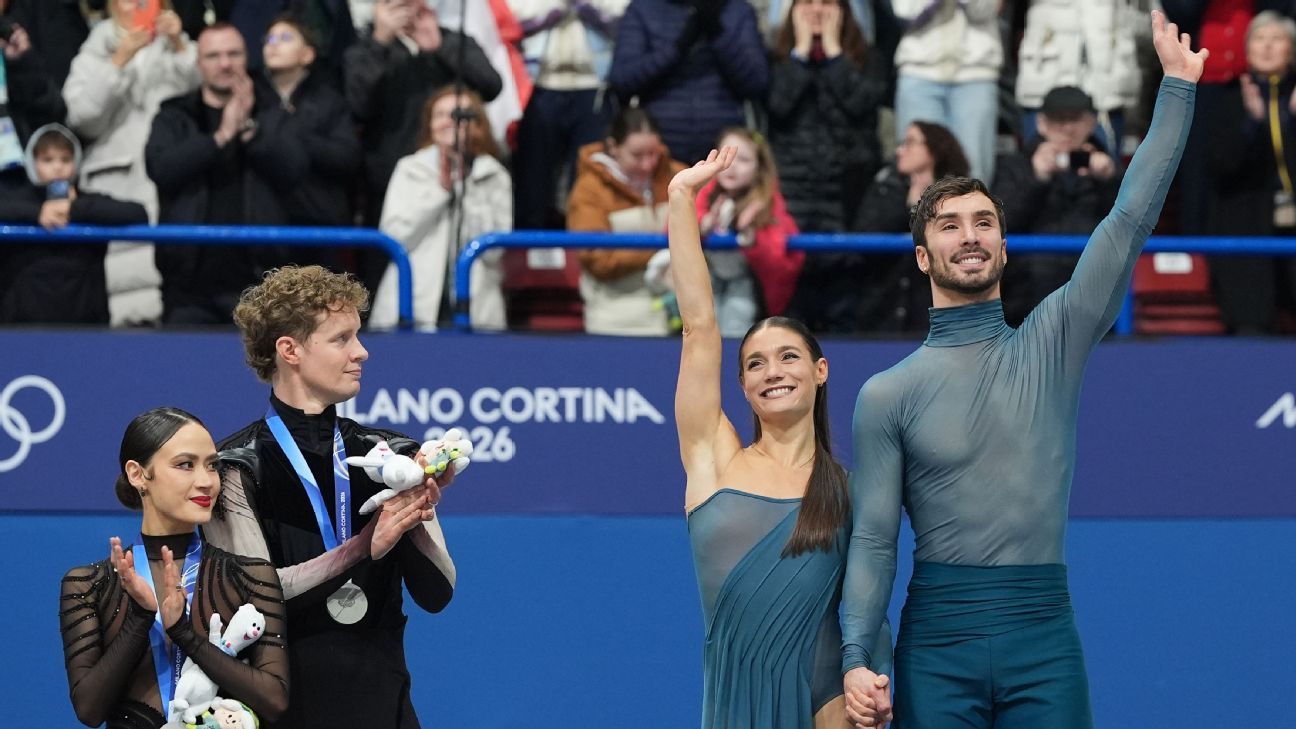
MILAN — On Wednesday, France’s Laurence Fournier Beaudry and Guillaume Cizeron won the Olympic gold medal in ice dance, narrowly edging out heavy favorites Madison Chock and Evan Bates of the United States — and the turmoil over the outcome remains.
Both teams recorded their season-best score in the free dance, but ultimately Fournier Beaudry and Cizeron edged out Chock and Bates by a margin of 1.43 points after both nights of competition. Chock and Bates, the three-time reigning world champions, were clearly disappointed after the scores were announced and were emotional throughout the podium ceremony and during their media obligations later in the evening. Bates called their program their “gold medal performance” and both said they were proud of what they had done on the ice.
While Chock and Bates have remained gracious when asked about the judging of the competition, the results have sparked backlash — and conversations about inconsistencies and potential unfairness.
Here’s everything to know about the judging discrepancies and other controversies around the French team.
Why do people believe the outcome was unfair?
After Fournier Beaudry and Cizeron earned the highest scores in the rhythm dance segment on Monday, despite some obvious synchronization issues on their twizzles and a clean skate from Chock and Bates, there was already debate about potential bias.
However, that went into hyperdrive after the free dance as Fournier Beaudry and Cizeron again had visible errors with their twizzles. Chock and Bates, on the other hand, had no such problems, and again had a near-flawless execution of their twizzles and all elements.
While several of the judges scores raised questions of bias and even nationalism, it was the French judge that really garnered notice. The judge, Jezabel Dabouis, scored Chock and Bates’ free dance a 129.74 — the lowest score from all nine of the judges on the panel and more than five points lower than the average. Dabouis gave Fournier Beaudry and Cizeron a 137.45, nearly three points higher than the average score from the panel.
The same judge raised eyebrows when judging both duos at the Grand Prix Finals in December, and gave the Americans only a slight edge despite multiple errors and a fall from Fournier Beaudry and Cizeron.
While Dabouis’ scoring was perhaps the most blatant and consequential, the Italian judge also drew ire for giving the top Italian duo Marco Fabbri and Charlene Guignard a questionable score despite an error. The Italian judge was the only one of the nine judges to place them in the top three.
Who has spoken out about it?
Chock and Bates have been measured in their reaction, but both have said multiple times they felt that they had skated at their highest level and did everything they could.
“I feel like life is … sometimes you can feel like you do everything right and it doesn’t go your way, and that’s life and that’s sport,” Bates said on NBC after the competition. “And it’s a subjective sport. It’s a judged sport. But I think one fact that is indisputable is that we delivered our best, we skated our best, we did season’s best almost every single time. And the rest is not up to us.”
In an interview with CBS on Thursday, Chock added she believed judges should be “vetted.”
“There’s a lot on the line for the skaters when they’re out there giving it their all, and we deserve to have the judges also giving us their all and for it to be a fair and even playing field,” she said.
In another interview, she added such confusion about results “does a disservice to our sport.”
Others have been even more outspoken about their feelings. Even Fabbri, who finished just off of the podium with Guignard, made his feelings clear after the event.
“I usually prefer Laurence and Guillaume,” Fabbri told reporters. “But tonight, Chock and Bates deserved [the gold medal].”
Guignard said she agreed. Fellow American ice dancer Emilea Zingas, who finished in fifth with her partner Vadym Kolesnik, expressed a similar sentiment when speaking to the media.
“I think they skated fabulously today,” she said. “It’s disappointing to me that they didn’t get the gold, but they’re my favorites. If it was my gold to give, I’d give it to them.”
A fan petition has since been created on Change.org urging the International Skating Union to investigate. At the time of this writing it has over 15,000 signatures.
Simply BEAUTIFUL. This is what 15 years of skating together looks like. 😍 pic.twitter.com/UQhpVEBB90
— NBC Olympics & Paralympics (@NBCOlympics) February 11, 2026
Has the ISU responded?
The ISU issued a statement on Friday defending the scoring.
“It is normal for there to be a range of scores given by different judges in any panel and a number of mechanisms are used to mitigate these variations,” the ISU said.
The organization added it has “full confidence in the scores given and remains completely committed to fairness.”
Who are Laurence Fournier Beaudry and Guillaume Cizeron?
The French duo at the center of it all are no strangers to controversy.
Fournier Beaudry had previously represented Canada with Nikolaj Sorensen, who is also her romantic partner, before he was suspended from the sport for six years following sexual assault allegations. She has publicly issued her support of him. The suspension was overturned in June on jurisdictional grounds, but the case remains pending.
Cizeron won Olympic gold in 2022 with his partner Gabriella Papadakis. She has since retired, as he did initially, and released a book this year calling him “controlling” and “demanding.” Cizeron has said Papadakis’ book and her allegations were a “smear campaign” and has denied the claims.
Fournier Beaudry and Cizeron announced they were teaming up last year — to much scrutiny — and are in their first season together. Fournier Beaudry received her French citizenship in November. The duo won two Grand Prix titles and the European Championships before coming to the Olympics — an unusual run of success for such a new pairing.
They train at the Ice Academy of Montreal, alongside Chock and Bates. Both teams work with the same coaches: Marie-France Dubreuil, Patrice Lauzon and Romain Haguenauer. Chock said they were “blindsided” by Cizeron’s return to the sport and the training facility, as well as the new partnership.
“They told us I think the day before they came to officially start training, and it was a lot to digest at first,” Bates told NBC ahead of the Olympics.
Olympic gold for Laurence Fournier Beaudry and Guillaume Cizeron 🇫🇷 pic.twitter.com/fBHi3cjErQ
— Embassy of France in the U.S. (@franceintheus) February 12, 2026
Have there been any other issues with judging in ice dance?
Yes. Piper Gilles and Paul Porrier, the two-time reigning world runners-up who earned the bronze medal Wednesday, have openly questioned scoring inconsistencies throughout the season.
Gilles criticized the technical panel at the Grand Prix event in Finland in November, and she later posted to social media about her frustration with the judging at the Grand Prix Final the following month. She wrote that many in the sport were being “diminished and manipulated by people with agendas,” and tagged the International Skating Union.
Even Cizeron voiced his displeasure at the same Grand Prix event in Finland.
“Of course I’m angry,” Cizeron said in a news conference. “I see some strange games being played that are destroying ice dance. I don’t think I’ve ever been to a competition like this in my career, from a judging standpoint.”
There have of course been other famous instances in figure skating overall. Perhaps the most known case also featured a French judge.
During the 2002 Olympics, Russian pair skaters Elena Berezhnaya and Anton Sikharulidze won the gold over Canada’s Jamie Sale and David Pelletier. However, allegations of vote-swapping and selling against Marie-Reine Le Gougne, the French judge, quickly emerged and resulted in an investigation by the ISU. She was found guilty and suspended. Sale and Pelletier were ultimately elevated to the gold.
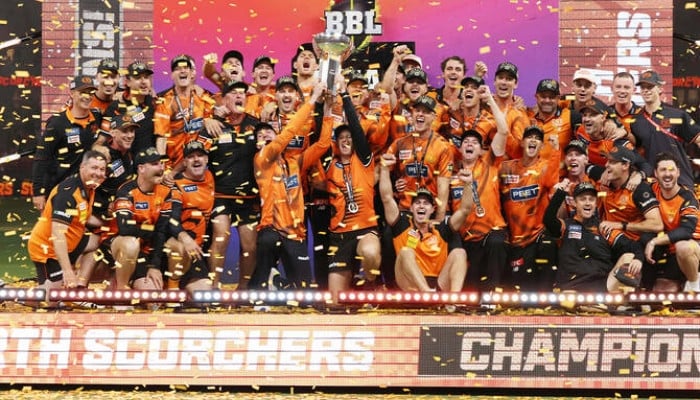
SYDNEY: As Twenty20 cricket competitions explode around the world, Australia’s Big Bash League is struggling to chart a vision for the future, after plans to privatise its franchises stalled.
Cricket Australia chief Todd Greenberg is adamant that outside investment is necessary to shore up the game’s financial future and keep pace with a boom in other well-funded leagues played in a similar time slot.
They include the UAE’s ILT20, South Africa’s SA20, and New Zealand’s privately-backed NZ20 scheduled to start in December 2027, all bidding for the best local and overseas players.
“If those salary caps (of other leagues) are significantly higher than ours over the coming years, and players can earn more in those areas, then players will follow those. That’s a real risk to us,” Greenberg told local media.
“I want to make sure that for Australian cricket, our ambition is to have a league that runs at the key part of the year for us, which is the December-January window, and it’s the best T20 league in the world at that moment in time.
“To do that, we have to have a significant amount of money in our salary caps to attract not only the best players from overseas, but to retain and attract our own best players.”
He added: “The concept of bringing private capital to cricket is inevitable at some point.”
While not a direct competitor as it runs in a different window, the benchmark Indian Premier League has seen massive success thanks to wealthy benefactors, with England’s The Hundred also on a roll after an influx of private capital.
But it is a thorny issue in Australia with an initial proposal to sell stakes in each of BBL’s eight teams stalling last month amid concerns about a loss of control for the game’s local custodians.
While the Victorian, Western Australian and Tasmanian cricket associations voiced support and South Australia said it was open to the idea, New South Wales and Queensland rejected the move.
Queensland Cricket, which controls the Brisbane Heat, said it was worried about player payments skyrocketing to unsustainable levels, and that private owners may not be as invested in the grassroots game.
Cricket NSW, which operates the Sydney Sixers and Sydney Thunder, was similarly concerned that it could be detrimental to how the sport is governed and how local players are produced.
‘Sugar hit’
There are also fears about an Indian takeover, with the most likely buyers seen as the rich IPL team owners who have invested in other short-form competitions around the globe.
Former Australian captain Greg Chappell is in the “No” camp, arguing that the BBL belongs to the states and communities that have built it into a successful and well-attended product.
While acknowledging the commercial realities, he said selling it off was not the answer.
“The moment you introduce private ownership at scale, you introduce a set of priorities that may not always align with the long-term health of the game,” he wrote in the Sydney Morning Herald.
“Private investors, however well-intentioned, answer to shareholders, not to Australian cricket.”
Andrew Jones, a former head of strategy at Cricket Australia who was instrumental in the launch of the BBL, is similarly unconvinced.
“A one-off sale is a sugar hit, not a solution,” he said in The Australian newspaper, arguing that revenues can be better grown through sponsorships, wagering, ticketing, and more focus on commercialising the women’s game.
Despite scepticism, Greenberg remains confident and is now eyeing a hybrid ownership model.
This would allow the BBL franchises keen to sell stakes to do so while allowing those against to maintain complete ownership.
“If we end up not going together at the same time, can we still extract the same level of revenue, and can we extract the same level of value?” he said.
“I think we can, but I’ve got to do the work to satisfy a recommendation that would ultimately go to the members and our board.”

NEWYou can now listen to Fox News articles!
The New York Knicks took a commanding 3-0 lead in the Eastern Conference Finals on Saturday as the franchise eyes its first NBA Finals berth since 1999.
Jalen Brunson scored 30 points to lead New York to a 121-108 win over Cleveland, while Mikal Bridges added 22 as the Knicks never trailed in Game 3.
CLICK HERE FOR MORE SPORTS COVERAGE ON FOXNEWS.COM
The New York Knicks bench reacts during the fourth quarter against the Cleveland Cavaliers in game three of the Eastern Conference finals at Rocket Arena in Cleveland, Ohio, on May 23, 2026. (David Richard/Imagn Images)
New York is the seventh team in NBA history to win at least 10 straight during a postseason run. The last team to do it was the Boston Celtics, who also went on a 10-game run on their way to the 2024 title.
All but one of the Knicks’ wins have been by double digits, with an average margin of victory of 22.5 points.
Cavaliers star Donovan Mitchell finished with 23 points in 38 minutes, while teammate James Harden added 21. Cleveland shot 12 of 41 from 3-point range and 12 of 19 from the foul line.
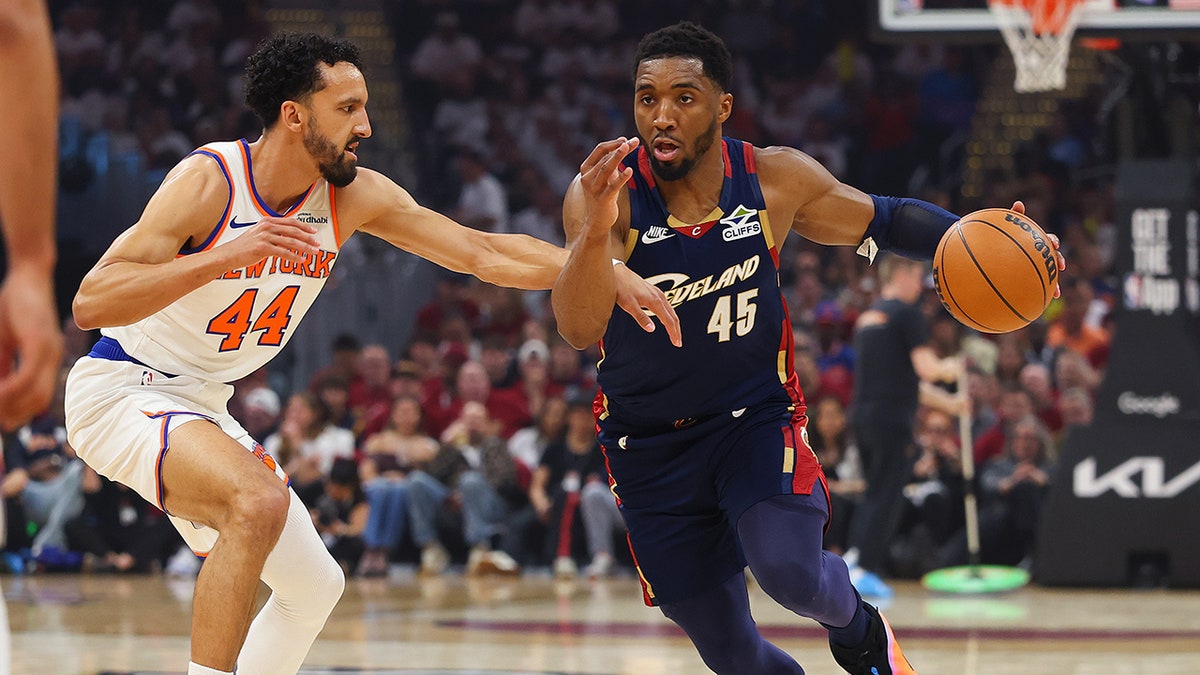
Cleveland Cavaliers guard Donovan Mitchell (45) drives to the basket against New York Knicks guard Landry Shamet (44) during the first quarter in Game Three of the NBA Eastern Conference Finals at Rocket Arena on May 23, 2026 in Cleveland, Ohio. (Gregory Shamus/Getty Images)
Cleveland rallied and tied it at 50-all on a jumper by Harden before the Knicks countered with a 10-1 run. They went into halftime with a 60-54 advantage.
Music superstar Taylor Swift was courtside for Game 3 of the Eastern Conference finals on Saturday night alongside fiancé and Ohio native Travis Kelce.
Swift and Kelce, who recently signed a three-year, $54 million contract with the Kansas City Chiefs, took their seats in Rocket Arena shortly before the opening tip.
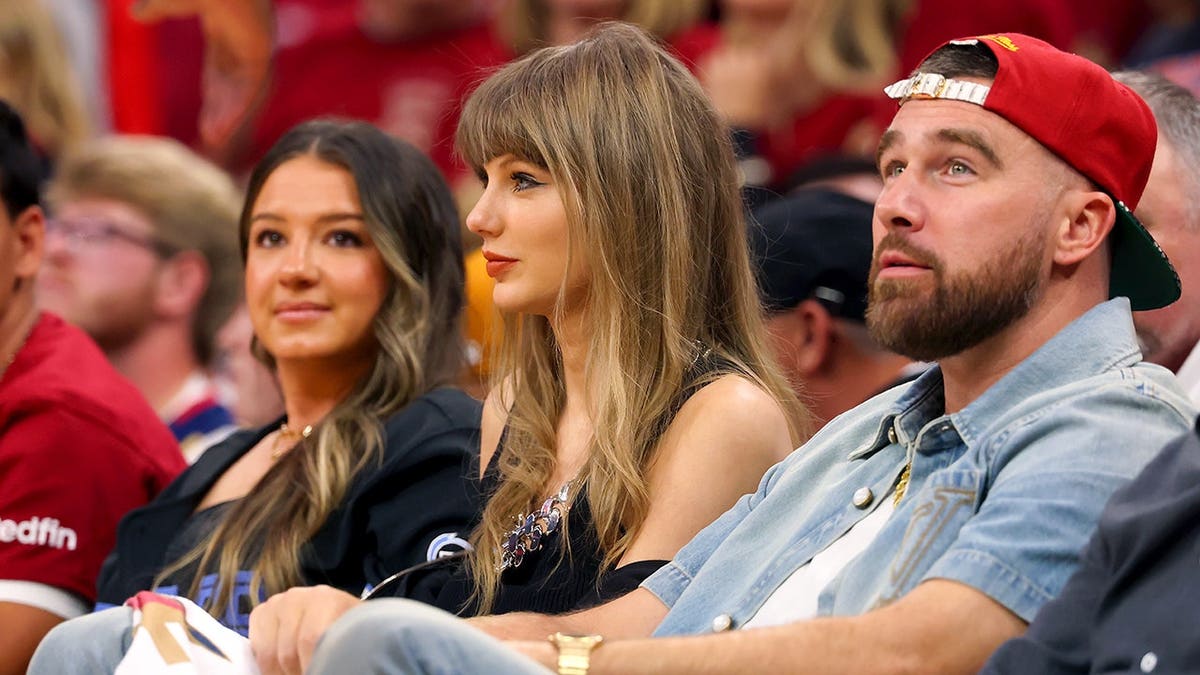
Singer Taylor Swift and Travis Kelce attend Game Three of the NBA Eastern Conference Finals between the New York Knicks and Cleveland Cavaliers at Rocket Arena in Cleveland, Ohio, on May 23, 2026. (Gregory Shamus/Getty Images)
With the Cavs trailing 91-82 at the end of the third quarter, Kelce and Swift were shown on the arena’s giant scoreboard. Fans cheered wildly as Kelce showed off his team cap and wine-and-gold shirt.
Game 4 is set for Monday night at Rocket Arena in Cleveland. The series will return to Madison Square Garden for Game 5 on Wednesday, if necessary.
CLICK HERE TO DOWNLOAD THE FOX NEWS APP
Meanwhile, in the Western Conference, the San Antonio Spurs will host the defending champion Oklahoma City Thunder in Game 4 on Sunday night. Oklahoma City enters the matchup with a 2-1 series lead.
The Associated Press contributed to this report.
Follow Fox News Digital’s sports coverage on X, and subscribe to the Fox News Sports Huddle newsletter.
Sports
NASCAR’s Truck Series and O’Reilly Autoparts Series honor Kyle Busch with moments of silence at Charlotte

NEWYou can now listen to Fox News articles!
The NASCAR world is paying tribute to Kyle Busch this weekend, and that includes some classy ones from two series in which the late driver had a lot of success.
While Busch — who passed away Thursday after “severe pneumonia [that] progressed into sepsis” — had been a full-time driver in NASCAR’s top series, the Cup Series, for more than 20 years, he still competed occasionally in both the O’Reilly Auto Parts Series and the Craftsman Truck Series.
He was especially known for his dominance in the Truck Series, winning 69 of his 184 races, and at one point owned a team. In fact, the final win of Busch’s career came just under a week before his death in a Truck Series race at Dover.
ZERO BS. JUST DAKICH. TAKE THE DON’T @ ME PODCAST ON THE ROAD. DOWNLOAD NOW!
Kyle Busch, driver of the No. 7 HendrickCars.com Chevrolet, is introduced before the NASCAR Craftsman Truck Series SpeedyCash.com 250 at Texas Motor Speedway in Fort Worth, Texas, on May 1, 2026. (James Gilbert/Getty Images)
On Friday, the Truck Series was in Charlotte as part of the Coca-Cola 600 weekend for a race that Busch was supposed to take part in.
NASCAR, RACING WORLD REACTS TO KYLE BUSCH’S SHOCKING DEATH AT 41: ‘CANNOT COMPREHEND THIS NEWS’
Corey Day was in the No. 7 Chevrolet for Spire Motorsports, the truck in which Busch took his final win, and it was set to start on pole after Friday’s qualifying was rained out.

Kyle Busch celebrates the final win of his NASCAR career at Dover Motor Speedway. (Photo by David Hahn/Icon Sportswire)
Before the race was set to begin on Friday evening, teams and fans held a moment of silence for Busch.
Unfortunately, the race never got underway and was postponed until Saturday morning and then again to Saturday night.
The O’Reilly Autoparts Series, which Busch raced in many times and won many times during his career, also took a moment to remember him before their race at Charlotte on Saturday.
CLICK HERE TO DOWNLOAD THE FOX NEWS APP
That race was also suspended due to rain.
There will be some heavy hearts on Sunday when the Coca-Cola 600, the NASCAR Cup Series’ longest race of the year, gets started at 6 p.m. ET.


Taylor Swift’s next plans revealed as ‘Showgirl’ era nears end

Trump says framework of Iran deal ‘largely negotiated,’ with provision to reopen Strait of Hormuz

China rescuers search for missing after mine blast kills 82

-

 Entertainment1 week ago
Where Pete Davidson, Elsie Hewitt stand after breakup: Details revealed
-

 Politics1 week ago
Rising diesel costs from Iran war strain US school budgets
-

 Tech1 week ago
Greg Brockman Officially Takes Control of OpenAI’s Products in Latest Shakeup
-

 Tech1 week ago
Why Is Your Grill So Dumb? The Best Grills Set Temp Like an Oven
-

 Tech1 week ago
This Solar-Powered Smart Sprinkler Keeps My Lawn Watered Without Any Power Cables
-

 Fashion1 week ago
RMG trade bodies seek policy support from Bangladesh PM
-

 Tech1 week ago
Tesla Reveals New Details About Robotaxi Crashes—and the Humans Involved
-
 Business1 week ago
Oil price gains and Westminster worry sink stocks