

Politics
Trump tells first meeting of Board of Peace that $7bn raised for Gaza

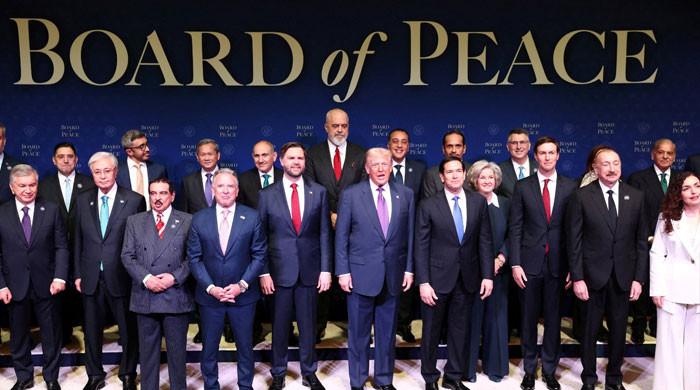
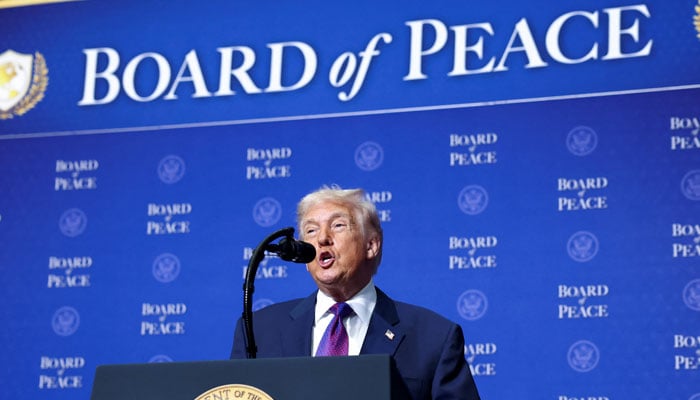
- Trump’s Board of Peace excludes Palestinian representatives.
- PM Shehbaz, other world leaders attend Trump-led BoP meeting.
- Trump hails PM Shehbaz, CDF Asim Munir at inaugural meeting.
US President Donald Trump told the first meeting of his Board of Peace (BoP) on Thursday that $7 billion has been contributed to a Gaza reconstruction fund that aims to rebuild the enclave.
In a flurry of announcements at the end of a long, winding speech, Trump said the United States will make a contribution of $10 billion to the Board of Peace. He said contributing nations had raised $7 billion as an initial down payment for Gaza reconstruction.
Prime Minister Shehbaz Sharif was among the world leaders who attended the inaugural meeting of the Board of Peace led by Trump in Washington DC.
Trump first proposed the board last September when he announced his plan to end Israel’s war in Gaza. He later made clear the board’s remit would be expanded beyond Gaza to tackle other conflicts worldwide.
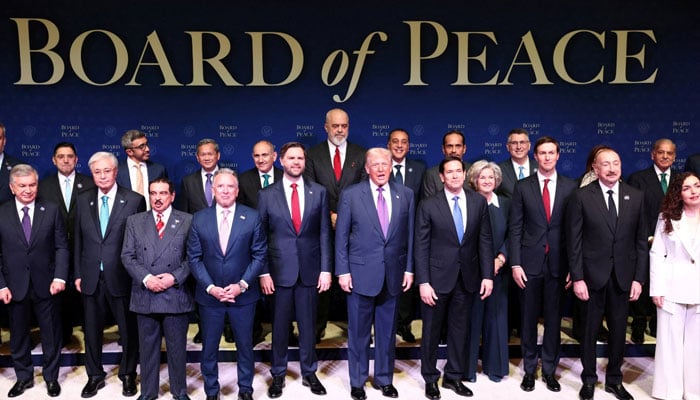
Addressing the meeting, Trump said countries had contributed more than $7 billion toward relief in Gaza as part of his Board of Peace effort.
“I’m pleased to announce that Kazakhstan, Azerbaijan, UAE, Morocco, Bahrain, Qatar, Saudi Arabia, Uzbekistan, and Kuwait have all contributed more than $7 billion toward the relief package,” Trump said at the board’s inaugural meeting in Washington.
He said that it will not be necessary to send soldiers to fight in Gaza.
Trump also said FIFA will raise $75 million for soccer-related projects in Gaza and that the United Nations will chip in $2 billion for humanitarian assistance.
Addressing the inaugural meeting of Trump’s Board of Peace, PM Shehbaz described his participation as an honour and reaffirmed Pakistan’s commitment to lasting peace in Gaza.
In his address, the prime minister said the pursuit of sustainable peace in Gaza remains a shared mission, adding that the day marked a “golden chapter in history” for peace efforts in the Middle East.
He expressed hope that the initiative would succeed in achieving long-term stability in the war-hit region.
PM Shehbaz specifically credited Trump’s timely intervention for preventing a full-scale war between Pakistan and India, stating that the ceasefire helped save thousands of valuable lives and protected South Asia from large-scale destruction.
The prime minister reiterated that the establishment of an independent and sovereign Palestinian state is essential for achieving a durable peace in the Middle East. He said Pakistan has consistently supported a just and lasting solution based on international principles.
“To achieve long-lasting peace [in Gaza], ceasefire violations must end,” he said.
Shehbaz also offered prayers for the success of the Board of Peace initiative, expressing optimism that it would contribute meaningfully to peace in Gaza and beyond.
Trump hails PM Shehbaz, CDF Munir
US President Trump also hailed PM Shehbaz and “tough serious fighter” Chief of Defence Forces and Chief of the Army Staff Field Marshal Asim Munir during the inaugural meeting of the Board of Peace in Washington.
Speaking at the initial meeting, Trump said: “I like this man [PM Shehbaz] of Pakistan.”
Referring to last year’s May conflict between Pakistan and India, Trump said: “There was some fighting going on when I got to know him and your great Field Marshal [Asim Munir], a great guy.”
The US president recalled the premier’s previous remarks, saying Prime Shehbaz had credited him with saving 25 million lives by halting the Pakistan–India war.
As the war between the two nuclear-armed neighbours raged, Trump reiterated that he played a role in stopping the conflict.
Last year, Pakistan and India engaged in a military showdown, the worst between the old foes in decades, which was sparked by a terrorist attack on tourists in IIOJK’s Pahalgam area, which New Delhi alleged was backed by Pakistan.
Islamabad denied involvement in the Pahalgam attack, which killed 26 people and offered to participate in a neutral probe into the deadly incident.
During the clashes, Pakistan downed seven Indian fighter jets, including three Rafale, and dozens of drones. After at least 87 hours, the war between the two nuclear-armed nations ended on May 10 with a ceasefire agreement brokered by the US.
Speaking on the occasion, the US president lauded the professionalism of CDF Munir, calling him a “tough good fighter”.
The US president said that he heard that Pakistan and India were fighting and the situation is worsening, adding that many planes were shut down.
Revising the tally of downed jets during the Pakistan-India war, the US president said that “11 very expensive” planes were shot down in the fight.
‘Any Iran deal must be meaningful’
The Board of Peace includes Israel but not Palestinian representatives and Trump’s suggestion that the Board could eventually address challenges beyond Gaza has stirred anxiety that it could undermine the UN’s role as the main platform for global diplomacy and conflict resolution.
“We’re going to strengthen the United Nations,” Trump said, trying to assuage his critics. “It’s really very important.”
The meeting came as Trump threatens war against Iran and has embarked on a massive military buildup in the region in case Tehran refuses to give up its nuclear programme.
Trump said he should know in 10 days whether a deal is possible. “We have to have a meaningful deal,” he said.
Trump said he hoped use of force to disarm Hamas would not be necessary. He said Hamas had promised to disarm, and it “looks like they’re going to be doing that, but we’ll have to find out.”
In Gaza, Hamas spokesperson Hazem Qassem said any international force must “monitor the ceasefire and prevent the Israeli occupation from continuing its aggression”. Disarmament could be discussed, he said, without directly committing to it.
Ahead of the gathering, three sources told Reuters that Pakistan wants firm assurances from Washington before committing any troops to Gaza as part of the proposed ISF.
Islamabad is seeking guarantees that the deployment would strictly be a peacekeeping mission and not involve disarming Hamas.
Three government sources said during the Washington visit, PM Shehbaz wanted to better understand the goal of the ISF, what authority they were operating under and what the chain of command was before deciding on deploying troops.
“We are ready to send troops. Let me make it clear that our troops could only be part of a peace mission in Gaza,” said one of the sources, a close aide of PM Shehbaz.
“We will not be part of any other role, such as disarming Hamas. It is out of the question,” he said.
Last month, Foreign Office Spokesperson Tahir Andrabi said that Pakistan would continue to engage with international efforts aimed at peace and security in Gaza.
“Pakistan will remain engaged with international efforts for peace and security in Gaza, leading to a lasting solution to the Palestine issue in accordance with United Nations resolutions,” he said.
Pakistan has reiterated at international forums its readiness to play a “constructive role” in the US peace plan for Palestine.
Trump launched his new board at the World Economic Forum in Davos in late January, with world leaders, including PM Shehbaz, signing on to pursue a lasting agreement for Gaza.
Force to oversee reconstruction and recovery
Trump’s 20-point Gaza plan calls for a force from Muslim nations to oversee a transition period for reconstruction and economic recovery in the devastated Palestinian territory, and Washington has been pressing Islamabad to join.
Analysts say Pakistan would be an asset to the multinational force, with its experienced military that has gone to war with arch-rival India and tackled insurgencies.
“We can send initially a couple of thousand troops anytime, but we need to know what role they are going to play,” the source added.
Two of the sources said it was likely PM Shehbaz, who has met Trump earlier this year in Davos and late last year at the White House, would either have an audience with him on the sidelines of the meeting or the following day at the White House.
Initially designed to cement Gaza’s ceasefire, Trump sees the board, launched in late January, taking a wider role in resolving global conflicts. Some countries have reacted cautiously, fearing it could become a rival to the United Nations.
While Pakistan has supported the establishment of the board, it has voiced concerns against the mission to demilitarise Hamas.
Politics
‘Sprit of resistance will continue’: Iran officials condemn Israeli assassination of IRGC intel. chief
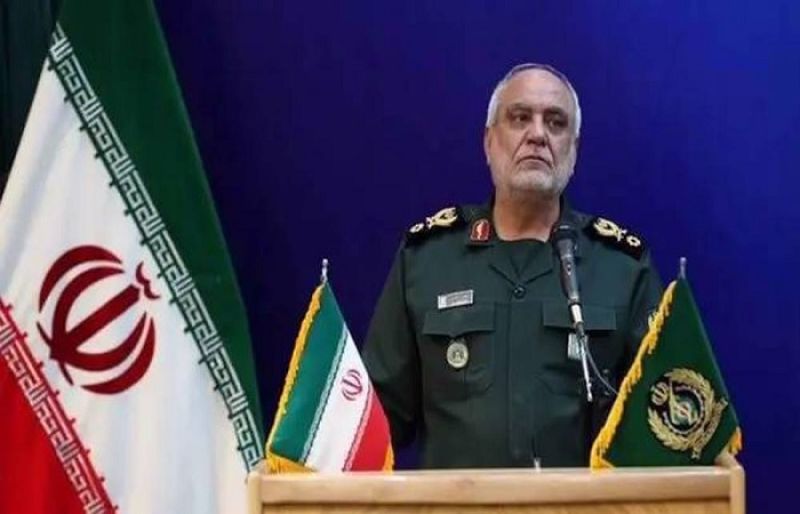
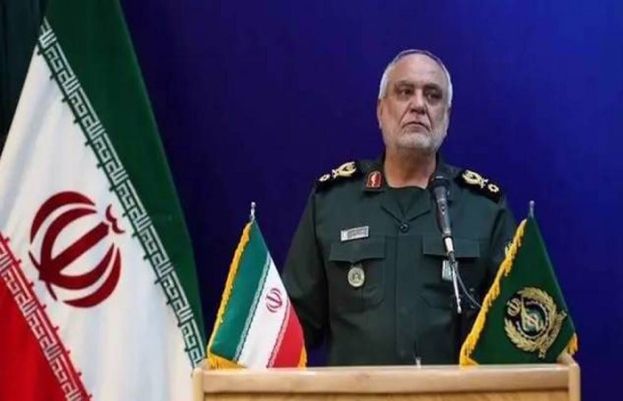
Messages of condolences pour in after the head of the Intelligence Organization of the Islamic Revolution Guards Corps (IRGC), Major General Majid Khademi, was assassinated in a US-Israeli terror strike in Tehran.
In a statement on Monday, the IRGC Public Relations Department said General Khademi, an elite commander, was martyred in the terrorist attack in the early hours of the day.
Major General Ali Abdollahi, commander of Iran’s Khatam al-Anbiya Central Headquarters, praised Khademi for his great endeavors to protect Islamic values and defend national security. He was martyred, Abdollahi said, by the “most vicious American-Israeli terrorists”.
The American and Zionist enemies must know that the martyrdom of such devoted commanders will make the Iranian nation and armed forces even “more resilient and determined” to keep on the path of the martyrs, General Abdollahi said.
‘Assassination will not undermine Iran’s national coherence’
Commander-in-chief of the Iranian Army Major General Amir Hatami said the barbarism put on global display by the American-Israeli enemy will fail to influence the “spirit of resistance of the proud Iranian nation”.
Iran’s adversaries, he said, are under the delusion that they can make any achievement through such wicked and blind moves. But the blood of martyrs only strengthens national will.
“This painful loss will not weaken the morale of the great Iranian people but rather strengthen national resolve and unity toward safeguarding independence and dignity”.
‘Enemies must await harder blows’
Parliament Speaker Mohammad Baqer Qalibaf said the martyrdom of the head of the IRGC Intelligence Organization is proof that the Israeli regime and the US are desperate.
The US-Israeli enemies are going to great lengths to make up for their weakness on the battlefield through cowardly assassinations, he said.
“This blind conspiracy of global arrogance is always doomed to failure, and even harsher blows await them”.
The illegal, imposed war of aggression by the United States and Israel began on February 28 when they assassinated Leader of the Islamic Revolution Ayatollah Seyyed Ali Khamenei, along with several senior military commanders.
In response, Iranian Armed Forces have launched decisive, devastating attacks against US and Israeli interests in the occupied territories and across West Asia.
As the war entered its sixth week, Iran continues to have an upper hand on the battlefield. The enemy is looking for an off-ramp amid heavy human and material loss.
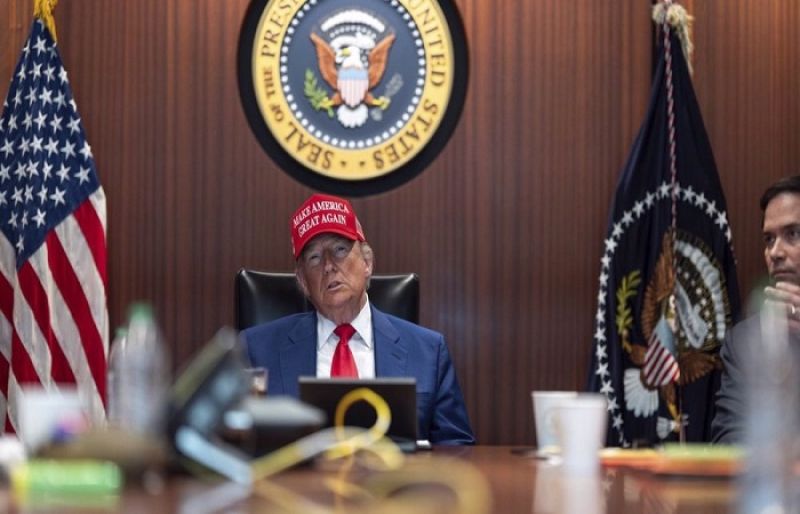
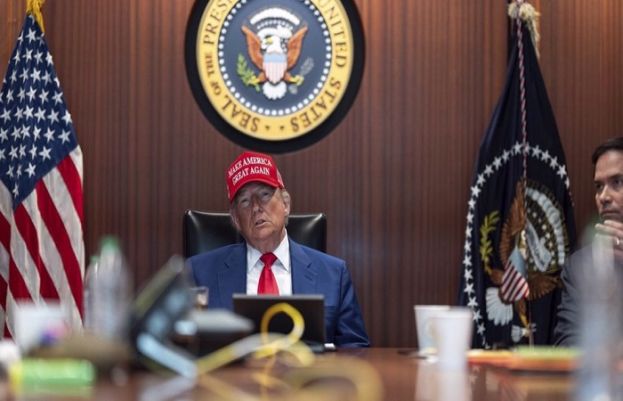
A growing number of lawmakers, experts, and commentators have called for Trump’s immediate removal from office by invoking the 25th Amendment, denouncing him for launching an unprovoked and unnecessary war against the Islamic Republic of Iran.
The 25th Amendment to the US Constitution, ratified in 1967, establishes the process for removing a president who is unable to perform his duties. Section 4, which has never been invoked, allows the vice president and a majority of the cabinet to declare the president “unable to discharge the powers and duties of his office.”
The US president’s Easter message, posted on the completion of one-month of the US-Israeli war on Iran, has drawn sharp rebuke for its content and tone.
US politicians, including some of Trump’s former allies and staunch opponents, described the statement as “psychotic,” “unhinged,” and evidence of a severe mental decline.
Senator Bernie Sanders (I-Vt.) was among the first to sound the alarm, saying the president’s words on the war against the Islamic Republic were more than just troubling.
“One month after starting the war in Iran, this is the statement of the President of the United States on Easter Sunday,” Sanders wrote. “These are the ravings of a dangerous and mentally unbalanced individual. Congress has got to act NOW. End this war.”
Representative Jim McGovern (D-Mass.) echoed Sanders’ concerns with even stronger language, directly questioning the president’s mental state.
“This is psychotic,” McGovern stated bluntly. “The President of the United States needs to get help. Totally unhinged and extremely dangerous.”
The calls for action were not limited to the US Congress. Several commentators and former political figures focused on the 25th Amendment to have Trump removed from office.
Former Republican Congressman Joe Walsh, once a Trump supporter turned fierce critic, pointed to the irony of the timing.
“His Easter morning post. And just 2 days ago, one of his ‘religious advisors’ compared him to Jesus Christ,” Walsh wrote. “He will forever be a stain on this country. And the world. 25th Amendment. Now. And to everyone else who, unlike Trump, understands & celebrates today – Happy Easter.”
The sentiment was shared by author and attorney Seth Abramson, who posed a straight question about the Republican Party’s inaction.
“I’m not saying this rhetorically—I’m speaking literally here,” Abramson said. “At what point do Republicans admit that Trump has lost his mind and replace him with Vance through the 25th Amendment? Never? Do we need to see a nuclear weapon dropped on a city of 10 million innocent civilians first?”
Concerns about the president’s mental fitness also came from medical professionals. Harry Sisson cited the reaction of Dr. Vin Gupta, a respected pulmonologist and health expert.
“Dr. Vin Gupta, a highly respected medical expert, has reacted to Trump’s insane Easter message amid ongoing questions about his health,” Sisson posted.
“‘The President is exhibiting all the signs of dementia.’ Trump has gone crazy and he’s showing it on the world stage.”
Other Democratic lawmakers and political activists questioned why the president’s own cabinet has remained silent so far, pointing to complicity in his actions.
Representative Yassamin Ansari (D-Ariz.) did not mince words, unequivocally calling the US president a threat to American national security.
“The 25th Amendment exists for a reason,” Ansari wrote. “The President of the United States is a deranged lunatic, and a national security threat to our country and the rest of the world.”
Representative Melanie Stansbury (D-N.M.) also weighed in, invoking a classic metaphor to describe the US president’s apparent lack of self-awareness.
“The emperor has no clothes,” Stansbury wrote. “Time for the #25thAmendment. Congress and the Cabinet must act.”
Senator Chris Murphy (D-Conn.) addressed the gravity of the situation as the US losses in the war against Iran pile up, emphasizing the deadly consequences of Trump’s erratic behavior.
“If I were in Trump’s Cabinet, I would spend Easter calling constitutional lawyers about the 25th Amendment,” Murphy wrote. “This is completely, utterly unhinged. He’s already killed thousands. He’s going to kill thousands more.”
Activist Melanie D’Arrigo said the Trump cabinet’s inaction in the face of war against Iran is a deliberate choice, pointing to potential personal gain as a motive for their silence.
“If you’re wondering why Trump’s cabinet isn’t invoking the 25th Amendment after yet another unhinged post announcing war crimes in the war he started that his family and donors are personally profiting from…” D’Arrigo wrote.
“It’s because they’re happily complicit and compromised.”
Journalist and social media influencer Candace Owens called it “a satanic administration.”
“We all realize that satanic Zionists occupy the White House and Congress needs to move to have the Mad King Trump removed,” she wrote.
“All of our lives may depend upon other countries realizing that Trump is deeply unwell and surrounded by religious fanatics who have convinced him that he is a messiah. We are in uncharted territory. Leaders worldwide need to act accordingly.”
Former San Jose Mayor Sam Liccardo said the American public has now seen enough to demand action, placing the burden squarely on the Trump cabinet.
“Our President posted this message to the world on Easter Sunday,” Liccardo said.
“The public now clearly knows that Trump is no longer mentally fit to hold office. Each member of his cabinet has a moral and professional duty to act under the authority of the 25th Amendment; remove him.”
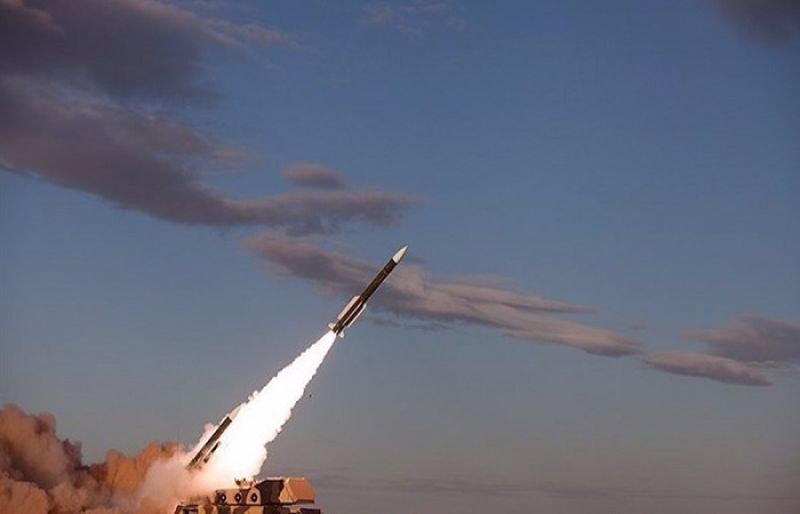

The Islamic Revolution Guards Corps (IRGC) has launched the 98th wave of the decisive Operation True Promise 4, targeting command, operational and logistics centers, as well as military-industrial infrastructure used by the United States and Israel in the region.
In a statement released on Monday, the IRGC’s Public Relations Department said during the first phase of the combined operations, IRGC naval forces precisely targeted the Israeli-owned container ship SDN7 with a cruise missile.
Meanwhile, the statement said, Iranian ballistic missiles struck northern and southern areas of Tel Aviv, strategic sites in Haifa, chemical companies and factories in Beersheba, and a gathering point of Israeli forces in Petah Tikva.
The elite Iranian military force also said the American amphibious helicopter carrier LHA7, transporting more than 5,000 sailors and marines, came under Iran’s attack and was forced to retreat deeper into the southern Indian Ocean.
In another phase of the operation, a drone production center jointly operated by the United Arab Emirates and Israel, along with several military aircraft stationed at Ali al-Salem air base in Kuwait, was hit by Iranian missiles and drones, the IRGC said.
The IRGC said its naval forces are monitoring transit in the Strait of Hormuz and the Persian Gulf while remaining prepared to act decisively against even the slightest movement by the enemies.
The illegal, imposed war of aggression by the United States and Israel began on February 28 with airstrikes that assassinated senior Iranian officials and commanders.
Iran has responded by carrying out 98 waves of retaliatory attacks against US and Israeli military and business assets across the region, using ballistic missiles and drones.
Iran also keeps the Strait of Hormuz shut to oil and gas tankers affiliated with the aggressors and those cooperating with them. This is to maintain security at the strategic waterway.


UNC set to hire Michael Malone as next men’s basketball coach after firing Hubert Davis: report

Border Patrol Agents Sold Challenge Coins With ‘Charlotte’s Web’ Characters in Riot Gear

New norms for NH & bridge works: Longer timelines, realistic deadlines – The Times of India

-

 Sports1 week ago
USMNT handed reality check by Doku, Belgium ahead of World Cup
-

 Sports1 week ago
2026 NCAA men’s hockey tournament: Schedule, results
-
Uncategorized4 days ago
[CinePlex360] Please moderate: “Trump signals p
-
Uncategorized1 week ago
[CinePlex360] Please moderate: “Further tariff
-

 Entertainment3 days ago
Joe Jonas shares candid glimpse into parenthood with Sophie Turner
-

 Tech3 days ago
Our Favorite iPad Is $50 Off
-

 Sports1 week ago
Man City show why they are worthy WSL title winners as tired United wilt
-

 Entertainment1 week ago
Demystifying the PTI