

Politics
Historic blizzard buries US Northeast under record snowfall

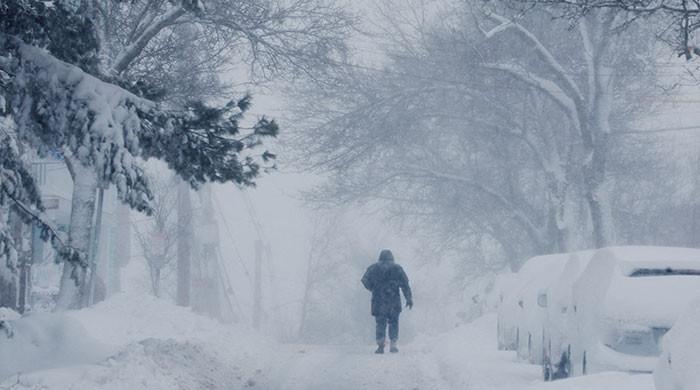
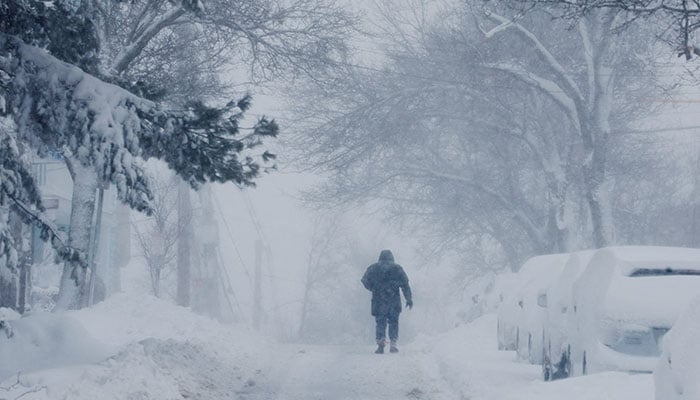
- Over two-and-a-half feet of snow paralyses US Northeast.
- At least 7,400 flights cancelled, thousands more delayed.
- Millions stranded as over 600,000 homes, businesses lose power.
NEW YORK: A powerful blizzard dropped more than two-and-a-half feet of snow (76.2 cm) across parts of the US Northeast on Monday, bringing travel to a near-standstill for millions of residents as the treacherous conditions closed roads, shut down train services and forced the cancellation of some 7,400 flights.
Thousands of homes and businesses lost power and officials, including New York City Mayor Zohran Mamdani, urged residents to stay off the roads so emergency crews could clear the streets. Schools in New York and throughout the region were closed. Broadway shut its theatres.
“New York remains in a state of emergency,” Mamdani said. “The travel ban has ended today at noon, but a hazardous travel advisory remains in place through midnight tonight.”
More than 19 inches (48 cm) of snow had fallen on New York City’s Central Park by 1 pm ET (1800 GMT) on Monday and over 14 inches fell in Boston, said Bob Oravec, a meteorologist with the National Weather Service’s Weather Prediction Centre.
Winds, at times reaching between 40 to 60 mph (64–100 kph), blew snowdrifts several feet high.
“It’ll probably take a week to dig out,” Oravec said.
Philadelphia received 14 inches while Providence, Rhode Island, was buried under more than 32 inches of snow, a record for the city.
More than 608,711 homes and businesses across the US were without power as of Monday afternoon, according to PowerOutage.us. That included one in 10 of the nearly 3 million power customers PowerOutage.us tracks in Massachusetts.
Many were astounded by the depth of the snowfall. In her 20 years or so living in New Hyde Park, on hard-hit Long Island, Sandra Wu said she had never seen a winter storm this bad. Her family could not open the front door and could barely see out of some windows because of the high snowdrifts.
“My husband went out early through the garage to start digging us out, but it was pointless,” Wu said.
Wu, 53, a veterinarian, said the storm, which had dropped about 18 inches of snow, reminded her of the storms in the 1990s when she lived in Buffalo, New York, which gets an average annual snowfall of 92 inches.
Her two children, ages 13 and five, were thrilled to have a snow day off from school, so they slept in.
“We thought we’d lose power, thankfully not,” she said. “So we’re baking today. There’s nothing else to do while we wait for the snow to stop.”
Regional emergencies
At least seven US states had declared states of emergency in response to the storm as of Monday.
Airlines had cancelled more than 7,400 flights by Monday afternoon and delayed another 2,300, according to the tracking site FlightAware.com. That figure included more than 1,800 cancelled Tuesday flights, according to the site. Most of the cancellations and delays were in the northeastern US, including New York’s John F. Kennedy International and LaGuardia airports, Boston’s Logan Airport, and New Jersey’s Newark Liberty International Airport.
New York Governor Kathy Hochul said she had activated 100 National Guard members to assist in Long Island, New York City and the lower Hudson Valley, areas expected to bear the brunt of the heavy snow and coastal winds. The storm forced the closure of the UN headquarters complex in Manhattan on Monday.
The Department of Homeland Security said that despite its ongoing funding lapse the Federal Emergency Management Agency’s disaster-response work would continue uninterrupted, including staff travel, emergency operations and critical assistance for people affected by active disasters.
Last week, Reuters reported the Trump administration had ordered FEMA to suspend the deployment of hundreds of aid workers to disaster-affected areas around the country while the DHS is shut down.
Massachusetts Governor Maura Healey declared an emergency and told state workers to stay home. Connecticut barred commercial vehicles from limited-access highways, exempting only emergency and essential deliveries.
Train and bus commuter lines in New Jersey were halted, while the Rhode Island Public Transit Authority said it would suspend all service through Monday and would announce plans to resume service only when conditions improve.
Even some ships were caught by the storm. Wu said her elderly in-laws were stuck on a cruise ship docked in New York Harbour, which cannot start sailing to the Bahamas on a planned holiday.
But Wu said they were enjoying themselves despite the delay.
“They are having the best time with 20 of their friends, eating well with plenty of entertainment,” while they wait for the storm to pass, Wu said.
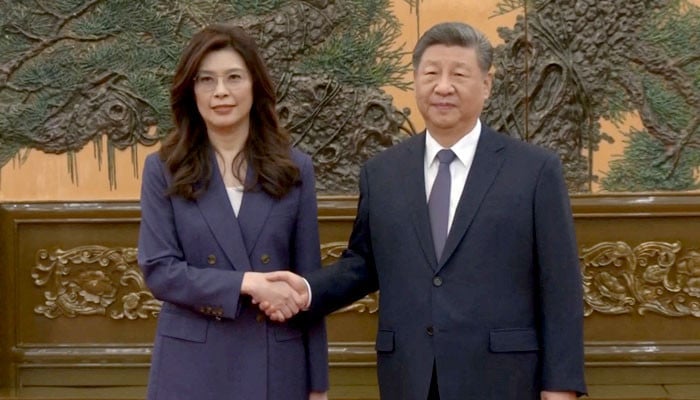
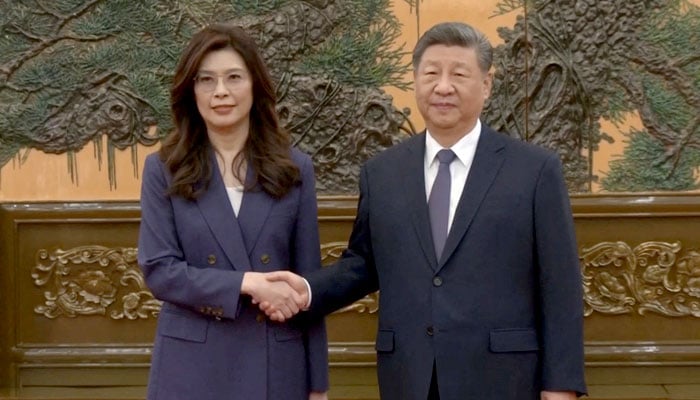
- Taiwan opposition leader in China for ‘peace’ mission.
- Cheng meets China’s Xi at Great Hall of the People.
- Cheng is party’s first leader to visit China in a decade.
China’s President Xi Jinping met Taiwan’s opposition party leader Cheng Li-wun in Beijing on Friday, telling the visiting delegation he had “full confidence” that Taiwanese and Chinese people would be united.
Kuomintang (KMT) chairwoman Cheng is the party’s first leader to visit China in a decade.
Xi told Cheng, as the two met on Friday, that “the general trend of compatriots on both sides of the Strait getting closer, edging nearer and becoming united will not change”.
“This is an inevitable part of history. We have full confidence in this,” Xi said during the talks carried by Taiwanese media.
He also said China was willing to strengthen dialogue with groups in Taiwan, including the KMT, on the “common political foundation of… opposing Taiwan independence”.
Earlier, she told Xi that the Taiwan Strait would “no longer be a focal point of potential conflict” and “both sides should transcend political confrontation”.
She also said Xi had responded “positively” to her proposal that the sides work toward Taiwan participating in international organisations such as Interpol and regional trade agreements.
Taiwanese lawmakers have been at loggerheads over the government’s plan to spend NT$1.25 trillion ($39 billion) on defence, which has been stalled for months in parliament, controlled by opposition parties including the KMT.
Defence spending
Cheng’s trip comes a month before US President Donald Trump is scheduled to visit Beijing for a summit with Xi.
The United States has been piling pressure on Taiwanese opposition lawmakers to back a proposal for defence purchases, including US weapons.
Cheng has railed against the government´s proposal, insisting “Taiwan isn’t an ATM” and instead backing a KMT plan to allocate NT$380 billion ($12 billion) for US weapons with the option for more acquisitions.
While KMT party members regularly fly to China for exchanges with officials, its last leader to visit was Hung Hsiu-chu in 2016.
Cross-strait relations have worsened in particular since the election of Tsai´s successor, Lai Ching-te, who Beijing considers a separatist.
Cheng landed in Shanghai on Tuesday evening, saying shortly after her arrival that “the two sides of the Taiwan Strait are not doomed to war, as the international community has feared”.
The KMT leader also travelled to the eastern city of Nanjing, where she visited the mausoleum of revolutionary leader Sun Yat-sen, one of the few Chinese historical figures revered in both Beijing and Taipei.


TEXAS: As diplomatic activity intensifies ahead of anticipated peace talks between the United States and Iran in Islamabad, a parallel surge is unfolding far from negotiating tables in the fast-moving world of online prediction markets, where hundreds of millions of dollars are being wagered on the outcome of the conflict.
On platforms such as Polymarket and Kalshi, traders are placing real-money bets on whether the fragile ceasefire will hold, whether negotiations will succeed, and how the broader confrontation might evolve. The scale of activity reflects a global consensus: the situation is both highly consequential and deeply uncertain.
Available data suggests that more than $300 million has been traded across Iran-related markets, transactions often described as “trading” rather than betting, with over $250 million concentrated in a single market tied to the timing and nature of a ceasefire.
Participants are effectively pricing probabilities: Will the Islamabad talks yield a breakthrough, or will tensions reignite?
Market sentiment, as reflected in these trades, remains cautious. The likelihood of a comprehensive and lasting peace agreement is currently viewed as limited, with implied probabilities ranging between 20% and 40%.
By contrast, a temporary or partial outcome such as an extension of the ceasefire or a limited diplomatic understanding is seen as more plausible, with estimates exceeding 50%.
At the same time, positions anticipating renewed escalation or a breakdown of the ceasefire hover between 30% and 50%, underscoring a widespread lack of confidence in long-term stability.
In some cases, traders have already reaped substantial gains. According to market reports, several participants earned more than $600,000 by correctly anticipating the ceasefire announcement before it became public, raising questions in some quarters about the possibility of insider information.
Analysts note that prediction markets have evolved beyond speculative entertainment into a serious barometer of geopolitical sentiment, where financial exposure intersects with information, analysis, and risk.
Meanwhile, international media outlets are describing the Islamabad talks as a “fragile but pivotal moment”. Yet there is broad agreement among analysts that the ceasefire itself remains tenuous, with core disputes unresolved.
Iran’s nuclear programme, control over the Strait of Hormuz, and ongoing hostilities in Lebanon continue to cast a long shadow over any diplomatic progress.
For Pakistan, the stakes are particularly high. Islamabad’s role as a mediator could enhance its diplomatic standing, but the risks are equally significant. Should the talks fail, the economic and security repercussions — especially through energy markets and regional instability are likely to be felt well beyond the negotiating room.
Experts caution that while financial wagering on geopolitical crises is not new, the scale of activity surrounding the US-Iran confrontation marks a turning point. Modern conflicts, they argue, are no longer confined to battlefields. Their impact ripples through financial systems, digital platforms, and global public opinion alike.
As attention turns to Islamabad, where negotiations are set to begin within hours, the outcome remains uncertain. What is clear, however, is that the world is watching and, in many cases, quite literally investing in what comes next.
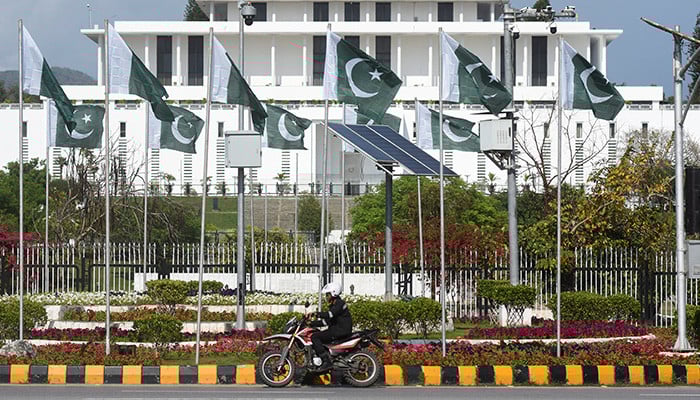
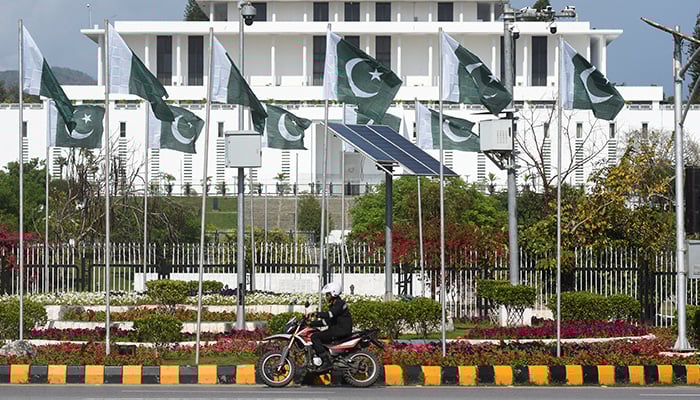
ISLAMABAD: The United States and Iran are holding their highest-level talks in years in Islamabad in a Pakistan-brokered bid to turn a fragile two-week ceasefire into a lasting end to a war that has roiled global energy markets.
Here are five things to know about the Islamabad talks:
The war behind the talks
On February 28, the US and Israel launched coordinated strikes that killed Supreme Leader Ali Khamenei and struck Iran’s military and nuclear infrastructure, killing more than 2,000 people in five weeks.
Tehran responded by effectively closing the Strait of Hormuz, through which about a fifth of global oil and gas passes, sending energy prices soaring and disrupting trade worldwide.
On April 8, the US and Iran agreed to a two-week ceasefire brokered by Pakistan. Iran’s Supreme National Security Council said the talks could continue for up to 15 days. The ceasefire is expected to expire on April 22.
Pakistan’s starring role
Pakistan, a nation more frequently making international headlines for its terror incidents and shaky economy, is hosting the first negotiations between Washington and Tehran since the war began, a stunning pivot for a country long viewed through the lens of deep security concerns.
Pakistan’s value as mediator rests on an unusually broad diplomatic network.
Iran was the first country to recognise Pakistan following independence in 1947, with the two neighbours sharing a 900-kilometre border and deep historical, cultural and religious ties.
At the same time, Islamabad has cultivated strong ties with Washington, Riyadh and Beijing.
Deputy Prime Minister and Foreign Minister Ishaq Dar visited Beijing at the end of March for talks with Wang Yi, who backed Islamabad’s mediation efforts as “in keeping with the common interests of all parties”.
President Trump himself told AFP that China helped bring Iran to the negotiating table, an account backed by authorities in Islamabad.
What’s on the table?
The gap between the two sides remains vast. Washington’s reported 15-point proposal centres on Iran’s enriched uranium, ballistic missiles, sanctions relief and the reopening of the Strait of Hormuz. Tehran has countered with a 10-point plan demanding control over the strait, a toll for vessels crossing the strait, an end to all regional military operations and the lifting of all sanctions.
Lebanon is also a major sticking point. Israel continued its strikes in the country, targeting Hezbollah — after the ceasefire came into force — with Israeli Prime Minister Benjamin Netanyahu rejecting the assertion that the truce included Lebanon.
US Vice President JD Vance appeared to take a softer tone, saying there may have been a “legitimate misunderstanding” from Iran that Lebanon would be included.
Iran’s President Masoud Pezeshkian warned on X that Israel’s strikes on Lebanon rendered the negotiations “meaningless”. “Our hands remain on the trigger. Iran will never forsake its Lebanese brothers and sisters.
Who are the negotiators?
Vance will lead the American team, joined by special envoy Steve Witkoff and Trump’s son-in-law Jared Kushner.
It marks the most senior US engagement with Iran since Secretary of State John Kerry negotiated the 2015 nuclear deal. Witkoff held multiple rounds of Oman-mediated talks with Iranian Foreign Minister Abbas Araghchi before the war cut the process short.
Iran’s parliament speaker Mohammad Bagher Ghalibaf and Araghchi are expected to lead the Iranian delegation.
Ghalibaf is a former IRGC commander, and it remains unclear whether any active IRGC representative will attend.
Foolproof security in Islamabad
The talks are being held in Islamabad. The streets of the federal capital are flooded with security personnel in military fatigues, traffic diversions and police checkpoints. The capital, already a quiet city, was even quieter on Friday.
The talks themselves are expected to be indirect: the two delegations sitting in separate rooms with Pakistani officials shuttling proposals between them, mirroring the format used in earlier Oman-mediated rounds.


Drewry WCI rises for sixth consecutive week, Hormuz a concern

Afrika Bambaataa, hip-hop pioneer and founder of Universal Zulu Nation, dies at 68

Sights and sounds from the second round of the Masters

-
 Business1 week ago
Jaguar Land Rover sees sales recover after cyber attack
-
Uncategorized1 week ago
[CinePlex360] Please moderate: “Trump signals p
-

 Entertainment7 days ago
Joe Jonas shares candid glimpse into parenthood with Sophie Turner
-

 Tech7 days ago
Our Favorite iPad Is $50 Off
-

 Sports7 days ago
UConn Final Four run could trigger a $50M furniture giveaway for Massachusetts-based Jordan’s Furniture
-
 Business7 days ago
Video: Why Is the Labor Market Stuck?
-

 Entertainment7 days ago
Blake Lively reacts to harassment claims dismissal against Justin Baldoni
-
 Politics7 days ago
Iran can sustain Strait of Hormuz closure for years, will cut US military logistics: Official