

Tech
Transnational AI regulation needed to protect human rights in the UK | Computer Weekly


The transnational nature of artificial intelligence (AI) means international regulation is essential to tackle the safety issues associated with advanced AI, according to tech chiefs.
In the final evidence session of the Joint Committee on Human Rights inquiry into human rights and the regulation of AI on 25 February, MPs and Lords pressed the AI minister and senior executives from Meta and Microsoft on the adequacy of current safeguards in protecting fundamental rights.
Lawmakers questioned the panel on misinformation, accountability, child safety, existential risk and Britain’s AI sovereignty, probing whether current safeguards are strong enough to protect democratic rights and freedoms as AI systems become embedded across society.
The session came just weeks after the committee warned that the UK’s existing regulatory framework is struggling to keep pace with AI harms – with several regulators telling MPs that a lack of resources, rather than statutory powers, is the greatest hurdle to effective oversight.
Ginny Badanes, general manager of tech for society at Microsoft, and Rob Sherman, deputy chief privacy officer of policy at Meta, welcomed greater harmonisation in regulatory standards at a global level.
Speaking on AI governance, Badanes told MPs the current issue is not a lack of activity, but the bigger challenge of fragmentation.
“I worry at times when we have this variety of approaches that we’re not actually addressing the broader safety or human rights risks that are at the centre of what everyone is trying collectively to solve,” she said.
Transnational by design
Badanes added that “everything about advanced AI is transnational by design – the systems are developed, tested and deployed in a variety of places across borders and within multiple supply chains, and then integrated into products that are used at a global scale”.
She argued that an alignment in international standards could lead to a base layer of agreement, “creating a strong place to get out of fragmented models”.
Sherman mirrored this, noting that Meta operates in most countries worldwide, and that its human rights policy applies globally.
He added that Meta does not build separate AI models for different countries, despite the regional variation in AI governance.
Asked whether the UK’s AI Opportunities Action Plan strikes the right balance between innovation and human rights, both companies were broadly supportive.
Badanes said the UK had made “a sensible start”, building on its “strong foundation of human rights” law and taking a risk-based approach.
Public trust, she argued, is “absolutely critical” to AI adoption. “People will not embrace and use a technology that they do not trust,” said Badanes, adding that strong but proportionate regulation would help secure that trust.
Sherman described the UK’s strategy as “a really thoughtful and sensible approach”, and, in some respects, “a global model”. He also praised the UK’s AI Security Institute as “a global thought leader” in technical AI governance.
Misinformation and democracy
The committee asked if Meta was doing enough to challenge the use of AI by foreign actors on social media, raising concerns about how AI and social media are being used to undermine democratic rights and freedoms.
The committee noted that anonymous posting is increasingly the main way people post on Facebook groups.
Sherman stressed that Facebook is a “real identity platform”, meaning identity is verified using government-issued photo IDs, and that these groups were intended to allow people to share sensitive information without attaching their identity to it. Without accounting for the platform’s own role in spreading misinformation, he said, “I would encourage people to be thoughtful about the sources of the information that they consume”.
However, Sherman said the company would “certainly never suggest that the work to do that is done”, noting that adversaries “continue to evolve their tactics” and “behave adversarially”.
On the reliability of large language models, executives admitted AI systems can generate false information – so-called “hallucinations”. While models are “designed to tell you the truth”, Sherman conceded they are not 100% accurate.
Badanes added: “I think it’s incredibly difficult to ask a large language model to consistently provide you with the truth, in part because of the inherent flaws of the way the systems are designed. I do expect they will continue to get better, but also because truth is at times subjective, and it is a challenging environment to guarantee or ensure anything.”
The committee asked about situations when chatbots provide incorrect or manipulative outputs. Badanes noted the importance of public trust in AI, saying it is lost when the system does not answer a question.
The witnesses said Facebook and Microsoft are working to improve factual alignment, provide citations and, in some cases, indicate levels of confidence in responses. They also emphasised the importance of AI literacy and managing expectations of what services chatbots should provide.
The most difficult questions centred on accountability. When asked who should be responsible if someone suffers harm after relying on incorrect or manipulative AI outputs, such as bad legal advice or encouragement of self-harm, executives stopped short of proposing a specific legal framework.
Microsoft’s Badanes said accountability should attach “where there’s meaningful control”, suggesting responsibility may vary depending on whether harm stems from the model itself, its deployment, or a malicious user. Meta’s Sherman agreed courts would likely need to examine “multiple players” in any given case.
Parental controls
Sherman highlighted that age verification often varies app to app, and highlighted that standardised, platform-level verification is not in the current ecosystem, but would be valuable.
Badanes emphasised the variation in experiences of AI across platforms. “A chatbox where a child can form relationships is going to be a higher-risk scenario than potentially a tutoring app,” she said, encouraging a risk-based approach to AI governance rather than attempting to apply a single age-based threshold across AI tools.
“It’s not just about restricting access, we also need to build these age-appropriate designs and safety guardrails – it’s about adding clear boundaries into the system from the very beginning,” said Badanes.
Existential risks from AI
Asked if individuals should be able to opt out of AI entirely, Sherman said AI has been embedded in services such as Facebook and Instagram “since the beginning”, from news feed ranking to spam filtering. “I don’t think that opting out of AI as a technology is probably realistic,” he said, warning against the idea that it would be possible to “wall off AI from the rest of technology”.
Sherman and Badanes pushed back against binary artificial general intelligence narratives, such as the 2023 extinction-risk statement from the Centre for AI Safety, signed by many leaders in the tech industry, that warned of possible risks of extinction from AI.
Sherman said: “I think the reality is maybe a little bit less exciting and a little bit more mundane, which is that the technology will continue to improve iteratively. I don’t think we’re in a situation where we’re going to wake up one day, and the world is vastly different.”
Badanes described existential harm as “low-probability, high-impact”, stressing that companies are focused on managing both long-term and immediate dangers. “We have to address the risks in the here and now,” said Sherman, while continuing to plan for more extreme scenarios.
Both firms pointed to internal governance structures, including red-teaming exercises, external expert consultation and frontier risk frameworks. Sherman told MPs that through the Frontier programme, Meta evaluates models for “chemical, biological, cyber security and autonomy risks” before and after deployment.
They also emphasised the importance of collaboration with governments, noting that states hold intelligence and national security information unavailable to the private sector.
Speaking to the committee in a separate session, AI minister Kanishka Narayan praised the UK’s AI Security Institute, saying it provides “unparalleled pre-deployment access” to advanced models and plays a key role in developing international evaluation standards.
Badanes likened AI to nuclear regulation. “There are a lot of really complicated challenges that we as a big, large society, have been able to resolve that have had similar roots,” she said.
However, MPs raised concerns about AI researchers who have left major companies over safety disagreements. Asked whether voluntary corporate safeguards were sufficient, Sherman responded that firms have “clear internal reporting mechanisms” and “encourage dissent”, but stopped short of calling for binding global treaties.
Industry leaders urged policymakers to prioritise “interoperable, risk-based global standards” for the most capable systems and invest in content provenance tools, including watermarking, to counter misinformation.
Narayan noted that compared with the first AI summit in Bletchley Park, the India AI Impact Summit was much more focused on the day-to-day experience of people rather than the more abstract, long-term questions of how AI might fundamentally transform the economy, or the more long-term risks it may pose.
Today, Apple announced its new budget MacBook. At $599, it looks seriously impressive. While I haven’t tested its performance, battery life, or display just yet, it may end up being hard to beat at that price based on some of the specs alone.
But that doesn’t mean the competition isn’t there. I want to recommend a couple of Windows laptops deals that offer various advantages over the MacBook Neo, showing where the Neo has both strengths and weaknesses.
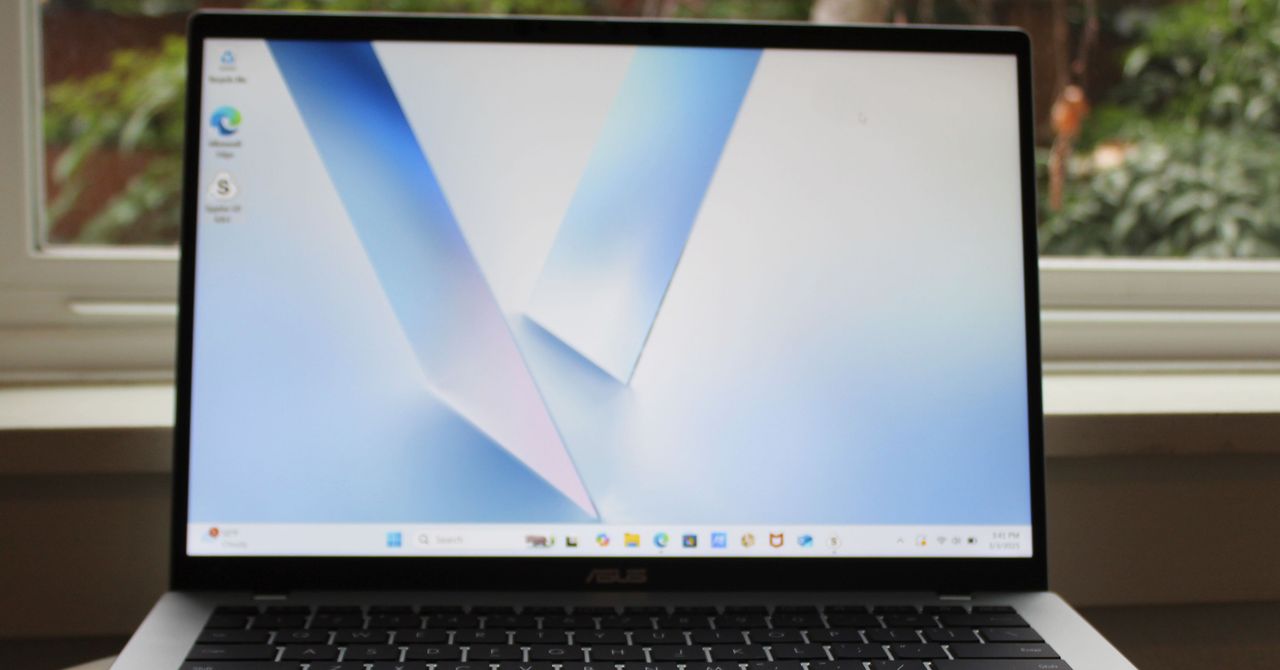
First, check out this Asus Vivobook 14, a laptop I’ve been happy to recommend as a budget computer for the past year. In many ways, this is the Windows version of a laptop like the MacBook Neo. It uses a highly-efficient ARM chip, the Qualcomm Snapdragon X, meaning it gets great battery life and performs admirably in daily tasks. It’s not quite as thin or light as the MacBook Neo, but it’s fairly portable for a laptop at this price.
Unlike the MacBook Neo, the Vivobook 14 comes with 16 GB of RAM and 512 GB of storage. That’s twice what you get in the MacBook Neo’s starting configuration. Right now, this configuration of the Vivobook 14 is on sale for $539. That’s a killer deal for those specs. It even comes with a healthier mix of ports, including HDMI, two USB-A, one USB-C, and a headphone jack. That also means it can support two external displays unlike the MacBook Neo, which can only handle just one.
Don’t get me wrong—I’m not at all saying the Vivobook 14 is a slam dunk over the MacBook Neo. Based on specs alone, I know the Vivobook 14 is a serious step down when it comes to the display. It’s less sharp, stretched across a larger screen, and the color performance isn’t so good. The Vivobook 14 maxes out at 280 nits, whereas Apple says the MacBook Neo can go all the way up to 500 nits. I have a hunch that the MacBook Neo will deliver a much better display in just about every regard.
There’s also the touchpad. It’s a little clunky to use, which is typical of budget Windows laptops. This is just a guess—but the touchpad on the MacBook Neo will likely feel smoother. It’s a mechanical trackpad (unlike the MacBook Air’s haptic feedback trackpad), but Apple has almost never made a bad trackpad.
If you’re not convinced by the Asus Vivobook 14, I’d also recommend the HP OmniBook 5, which is currently on sale for $500 and uses the same Snapdragon X chip. While it only has 256 GB of storage, it has a much better screen than the Vivobook 14, using an OLED display. It’s not any brighter than the Vivobook 14, but it gives you far better color performance and contrast. It’s also just 0.50 inches thick, matching the MacBook Neo exactly in portability.
Other Good USB Hubs to Consider
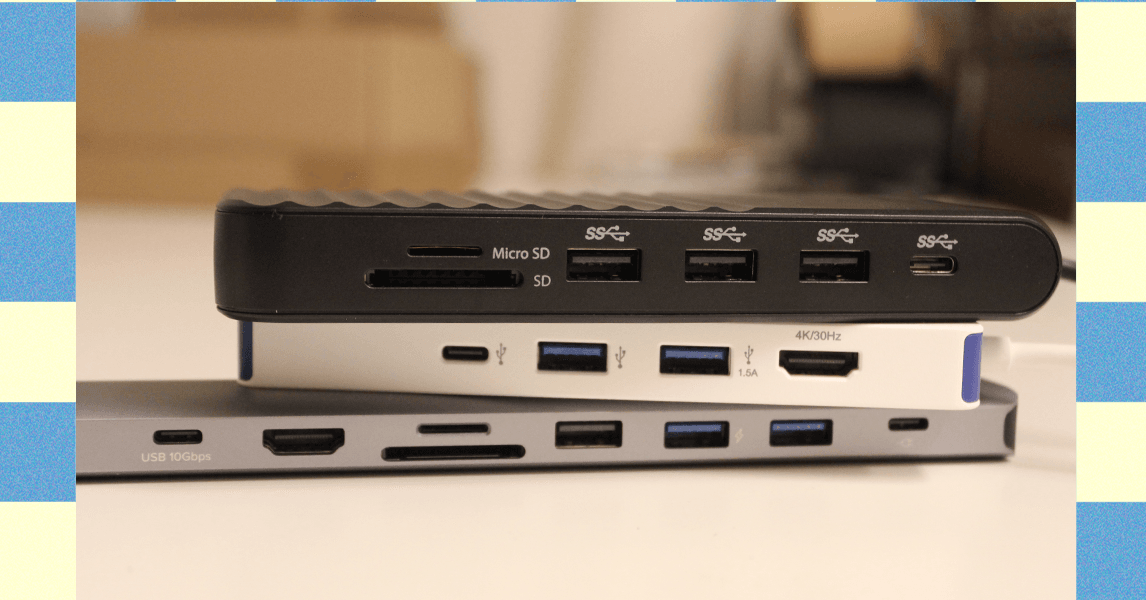
Ugreen Revodok Pro 211 Docking Station for $64: Most laptop docking stations are bulky gadgets that often require a power source, but this one from Ugreen straddles the line between dock and hub. It has a small, braided cable running to a relatively large aluminum block. It’s a bit hefty but still compact, and it packs a lot of extra power. It has three USB ports (one USB-C and two USB-A) that each reached up to 900 MB/s of data-transfer speeds in my testing. That was enough to move large amounts of 4K video footage in minutes. The only problem is that using dual monitors on a Mac is limited to only mirroring.
Photograph: Luke Larsen
Hyper HyperDrive Next Dual 4K Video Dock for $150: This one also straddles the line between dock and USB hub. Many mobile docks lack proper Mac support, only allowing for mirroring instead of full extension. The HyperDrive Next Dual 4K fixes that problem, though, making it a great option for MacBooks (though it won’t magically give an old MacBook Air dual-monitor support). Unfortunately, you’ll be paying handsomely for that capability, as this one is more expensive than the other options. The other problem is that although this dock has two HDMI ports that can support 4K, though only one will be at 60 Hz and the other will be stuck at 30 Hz. So, if you plan to use it with multiple displays, you’ll need to drop the resolution 1440p or 1080p on one of them. I also tested this Targus model, which is made by the same company, which gets you two 4K displays at 60 Hz but not on Mac.
.png)
Anker USB-C Hub 5-in-1 for $20: This Anker USB hub is the one I carry in my camera bag everywhere. It plugs into the USB-C port on your laptop and provides every connection you’d need to offload photos or videos from camera gear. In our testing, the USB 3.0 ports reached transfer speeds over 400 MB/s, which isn’t quite as fast as some USB hubs on this list, but it’s solid for a sub-$50 device. Similarly, the SD card reader reached speeds of 80 MB/s for reading and writing, which isn’t the fastest SD cards can get, but adequate for moving files back and forth.—Eric Ravenscraft
Kensington Triple Video Mobile Dock for $83: Another mobile dock meant to provide additional external support, this one from Kensington can technically power up to three 1080p displays at 60 Hz using the two HDMI ports and one DisplayPort. It’s a lot of ports in a relatively small package, though the basic plastic case isn’t exactly inspiring.
Power up with unlimited access to WIRED. Get best-in-class reporting and exclusive subscriber content that’s too important to ignore. Subscribe Today.
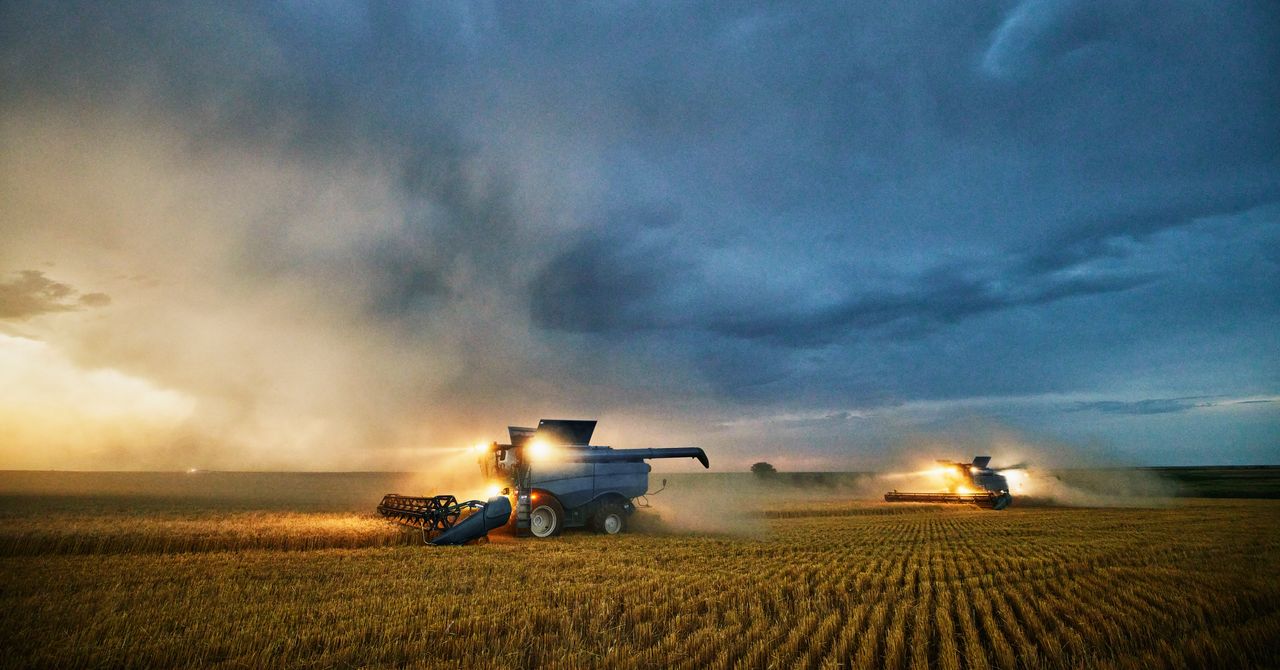
Global oil and gas prices have skyrocketed following the US attack on Iran last weekend. But another key global supply chain is also at risk, one that may directly impact American farmers who have already been squeezed for months by tariff wars. The conflict in the Middle East is choking global supplies of fertilizer right before the crucial spring planting season.
“This literally could not be happening at a worse time,” says Josh Linville, the vice president of fertilizer at financial services company StoneX.
The global fertilizer market focuses on three main macronutrients: phosphates, nitrogen, and potash. All of them are produced in different ways, with different countries leading in exports. Farmers consider a variety of factors, including crop type and soil conditions, when deciding which of these types of fertilizer to apply to their fields.
Potash and phosphates are both mined from different kinds of natural deposits; nitrogen fertilizers, by contrast, are produced with natural gas. QatarLNG, a subsidiary of Qatar Energy, a state-run oil and gas company, said on Monday that it would halt production following drone strikes on some of its facilities. This effectively took nearly a fifth of the world’s natural gas supply offline, causing gas prices in Europe to spike.
That shutdown puts supplies of urea, a popular type of nitrogen fertilizer, particularly at risk. On Tuesday, Qatar Energy said that it would also stop production of downstream products, including urea. Qatar was the second-largest exporter of urea in 2024. (Iran was the third-largest; it’s also a key exporter of ammonia, another type of nitrogen fertilizer.) Prices on urea sold in the US out of New Orleans, a key commodity port, were up nearly 15 percent on Monday compared to prices last week, according to data provided by Linville to WIRED. The blockage of the Strait of Hormuz is also preventing other countries in the region from exporting nitrogen products.
“When we look at ammonia, we’re looking at almost 30 percent of global production being either involved or at risk in this conflict,” says Veronica Nigh, a senior economist at the Fertilizer Institute, a US-based industry advocacy organization. “It gets worse when we think about urea. Urea is almost 50 percent.”
Other types of fertilizer are also at risk. Saudi Arabia, Nigh says, supplies about 40 percent of all US phosphate imports; taking them out of the equation for more than a few days could create “a really challenging situation” for the US. Other countries in the region, including Jordan, Egypt, and Israel, also play a big role in these markets.
“We are already hearing reports that some of those Persian Gulf manufacturers are shutting down production, because they’re saying, ‘I have a finite amount of storage for my supply,’” Linville says. “‘Once I reach the top of it, I can’t do anything else. So I’m going to shut down my production in order to make sure I don’t go over above that.’”
Conflict in the strait has intensified in the early part of this week, as the Islamic Revolutionary Guard Corps have reportedly threatened any ship passing through the strait. Traffic has slowed to a crawl. The Trump administration announced initiatives on Tuesday meant to protect oil tankers traveling through the strait, including providing a naval escort. Even if those initiatives succeed—which the shipping industry has expressed doubt about—much of the initial energy will probably go toward shepherding oil and gas assets out of the region.
“Fertilizer is not going to be the most valuable thing that’s gonna transit the strait,” says Nigh.


US’ Wolverine Worldwide 2025 revenue rises 6.8% on Active Group growth

Extreme heat threatens health, jobs in Indian textile sector: Report

Saudi Oil Supply Assurance Lifts Pakistan Stock Market – SUCH TV

India Us Trade Deal: Fresh look at India-US trade deal? May be ‘rebalanced’ if circumstances change, says Piyush Goyal – The Times of India

Attock Cement’s acquisition approved | The Express Tribune

What are Iran’s ballistic missile capabilities?

-
Business6 days ago
India Us Trade Deal: Fresh look at India-US trade deal? May be ‘rebalanced’ if circumstances change, says Piyush Goyal – The Times of India
-
Business7 days ago
Attock Cement’s acquisition approved | The Express Tribune
-
 Politics7 days ago
What are Iran’s ballistic missile capabilities?
-

 Politics1 week ago
US arrests ex-Air Force pilot for ‘training’ Chinese military
-
 Business1 week ago
Households set for lower energy bills amid price cap shake-up
-

 Fashion1 week ago
OECD GDP growth slows to 0.3% in Q4 amid mixed trends
-

 Fashion7 days ago
Policy easing drives Argentina’s garment import surge in 2025
-

 Sports6 days ago
LPGA legend shares her feelings about US women’s Olympic wins: ‘Gets me really emotional’