

Business
AI demand means data centres are worsening drought in Mexico


Suzanne BearneTechnology Reporter, Querétaro, Mexico
 Arterra/Getty Images
Located in the middle of Mexico, Querétaro is a charming and colourful colonial-style city known for its dazzling stone aqueduct.
But the city, and state of the same name, is also recognised for a very different reason – as Mexico’s data centre capital.
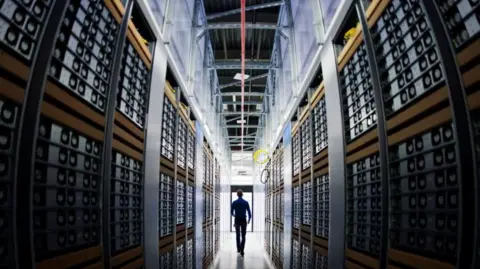
Across the state companies including Microsoft, Amazon Web Services and ODATA own these warehouse-like buildings, full of computer servers.
No one could supply an exact number, but there are scores of them, with more being built.
Ascenty, which claims to be the largest data centre company in Latin America, has two in Querétaro, both around 20,000 sq ft in size, with a third under construction.
It is forecast that more than $10bn (£7.4bn) in data centre-related investment will pour into the state in the next decade.
“The demand for AI is accelerating the construction of data centres at an unprecedented speed,” says Shaolei Ren, associate professor of electrical and computer engineering at the University of California Riverside.
So, what’s the attraction of Querétaro?
“It’s a very strategic region,” explains Arturo Bravo, Mexico country manager at Ascenty.
“Querétaro is right in the middle [of the country], connecting east, west, north and south,” he says.
That means it is relatively close to Mexico City. It is also connected to high-speed data cables, so large amounts of data can be shifted quickly.
Mr Bravo also points out that there is support from the municipality and central government.
“It’s been identified as a technology hub,” he says. “Both provide a lot of good alternatives in terms of permits, regulation and zoning.”
But why are many US companies choosing this state over somewhere closer to home?
“The power grid capacity constraint in the US is pushing tech companies to find available power anywhere they can,” says Shaolei Ren, associate professor of electrical and computer engineering at the University of California Riverside, adding that the cost of land and energy, and business-friendly policies are also attractive.

 Shaolei Ren
Data centres host thousands of servers – a specialised type of computer for processing and sending data.
Anyone that’s worked with a computer on their lap will know that they get uncomfortably hot. So to stop data centres melting down, elaborate cooling systems are needed which can use huge amounts of water.
However, not all data centres consume water at the same rate.
Some use water evaporation to dissipate the heat, which works well but is thirsty.
A small data centre using this type of cooling can use around 25.5 million litres of water per year.
Other data centres, like those owned by Ascenty, use a closed-loop system, which circulates water through chillers.
Meanwhile, Microsoft told the BBC it operates three data centres in Querétaro. They use direct outdoor air for cooling approximately 95% of the year, requiring zero water.
It said for the remaining 5% of the year, when ambient temperatures exceed 29.4°C, they use evaporative cooling.
For the fiscal year 2025, its Querétaro sites used 40 million litres of water, it added.
That’s still a lot of water. And if you look at overall consumption at the biggest data centre owners then the numbers are huge.
For example, in its 2025 sustainability report Google stated that its total water consumption increased by 28% to 8.1bn gallons between 2023 to 2024.
The report also said that 72% of the freshwater it used came from sources at “low risk of water depletion or scarcity”.
In addition, data centres also indirectly consume water, as water is needed to produce electricity.
 Getty Images
The extra water consumption by data centres is a big problem for some in Querétaro which last year endured the worst drought of a century, impacting crops and water supplies to some communities.
At her home in Querétaro, activist Teresa Roldán tells me residents have asked the authorities for more information and transparency about the data centres and the water they use but says this has not been forthcoming.
“Private industries are being prioritised in these arid zones,” she says. “We hear that there’s going to be 32 data centres but water is what’s needed for the people, not for these industries. They [the municipality] are prioritising giving the water they have to the private industry. Citizens are not receiving the same quality of the water than the water that the industry is receiving.”
Speaking to the BBC in Querétaro, Claudia Romero Herrara, founder of water activist organisation Bajo Tierra Museo del Agua, wouldn’t comment directly on the data centres due to a lack of information but says she’s concerned about the state’s water issues.
“This is a state that is already facing a crisis that is so complex and doesn’t have enough water for human disposal. The priority should be water for basic means…that’s what we need to guarantee and then maybe think if there are some resources available for any other economic activity. There has been a conflict of interest on public water policy for the last two decades.”
A spokesperson for the government of the state of Querétaro defended their decision saying: “We have always said and reiterated that the water is for citizen consumption, not for the industry. The municipality has zero faculties to water allocation and even less to assign water quality. Nor the state, nor the municipality can water allocate to any industry or the primary sector, that’s a job for the National Water Commission.”
 Suzanne Bearne
Another concern for those living near data centres is air pollution.
Prof Ren says data centres typically rely on diesel backup generators that release large amounts of harmful pollutants.
“The danger of diesel pollutants from data centres has been well recognised,” he says, pointing to a health assessment of the air quality surrounding local data centres by the Department of Ecology at the state of Washington.
Mr Bravo responded to those concerns by saying: “We operate under the terms and conditions specified by authorities, which, in turn, in my perspective, are the ones taking care of the fact that those conditions are acceptable for the communities around and the health of everybody.”
As for the future, Ascenty is planning more data centres in the region.
“I do see it just kind of progressing and progressing, with a new data centre there every few years,” says Mr Bravo.
“The industry will continue to grow as AI grows. It’s a great future in terms of what is coming.”

The UK could face some food shortages by the summer under a worst case scenario drawn up by government officials.
Source link

The U.S. Internal Revenue Service (IRS) building stands after it was reported the IRS will lay off about 6,700 employees, a restructuring that could strain the tax-collecting agency’s resources during the critical tax-filing season, in Washington, D.C., Feb. 20, 2025.
Kent Nishimura | Reuters
A version of this article first appeared in CNBC’s Inside Wealth newsletter with Robert Frank, a weekly guide to the high-net-worth investor and consumer. Sign up to receive future editions, straight to your inbox.
For seven years, wealthy Americans faced a looming deadline to take advantage of tax provisions that were set to expire at the end of 2025. While the One Big Beautiful Bill Act alleviated much of the uncertainty by making most of the cuts permanent, lawyers and tax accountants say the ever-shifting tax code requires constant planning.
With this year’s Tax Day now behind us, here are five of the most important planning strategies wealthy investors and high earners are thinking about for next year and beyond.
1. Long-short tax-loss harvesting
Last year’s tax bill permanently raised the estate tax exemption to $15 million per person, up from $13.99 million. (It was initially set to be cut in half at the end of 2025.)
The higher threshold has prompted a shift in focus from minimizing federal estate taxes to lowering taxes on income and capital gains. Minimizing capital gains has become crucial after several years of strong market gains, according to Mitchell Drossman, head of national wealth strategies in Bank of America’s chief investment office. The S&P 500 has surged more than 75% since the beginning of 2023.
“The biggest tax story to me is a capital gains and investing story,” said Drossman. “You have lots of clients who are sitting on significant gains.”
Investors are increasingly turning to long-short tax-loss harvesting, an aggressive form of a popular strategy, in order to minimize capital gains, Drossman said. With traditional tax-loss harvesting, investors sell losing assets to offset realized gains on others. Long-short tax strategies, on the other hand, borrow against the portfolio to buy short positions expected to fall and maintain long positions expected to thrive.
“If there’s natural volatility in the markets, you have, now, a greater amount of an asset base to choose from in terms of harvesting losses,” he said. “But when you look at your overall portfolio, you’re still kind of neutral.”
2. Bonus depreciation
The 2025 tax bill renewed bonus depreciation, allowing businesses to deduct the full cost of qualifying assets like machinery, computers or vehicles the first year they are used.
Adam Ludman, head of tax strategy at J.P. Morgan Private Bank, said many clients with operating businesses are investing with bonus depreciation in mind, such as buying private jets.
Real estate developers and investors are trying to get the most bang for their buck by assessing which parts of their properties can be depreciated faster, according to Ludman. For instance, while a commercial building can take 39 years to depreciate, a parking lot can be depreciated over 15 years, allowing owners to recover costs faster.
3. Changing domiciles
A wave of blue states are considering new taxes on top earners and high-net-worth individuals in order to cover cuts in federal aid. California’s one-time billionaire tax proposal may end up on the November ballot, while Maine and Washington have recently passed millionaire taxes.
Jane Ditelberg, chief tax strategist for Northern Trust Wealth Management, said a growing number of clients are asking how to change their tax status as these proposals gain traction. Depending on their state, residents can avoid state-level taxes by creating trusts in states with favorable trust income laws like Delaware.
The most straightforward way to avoid local taxes is to change your domicile, which is easier said than done, according to Jere Doyle of BNY Wealth. The senior estate planning strategist based in Massachusetts, which imposes a millionaire tax, said he has had clients move to New Hampshire and establish residency before selling their businesses.
But clients are often loath to take the steps necessary to establish intent not to return, Doyle said. For instance, moving to Florida may not be enough to avoid Massachusetts taxes if you refuse to sell your Martha’s Vineyard home, he said.
“Everyone thinks that if they spend 183 days in another state, you’re domiciled in that state. That’s not necessarily true. Each state’s a little bit different,” he said. “You [have] got to change where you vote, where your car is registered, even where your doctors are, what clubs you belong to, golf clubs, country clubs, things like that.”
4. Bunching charitable gifts
One notable drawback of last year’s tax bill was a reduction in the tax benefits of charitable giving for top earners.
The bill limits top-earning donors in two ways. First, starting this year, donors who itemize will only be able to deduct charitable contributions in excess of 0.5% of their adjusted gross income, or AGI.
Second, taxpayers in the 37% tax bracket will have their itemized deductions reduced by 2/37th of the value. This ceiling reduces the effective tax benefit from 37% to 35%.
Ditelberg said many clients accelerated their charitable giving last year before these new rules took effect. She said she anticipates clients will continue to “bunch” their donations, by giving a larger sum in one year rather than spreading it over multiple years, so they only trigger the 0.5% haircut once, either through their foundations or donor-advised funds.
5. Opportunity zones
The tax bill also offered an incentive for business owners and real estate owners to postpone selling their assets. The bill made permanent the qualified opportunity zone program, which allows investors to defer capital gains by rolling them over into a fund that invests in a low-income community.
The opportunity zone funds created under the first Trump administration still exist, but you can only defer the taxes until the end of the year. The new opportunity zones, which have yet to be designated, come with enhanced benefits, especially for investors in rural communities. For instance, if you hold your investment in a qualified rural opportunity fund for five years, your capital gains are reduced by 30% for tax purposes.
But you only have 180 days to roll over your gains, and the new opportunity zone rules don’t take effect until 2027, Ditelberg noted.
“If you’re thinking of incurring a major gain, you may want to defer it until August or September, instead of doing it in May or June, if you think you would like to take advantage of the opportunity zone deferral,” she said. “I think we’re going to see people who are incurring gains in the second half of this year.”
That said, investors are waiting to see what the new funds entail. Drossman said some clients are reluctant to invest in opportunity zones again after their previous investments underperformed.
“It’s a classic example of not letting the tax-tail wag the dog because these need to be sound investments,” he said. “Like with all investments, there is an element of risk and return.”

Illuminated logo for Pepsi on a soda fountain in Walnut Creek, California, March 4, 2026.
Smith Collection | Gado | Archive Photos | Getty Images
PepsiCo on Thursday reported quarterly earnings and revenue that topped analysts’ expectations as its struggling North American food business reported a return to volume growth.
Here’s what the company reported compared with what Wall Street was expecting, based on a survey of analysts by LSEG:
- Earnings per share: $1.61 adjusted vs. $1.55 expected
- Revenue: $19.44 billion vs. $18.94 billion expected
Pepsi reported first-quarter net income attributable to the company of $2.32 billion, or $1.70 per share, up from $1.83 billion, or $1.33 per share, a year earlier.
Excluding items, the company earned $1.61 per share.
Net sales rose 8.5% to $19.44 billion.


Princess Anne keeps up her relentless royal pace in Dartmouth

France’s Kering begins 2026 on stable footing, eyes Gucci revival

ICE cotton rallies to 22 month-high on weaker dollar, drought worries

-

 Entertainment1 week ago
Queen Elizabeth II emotional message for Archie, Lilibet sparks speculation
-

 Tech1 week ago
Azure customers up in arms over ‘full’ UK South region | Computer Weekly
-

 Tech1 week ago
As the Strait of Hormuz Reopens, Global Shipping Will Take Months to Recover
-

 Fashion1 week ago
CII submits 20-pt agenda to Indian govt to back firms hit by Iran war
-

 Tech1 week ago
This AI Button Wearable From Ex-Apple Engineers Looks Like an iPod Shuffle
-

 Politics6 days ago
Indian airlines hit hardest after Dubai limits foreign flights until May 31
-

 Politics6 days ago
Chinese, Taiwanese will unite, Xi tells Taiwan opposition leader
-
 Business1 week ago
Women In Credit: Share of women in credit rising boosted by digital platforms – The Times of India