

Business
Costly oil sparks shift to plug-in Evs | The Express Tribune

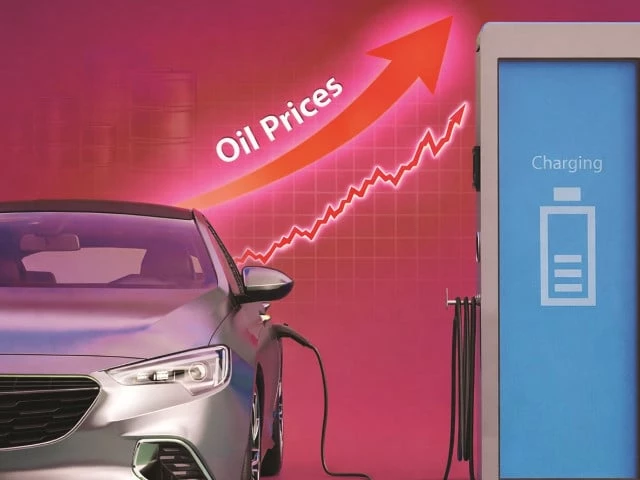
Electric vehicle. Design: Ibrahim Yahya
ISLAMABAD:
As fuel prices shoot up in Pakistan following intensifying war in the Middle East, the economics of driving sport utility vehicles (SUVs) is shifting as plug-in hybrids and extended-range electric vehicles are becoming the more cost-efficient choice.
Pakistan’s latest official petrol pricing data shows ex-depot motor spirit (petrol) is being sold for around Rs321 per litre, underscoring how vulnerable everyday mobility is in the backdrop of imported fuel volatility.
With petrol prices at unprecedented highs, the economics of driving an SUV is shifting rapidly in favour of plug-in hybrids and extended-range electric vehicles, remarked Syed Asif Ahmed, Director Sales and Marketing, Chery Master Pakistan, while talking to The Express Tribune.
Ahmed stressed that the discussion around new energy vehicles (NEVs) should no longer be limited to environmental positioning alone. “For Pakistani commuters, especially SUV users, this is now a straightforward economic decision,” he said. “When fuel prices rise to these levels, the cost of running a conventional petrol SUV becomes a serious burden on household budgets.”
Plug-in Hybrid Electric Vehicles (PHEVs) and Range-Extender Electric Vehicles (REEVs) now offer the most practical relief, Ahmed said, mentioning that a typical petrol-powered C-segment SUV having mileage of around 10 kilometres per litre now costs roughly Rs32 per km to run at current petrol rates.
Even a conventional hybrid, at an assumed fuel economy of around 18 km per litre, costs nearly Rs18 per kilometre. “A hybrid improves efficiency, but it still remains exposed to petrol price shocks,” Ahmed mentioned. “The vulnerability is reduced, but is not removed.”
He argued that plug-in hybrids and REEVs change that equation because they allow most daily urban driving to be completed on electricity instead of petrol. Citing the Chery Tiggo 9 PHEV as an example, he noted that the SUV carries a 34.46 kilowatt-hour (kWh) battery and offers a 170km electric range under the NEDC cycle.
“At a household electricity tariff of Rs50 per unit, a full charge costs about Rs1,723,” Ahmed said. “Spread over 170 km, it means a running cost of roughly Rs10 per km.”
This puts a plug-in SUV dramatically below a petrol SUV in day-to-day running cost, with savings of roughly Rs22 per km and also meaningfully below a conventional hybrid by about Rs8 per km. The advantage becomes even more compelling for urban families, who already have rooftop solar systems at home.
Pakistan’s rooftop solar market has expanded rapidly, with net-metering capacity rising sharply and cumulative rooftop solar installations reaching several gigawatts by 2025, which reflects a major consumer shift towards self-generation.
“This is where Pakistan’s energy transition and mobility transition start meeting each other,” Ahmed said. “A household that generates more of its own power is no longer just reducing its electricity bill; it can also reduce the cost of driving.”
This makes PHEVs and REEVs especially relevant for Pakistani SUV buyers, who typically need space, flexibility and long-distance usability, but are increasingly under pressure from fuel costs. Unlike a full-battery EV, a PHEV or REEV offers electric-led commuting without forcing the customer to depend entirely on a still-developing charging network.
Ahmed linked the argument to the wider national economy, saying Pakistan’s dependence on imported petroleum continues to create pressure on foreign exchange reserves and public finances whenever global oil markets turn volatile. Pakistan’s Fiscal Risk Statement has warned that a 20% global oil price shock could widen the fiscal deficit by Rs487 billion in fiscal year 2025-26 through lower petroleum levy collection and higher subsidies.
“The case for PHEVs and REEVs is not just about one brand or one vehicle,” he said. “It is about giving Pakistani consumers a realistic SUV solution that cuts running costs, reduces exposure to oil shocks and fits local driving conditions.” As petrol prices remain elevated, the market is moving towards a clear conclusion – for Pakistani commuters who want to keep driving SUVs without carrying the full burden of fuel inflation, plug-in hybrids and extended-range EVs are emerging as the most practical answer.





NEW DELHI: The Competition Commission has ordered a detailed probe against French spirits major Pernod Ricard and seven other entities for alleged cartelisation in the Indian-made foreign liquor market.The seven entities that have come under the watchdog’s lens are Indo Spirits, Pathway HR Solutions, Universal Distributors, Khao Gali, Bubbly Beverages, Shiv Associates and Organomix Ecosystems.Ordering the investigation, the regulator said it is of prima-facie view that Pernord Ricard’s restrictive conduct with its retailers/wholesalers, purportedly, to induce brand pushing and achieve higher market share in IMFL market in Delhi, falls within the purview of ‘exclusive dealing agreement’ under the Competition Act. Such conduct violates the Act, according to a 26-page order, dated May 5, by the Competition Commission of India (CCI). The complaint was filed before the CCI in 2024.CCI’s Director General (DG) will carry out the investigation that will also look into the role of the persons/officers who were responsible for the conduct of the activities of such entities as well as individuals whose consent or connivance was involved during the time of the contraventions.

More than half of tradespeople have seen an increase of late payments compared to a year ago, a survey finds.
Source link
Business
Pakistan takes major step with floating solar power project at Keenjhar Lake, Sindh – SUCH TV
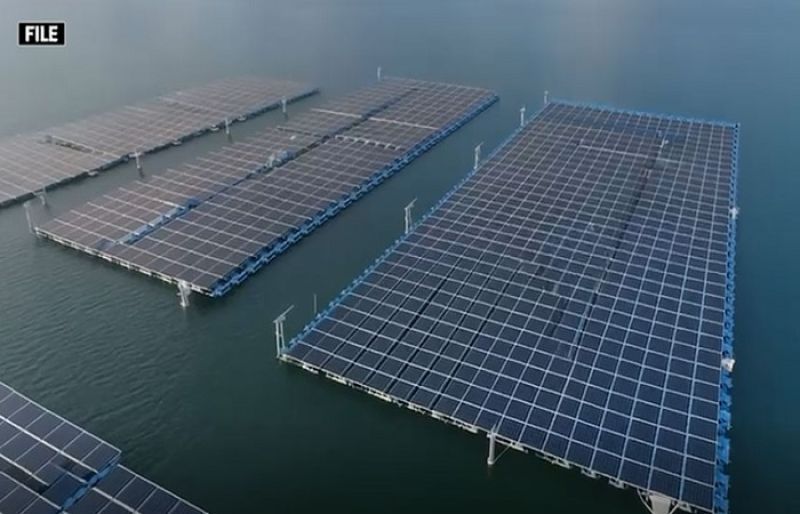
Pakistan is taking a significant step towards promoting renewable energy and energy self-sufficiency with 243 million dollars floating solar power project on Keenjhar Lake in Sindh.
The 500 megawatt project has already been finalized and aims to promote renewable energy and reduce dependence on imported fossil fuels.
The floating solar system on Keenjhar Lake will provide an innovative solution for generating energy without using land and will help in efficient power transmission and meeting energy needs of industrial and urban areas.
This development is a significant step towards Pakistan’s 2030 environmental goals and self-sufficiency in the energy sector.

Cost of living crisis sees tradespeople having to chase debt
CCI to probe Pernod Ricard, seven others – The Times of India

Justin Timberlake pays Mother’s Day tribute to “greatest women” in life

-
 Politics1 week ago
Iran weighs US reply delivered via Pakistan as Trump signals opposition to deal terms
-

 Fashion1 week ago
US’ J.Jill, Inc. appoints Kimberly Wallengren as CMO
-

 Fashion1 week ago
AAFA pushes for swift US House passage of key anti-counterfeiting law
-

 Fashion1 week ago
US cotton export sales show strong recovery, Upland rise 36%
-

 Sports1 week ago
Sajid Ali Sadpara summits world’s fifth-highest peak
-

 Tech6 days ago
DHS Demanded Google Surrender Data on Canadian’s Activity, Location Over Anti-ICE Posts
-

 Fashion1 week ago
ICE cotton witnesses sharp rise on weaker dollar, strong exports
-
 Business7 days ago
Heineken to invest £44.5m in hundreds of pubs creating 850 jobs