

Politics
Trump approved Iran operation after Netanyahu argued for joint assassination of Khamenei: sources

- Netanyahu lobbied hard for Iran attack.
- Rubio warned US facilities will be targeted.
- Operation Epic Fury launched Feb 27.
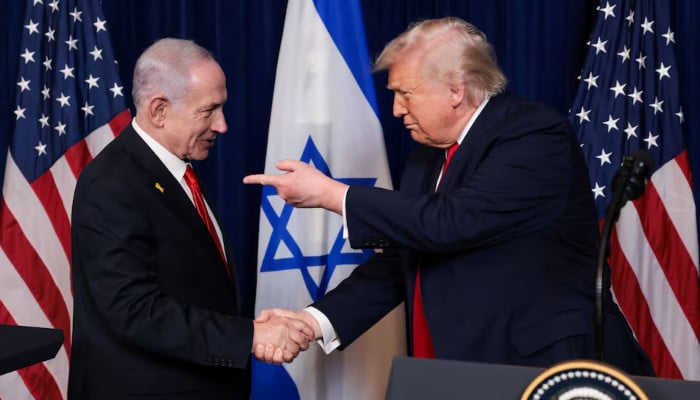
Less than 48 hours before the US-Israeli strike on Iran began, Prime Minister Benjamin Netanyahu spoke by phone to President Donald Trump about the reasons for launching the kind of complex, far-off war the American leader once had campaigned against.
Both Trump and Netanyahu knew from intelligence briefings earlier in the week that Iranian Supreme Leader Ayatollah Ali Khamenei and his key lieutenants would soon meet at his compound in Tehran, making them vulnerable to a “decapitation strike” — an attack against a country’s top leaders often used by Israelis but traditionally less so by the United States.
But new intelligence suggested that the meeting had been moved from Saturday night to Saturday morning, according to three people briefed on the call.
The call has not been previously reported.
Netanyahu, determined to move forward with an operation he had urged for decades, argued that there might never be a better chance to assassinate Khamenei
By the time the call took place, Trump already had approved the idea of the United States carrying out a military operation against Iran but had not yet decided when or under what circumstances the United States would get involved, said the sources, who spoke on condition of anonymity to discuss sensitive internal deliberations.
The US military had for weeks built up a presence in the region, prompting many within the administration to conclude it was just a matter of when the president would decide to move forward. One possible date, just a few days earlier, had been scuttled because of bad weather.
Reuters was unable to determine how Netanyahu’s argument affected Trump as he contemplated issuing orders to strike, but the call amounted to the Israeli leader’s closing argument to his US counterpart.
The three sources briefed on the call said they believed it — along with the intelligence showing a closing window to assassinate Iran’s leader — was a catalyst for Trump’s final decision to order the military on February 27 to move ahead with Operation Epic Fury.
The first bombs struck on Saturday morning, February 28. Trump announced that evening that Khamenei was dead.
In response to a request for comment, White House spokeswoman Anna Kelly did not directly address the call between Trump and Netanyahu but told Reuters the military operation was designed to “destroy the Iranian regime’s ballistic missile and production capacity, annihilate the Iranian regime’s Navy, end their ability to arm proxies, and guarantee that Iran can never obtain a nuclear weapon.”
Neither Netanyahu’s office nor Iran’s UN representative responded to comment requests.
Netanyahu in a news conference on Thursday dismissed as “fake news” claims that “Israel somehow dragged the US into a conflict with Iran. Does anyone really think that someone can tell President Trump what to do? Come on.”
Trump has said publicly that the decision to strike was his alone.
Reuters reporting, with officials and others close to both leaders speaking mostly on condition of anonymity given the sensitivity of internal deliberations, does not suggest that Netanyahu forced Trump to go to war.
But the reporting shows that the Israeli leader was an effective advocate and that his framing of the decision — including the opportunity to assassinate an Iranian leader — was persuasive to the president.
Defence Secretary Pete Hegseth in early March suggested that revenge was at least one motive for the operation, telling reporters, “Iran tried to kill President Trump, and President Trump got the last laugh.”
June attack targeted nuclear sites
Trump ran his campaign in 2024 based on his first administration’s foreign policy of “America First” and said publicly that he wanted to avoid war with Iran, preferring to deal with Tehran diplomatically.
But as discussions over Iran’s nuclear programme failed to produce a deal last spring, Trump began contemplating a strike, according to the three people familiar with White House deliberations.
A first attack came in June, when Israel bombed Iran’s nuclear facilities and missile sites, and killed several Iranian leaders. US forces later joined the attack, and when that joint operation ended after 12 days, Trump publicly reveled in the success, saying the US had “obliterated” Iran’s nuclear facilities.
Yet months later, talks began again between the US and Israel about a second aerial attack aimed at hitting additional missile facilities and preventing Iran from gaining the ability to build a nuclear weapon.
The Israelis began to plan their attack on Iran under the assumption they would be acting alone, Defence Minister Israel Katz told Israel’s N12 News on March 5.
But during a December visit to Trump’s Mar-a-Lago estate in Florida, Netanyahu told Trump that he was not fully satisfied with the outcome of the joint operation in June, said two people familiar with the relationship between the two leaders, speaking on condition of anonymity.
Trump indicated he was open to another bombing campaign, the people added, but he also wanted to try another round of diplomatic talks.
Two events pushed Trump toward attacking Iran again, according to several US and Israeli officials and diplomats.
The US operation on January 3 to capture Venezuela’s President Nicolas Maduro in Caracas — which resulted in no American deaths while removing from power a longstanding US foe — demonstrated the possibility that ambitious military operations could have few collateral consequences for US forces.
Later that same month, massive anti-government protests erupted in Iran. Trump vowed to help the protesters but did little immediately that was public.
Privately, however, cooperation intensified between the Israel Defence Forces and the US military’s Middle East command, known as Centcom, with joint military planning conducted during secret meetings, according to two Israeli officials, speaking on condition of anonymity.
Not long after, during a February visit by Netanyahu to Washington, the Israeli leader briefed Trump on Iran’s growing ballistic missile programme, pointing out specific sites of concern.
He also laid out the dangers of the ballistic missile programme, including the risk that Iran might eventually gain the ability to strike the American homeland, said three people familiar with the private conversations.
The White House did not respond to questions about Trump’s December and February meetings with Netanyahu.
Trump’s chances at history
By late February, many US officials and regional diplomats considered a US attack on Iran very likely to proceed, though the details remained uncertain, according to two other US officials, one Israeli official and two additional officials familiar with the matter.
Trump was briefed by Pentagon and intelligence officials on the potential advantages to be gained from a successful attack, including the decimation of Iran’s missile program, according to two people familiar with those briefings.
Before the phone call between Netanyahu and Trump, Secretary of State Marco Rubio told a small group of top Congressional leaders on February 24 that Israel was likely to attack Iran, whether or not the US participated, and Iran would then likely retaliate against US targets, according to three people briefed on the meeting.
Behind Rubio’s warning was an assessment by American intelligence officials that such an attack would indeed provoke counterstrikes from Iran against US diplomatic and military outposts and US Gulf allies, said three sources familiar with US intelligence reports.
This prediction proved accurate. The strikes have led to Iranian counterattacks on US military assets, the deaths of more than 2,300 Iranian civilians and at least 13 US service members, attacks on US Gulf allies, the closure of one of the world’s most vital shipping routes, and a historic spike in oil prices that is already being felt by consumers in the United States and beyond.
Trump had also been briefed that there was a chance, even if small, that the assassination of Iran’s top leaders could usher in a government in Tehran that was more willing to negotiate with Washington, said two other people familiar with Rubio’s briefing.
The possibility of regime change was one of Netanyahu’s arguments in the call shortly before Trump gave final orders to attack Iran, said the people briefed on it.
That view was not held by the Central Intelligence Agency, which had assessed in the weeks prior that Khamenei would likely be replaced by an internal hardliner if he was killed, as Reuters previously reported.
The CIA did not immediately respond to a request for comment.
Trump repeatedly called for an uprising after Khamenei was assassinated. With the war in its fourth week and the region engulfed in conflict, Iran’s Revolutionary Guards still patrol the nation’s streets. Millions of Iranians remain sheltered in their homes.
Khamenei’s son Mojtaba, considered even more harshly anti-American than his father, has been named the new supreme leader of Iran.
- Xi calls visit a milestone.
- Trump touts Boeing deal.
- China urges lasting Iran ceasefire.
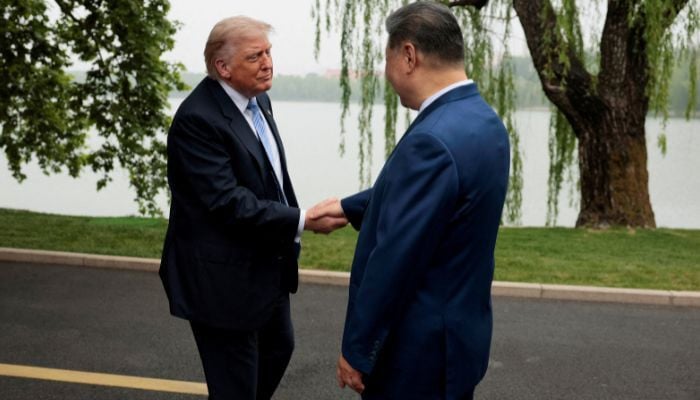
BEIJING: President Donald Trump said he had made “fantastic trade deals” with China’s Xi Jinping, as the pair met on Friday at final talks of a superpower summit that, according to the US leader, has also reaped a Chinese offer to help open the Strait of Hormuz.
Trump had arrived in Beijing seeking to seal deals in sectors including agriculture, aviation and artificial intelligence, as well as to contain differences between the two sides in a number of tense geostrategic areas — not least the Middle East war.
Trump’s overtures to Xi, whom he described as a “great leader” and “friend”, have so far been met with more muted tones by the Chinese leader.
But the US leader said “a lot of good” has come out of the visit.
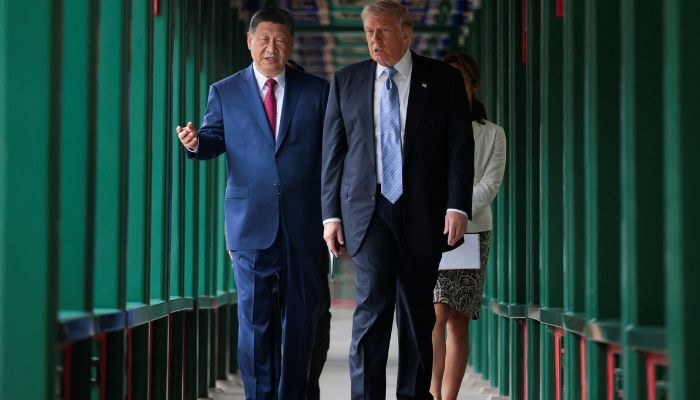
“We’ve made some fantastic trade deals, great for both countries,” he said after a walk with Xi among the rosebushes in the gardens of Zhongnanhai, a central leadership compound next to Beijing’s Forbidden City.
“We’ve settled a lot of different problems that other people wouldn’t have been able to solve,” he added, without providing details.
Xi said it was a “milestone visit”, and that the two sides had to date established “a new bilateral relationship, which is a relationship of constructive strategic stability”.
He promised to send Trump seeds for the White House Rose Garden.
‘Help on Hormuz’
In an interview with Fox News after the first day of the summit had wrapped, Trump said Xi had agreed to several US wishlist points.
On the topic of the war in Iran, the US president said Xi had effectively assured his counterpart that China was not preparing to militarily aid Tehran, which has essentially closed the Strait of Hormuz.
“He said he’s not going to give military equipment… he said that strongly,” Trump told Fox.
“He’d like to see the Hormuz Strait open, and said ‘if I can be of any help whatsoever, I would like to help,'” Trump added.
Asked whether the two leaders had discussed Iran, the Chinese foreign ministry on Friday released a statement calling for “a comprehensive and lasting ceasefire”.
“Shipping lanes should be reopened as soon as possible in response to the calls of the international community,” it added.
Taiwan policy ‘unchanged’
The warm handshakes and pomp on Thursday were somewhat overshadowed by a blunt warning from Xi on a much longer-standing geopolitical flashpoint, Taiwan.
Shortly after talks started, Chinese state media reported Xi had told Trump that missteps on the sensitive issue of Taiwan could push their two countries into “conflict”.
The Fox News interview did not touch upon Taiwan, and Trump did not comment to reporters when asked about the matter on Thursday.
US Treasury Secretary Scott Bessent told CNBC the president would say more “in the coming days”.
Secretary of State Marco Rubio told NBC on Thursday though that “US policy on the issue of Taiwan is unchanged… as of the meeting”.
Beijing had raised the topic, he said, but “we always make clear our position, and we move on to the other topics”.
Taipei responded Friday, thanking Washington “for repeatedly expressing its support”.
Boeing, oil, soybeans
Trump did not spell out on Friday the trade agreements that he said had been sealed with China.
However, in the Fox interview, Trump said one big business deal struck involved Xi agreeing to purchase “200 big” Boeing jets.
Shares of the US aviation giant fell after Trump’s comments, in a sign the market had expected a more robust purchase from China.
The US president also said Beijing had voiced interest in buying US oil and soybeans.
China, which is the key foreign customer of Iranian oil, bought small amounts of US oil before Trump imposed tariffs last year.
It has sharply slowed down purchases of US soybeans, turning instead to Brazil.
And Treasury Secretary Scott Bessent told CNBC that Trump and Xi were talking about setting up “guardrails” for the use of artificial intelligence.
Bessent said the world’s “two AI superpowers are going to start talking”, though US export controls on the advanced technology to China remain a sore point in relations.
- Formal contest to replace Starmer yet to be triggered.
- Cabinet ministers express support for the PM.
- Prime Minister Starmer signals he will fight on.
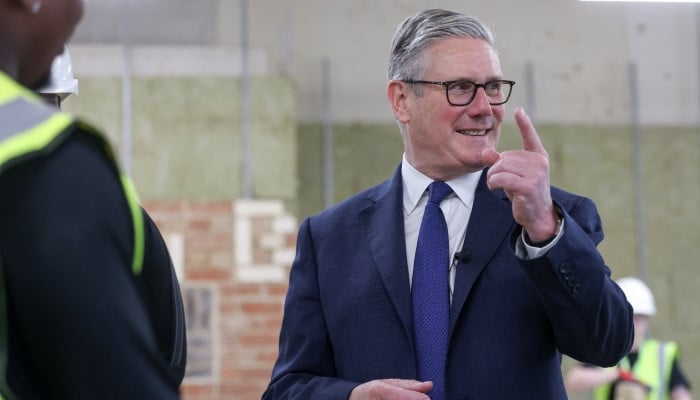
LONDON: British Prime Minister Keir Starmer was struggling to hold on to power after his main rival in the government resigned on Thursday, accusing him of political drift, and others positioned themselves for potential challenges to his leadership.
Disastrous results for the governing Labour Party in local elections last week have plunged Britain into a new crisis, just under two years after Starmer won a large majority on a vow to bring stability and end a decade of political chaos.
After days of calls by Labour lawmakers for Starmer to quit or set out a timetable for his departure, Wes Streeting resigned as health minister, the first senior minister to break cover. He said he was standing down because “it is now clear you will not lead the Labour Party into the next general election”.
While Streeting did not trigger a formal contest, potential rivals to the prime minister, such as Greater Manchester mayor Andy Burnham, started positioning themselves for a possible leadership challenge that Starmer has said he will fight.
Streeting criticised his former boss in a resignation letter which said he was standing down to allow a wide debate about what comes next, one which the Labour movement wanted to focus on ideas rather than personalities or factions.
“It needs to be broad, and it needs the best possible field of candidates,” Streeting wrote.
Streeting says Britain needs vision
“Where we need vision, we have a vacuum. Where we need direction, we have drift,” Streeting said in pointed remarks about Starmer. “Leaders take responsibility, but too often that has meant other people falling on their swords.”
A source close to Streeting said the former health minister had enough support to mount a formal leadership challenge but had not triggered an immediate contest because he felt it would be preferable for Starmer to set out an orderly timetable.
Starmer responded with a letter expressing regret Streeting had stepped down, saying “it is incumbent on all of us to rise to what I see as a battle for the soul of our nation” and “turn the page on the chaos”.
He swiftly appointed one of his supporters, James Murray, as Streeting’s replacement.
The British leader has said he will battle to keep his job, and sources close to him say he is determined to fight any leadership contest.
The pound edged lower after Streeting’s resignation and news that Burnham would seek to return to parliament.
Potential candidates face off against Starmer loyalists
Another possible candidate in any leadership contest, Starmer’s former deputy, Angela Rayner, said earlier on Thursday that she had been cleared of deliberate wrongdoing over her tax affairs, an impediment to challenging the prime minister. But she would not say whether she wanted to launch a formal bid.
Burnham was also offered a path for a possible leadership challenge. After a Labour lawmaker in Greater Manchester said he would resign from his parliamentary seat, Burnham said he would seek permission to stand as Labour’s candidate.
He would have to win an election for that seat to be able to challenge Starmer – an aim he stopped short of voicing.
“Much bigger change is needed at a national level if everyday life is to be made more affordable again. This is why I now seek people’s support to return to parliament,” he said on X.
Another potential candidate is armed forces minister Al Carns, a former Royal Marine seen by some in Labour as a new face who could freshen up the party.
But Starmer still enjoys some support. Education Minister Bridget Phillipson repeated her backing for Starmer and suggested the rest of his cabinet team of top ministers were also supportive.
“This is now a chance for us to pause, take a breath as a party and try and draw a line under all of this,” she said.
Starmer, 63, has adopted a “business-as-usual” approach, and finance minister Rachel Reeves warned lawmakers against plunging Britain into chaos when its anaemic economy was turning a corner. The economy grew unexpectedly in March.
Business leaders fear another leadership race to choose what would be Britain’s seventh prime minister in about a decade would deter investment — something the Labour government has said must improve to turn around Britain’s fortunes.
The political instability has pushed borrowing costs higher, with some investors nervous about the possible election of a more left-wing, tax-and-spend Labour prime minister.
“There have been too many changes of government strategy, leadership, just in my six years of being CEO,” Amanda Blanc, boss of insurance company Aviva, told Reuters. “And I think that is harmful to a major economy such as the UK and how we are perceived abroad.”
- Gales, lightning and rain batter state.
- More than 200 homes damaged.
- Aid ordered for affected families.
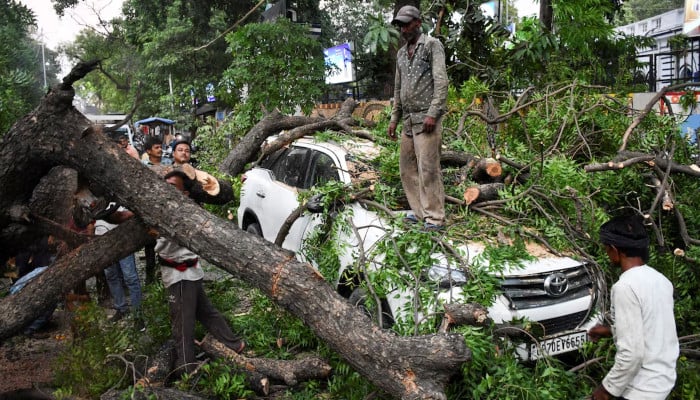
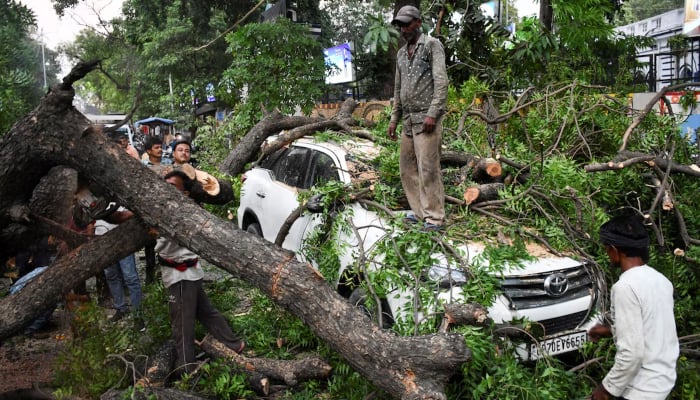
New Delhi: Powerful storms that swept across India’s northern Uttar Pradesh state this week killed at least 111 people, government officials said, raising an earlier death toll as more districts reported casualties.
Gales, lightning and torrential rain battered the state on Wednesday, ripping tin roofs from buildings and uprooting trees that blocked roads, footage broadcast on television showed.
Uttar Pradesh, home to more than 240 million people, is frequently hit by storms during the summer months ahead of the monsoon rains, with lightning strikes a regular cause of death.
The Relief Commissioner’s office, the state aid agency, had initially said that on May 13, 89 people had been killed and 72 injured, with more than 200 homes damaged.
It later updated the toll to 111 dead as more reports came in, according to published remarks in The Hindu newspaper on Friday.
“Reports of 111 deaths were received,” the statement read, adding that 72 people were injured.
The Times of India reported the toll at 117, but AFP was not able to immediately confirm the figure.
One video, widely shared by Indian media, appeared to show a man hurled high into the air in the state’s Bareilly district, as a building roof was torn off.
AFP was unable to immediately verify the video, but the Press Trust of India (PTI) news agency spoke to a survivor in hospital who said he was the man seen in the video.
Nanhe Ansari, a labourer, said he was trying to secure a tin roof with a rope when an intense gust lifted the sheet metal, and he clung on.
“The tin sheet started shaking due to strong winds, so I asked them to bring a rope to tie it down,” he told PTI from his hospital bed.
“While some of us were holding it and one person was tying it, a very strong gust of wind came. My grip did not loosen, and I was lifted nearly 50 feet (15 metres) into the air along with the tin sheet and thrown about 80 feet away,” he added.
“The sheet fell first, and then I fell into a maize field filled with water. I thought I would not survive, but I did.”
India’s weather office has in recent years warned of an increase in extreme weather events, including intense thunderstorms and lightning, which experts link to rising temperatures and changing climate patterns.
The statement said officials have been instructed to distribute financial aid to the affected families.
The violent weather that tore across Uttar Pradesh on Wednesday was part of widespread pre-monsoon thunderstorm activity triggered by unstable atmospheric conditions.


India plans comprehensive employment policy after labour code rollout

Trump says made ‘fantastic trade deals’ with Xi
‘Cheaper’ funeral option left Somerset man unable to say goodbye

-

 Tech7 days ago
A new frontier: Identity stack evolves for agentic systems | Computer Weekly
-

 Tech7 days ago
‘Orbs,’ ‘Saucers,’ and ‘Flashes’ on the Moon: Pentagon Drops New UFO Files
-

 Fashion7 days ago
New orders in German manufacturing up 5% MoM in Mar 2026: Destatis
-

 Tech7 days ago
Nick Bostrom Has a Plan for Humanity’s ‘Big Retirement’
-

 Sports7 days ago
Shaheen Afridi achieves landmark feat during opening Test against Bangladesh
-

 Tech1 week ago
What Microsoft Executives Really Thought About OpenAI in 2018
-

 Fashion7 days ago
US’ Carter’s taps retail veteran Sharon Price John as new CEO
-

 Entertainment6 days ago
Rihanna embraces new tattoo given by children