

Tech
Enjoy up to 60% Off With eBay Coupons in April 2026


Long before we had Amazon or Facebook marketplace, or thousands of other online retailers, we had eBay. And now, we have an eBay coupon to help you save on basics like vacuums and phones, to even your most niche need—because eBay has everything from haunted objects to ironic landline phones to retro gaming consoles. One of the first and most enduring online shopping platforms, eBay has stood the test of time, providing us with the old-school feel of estate sales, complete with bidding wars and gently used items of quite literally every type.
Save up to 60% on Your Next Purchase at eBay
eBay has rotating deals, like 20% off up-and-coming brands, so be sure to check their page often to know which deals are next. They have huge savings on essentials, like Dyson vacuums—an enduring titan in the home cleaning realm. There’s also discounts on like-new refurbished Apple MacBooks and iPads so you can work or study for so much less. It’s not only office tech they have deals on, but even kitchen essentials, like the forever-popular KitchenAid Stand Mixer. eBay has deals on everything from clothing and jewelry to power tools, so check eBay’s deals page often.
How to Use an eBay Coupon (If you Have one Handy)
Once you’ve perused the nearly endless options of items on eBay, here’s how you can redeem the eBay discount code or offer at checkout: first, make sure your code isn’t expired (I know it sounds like a no-brainer, but you don’t want to be disappointed when that dreaded ‘invalid’ pop-up comes on the screen). Enter the code in the ‘Add coupons’ section, or check the box if the coupon is displayed. When you select ‘apply,’ you should see the discounted total, and then you’ll be prompted to pay.
Save More With Free Shipping
Once you find the special item of your dreams, go to the “shipping and pickup” search filter and check the “free shipping” box to get free shipping. Make sure you choose eBay free shipping on a multitude of items like motor parts, books, golf clubs, Pokemon cards, haunted objects, tech, and virtually anything else you can imagine.
Shop These Rotating eBay Deals
eBay has rotating deals, like 20% off up-and-coming brands, so be sure to check their page often to know which deals are next. They also have spotlighted, trending, and featured deals for huge savings on a myriad of products like auto parts, golf clubs, shoes, and more. eBay has a money-back guarantee to ensure you get the item you ordered or you get your money back.
Shop With eBay Mastercard to Get More Rewards
Have you heard of an eBay Mastercard? I hadn’t either, but if you’re a collector or frequent eBay shopper, an eBay Mastercard is a smart way to save on purchases you were already planning to make. You’ll earn five times the amount of points for the rest of the year after you spend $1,000 on eBay in a calendar year. Until then, you’ll earn three times the points per $1 spent, up to $1,000, on eBay in a calendar year. You can also earn twice as many points per $1 spent on gas, restaurant, and groceries, and 1 times as many points per $1 spent on all other Mastercard purchases.
Get Daily Deals With the eBay App
If you’re someone who shops or sells on eBay often, I’d suggest downloading the eBay app for even more perks. The eBay mobile app makes it easy to find the best rotating deals on various items and access to the hottest deals and discounts of the day before they leave. Through the app, you can browse everything from trendy items, to power tools, to tech gadgets, and then choose whatever price looks best. There’s also app-only discounts and special offers exclusively for eBay app users. Plus, eBay will help you figure out when’s the best time to buy, with price notifications to let you know when the price has dropped.












Other Standing Desks to Consider
Photograph: Nicole Kinning
Luxor Compact Electric Standing Desk for $200: The Luxor is a no-nonsense standing desk that does exactly what you expect and takes up minimal space. It’s perfect for students, small apartments, and anyone who needs a compact, budget-friendly setup. At 23.5 inches deep, the tabletop is shallow enough to fit into tight corners or shared spaces. The electric lift moves steadily at an inch per second, whisper-quiet, and the 154-pound weight capacity can handle a laptop, monitor, and a few textbooks with no sweat. The lift mechanism is exposed underneath, so you’ll want to leave some legroom when at sitting height. —Nicole Kinning
Simple Height Adjustable Desk for $850: The Simple Height Adjustable Desk lives up to its name. Assembly is straightforward and cable routing is tidy thanks to an integrated channel that keeps everything corralled. The T-shaped legs slide into a bracket instead of screwing or locking into place, which feels a little ambiguous, but once it’s upright, the desk is solid and sturdy. In practice, the desk became everything I needed. It’s smooth, quiet, and spacious, with four height presets. The laminate top is durable and forgiving—ideal if you’re like me and regularly forget that coasters exist. There are no fancy gimmicks, which is exactly the point. It’s a dependable, fuss-free desk that prioritizes function over flashy. —Nicole Kinning
Autonomous Desk Pro for $600: The standout feature here is the new Desk AI, a separate control attachment that tracks your standing habits along with environmental factors like air pressure and quality, temperature, humidity, and noise. In theory, it’s meant to help you work smarter, but in practice, it mostly flags things you can’t control from the desk itself. If it came with an air purifier or fan to manage these conditions, then we’d be talkin’. Still, it’s a fun and techy bonus on an otherwise reliable desk. —Nicole Kinning

Photograph: Nicole Kinning
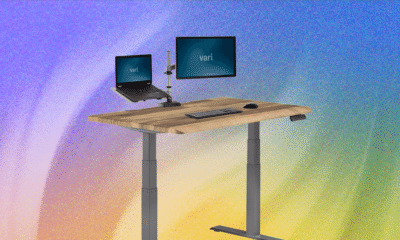
Vari Solid Wood Electric Standing Desk for $1,500: Even though it’s solid wood, this desk never felt too precious for everyday use. Made from FSC-certified lumber, the desk is heavy and stable, even at standing height on carpet, and the motor is impressively quiet and subtle when adjusting. The ComfortEdge feature turned out to be more helpful than I expected; over long typing sessions, it noticeably softened where my wrists meet the desk, a nice upgrade to a standard desk’s hard, squared-off edges. Yes, the solid wood Vari is on the pricier side, but it feels justified if solid wood and long-term durability matter to you. If they don’t, consider the traditional version. —Nicole Kinning
Boulies Magvida for $760: The Boulies Magvida advertises its best feature in the name itself. This mid-size desk (55 x 28 inches) is known for its EMO system, a magnetic organization setup built beneath the desktop. Instead of drilling holes or fiddling with brackets, you just snap accessories like a cable tray, hooks, and silicone straps, into place. The add-ons feel premium and the magnets don’t budge, and there’s an optional magnetic drawer that’s also handy. Add in memory presets, a child lock, anti-collision detection, and simple color options and you’ve got a clean, clever setup. —Nicole Kinning
Herman Miller Jarvis Bamboo Standing Desk for $1,625: As someone who spent years hunching over keyboards, obsessive research led me to the Jarvis Standing Desk (now owned by Herman Miller), which has served me well for six years. With a contoured bamboo top, handy optional extras to tuck wires out of sight, and a responsive control panel for easy height adjustment (including presets), this is an excellent standing desk. The only weakness is that it wobbles slightly at higher levels. The newer touchscreen OLED control unit is not as reliable as the original, so opt for the programmable controls. —Simon Hill
Staples Union & Scale Electric Standing Desk With Micro Movements (UN62092) for $513: Staples’ house brand, Union & Scale, makes some of my favorite affordable office furniture, and its standing desk is no exception. It was easy to put together, and while the white desktop is not much to look at, the dual motors do the job. I like the control panel, which has dedicated buttons for moving the desk up and down, as well as two height presets. I didn’t see any wobble, though the collision sensor could stand to be more sensitive. There’s a cable tray at the bottom back of the desk to route cables, but there’s sadly no grommet to pull them through. The Micro Movement mode. moves the desk up and down over time to reduce fatigue and encourage movement, but I found it more distracting than useful. —Julian Chokkattu
Beflo Tenon Premium for $3,998: While incredibly expensive (and heavy!), this hardwood smart desk is both sturdy and well designed. Assembly was straightforward, and once the desk was up and running, I found all of the features (touchscreen controls, a built-in power strip, audio passthrough, and LED lighting) to work well, and in convenient locations. The touchscreen controls are intuitive (iOS-like), and features like a sit/stand timer and phone connectivity provide additional functionality. The desk supports over 200 pounds of stuff even when moving, and the height-adjustment motors will temporarily disable if they overheat, instead of risking damage to the desk. The table also looks fantastic, and a multitude of first-party accessories let you customize the desk to your specific needs. My largest issue with this table is the noise. While in no way loud, it was certainly more audible than the “whisper-quiet” descriptor Beflo uses in its marketing. Besides that, the lighting color adjustment had some difficulties creating specific colors using the built-in touchscreen, and the audio cable was too short to reach a desktop computer on the floor, even at the lowest height. However, the Tenon is still a great, if pricey, option to consider. —Henri Robbins
Herman Miller Spout Sit-to-Stand Table for $3,275: Herman Miller’s Spout Sit-To-Stand Table is lovely to look at. Like the Branch Four-Legged Desk, it looks like a normal desk with four legs, giving it a luxe look. Those motors in the legs rise smoothly, and it’s easy to raise and lower the desktop to my preferences with the button on the right. The motor does have a high hum to it, and is loud enough that I’d hesitate to use it when my husband is on a call in the same room, but not so loud it would disturb my son if he were sleeping a room away. Bizarrely, it doesn’t have memory presets, but I found it pretty easy to just adjust the desk to my preferred sitting and standing heights each time. You can add a cable tray underneath the desk to organize cords, but it costs extra. The only other item built into the desk is a single slim center drawer perfect for pens and notebooks. It comes in three desktop sizes and three finishes: laminate white, veneer walnut, and veneer ash. You can also customize the base color, with seven different colors ranging from your classic black and white to a gentle blue and olive green. While it’s gorgeous to look at and works well, it is disappointing that such a high-priced desk doesn’t have presets and uses veneers rather than real wood. —Nena Farrell
Flexispot E7 Pro for $400+: Standing desks can get pricey, but Flexispot routinely offers similar functionality at a lower price. At first glance, the E7 Pro looks much like the Herman Miller Jarvis, but look closer, and you discover the entry-level option has a shallow 23-inch desktop, the control unit feels a bit cheap, and it emits a high-pitched whine in operation. I also had some issues fitting larger power adapters in the cable tidy, and it can get wobbly when fully extended. But, even when fully configured, the E7 Pro is cheaper than many rivals. Minor flaws aside, it is a perfectly decent standing desk. —Simon Hill
Inbox Zero 47-inch Adjustable Electric Standing Desk for $163: This desk has every feature I need for just about $200. There are rolling casters so you can not only move the desk up and down, but also shake it all around. It has electric controls that have presets but also allow you to fine-tune the height—my actual use-case for standing desks, as I don’t like standing to work as much as I should, but I do like to adjust the height to accommodate changes in my posture when I’m typing versus Zooming. The split top that makes it easier and cheaper to ship doesn’t hurt the performance, but is less pleasant visually, and the little motor works audibly hard (tshunk, tschunk, tshunk) while raising the desktop. After three months of testing, I’d recommend it to someone who needs a budget standing desk with casters, but if you can spend a little more, you’ll probably be happier with something else. —Martin Cizmar
Standing Desk Accessories
-front-Reviewer-Photo-SOURCE-Julian-Chokkattu-(no-border).jpg)
Branch Clamp-on Power for $89: This simple and elegant clamp attaches to your desktop and adds three AC outlets, a USB-C, and a USB-A, so you don’t have so many wires running down to the ground. —Julian Chokkattu
LumeCube EdgeLight 2.0 for $150: Why have a lamp take up valuable desk space when you can clamp the lamp to your desk? These task lights from LumeCube are great for illuminating the desktop and even your face during late-night Zoom calls. You can adjust the color temperature and the brightness. —Julian Chokkattu
-(no-border)-SOURCE-Julian-Chokkattu.jpg)
BenQ ScreenBar Lamp for $139: Alternatively, you can place these ScreenBar lamps over your computer monitor, and it will light up your desktop, no clamping required. The ScreenBar Pro also has a motion sensor, so when you leave your desk, the lamp will turn off, and it will light up when you’re back. You can adjust the brightness and color temperature, and an automatic setting makes it adjust these controls based on the room’s ambient lighting. —Julian Chokkattu
Secretlab Premium Footrest for $89: I’ve been using this footrest for several years, and it’s excellent. The plush memory foam is cushy and a nice respite for my feet, and it’s easy to clean with a vacuum and a damp cloth. It hasn’t shown much wear despite years of use. —Julian Chokkattu
Monoprice Single Monitor Adjustable Gas Spring Desk Mount for $84: I’ve had a few of these WorkStream arm mounts for years, and they’ve reliably done the job. You can adjust the tension with a hex key and move the monitor around to your desired position. Just make sure you don’t go over the recommended weight load with a big and heavy screen. —Julian Chokkattu
Mount-It! Dual Monitor Arm for $280: This heavy-duty monitor arm holds up my ultrawide monitor and my vertical monitor, both of which have BenQ Screenbar lamps on top, along with my webcam. It handles the weight with no effort, and the clamp is accommodating enough to even work with the 5-inch Room & Board standing desk. There’s RGB lighting throughout, but it’s not bright enough to splash onto the wall, so it’s a little pointless. —Julian Chokkattu
Harber London Professional Desk Mat for $239: Keep your desktop protected with a large desk mat like this one. I’ve used several mats from Harber London over the years, and this latest model is my favorite. The pebbled leather is supple and soft, and the mat stays put. It’s easy to clean too. —Julian Chokkattu
Avoid These Standing Desks
.jpg)
Corsair Platform:6 Desk for $1,400: Where do I start? I liked Corsair’s standing desk because it’s spacious, has a fun pegboard design to mount your tchotchkes, and even has an interesting rail system that lets you mount and slide things across the desktop, like your monitors. Unfortunately, several months after mounting two monitors on the included dual-monitor arms, this rail system has tilted forward due to the weight. (I’m also not the only one to experience this.) It doesn’t help that I never really found this rail to be all that useful. The standing function works well, and you get two presets, but sometimes the little screen would throw me an error message “rE5.” Pressing and holding the down button resolved it, but none of these are issues anyone should deal with considering the crazy-high price. That’s the real problem. It’s just so expensive, and the five-year warranty feels like a slap in the face. —Julian Chokkattu
Marinamantra ‘Flow’ Sit-to-Stand Desk for $1,049: I had high hopes for this one. A desk that lets me sit criss-cross applesauce while I work?! Sold. But the reality didn’t live up to the pitch. When I unboxed the desk, several screws were scattered loose in the box. That set the tone for a desk that eventually worked, but often misbehaved, sometimes refusing to move up and down. That said, I do like the cord management lip and the clever velcro covers that keep cables and hardware neatly tucked out of sight. Unfortunately, none of that matters much if I’m spending more time flipping it over and poking around underneath the hood than actually using it. —Nicole Kinning
ErgoAV Standing Desk for $2,000: I’ve wanted a standing desk for years, so I was extremely excited to try out this one from ErgoFx. For almost two grand, it comes jam-packed with features including a wireless charging pad that automatically lifts and rotates towards you, a five-outlet power strip, and a built-in drawer to put all your office supplies in. You can also control it via the companion app. It has a super durable laminated MDF desktop and a carbon-steel frame and looks sleek. Unfortunately, only a few months into using it, I started having issues where the desk would get stuck at a specific height. This would typically happen if I didn’t adjust it for a few days or weeks. The only way to solve this was by unplugging the power cord and plugging it back in. After each reset, it would work normally again. But this issue comes back every time, so that I’ve stopped trying to fix it. It’s become more trouble than it’s worth—especially at this price. —Brenda Stolyar
Power up with unlimited access to WIRED. Get best-in-class reporting and exclusive subscriber content that’s too important to ignore. Subscribe Today.

To anyone with a pulse and a smartphone, it’s obvious that the internet has an AI slop problem. The issue has grown more severe since ChatGPT launched in 2022, with some social platforms flooded with AI-generated writing. Now, there’s data to back up the anecdotal evidence.
A new preprint study published today from researchers at the Imperial College of London, Stanford University, and the Internet Archive found that approximately 35 percent of all new websites are either AI-generated or AI-assisted. The same study also found that online writing is “increasingly sanitized and artificially cheerful.” In other words, AI is making the internet fake-happy.
The research team tried four different approaches to AI detection before settling on tools from Pangram Labs after it delivered the most consistent results. (Though the team found it performed well on its tests, it is worth noting that all artificial intelligence detection tools are imperfect.) To compile a representative sample of websites, it tapped the Internet Archive’s Wayback Machine, which collects snapshots of webpages. In addition to quantifying how many sites created between 2022 and 2025 lean on AI-generated writing, the study also tested six different theories about the characteristics of slop.
The test that looked into artificial cheerfulness examined how AI affected the tone of online writing. Using sentiment analysis, which classifies words as positive, neutral, or negative, it found that “the average positive sentiment score of AI-generated or AI-assisted was 107 percent higher than that of non-AI websites.” The researchers see this spike in artificial happiness as a “symptom” of the “sycophantic and overoptimistic nature of existing LLMs.” In this way, AI writing tools’ tendency to suck up to their human users has a spillover effect, making the overall tenor of online writing more saccharine.
Another test investigated whether the increase in AI-generated writing shrinks “the range of unique ideas and diverse viewpoints” on offer. The researchers found that AI did make the internet less ideologically diverse, with AI websites scoring roughly 33 percent higher on testing for “semantic similarity” than human-made websites.
While those two tests validated the researchers’ assumptions about AI, others did not. Four theories that the researchers tested were not confirmed. Notably, they had suspected that AI would lead to a rise in misinformation, but their analysis of the evidence did not support the hypothesis. They had also guessed that AI writing wouldn’t link out to external sources, and that it would be stylistically more generic than human writing. Confounding expectations, neither of those theories were supported by the evidence, either.
While the analysis found that the ideas espoused by AI writing were more homogenous—and specifically, more consistently cheery—the writing style itself was not confirmed to be flattened. This came as a big surprise to the researchers, who had assumed they would see a clear move towards more generic output. “Everyone on the team expected that to be true,” says Stanford researcher Maty Bohacek. “But we just don’t have significant evidence for that.”
Prior to conducting its analysis, the research team commissioned a poll on how people feel about AI. Comparing it to the results, it discovered that the researchers weren’t the only ones who had their expectations upended. Many commonly held beliefs about AI writing are wrong, their study finds.
Like the researchers, most people polled had also assumed that they would encounter a rise in fake news as the amount of AI-generated websites they saw increased. The vast majority of respondents had also assumed that AI writing would stop linking to external sources, and that it would have an increasingly generic, uniform voice. “It’s interesting to see that people tended to expect the worst outcomes,” Bohacek says.
This study is far from the last word on what AI is doing to the internet. “We just wanted to break ground,” says Bohacek, who sees this as a jumping-off point for deeper exploration. As a snapshot of AI slop’s impact, it offers a particularly human flavor of insight: Sometimes, it’s simply hard to predict how things will unfold.

Nevertheless, there are clear patterns that appear. In nearly all cases, teenage boys are allegedly responsible for the creation of the images or videos. They are often shared in social media apps or via instant messaging with classmates. And they are hugely harmful to the victims. “I’m worried that every time they see me, they see those photos,” one victim in Iowa said earlier this year. “She’s been crying. She hasn’t been eating,” another’s family said.
In multiple instances, victims often do not want to attend school or be faced with seeing those who created explicit images or videos of them. “She feels hopeless because she knows that these images will likely make it onto the internet and reach pedophiles,” says lawyer Shane Vogt, and three Yale Law School students, Catharine Strong, Tony Sjodin, and Suzanne Castillo, who are representing one unnamed New Jersey teenager in legal action against a nudifying service. “She is severely distressed by the knowledge that these images are out there, and she will have to monitor the internet for the rest of her life to keep them from spreading.”
In South Korea and Australia, schools have given pupils the option not to have their photos in yearbooks or stopped posting images of students on their official social media accounts, citing their use for potential deepfake abuse. “Around the world, there have been cases where school images were taken from public social media pages, altered using AI, and turned into harmful deepfakes,” one school in Australia said. “Imagery will instead feature side profiles, silhouettes, backs of heads, distant group shots, creative filters, or approved stock photography.”
Sexual deepfakes created using AI have existed since around the end of 2017; however, as generative AI systems have emerged and become more powerful, they have led to a shadowy ecosystem of “nudification” or “undress” technologies. Dozens of apps, bots, and websites allow anyone to create sexualized images and videos of others with just a couple of clicks, often with no technical knowledge.
“What AI changes is scale, speed, and accessibility,” says Siddharth Pillai, cofounder and director of the RATI Foundation, a Mumbai-based organization working to prevent violence against women and children. “The technical barrier has dropped significantly, which means more people, including adolescents, can produce more convincing outputs with minimal effort. As with many AI-enabled harms, this results in a glut of content.”
Amanda Goharian, the director of research and insights at child safety group Thorn, says its research indicates that there are different motivations involved in teenagers creating deepfake abuse, ranging from sexual motivations, curiosity, revenge, or even teens daring each other to create the imagery. Studies involving adults who have created deepfake sexual abuse similarly show a host of different reasons why the images may be created. “The goal is not always sexual gratification,” Pillai says. “Increasingly, the intent is humiliation, denigration, and social control.”
“It’s not just about the tech,” says Tanya Horeck, a feminist media studies professor and researcher focusing on gender-based violence who has looked at sexualized deepfakes in UK schools at Anglia Ruskin University. “It’s about the long-standing gender dynamics that facilitate these crimes.”


ASEAN+3 sees macroeconomic stabilisation amid structural adjustments

Morgan Stanley tops estimates as trading revenue exceeds expectations by nearly $1 billion

Kornit brings global apparel leaders together at Konnections 2026

-

 Fashion1 week ago
India’s exports face reset as EU links trade to carbon metrics: EY
-

 Entertainment1 week ago
Queen Elizabeth II emotional message for Archie, Lilibet sparks speculation
-

 Tech7 days ago
As the Strait of Hormuz Reopens, Global Shipping Will Take Months to Recover
-

 Entertainment1 week ago
Lamar Odom shocking response to Khloé Kardashian account of his overdose
-

 Tech1 week ago
Azure customers up in arms over ‘full’ UK South region | Computer Weekly
-

 Fashion1 week ago
CII submits 20-pt agenda to Indian govt to back firms hit by Iran war
-

 Tech6 days ago
This AI Button Wearable From Ex-Apple Engineers Looks Like an iPod Shuffle
-

 Tech1 week ago
A Single Strike Won’t Shut Off the Gulf’s Desalination System