

Business
Oil prices edge higher as Trump weighs Iran’s latest proposal to open Hormuz

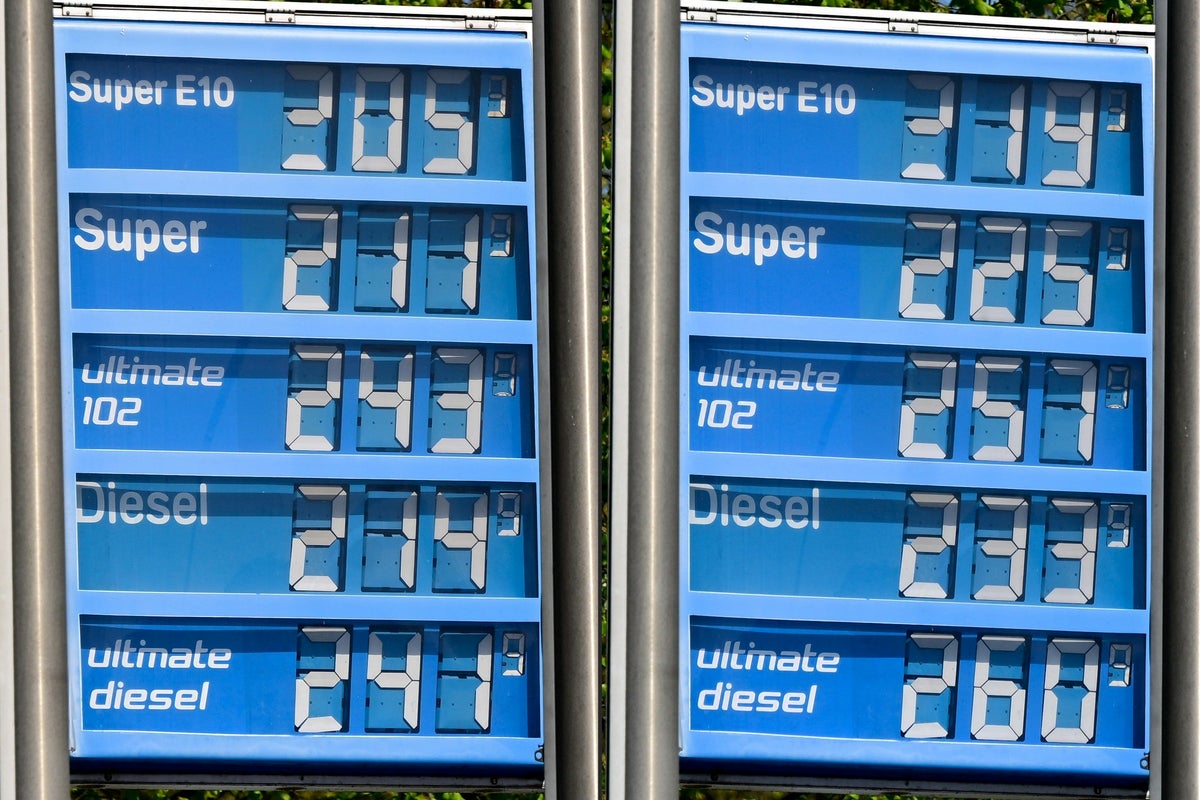
Oil prices jumped on Tuesday as Donald Trump weighed Iran’s latest proposal to end the war.
The US president is unhappy with the latest Iranian proposal, a US official said on Monday. Iranian sources disclosed that Tehran’s proposal avoided addressing its nuclear programme until hostilities cease and Gulf shipping disputes are resolved.
Trump’s displeasure with the Iranian offer leaves the conflict deadlocked, with Iran shutting shipping flows through the Strait of Hormuz, which typically carries supply equal to about 20 per cent of global oil and gas consumption, and the US keeping in place its blockade of Iranian ports.
Brent crude rose to $108.13 per barrel, hovering near a three-week high, while US West Texas Intermediate went up to $96.48.
Both benchmarks are well above pre-war levels. Brent was trading at $72 before the US-Israeli war on Iran began on 28 February.
Asian stocks were broadly subdued at the opening. While MSCI’s broadest index of Asia-Pacific shares outside Japan was down 0.12 per cent, hovering near the record high it touched on Monday, Nikkei fell 0.5 per cent.
The S&P 500 eked out modest gains on Monday and was on course for a nearly 10 per cent gain for April. US stock futures were 0.1 per cent higher in Asian hours.
Indian shares are set to open lower on Tuesday, with GIFT Nifty futures pointing to the benchmark Nifty 50 opening below Monday’s close of 24,092.70. Both Nifty and Sensex snapped a three-session losing run on Monday, led by a rebound in technology stocks, but the broader momentum remained constrained by unresolved tensions around the Strait of Hormuz.
Elevated oil prices are a particular headwind for India, the world’s third-largest crude importer, heightening inflation risks, pressuring economic growth and widening the country’s import bill.
Foreign portfolio investors offloaded domestic stocks worth Rs 11.5bn ($122m) on Monday, extending their selling streak to a sixth straight session.
Vessel crossings showed signs of recovery over the weekend, according to the maritime intelligence firm Windward, but analysts warned increased movement was yet to translate into a surge in oil and gas flows.
Iran reportedly offered to end its blockade of the waterway without addressing its nuclear programme, passing the proposal to Washington through Pakistani mediators. But Mr Trump has made ending Iran’s atomic programme a condition for any deal.
Central banks are also in focus this week, with the Bank of Japan, the US Federal Reserve, the Bank of England, and the European Central Bank all due to announce policy decisions. All are expected to hold rates steady, but markets will be watching closely for signals about how policymakers plan to respond to the inflationary pressure from the war.
“The BOJ is likely to stay highly sensitive to market volatility,” Fred Neumann, chief Asia economist at HSBC, told Reuters. “Our base case remains one single 25 basis point hike this year in July, but a June rate rise becomes more likely if the Strait of Hormuz is still effectively closed after mid-May.”
Business
FDA proposes excluding Novo, Lilly weight loss drugs from bulk compounding list in win for the companies

The headquarters of the U.S. Food and Drug Administration in Silver Spring, Maryland, Nov. 4, 2009.
Jason Reed | Reuters
The Food and Drug Administration on Thursday proposed excluding the active ingredients in Novo Nordisk and Eli Lilly‘s blockbuster obesity and diabetes medications from the list of drugs that outsourcing facilities can use for compounding in bulk.
If that proposal is finalized, the exclusion would likely limit the mass compounding — or the making of custom, often cheaper alternatives — of those medicines unless they appear on the FDA’s drug shortage list. The agency said it will consider public comments, which can be submitted until late June, before making a final decision.
The FDA finds “no clinical need” for outsourcing facilities to compound them from bulk drug substances, the agency said in a release.
The proposal includes semaglutide, the active ingredient in Novo’s obesity drug Wegovy and diabetes counterpart Ozempic, and tirzepatide, which is in Lilly’s weight loss injection Zepbound and diabetes shot Mounjaro. It also covers Novo’s older molecule liraglutide.
“When FDA-approved drugs are available, outsourcing facilities cannot lawfully compound using bulk drug substances unless there is a clear clinical need,” FDA Commissioner Marty Makary said in the release.
The agency’s proposal specifically targets 503B outsourcing facilities, which manufacture compounded drugs in bulk with or without prescription and are largely regulated by FDA guidelines.
The proposal does not impact 503A pharmacies, which make compounded drugs according to individual prescriptions for a specific patient and are largely regulated by states rather than the FDA.
Lilly and Novo have invested billions to ramp up manufacturing capacity over the last several years, which has helped alleviate supply constraints. The companies have also pursued efforts to make their branded medications more affordable to win over users who had flocked to cheaper compounded medications.
Reform UK leader Nigel Farage said in an interview on BBC Breakfast on Wednesday that “most of our gas now comes from Montana in the (US) Midwest”.
It is not the first time that Mr Farage has made a similar claim. Earlier in April he said: “Most of the gas we currently import comes from Montana.”
Evaluation
The US is only the third largest source of the UK’s gas supply, and the second largest foreign supplier. It is the largest supplier of liquid natural gas, the type that is transported by ship, rather than pipeline.
It is unclear why Mr Farage mentioned Montana specifically. Montana is not a major gas producing state.
The facts
Provisional data for 2025 shows that the UK’s own production of gas was 332,444 gigawatt hours (GWh). The country imported 463,692 GWh of gas. Of that, 320,249 GWh came from Norway and 104,360 GWh came from the US.
All the gas imported from the US was liquid natural gas (LNG) – the type that is super-chilled and transported by ship rather than in pipelines. The US was the UK’s largest supplier of LNG.
But it unclear how much – if any – of the UK’s gas comes from Montana specifically.
Data from the US Energy Information Administration (EIA) show that in 2024, the US produced a total of 37.7 trillion cubic feet of dry gas. Of this Montana accounted for around 40.0 billion cubic feet, or 0.1% of the total US production.
EIA data also show that Montana’s gas production was lower than its consumption of gas.
However, this does not mean that the state does not export any of its gas to other states or countries.
A 2023 report from the Montana Department of Environmental Quality said that while “Montana currently consumes more natural gas than it produces” a “significant portion” of the state’s production is exported.
Data from the US Census Bureau show that the US exported 2.8 billion US dollars worth of natural gas to the UK in 2025. This came from four states: Georgia, Louisiana, Maryland and Texas.
The data shows the state that the gas was exported from, not where the gas was actually initially produced. Although they are major LNG exporters, Maryland and Georgia produce little to no natural gas themselves.
The US Census Bureau data also show that Montana exported 525,083 US dollars worth of natural gas in 2025, all of which went to Canada.
A 2021 report from the UK’s Foreign and Commonwealth Office and Department for International Trade said that the UK was the fifth largest export market for Montana in 2019, selling 39 million US dollars worth of goods to the UK.
It listed the main goods exports from Montana to the UK in 2019 as electrical equipment, basic chemicals, navigational and measurement instruments, aerospace products and parts, and miscellaneous general purpose machinery.
There is no mention of gas in that report.
The US Census Bureau does not define Montana as being part of the Midwest.
Links
Facebook video (archived video download)
Gov.uk – Natural gas supply and consumption (archived page and spreadsheet)
Gov.uk – Natural gas imports (archived page and spreadsheet)
EIA – Natural Gas Gross Withdrawals and Production (archived)
EIA – Natural Gas Summary, Montana (archived)
Montana Department of Environmental Quality – Understanding energy in Montana (archived)
US Census Bureau – Foreign Trade (archived page and spreadsheet download)
EIA – Natural Gas Summary, Georgia (archived)
Gov.uk – UK-Montana trade and investment highlights (archived)
US Census Bureau – 12 States Make up the Midwest Region of the Country (archived)
The Bank of England votes for no immediate change to borrowing costs as it monitors the knock-on effects of the Middle East conflict.
Source link


Chinese team visits Bangladesh, discusses FDI in textile sector
FDA proposes excluding Novo, Lilly weight loss drugs from bulk compounding list in win for the companies

Drake Maye voices support for Patriots coach Mike Vrabel as off-field controversy continues to swirl
Us-India Trade Talks: US–India trade deal: Where do talks stand & what to expect – explained – The Times of India

PSL 11: Hyderabad Kingsmen opt to field after winning toss against Multan Sultans

Trump administration in advanced talks for a rescue package for Spirit Airlines, source says

-
Business1 week ago
Us-India Trade Talks: US–India trade deal: Where do talks stand & what to expect – explained – The Times of India
-
 Sports1 week ago
PSL 11: Hyderabad Kingsmen opt to field after winning toss against Multan Sultans
-
Business1 week ago
Trump administration in advanced talks for a rescue package for Spirit Airlines, source says
-
 Business1 week ago
UK inflation accelerates after Iran war drives sharp rise in fuel prices
-

 Tech1 week ago
Nation states responsible for ‘nationally significant’ cyber attacks against UK, says NCSC chief | Computer Weekly
-

 Tech1 week ago
Microsoft faces court battle in £2bn Windows Server class action | Computer Weekly
-

 Tech1 week ago
Blackbox replaces two racks of HPE storage with 8U of Everpure | Computer Weekly
-

 Fashion1 week ago
Bangladesh RMG units call for allowing local FOC raw material sourcing