

Entertainment
Book excerpt: “A Course Called Home” by Tom Coyne

Avid Reader Press
We may receive an affiliate commission from anything you buy from this article.
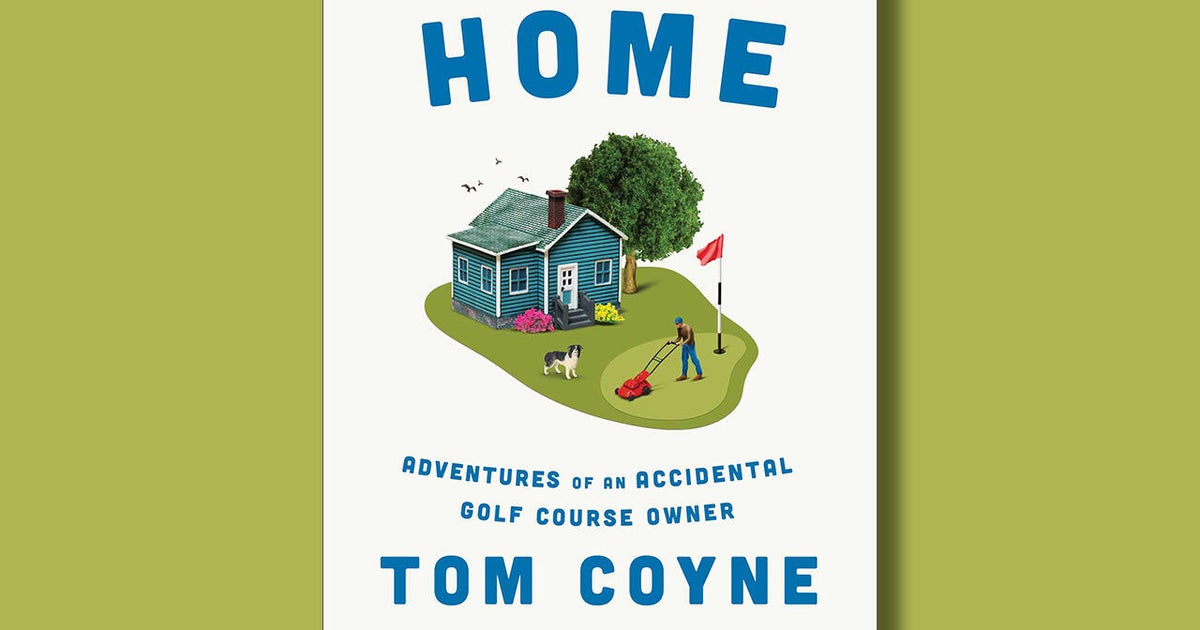
Tom Coyne, the editor of The Golfer’s Journal, teed up for a challenge: taking over operations of a failing nine-hole community golf course in New York’s Catskill Mountains. He writes of his experience, and the tribulations that were par for the course, in “A Course Called Home: Adventures of an Accidental Golf Course Owner” (to be published May 5 by Avid Reader Press).
Read an excerpt below, and don’t miss Lee Cowan’s interview with Tom Coyne on “CBS Sunday Morning” May 3!
“A Course Called Home” by Tom Coyne
Prefer to listen? Audible has a 30-day free trial available right now.
Hands caked with mud, fingertips diced by a thousand tiny cuts, and my wheels were spinning again.
It had been the wettest Catskills summer in memory, and Shaun had warned me to throttle down as I drew closer to the green. I killed the engine and slid out of the seat, got back down on my knees, and ripped clumps of soggy grass from the reels—right, middle, left, then the rear units beneath the chassis that I struggled to reach. If we had the money or time to sharpen our bed knives, I’d have lost a digit by now; instead, I shaved away my fingerprints as I felt for jams and tore chunks of wet earth, pulling hair from a clogged drain, until I could turn each cylinder by hand. This was the ninth time I’d had to clear the reels on this run, eight piles of discharged mud lined up in the rough behind me, and my favorite morning job looked like it would become that afternoon’s job, too.
I’ve come to believe that golfers should know what it’s like to ride a mower or cut a hole or water a green before they play. Not as punishment, but to better know our playing grounds and appreciate the big and small things—like freeing wads of vegetation from an undercarriage—that turn a field into a stage. We’d not only understand our good fortune as golfers, but we’d earn the answers to questions we may have long pondered. We’d know why our tees and fairways have rounded corners (because the mowers turn on a certain radius) and why someone let the rough grow on that hillside (because the mower tips over up there) and why we can’t have those vertical bunker faces we see on TV (because trimming them costs a day’s worth of manpower, fuel, and gear we don’t possess and can’t afford).
We’d know why tall fescue is fashionable (no cut, no work), why we should pick up our tees (they dull mower blades, and resharpening robs hours), and why benches, cart signs, and tee markers are a blight (cut the engine, hop off, move them, restart, mow, move them back—if your legs are as stiff as mine, you daydream about blowing them out the back of your machine). We’d know that nobody asked a greenskeeper whether wall-to-wall fairways was a trend worth pursuing, and we’d learn how a course’s maintenance budget can be halved if the course has been designed for simpler upkeep, or if its players accepted brown as a firmer shade of green. We’d likely never leave a pitch mark or bare divot again, understanding that those banal scorecard requests aren’t about manners or even playing conditions—they’re about simple respect for the people whose job it is to grow grass, and a gentle nod to their existence. And if you’re like me, you’d enjoy the art of upkeep. Maybe even more than your golf.
It’s hard and early work, and at places like ours, it doesn’t pay that well, either. I used to wonder why they do it, the greenskeepers who might get thanked once a year at the member-guest, but who mostly pass by in hooded sweatshirts and heavy brown boots, working through a checklist that started before dawn. They’re a unique breed, the turf types, but those who get it in their blood tend to stick with it, and after a few months among them, I now had some understanding of why. Getting up and going to work for most people is coffee and a commute, shaving or some makeup, dressing appropriately so you can stare at your phone for an hour. Asking and answering questions in as few words as possible, creating tasks and passing them along, and maybe noticing whether the sun is shining or not.
In the work out here, the weather is all you notice—your day is dictated by sun and seasons and a rain gauge that’s inspected every morning. The forecast tells you when to fire up the mowers and where to take them, and each morning is a chance to know satisfaction before most people have finished deleting their overnight emails. It’s just you atop a humming red rig, tracing lines into a field shining with dew, the fog still spinning in your blades, and your only company a few deer who hardly look up when they see you anymore, and soon every tuft is trimmed and you’ve got the mow lines to prove it and can look back and see what you’ve done—it’s a kind of work I’d never known before this summer, work that gives you clear beginnings and endings and doesn’t ping you after dinner, the sort of job you still feel that evening as you fall asleep, bones sore with effort but your mind clear for having answered what the day asked.
This day’s aches and scrapes might last a little longer. We typically welcome the rain because we lack a working irrigation system for our fairways, and our method for dousing the greens is something we try not to discuss, let alone use. We have nine garden hoses wrapped around hubcaps on posts that stand guard beside each green, but the pump meant to send them water from the pond is old and irritable, and the pipes that run to each hose are a patchwork of red iron and PVC held together by putty and tape, and only half of them remain buried anymore. Where they cross streams or change grade in the woods, we built tiny rock towers to support their weight and keep them from snapping, and with so many leaks, they deliver a mere trickle to those hoses. After a bone-dry May and June, we were praying for rain, forgetting that Noah probably prayed for a drizzle, too.
Not only do we lack the pipes to spray water on the golf course, we don’t have pipes to drain water off it, either. Occasionally I’d spot a rusty drain buried in a fairway, relics from our course’s heyday, but when the water comes now, puddles form in all our low spots (at a course beside a mountain, we have plenty of those). Rain pushes the weeds higher, then shelters them on turf too soft for the machines meant to clip them.
We often tried when we shouldn’t have, and that’s when we felt the agony of tires lurching and spinning, stuck dead in a wet patch. Ever try to slide a piece of old furniture and feel a nail gash your wooden floor? It’s close to that, and then it gets worse when you hit the gas hard because your only way out is forward as platter-sized pieces of fairway come loose beneath your wheels. On your next pass, you see the mess you’ve made and wonder what kind of a****** would do that to a golf course.
Sometimes you can’t motor through it, and that’s where I found myself on number eight, my twice-a-week nemesis. Not only is it big—a runway par-five of almost all fairway—but its approach is an awkward cut, where your lines squeeze into a tight funnel as you approach a narrow, raised plateau with a collar that’s tough to trim without dropping clippings all over the green. It sits beside a hidden spring in the greenside rough, and today I’d found the heart of it. I looked around, hoping to find one of my comrades, but it was just me and the deer. They’d been watching me stall out all morning, happy to nibble the grass I was failing to shorten.
Bearded Chris was responsible for trimming the rough on his Ventrac, an eight-wheeled beast that could handle our most unreasonable slopes. Shaun mowed the greens, sometimes pushing by hand or, when the triplex was working, atop his riding mower. Fairways were my job, but maybe not much longer, I thought—I’d cleaned my reels, but the tires were buried in three inches of soup. I rocked from forward to reverse with no luck. Shut it down, started it back up. The ignition was shot so we had to hotwire our fairway unit, pressing a wire against the battery with a wrench we kept in the cupholder. No joy. I pulled out my phone and called Shaun, who was cutting greens on the other side of the property. I don’t know how he heard or felt his phone vibrating while his machine was roaring, but when I was working the course, he never failed to pick up. He knew his staff (all two of us) and probably suspected that his fairway might be calling.
“I’m stuck. In the spring on eight.”
He laughed a tired chuckle. “On my way.”
I knew the water was there and should have been more careful, but I was so damn close to done—three hundred yards of fairway cut back-and-forth in perpendicular passes. Cut, loop around, drop the blades, cut, lift again, loop back—and rather than steer my way around the spring, I rolled the dice on turning here and lost.
We varied our fairway cuts to keep the grass from getting too comfortable lying in one direction. On the chalkboard in the maintenance shed, Shaun would draw the design he wanted me to follow that day. Start with a stripe down the middle, then mow in a figure eight to get that half-dark, half-light tuxedo look, or, my preferred method, loop around like a Zamboni until you’re done. Shaun didn’t love it, but it was easier than trying to set a perfect center stripe the way he could—miss the middle, and you left yourself with more grass left or right, circling back and hunting for ribbons until you lost all sense of where you’d been. The short, perpendicular paths I was tracing today (the dark track is what you just hit; keep it close) ensured a good cut, even if it meant less blade time with all the turnarounds, and what I liked best about this job was that I now used terms like “blade time” and phrases like “That was a good cut” and felt like I had earned them.
As I waited for Shaun to finish up whatever green he was working, I licked the dirt from my fingertips, rubbed my thumb against them, and felt the razor rash from brushing my fingers over bed knives.
Stuck in the mud atop a lawnmower three times the size of anything they sold at Home Depot, waiting beside a green in the Sullivan County Catskills, for a moment, I felt like a fake from afar. I was not a greenskeeper. My new role as course operator had not been earned; I was a measure of last resort. It would be a daydream sort of fun to play my own golf holes, sure, but there was no bucket list in my drawer with Run a Golf Club or Mow a Fairway or Raise Money and Buy a Golf Course scribbled upon it. So how had I landed here? I was a writer and a spoiled golfer—my career had taken me to first tees at some of the world’s most wonderous places, where I played golf, jotted down a few paragraphs, bought a shirt, and went looking for the next.
But this place didn’t sell shirts. It didn’t even have a logo. And wondrous wasn’t a word a visitor might have used to describe this nine-holer. Sporty and charming with views for days, but not a destination you’d come to write about. This was rural, local, community golf, and as with most golf courses fitting that description, it was failing. If we didn’t find a way to turn that around this summer and plot a new path, the course would be sold for land and closed two years shy of reaching its one hundredth anniversary. And from my viewpoint, my wheels still spinning in the slop, that new path was anything but clear.
Excerpted from “A Course Called Home: Adventures of an Accidental Golf Course Owner” by Tom Coyne. Published by Avid Reader Press/Simon and Schuster. Copyright © 2026. All rights reserved.
Get the book here:
“A Course Called Home” by Tom Coyne
Buy locally from Bookshop.org
For more info:













The Hantavirus outbreak on a Dutch cruise ship has now pushed the WHO to issue evacuation orders.
The UN health agency said on Tuesday, May 5, it issued evacuation orders for two passengers onboard MD Hondius ship, fearing human-to-human transmission can’t be ruled out.
To facilitate the evacuation of two individuals, WHO medics would board the vessel.
In a latest update, Dr. Maria Van Kerkhove, WHO director for Epidemic and Pandemic Preparedness and Prevention, briefed the media on the hantavirus outbreak.
She said, “We do know that some of the cases had very close contact with each other and certainly human-to-human transmission can’t be ruled out so as a precaution this is what we are assuming.”
The Hantavirus has so far claimed three lives, with several others falling ill.
Among the deceased are a Dutch couple and a German national, while one British national is said to be still in intensive care in South Africa.
There are 150 people, including 17 U.S. nationals, who remain stuck on the MV Hondius that is sailing off the coast of West Africa.
The outbreak was first reported on the Netherlands based cruise MV Hondius, which was sailing between Argentina and Cape Verde on Sunday, May 3, 2026.
Earlier on Tuesday, May 4, a WHO official had said, “There was no need for panic and the risk to the public was low.”

Bella Hadid made a conscious decision to not attend the Jeff Bezos-backed Met Gala this year, despite her older sister Gigi Hadid attending.
The 29-year-old supermodel, who has been very politically active these past few years, sat out fashion’s biggest night for the fourth year in a row. Although she has not publicly commented on the reason for her absence this year, Bella’s social media activity confirmed she is boycotting the event due to Jeff Bezos serving as a sponsor and a co-chair.
Three days ahead of the event, Bella “liked” a video by writer and comedian Meredith Lynch, who points out the hypocrisy of wearing an “ICE OUT” pin to the Met Gala.

“You cannot wear the ICE OUT pin to the Jeff-Bezos-backed Met Gala. Jeff Bezos is part of the reason we’re in this f***ing mess. Jeff Bezos supports this f***ing mess,” Lynch explains in the video, noting that although the funds from the event “go to a good cause,” it is impossible to reconcile the fact that the Met Gala is sponsored by Bezos, who in turn backs President Donald Trump.
Another celebrity voicing their disapproval was Taraji P. Henson, who wrote in the comments section of Lynch’s video: “I am so confused by some ppl that are going. I am just like WTF ARE WE DOING!?!?!?!”

King Charles III’s wise move proves he will never ditch his late mother Queen Elizabeth’s legacy as he makes secret efforts to keep the family united.
The 77-year-old’s nod to his niece Princess Eugenie has raised hopes for Andrew and Fergi’es reunion as speculation about the former Duke and Duchess of York’s future move has escalated, attracting massive media attention.
The much-needed relief for the York family comes at a time when Andrew and Ferguson’s controversies have loomed large over their lives.
A royal expert claims Andrew will not really settle in Sandringham, and Sarah is obviously looking for an escape route after her latest hiding place was discovered.
“I have a suspicion both might end up in Portugal to be close to their grandchildren and lead a simpler, quieter life,” royal broadcaster Ian Pelham Turner claimed to Fox News Digital.
However, attention has returned to the Yorks after King Charles’ nod to his niece Eugenie as the Palace took the step to embrace the York family and celebrate their joyful moments publicly.
The new arival may releses stress from Beatrice and Eugenie’s disgraced parents, who have been in forced exile since the King stripped them of their royal tiles and patronages..


Vietnam attracts $18.24 bn FDI in January-April 2026, trade up

Ferrari tops Wall Street’s first-quarter expectations ahead of EV debut

Hantavirus outbreak on cruise ship prompts WHO to issue evacuation orders

-

 Tech1 week ago
A Brain Implant for Depression Is About to Be Tested in Humans
-
 Business1 week ago
‘I had £20,000 stolen and had to fight a 13-month fraud reporting rule to get it back’
-

 Tech1 week ago
Almost 90% of women leave tech industry within 10 years | Computer Weekly
-
 Business1 week ago
Pakistan’s oil market is fuelling the crisis | The Express Tribune
-

 Sports7 days ago
Pro wrestling star Steph De Lander reveals how colleague’s advice helped lead her to title triumph at ACW
-

 Entertainment1 week ago
Norway joins Type 26 Frigate Programme to boost NATO naval power
-

 Entertainment1 week ago
Melania Trump says ABC should ‘take a stand’ on late-night host Kimmel
-

 Tech1 week ago
This Ambitious Laptop Doesn’t Leave Much Room for Your Hands