

Politics
Maldives suspends licence of luxury vessel after Italian divers’ deaths



The Maldives suspended the operating licence of a luxury vessel on Saturday after five of its Italian passengers perished in the deadliest diving disaster in the Indian Ocean tourist destination.
Rescuers were searching for a third day for the Italians who failed to return after a dive on Thursday, officials said. One body from the group of five was recovered the same day.
The University of Genoa said the victims included a marine biology professor, her daughter and two young researchers.
Chief government spokesman Mohamed Hussain Shareef said an investigation had been launched into why the group went below the officially permitted depth of 30 metres (98 feet).
The body of one diver, yet to be publicly named, was found in a cave at a depth of 60 metres (196 feet).
The first search to locate the other four members of the group was unsuccessful on Friday.
“The Ministry of Tourism and Civil Aviation has suspended the operating licence of the liveaboard vessel MV Duke of York indefinitely, pending the outcome of an investigation into the diving incident that occurred in Vaavu Atoll on May 14,” the ministry said.
The Duke of York is a 36-metre luxury boat that can accommodate 25 guests.
Italy’s foreign ministry confirmed on Thursday that all five of its nationals had died.
The low-lying Maldives, a nation of 1,192 tiny coral islands scattered some 800 kilometres (500 miles) across the equator in the Indian Ocean, is a luxury holiday destination popular with divers, who often stay at secluded resorts or on liveaboard dive boats.
Diving and water-sport-related accidents are relatively rare in the South Asian nation, although several fatal incidents have been reported in recent years.
- Rescue work continues as fire under control: official.
- Incident being probed to find cause, says authority.
- Crash also involved cars and motorcycles: witnesses.
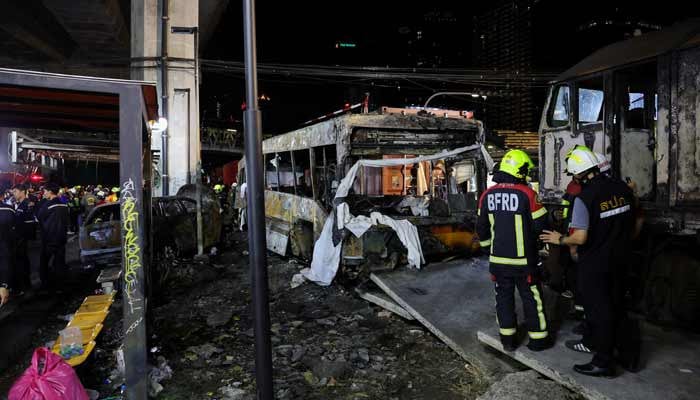
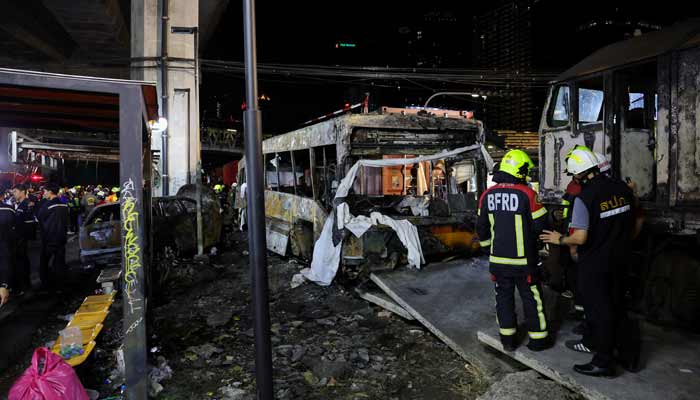
At least eight people were killed and 32 others were injured in Thailand on Saturday after a freight train struck a bus at a rail crossing in Bangkok, igniting a fire that engulfed the vehicle, rescue officials and a deputy transport minister said.
Firefighters and rescue crews were dispatched as flames engulfed the public bus and nearby vehicles close to the Airport Rail Link’s Makkasan station, officials said, adding that the crash also involved cars and motorcycles.
Preliminary reports showed the bus had been stopped on the tracks at a red light, preventing crossing barriers from closing, Deputy Transport Minister Siripong Angkasakulkiat told reporters.
The train, which was transporting containers, was unable to stop in time to avoid colliding with the bus, he added.
“Eight people were killed and 32 injured, with the wounded being treated at various hospitals. All eight dead were on the bus,” he said.
Videos shared on social media showed the train striking the bus and dragging several other nearby vehicles along the tracks.
“The bus was stuck at a red light, so it couldn’t move. Cars were also blocked and unable to move forward,” Wanthong Kokpho, a motorcycle taxi driver who witnessed the crash, told Reuters.
“The fire broke out immediately … If this had been a normal working day, the damage would have been much worse.”
Rescue teams worked to pull injured victims from the wreckage as fire crews battled the blaze with water hoses, officials said.
The fire was brought under control, and crews were cooling the area, venting gas and continuing to search for victims, they said. Authorities are investigating the cause of the incident.
Thailand’s roads rank among the world’s deadliest, according to the World Health Organisation, due to weak enforcement of safety standards.
Rising diesel costs from Iran war strain US school budgets
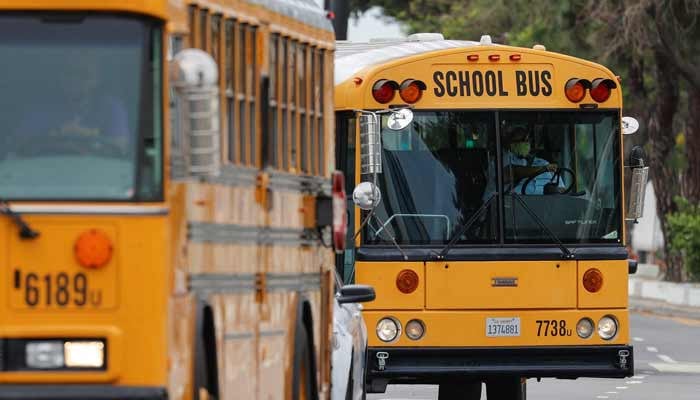
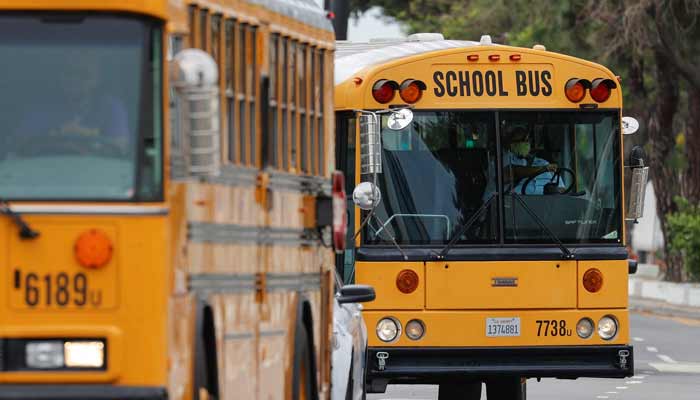
Soaring diesel prices since the onset of the Iran war are draining already tight US school district budgets, making it more expensive to bus students and run generators in a shock officials say they will not be able to afford for long.
School districts from Yakima, Washington to Waco, Texas are tapping emergency funding reserves to keep buses running. In remote Alaska, officials are scrambling to secure enough fuel to keep the lights on, according to Reuters interviews.
“It’s more than a straw on the camel’s back, it’s like a haystack,” said Yakima Superintendent Trevor Greene.
The stress reflects one of many knock-on impacts of the US-Israeli war on Iran, which has disrupted the flow of around a fifth of the world’s oil supplies.
Since the war started in late February, fuel prices have posted one of their most rapid climbs on record. The spike has upended economies around the globe. It has caused enough pain in the US to be a political liability for President Donald Trump ahead of November midterm elections when his Republican party is trying to maintain slim majorities in the US Congress.
US school bus operators are major buyers of diesel, consuming more than 800 million gallons of diesel annually, according to the American School Bus Council.
Since December, the price US fleets of all types pay for diesel fuel has jumped 67% to $5.52 a gallon, an increase that would add about $1.8 billion to the annual cost of operating those school buses, according to a recent analysis by fleet management technology provider Samsara.
That’s a huge challenge for schools already facing tight budgets, said James Rowan, executive director of the Association of School Business Officials International.
“Districts can plan for higher costs, but rapid swings in prices make it very difficult to budget accurately,” he said. “Even districts that have been able to absorb costs this year through reserves or temporary measures — they may not have that same flexibility going forward.”
Close to a third of US school districts are now siphoning money away from other funds or programmes to cover their increased fuel costs, while almost a fifth are tapping reserves or rainy day funds, according to a survey of 188 school officials commissioned by the School Superintendents Association known as AASA and conducted during the week of May 4.
School officials are trying to save money by consolidating bus routes, enforcing anti-idling measures, changing fuel purchasing practices, deferring maintenance work and reducing administrative spending and staffing, according to the survey, the results of which were shared exclusively with Reuters.
‘Tremendously underfunded’
Washington State’s Yakima School District executives said the price they pay for diesel was recently up 64% year-on-year to $6.30 a gallon. At that price, the district would need to pay $213,000 more a year on fuel to operate its 60 buses — roughly the equivalent of salaries for two teachers, said Greene.
That is a big burden in an agriculture-dominated school district that has a poverty rate of 86%, and which is already “tremendously underfunded,” he said.
In the meantime, the district is making piecemeal purchases for its 30,000-gallon diesel tank on days when prices dip, instead of filling it up, as it “limps through the end of the year,” district CFO Jacob Kuper said.
Christopher Mills, superintendent of Thief River Falls Public Schools in northwestern Minnesota, said diesel costs tied to transporting as many as 800 students are up around 30% since the Iran war began.
The district is working to limit direct impacts on classrooms, Mills said, “but if the prices continue to increase we could be in a position of reducing support services to students.”
Even schools in oil-rich Texas have not been spared. The Waco Independent School District, which has more than 80 buses and average round-trip routes of about 60 miles per day, experienced an 84% year-over-year increase in the price it paid for diesel in early April, the district said.
Pressure-packed
In Southwestern Alaska’s Yupiit School District, diesel is not used for buses but for classroom heat, and community generators for power.
“If they can’t produce electricity, then we can’t run the school,” Yupiit School District Superintendent Scott Ballard said in a telephone interview from his office in Akiachak.
The district, which serves 550 students, is icebound for much of the year, giving it a short window to get fuel.
So, leaders now face a difficult choice, Ballard said: Do they lock in a price almost 66% higher than last year or gamble prices will fall? “We’re in a very pressure-packed situation.”
At the other extreme, some of the largest US school districts are partially insulated from fuel price swings.
The New York City district, the nation’s largest by population, outsources about 60% of pupil transportation in arrangements that often shift fuel price changes to contractors, said Paul Quinn Mori, president of the New York School Bus Contractors Association.
Meanwhile, the Los Angeles Unified School District, the nation’s second-largest, has been moving away from diesel-powered buses for years. Of its roughly 1,300-bus fleet, 70% run on alternative fuels or batteries, a district spokesperson said.
“Rising diesel prices continue to impact Los Angeles Unified’s transportation budget; however, the district has taken proactive steps to reduce reliance on fossil fuels through significant investments in clean transportation,” a spokesperson said.
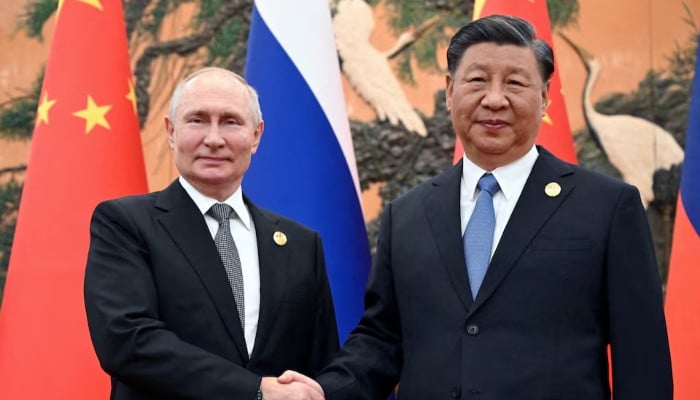
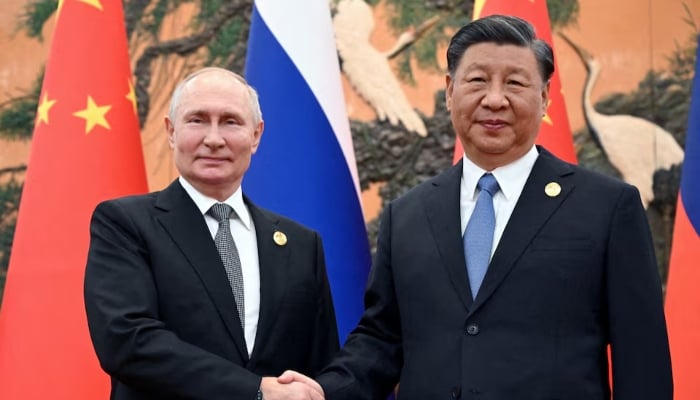
- Putin, Xi Jinping to discuss strategic cooperation.
- Leaders expected to sign joint declaration after talks.
- Visit follows Donald Trump’s China trip this week.
MOSCOW: Russian President Vladimir Putin will travel to China on May 19 for a two-day visit, hot on the heels of US President Donald Trump’s trip to Beijing, the Kremlin said on Saturday.
During the trip, the Russian leader will discuss with his Chinese counterpart Xi Jinping how to “further strengthen the comprehensive partnership and strategic cooperation” between Moscow and Beijing, according to a Kremlin statement.
Putin and Xi will “exchange views on key international and regional issues” and sign a joint declaration at the conclusion of their talks, it added.
As part of the visit, Putin is also scheduled to discuss economic and trade cooperation with Chinese Premier Li Qiang.
The announcement of Putin’s trip comes just after Trump wrapped up on Friday the first visit to China by a US president in nearly a decade, with the grand reception belying a roster of unresolved trade and geopolitical tensions, including over the Ukraine-Russia conflict.
Although Trump and Xi discussed the more than four-year-long conflict — as well as the US leader’s stalemated war with Iran — the Republican president took off from China on Friday without appearing to secure a breakthrough on either front.
Negotiations to end the fighting in Ukraine, brokered by the United States, have appeared stalled since the beginning of the US-Israeli war with Iran, which broke out on February 28.
Before Trump arrived in China, Ukraine’s President Volodymyr Zelensky asked the US leader to raise the matter of how to stop the conflict during the talks with Xi.
Moscow has ruled out a ceasefire or comprehensive negotiations with Ukraine unless Kyiv caves to the Kremlin’s maximalist demands.
‘Delighted’
While China has regularly called for talks to end the fighting, it has never condemned Russia for sending troops into Ukraine in February 2022, and presents itself as a neutral party.
Beijing also denies providing Moscow with weapons and military components for its defence industry, blaming Western countries for prolonging Europe´s deadliest conflict since World War II by arming Ukraine instead.
As the world’s top buyer of Russian fossil fuels, China has become Moscow’s key economic partner, especially since Western countries imposed economic sanctions on Russian oil and gas over the conflict.
Trump left China on Friday, claiming he had negotiated “fantastic” trade deals, including a commitment for Beijing to purchase 200 Boeing aeroplanes as well as US oil and soybeans.
But the details were vague or scanty, while China made no formal announcement on any trade deal.
In contrast to Trump — who described Xi as a “great leader” and “friend” -— Beijing’s response to the summit as a whole was more muted.
Russia’s top diplomat on Friday welcomed the China-US summit, but said that Moscow enjoyed warmer ties with Beijing.
“If the agreements reached or to be reached by Beijing and Washington are in the interests of our Chinese friends, we can only be delighted,” Sergey Lavrov told a press conference in New Delhi.
But Lavrov insisted that Russia was “bound to China by ties… that are deeper and stronger than traditional political and military alliances”.

[CinePlex360] Please moderate: “Low-grade heat
[CinePlex360] Please moderate: “Prince Harry ma

"Survivor" superfan builds her own tribe

-

 Tech1 week ago
A new frontier: Identity stack evolves for agentic systems | Computer Weekly
-

 Tech1 week ago
‘Orbs,’ ‘Saucers,’ and ‘Flashes’ on the Moon: Pentagon Drops New UFO Files
-

 Tech1 week ago
What Microsoft Executives Really Thought About OpenAI in 2018
-

 Fashion1 week ago
New orders in German manufacturing up 5% MoM in Mar 2026: Destatis
-

 Tech1 week ago
Nick Bostrom Has a Plan for Humanity’s ‘Big Retirement’
-

 Tech1 week ago
I Tried the Best Captioning Smart Glasses, and Only One Leads the Pack
-

 Sports1 week ago
Shaheen Afridi achieves landmark feat during opening Test against Bangladesh
-

 Fashion1 week ago
US’ Carter’s taps retail veteran Sharon Price John as new CEO