

Sports
‘There’s a lot of hate:’ These games define the Mizzou-Kansas rivalry

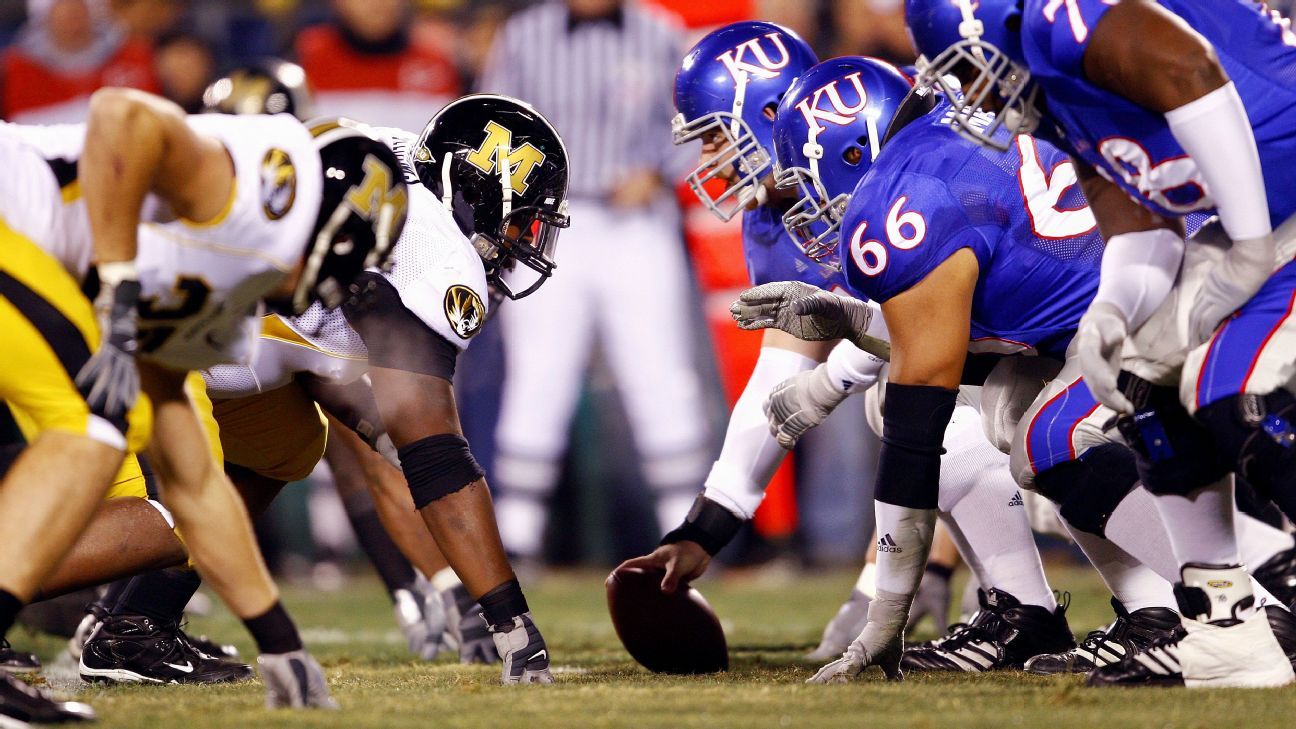
Around 5 or 5:15 p.m. local time on Saturday, the second Missouri Tigers home game of the season will go to a commercial break before the fourth quarter begins, and as has become customary in recent seasons, the Killers’ “Mr. Brightside” will play over the loudspeaker.
It has also become customary that the Mizzou fans in attendance at Memorial Stadium will lob F-bombs in unison at their biggest rival.
For the first time in quite a few years, that rival will be in said stadium to hear it.


Missouri and the Kansas Jayhawks will meet on the gridiron for the first time since 2011 (3:30 p.m. ET on ESPN2) and for the first time in Columbia since 2006. When Mizzou left the Big 12 for the SEC in 2012, the rivalry went on pause. The basketball rivalry resumed in 2021, with Kansas winning the first three games and Mizzou finally getting back on the board last December. Now it’s football’s turn.
This rivalry’s roots stem from Civil War days. Both schools’ nicknames were derived from Civil War nomenclature — “Jayhawkers” were robbers and raiders who terrorized slave-state supporters in Missouri counties bordering Kansas, while “Tigers” refers to a group of soldiers who protected the city of Columbia from pro-Confederacy guerillas, including some of the same people who participated in burning Lawrence to the ground in 1863. Mizzou and Kansas fans have certainly leaned into Civil War and Burning Lawrence connotations through the years, as problematic as it may look from the outside.
The rivalry’s name was changed from “Border War” to “Border Showdown” in the 2000s, but it didn’t tamp down the hostility. For that matter, neither did conference realignment. If you’re a KU or MU fan living in Kansas City, you probably have an MU or KU neighbor. The jawing has never really stopped, and if you didn’t believe that before Mizzou fans began adding a “F— KU” chant before the bridge to “Mr. Brightside,” no matter the day’s opponent, that certainly served as a pretty vivid and profane reminder.
“This is deeply seated,” Missouri coach Eli Drinkwitz told ESPN. “There’s a lot of hate, and whether it’s been basketball games that we’ve seen or soccer matches or now football games, we know it’s important to the fan base.”
“I’ve gone to those [basketball games], and obviously the crowd’s extremely into it and they’re exciting to see,” Kansas coach Lance Leipold said. “You can see that there’s an extra intensity during the game.”
The crowd in Columbia on Saturday will be awfully hostile, and the players will have to meet the moment. That’s a tricky thing when almost no player on the field actually grew up with the rivalry. The last time the game was played, after all, current freshman football players were about 4 years old.
“It’s important to go back all the way to the history of it,” Drinkwitz said. “We had Andy Hill, a former Mizzou player and coach, come back and share with us. We had [former ESPN anchor and Mizzou alum] John Anderson come back and share. We’ve really tried to emphasize the importance to the team. We had to educate them on what it is.”
“As this game’s been on the schedule, when I’m out in public appearances and things, people have come up to me and talked more about this one than any other game in recent years,” Leipold told ESPN. “There’s excitement that these two teams are playing again.”
The Mizzou-Kansas football rivalry hasn’t necessarily packed the same number of wild finishes or memorable moments as the men’s basketball rivalry has through the years. But it’s still tremendously hostile, and it still had an impact on multiple national title races, school rushing records and the invention of homecoming. It provided a trio of unbelievable neutral-site games in the 2000s, too. Let’s walk through 10 games that accurately describe the stakes and strange history of this reborn rivalry.

1911: Missouri 3, Kansas 3
“The most impressive feature of a Yale-Harvard game is the meeting of the old ‘grads’ who have come back to their college town to see the contest. After a few years this will be the case with the Missouri-Kansas game.” — Columbia Missourian, 1911
Mizzou claims the oldest homecoming gathering, or at least the oldest continuous homecoming, or at least the most homecoming-like substance, with rallies and parades and whatnot a part of its own homecoming since 1911. No matter what, it all started with KU. In front of about 9,000 fans on Rollins Field in Columbia — Memorial Stadium wasn’t built until the 1920s — Jimmy Shuck’s field goal allowed the home team to tie the game with about five minutes left and salvaged a smidgen of pride from a disappointing 2-4-2 season.
1958: Missouri 13, Kansas 13
You need some impossibly silly endings to drive a proper rivalry, and in the first Border War for new head coaches Dan Devine (Mizzou) and Jack Mitchell (Kansas), two near-.500 teams ran up the silly points here.
Mizzou burst to an early 13-0 lead in front of a sellout crowd of 32,000, thanks in part to a long touchdown off of a downfield lateral from Ed Mehrer to Jerry Curtright. The lead seemed like it was going to hold up despite a trio of missed field goals, but after a short touchdown by KU’s Bill Crank made it 13-7, Homer Floyd reeled in a pass over the middle with just 18 seconds left and raced for a stunning 80-yard touchdown. Victory seized from defeat? Nope! Mizzou’s Dale Pidcock blocked the ensuing PAT attempt. Tie game.
1960: Kansas 23, No. 1 Missouri 7
In almost any broadcast for any Mizzou-Kansas game, you’re almost guaranteed to hear something to the effect of, “These rivals are so bitter, they can’t even agree on the series record!” This game is the reason why.
By his third season in Columbia, Devine had Mizzou on the brink of its first national title. The Tigers had just moved to No. 1 for the first time ever following a blowout of Oklahoma, and with the final AP poll vote coming before bowl season, all Mizzou had to do was beat Kansas to wrap things up. But at 6-2-1, with losses only to two previous No. 1 teams (Syracuse and Iowa), Kansas was on the rise itself. Mitchell had brought in quite a few talented players, including a TCU transfer named Bert Coan. The Jayhawks were ineligible for an Orange Bowl bid because of violations that occurred during Coan’s recruitment, but he hadn’t yet been deemed ineligible himself, so he played against Missouri.
This was one of the most anxious and ruthlessly physical games in the rivalry’s history, producing just 353 combined offensive yards and eight turnovers. But the 6-foot-4 Coan reeled in a touchdown pass from John Hadl to make it 10-0 in the third quarter, then scored again to put the game out of reach.
Nearly three weeks after the game, the Big 8 Conference officially voted Coan ineligible and ordered KU to forfeit two games in which Coan played. That made Missouri the conference champion. An Orange Bowl win over Navy completed an “unbeaten” season — one-loss Minnesota was still named the AP’s national champion (and then lost again in the Rose Bowl) — and Mizzou lists the forfeit as the official result. But since the NCAA never officially recognized the forfeit, Kansas continues to claim a win as well. According to Mizzou, the Tigers lead the overall series 57-54-9. According to Kansas, it’s 56-55-9.
1976: Kansas 41, Missouri 14
The 1960s were a decade of success for both programs, as they combined for three conference titles (two for Mizzou) and 15 winning seasons. But Kansas grew increasingly inconsistent in the 1970s, and after Devine left for the NFL, Al Onofrio’s Tigers went from giants to inconsistent giant killers.
In six seasons from 1972 to 1977, Mizzou beat nine top-10 teams … and went 1-5 against Kansas. Depending on which team you root for, either the peak or nadir of this strange period came in 1976. Kansas came to Columbia 5-5, having lost five of its last six games thanks to an injury to quarterback Nolan Cromwell. Mizzou, meanwhile, had beaten both No. 8 USC and No. 2 Ohio State on the road in nonconference play, then toppled No. 3 Nebraska in the Big 8. The Tigers had risen as high as sixth in the AP poll. But they were also leaking fuel, having lost three of their last five games to fall to 6-4.
Only one team showed up at Faurot Field. Kansas scored 24 second-quarter points and led by as much as 34 as, in the words of the St. Louis Post-Dispatch’s Bob Broeg, “Comeback Kansas embarrassed (1) mystifying Missouri, (2) the red-faced Sun Bowl committee, (3) solemn Al Onofrio and (4) most of a hang-dog crowd of 62,559 Saturday.” Onofrio was fired a year later.
1988: Missouri 55, Kansas 17
Within a decade or so, Mizzou didn’t have to worry about beating giants anymore. Neither did Kansas. By 1986, Sports Illustrated was calling the Mizzou-Kansas-Kansas State trio the “Bermuda Triangle” of college football, “for lost fans, lost coaches, lost attendance.” K-State had never generated much football traction (at least until hiring Bill Snyder in 1989), Kansas enjoyed only one winning season between 1977 and 1990, and Mizzou didn’t manage a single one from 1984 to 1996. The Tigers’ and Jayhawks’ combined destitution was at its worst in 1988, when they managed only four combined wins — two against 0-11 Kansas State, one against Utah State, and one head-to-head.
Kansas took an early 10-7 lead in this one, but Mizzou won the last 3½ quarters by a 48-7 margin. Led by running back Mike Jones — who would switch to linebacker in the pros and make one of the most famous tackles in Super Bowl history — the Tigers rushed for 471 yards while forcing five turnovers. It continued an odd streak: Despite the teams being evenly matched in most of the 14 years from 1983 and 1996, only two games finished within single digits.
1991: Kansas 53, Missouri 29
Glen Mason’s tenure as Kansas’ head coach began disastrously in 1988, but by 1991 he was generating some traction: The Jayhawks would go 6-5 that year and keep inching upward toward a 10-win 1995 breakthrough. They won four of five against the destitute Tigers in this span, and one win broke records.
With both the temperatures and the winds in the mid-30s at kickoff and just 28,000 in the stands in Lawrence, Mizzou found brief success with its passing game in the second quarter, and KU led just 25-22 at halftime despite 156 rushing yards from the Jayhawks’ Tony Sands. But Mizzou’s Jeff Handy stopped completing passes in the second half, and Sands just kept running. He had 141 yards in the third quarter alone. And then he produced another 99 in the fourth quarter. He ended the day with 58 carries — hey, why not, it was the last game of the season — and a then-record 396 yards. Four players have since topped 400 yards in a game, but no one did it against their most bitter rival.
•”Kansas. Missouri. A rivalry that never disappoints – this game leave your brick from start to finish. 🔥 #BorderWar” @FansOfKU @KUAthletics @JayhawkSlant @nostalgic_ku @JayhawkTakeover @JayhawkTakeover @KUJHawks @jaylassoku @JayhawkTalk @JayhawkFocus @Brewenor @BarstoolKU pic.twitter.com/uJw1IRy4WS
— Tony sands (@tonysands24) August 31, 2025
1998: No. 25 Missouri 41, Kansas 23
The 1990s ended with a reversal. Mason left for Minnesota, and KU would suffer nine straight losing seasons; Mizzou, meanwhile, briefly emerged from its stupor under Larry Smith and came achingly close to greatness in 1998. The Tigers led four different top-10 teams at halftime but lost all four games, three by one score. But at least they exacted some Sands-ian revenge.
In a rare early-season meeting, running back Devin West needed only 32 carries to gain 319 yards. Upset-minded KU took a 23-20 lead midway through the third quarter, but rushing scores from West, then quarterback Corby Jones, then West again from 45 yards out, allowed the Tigers to pull away. “I’m going to lie down,” West told the Kansas City Star’s Joe Posnanski after the game, “and I might not get up for a long, long time.”
2007: No. 3 Missouri 36, No. 2 Kansas 28
This rivalry might have all the bitterness in the world, but it hasn’t seen a ridiculous number of tight games. The stars aligned in the early 2000s, however. For three straight years at Kansas City’s Arrowhead Stadium, the Tigers and Jayhawks both fielded solid to great teams — another rarity — and played absolute classics.
The first of the trio was, by any measure, the rivalry’s biggest game. Near the end of the most chaotic season in college football’s history, the rivals met in Kansas City as the No. 2 and No. 3 teams in the country, and with No. 1 LSU having lost the day before, the winner was guaranteed to move to the top spot and, with a win in the following week’s Big 12 championship game, lock up a berth in the national title game. ESPN’s “College GameDay” and a record-at-the-time “GameDay” audience awaited.
The game was cagey, weird and, by the end, incredibly tense. Missouri’s Chase Daniel threw a touchdown pass in each of the first three quarters, and Gary Pinkel’s Tigers eased out to a 28-7 fourth-quarter lead, but Todd Reesing and the KU offense got rolling late. They scored three times and got the ball back with a chance to win, down 34-28. But Mizzou’s defensive line dogpiled Reesing in the KU end zone for a safety with 12 seconds remaining. Mizzou went to No. 1 for a week, but after a second-half collapse against Oklahoma in the Big 12 championship, the Tigers fell short of a national title shot.
2008: Kansas 40, No. 12 Missouri 37
The stakes weren’t the same a year later, with Missouri having already clinched a second straight Big 12 North title and Mark Mangino’s Kansas having lost four of five after starting the year in the AP top 15. But revenge is always sweet, and the Jayhawks got theirs in a snowy and particularly picturesque Arrowhead.
This time it was KU’s turn to take a commanding lead, as two Reesing TD passes and a 19-yard run by Jake Sharp made it 26-10 Jayhawks midway through the third quarter. The Tigers struck back with TD passes from Daniel to Jeremy Maclin and Tommy Saunders, and we were all set for a classic ending. Mizzou took its first lead (30-26) on a short Chase Coffman touchdown, but Reesing and Kerry Meier made it 33-30 Jayhawks barely two minutes later. Mizzou’s Derrick Washington plunged in from 6 yards to make it 37-33 Mizzou with 1:50 left, but on fourth-and-7 from the Mizzou 26, with just 33 seconds remaining, Meier broke loose in the Tigers’ secondary and reeled in a touchdown lob. Phillip Strozier blocked a last-second, 54-yard field goal attempt, and Kansas scored one of the rivalry’s wildest wins.
2009: Missouri 41, Kansas 39
The Arrowhead rubber match had the lowest stakes: Mizzou was 7-4 following the departures of Daniel and other stars, while Kansas had plummeted from 5-0 to 5-6 and was just hoping to salvage bowl eligibility. But in terms of drama, this game was almost impossible to match. It featured 1,100 total yards, four turnovers and another well-timed safety. After trailing by 11 late in the first half, Mizzou seized the advantage with help from a 68-yard touchdown catch by All-American Danario Alexander. But Reesing and Dezmon Briscoe connected for a 74-yard score, and a field goal put KU back on top.
The Jayhawks got the ball back with a chance to run out the clock, but the script writers cued up another safety on another sack of Reesing — in the same end zone as the 2007 safety, no less — and down 39-38, Mizzou got one last chance to win. A quick pass to Alexander and a 27-yard run by Washington (who intentionally went down at the KU 5) set up Grant Ressel for a 27-yard game winner, and he nailed it as time expired.
The game remained at Arrowhead for Mizzou’s final two Big 12 seasons, but Kansas’ post-Mangino collapse was well underway, and both games were forgettable Tigers wins. Still, for three years, the potential of this gridiron rivalry was fully realized.
Both Leipold and Drinkwitz have been part of classic rivalries through the years. Leipold was part of Wisconsin-Minnesota when he was a graduate assistant, then took in Nebraska-Oklahoma and Nebraska-Colorado when he was an assistant in Lincoln. Drinkwitz got to know the Iron Bowl in two seasons as a young Auburn quality control coach, and he spent three years immersed in UNC-NC State when he was in Raleigh. There’s a pent-up hostility that could make Saturday’s matchup unique, but both coaches understand the importance of balancing the extreme need to win this game versus the fact that there are still three more months left in the season.
“If you put all your eggs in that basket, if you lose the game, how are you going to get your team back?” Leipold said. “And if you win the game, how are you going to keep ’em humble enough to be energized, come back and play the next week? The environment will be exciting, and we’re playing a team that’s won 21 football games over the last two years. But keeping the balance — that wherever the game takes us, we’ve got to get ready for a conference season shortly thereafter — will be a big focal point.”
“The players have to understand the intensity level of the rivalry,” Drinkwitz said, “but they’ve also got to understand that raw emotion isn’t going to help you block somebody else or tackle. You’ve got to really bring your fundamentals. It was important for me throughout the summer and offseason to share about the rivalry, but once we’re into game week, it’s going to be about fundamentals and technique and execution.”
Into the future, the Border Showdown will become the latest of what you might call the post-realignment rivalries. Pitt and West Virginia rekindled the Backyard Brawl to great excitement, but only in four-year chunks — 2022-25, then 2029-32. Pitt played Penn State from 2016-19, too. Oklahoma and Nebraska played in 2021 and ’22 and have another home-and-home series set up for 2029 and ’30. Nebraska and Colorado played in 2018 and ’19 and 2023 and ’24. Mizzou and Kansas State played in 2022 and ’23, and Mizzou will play Colorado in 2030 and ’31. (The Tigers will host the Buffaloes on the 40th anniversary of the Fifth Down.) UCLA and Cal, recently separated, have scheduled games for 2026-29.
Mizzou and Kansas have scheduled home-and-home series for 2025 and ’26 and 2031 and ’32. It’s something, but watch 30 seconds of Saturday’s game, and you’ll wonder, as with the Backyard Brawl, how in the hell college football isn’t making sure this game happens every year. It’s a waste of hostility, a waste of a sellout crowd and — an increasing rarity — a waste of a drivable game for local fans.
“Almost everybody except the SEC, I think, has gone almost coast-to-coast with conference members,” Leipold said, “and it makes it more difficult for fans to travel and pick what games they’re going to. When you have these types of matchups, which are very drivable, I think it’s healthy for attendance and all the other things that are also important in today’s college athletics. Anytime you can play bordering states where there’s a past history of competitiveness, I think it’s healthy. It’s great for college football.”
The healthiest version of the sport is when teams are playing games fans want them to play and players are well taken care of. We’ve made great headway on the latter, but we’re inching further and further from the former.
Of course, since teams continue to draw up their nonconference schedules for five or 10 years out, there aren’t exactly holes to fill with these types of games. You’d have to buy out contracts with other schools, and while there would probably be a financial benefit from doing so, it’s not something that happens often. Plus, since the SEC has announced it is expanding to a nine-game conference schedule starting in 2026 and Mizzou has four nonconference games scheduled from 2027-31, it already has some games to get rid of.
Granted, when they put me in charge of the sport, I’ll just draw up the schedules by hand and make sure that the Border War, Backyard Brawl, Bedlam and lots of other semi-lost rivalries are played annually.
“It’s one thing when people tell you about the past history of something,” Drinkwitz said, “but it’s another thing to try to learn it and understand it and realize its significance. That’s really what we try to do is make sure they understand the significance. And this is Team 136 [at Mizzou] — just because we haven’t played them for 13 years doesn’t mean that Teams 1 through 122 don’t have significant feelings about this game.
“That’s really important for us. We get a chance to represent all the past teams when we play.”
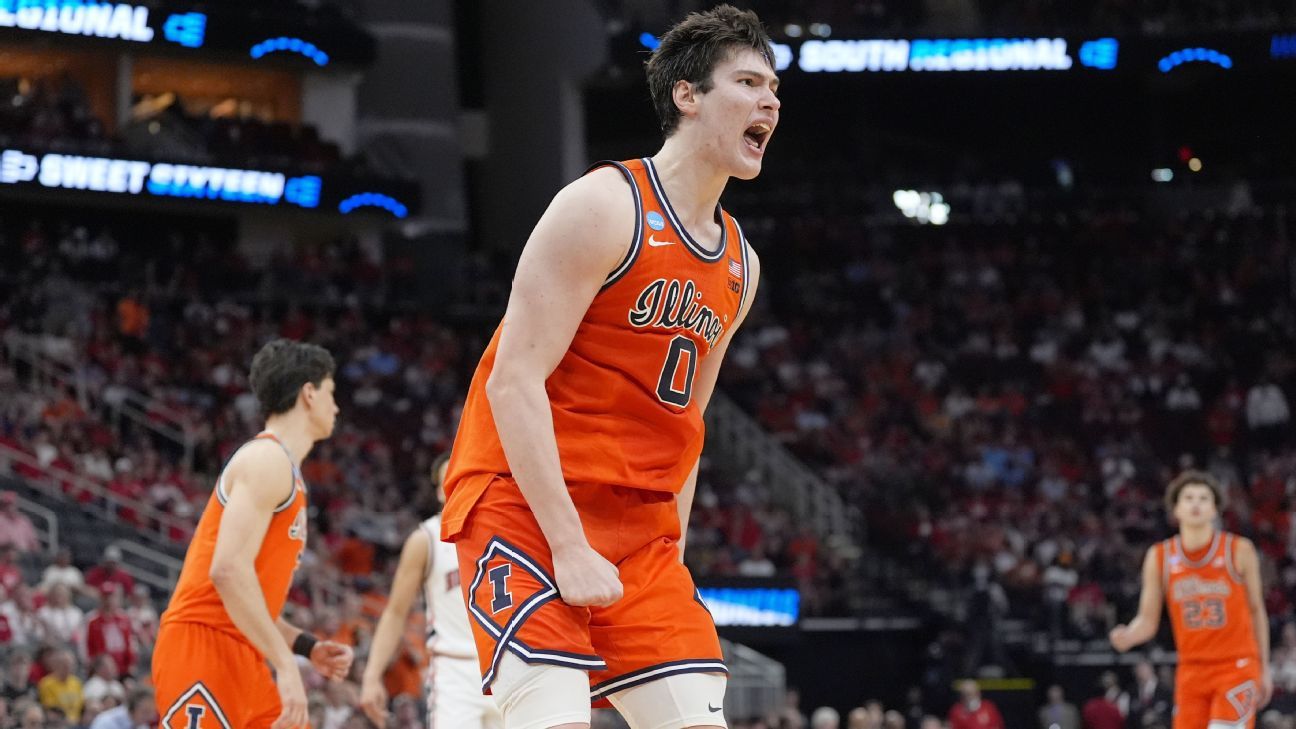
HOUSTON — David Mirkovic had 14 points and 10 rebounds, and third-seeded Illinois flexed its defensive muscles to eliminate last year’s national runner-up from the NCAA tournament, beating Houston 65-55 in the South Region semifinals on Thursday night.
Next up is a meeting Saturday with ninth-seeded Iowa to see which Big Ten team will advance to the Final Four. It will be the 11th Elite Eight appearance for Illinois (27-8) and its second in three seasons under Brad Underwood.
In the Sweet 16 for a seventh consecutive time, the second-seeded Cougars (30-7) were thrilled to be playing just over two miles from their campus. But their poor shooting gave Houston fans little to cheer about and delighted the orange-clad Illini faithful who made the long trip to Texas.
“At the beginning of the game Houston fans were a little louder, but as game was going, [our fans] started being louder in their city,” Mirkovic said. “So it’s just really important for us, I would say just like a wind to our back. They pushed us, and thanks for them.”
Star freshman point guard Kingston Flemings, who is expected to be an NBA lottery pick, had 11 points on 4-of-10 shooting. Milos Uzan made just 2 of 11 shots.
But they were far from the only Cougars who struggled offensively. The team shot just 34% in its lowest-scoring game of the season.
Underwood was asked about his team’s defensive performance.
“I think it’s a mental focus,” he said. “We’ve been very good at times defensively. It’s just sustaining it. We’ve got very capable defenders, we’ve got size and length, and we just got to make shots difficult.”
Illinois finished well under the 84.7 points a game it averaged entering Thursday. But its offense was still plenty powerful enough to send Houston back to its nearby campus. Keaton Wagler had 13 points and a team-high 12 rebounds for the Illini; he and Mirkovic became the first pair of freshman teammates to each have a double-double in the same NCAA tournament game since freshmen became fully eligible in 1972-73, according to ESPN Research.
“Coaches were telling us before the game: ‘It’s going to be a guard game to get rebounds. We need 10-plus out of the guards,'” he said. “So I took that challenge on. I went in there, tried to play as tough as I could, not let them get any second-chance rebounds. I went in there and tried to get every rebound I could.”
Andrej Stojakovic — with his dad, three-time NBA All-Star Peja Stojakovic, in the stands — also scored 13.
By the time the final seconds ticked off the clock, many Houston fans had cleared out and the Illinois supporters stood and cheered as their team celebrated.
“I was proud of our kids’ effort,” Houston coach Kelvin Sampson said. “We just didn’t play good enough.”
The Illini were up by one early in the second half when they broke it open with a 17-0 run for a 44-26 lead with about 12 minutes left. Jake Davis scored five points during the burst, including a 3-pointer, and Mirkovic and Ben Humrichous capped it with consecutive 3s.
The Cougars missed seven consecutive shots as Illinois built its lead. When Uzan finally ended Houston’s drought with a 3-pointer with 11:20 left, it had been almost seven minutes since the team had scored.
“We were getting stops and we were limiting them to one shot, and to tough shots as well,” Wagler said. “Making them shoot tough middies or contested at the rim, 3-pointers, all of that, and then we were going in and grabbing the rebound and offensively we were getting the shots that we wanted, we were knocking them down.”
Consecutive 3-pointers by Chase McCarty got Houston within nine with about six minutes left. But Wagler and Tomislav Ivisic made 3-pointers to fuel an 8-0 run that extended the lead to 58-41.
The Associated Press contributed to this report.
Sports
Trey Kaufman-Renn’s controversial tip-in gives Boilermakers spot in Elite Eight, ends Texas’ Cinderella story
NEWYou can now listen to Fox News articles!
The No. 11 Texas Longhorns’ Cinderella story in the NCAA Tournament came to a heartbreaking end on Thursday night, as Trey Kaufman-Renn’s tip with 0.7 seconds left on the clock gave No. 2 Purdue a 79-77 lead to advance to the Elite Eight.
It was a thriller to the end in this Sweet 16 matchup between a team that needed to play in the First Four to kick off the tournament, and one of the higher seeds in March Madness.
The Longhorns’ Dailyn Swain made a clutch and-one layup with 11 seconds left that allowed him the opportunity to tie the game at 77 apiece if he made his free throw. He nailed it with the pressure on, but the Boilermakers had 11 seconds to get up court and potentially win the game.
CLICK HERE FOR MORE SPORTS COVERAGE ON FOXNEWS.COM
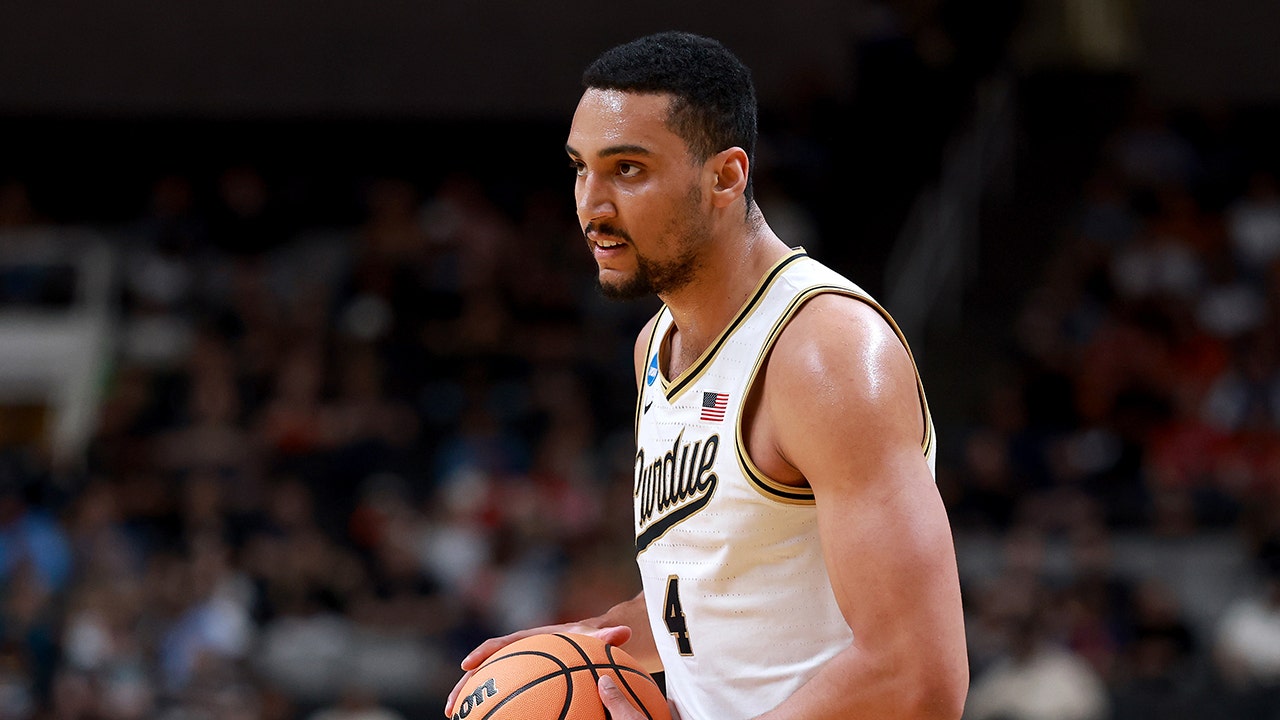
Trey Kaufman-Renn of the Purdue Boilermakers dribbles the ball against the Texas Longhorns during the first half in the Sweet Sixteen of the 2026 NCAA Men’s Basketball Tournament at SAP Center on March 26, 2026, in San Jose, California. (Ezra Shaw/Getty Images)
It was Braden Smith finding his way to the lane and putting up his own layup. However, the ball didn’t have the correct English off the glass, as it started to roll off the rim.
But Kaufman-Renn, who positioned himself underneath the basket, tipped home the game-winning bucket, giving himself 20 total points to help Purdue move on and keep their tournament dreams alive.
8TH-GRADER STANDS ALONE WITH LAST PERFECT WOMEN’S NCAA BASKETBALL BRACKET
There was some discourse on social media, though, as an overhead shot of Kaufman-Renn’s tip showed a potential foul, as he was hooking the arm of the Longhorns player jostling for the rebound.
Either way, no whistle blew, and the Boilermakers were celebrating, while the Longhorns couldn’t believe their season came to a close in that fashion.
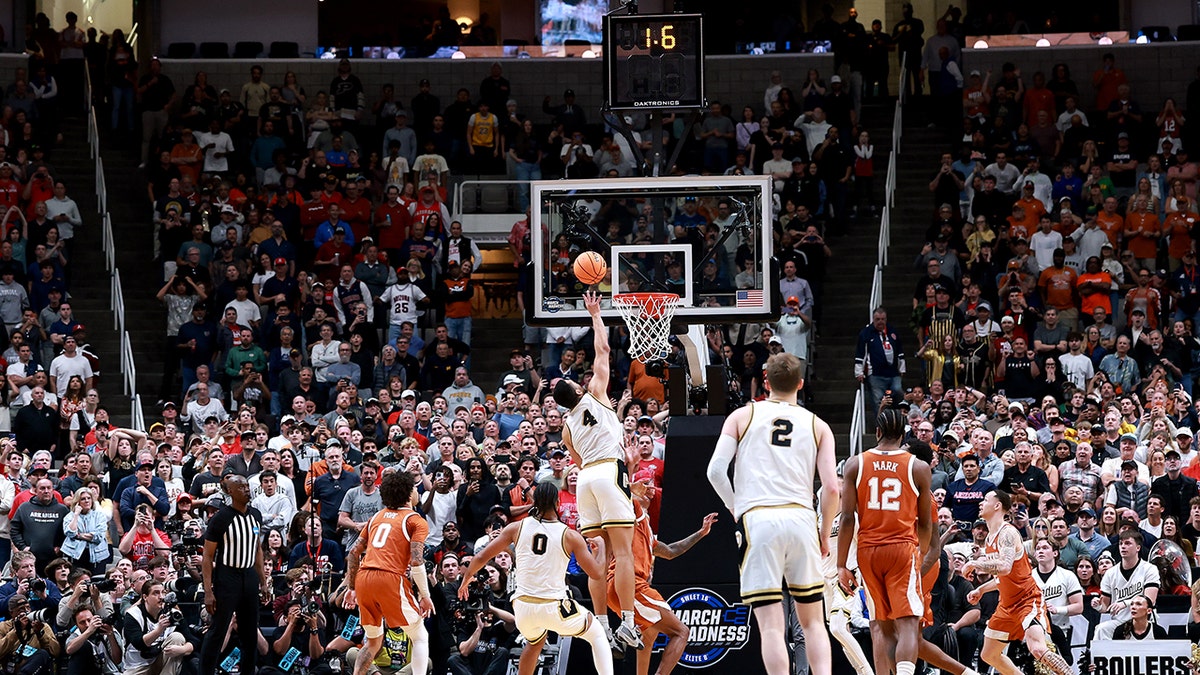
Trey Kaufman-Renn of the Purdue Boilermakers shoots the game-winning shot against the Texas Longhorns during the second half during the second half in the Sweet Sixteen of the 2026 NCAA Men’s Basketball Tournament at SAP Center on March 26, 2026, in San Jose, California. (Ezra Shaw/Getty Images)
This was a back-and-forth game throughout the 40 minutes on the court, as both teams traded the lead, especially in the second half. The largest lead any team had was Purdue at only seven points, while Texas’ lead never got higher than four.
But it’s because both teams were shooting well, with Texas making 52% of its shots (29-of-56), while Purdue poured in 48% (30-of-62).
Looking more into the box score, every Boilermakers starter had at least 10 points, while Fletcher Loyer (18), and Braden Smith (16) doing crucial work in the backcourt to help the winning cause.
Meanwhile, Texas’ Tramon Mark left it all out on the court, shooting 11-of-15 for 29 points, including 5-of-7 made from beyond the arc. Swain also just missed a double-double with nine rebounds, while tallying five assists.
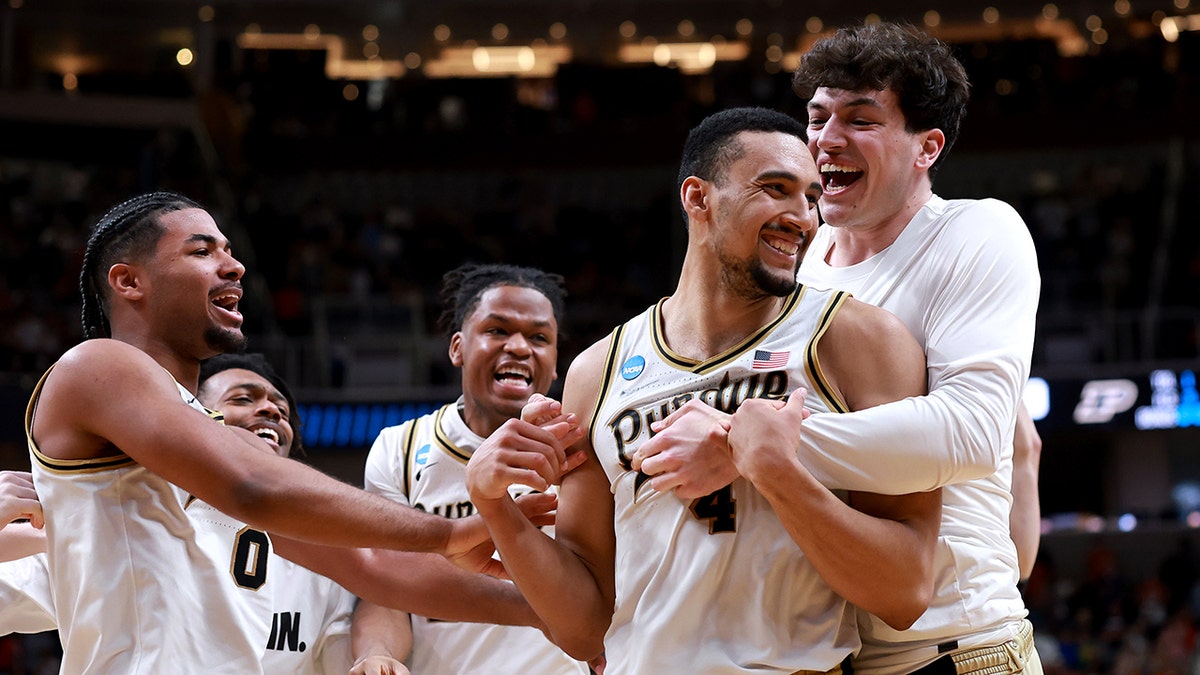
Trey Kaufman-Renn of the Purdue Boilermakers celebrates with teammates after making the game-winning shot against the Texas Longhorns during the second half in the Sweet Sixteen of the 2026 NCAA Men’s Basketball Tournament at SAP Center on March 26, 2026, in San Jose, California. (Ezra Shaw/Getty Images)
CLICK HERE TO GET THE FOX NEWS APP
Purdue now awaits the winner of Arkansas and Arizona to see who they must play to earn a spot in this year’s Final Four, which will be played at Lucas Oil Stadium in Indianapolis.
Follow Fox News Digital’s sports coverage on X and subscribe to the Fox News Sports Huddle newsletter.
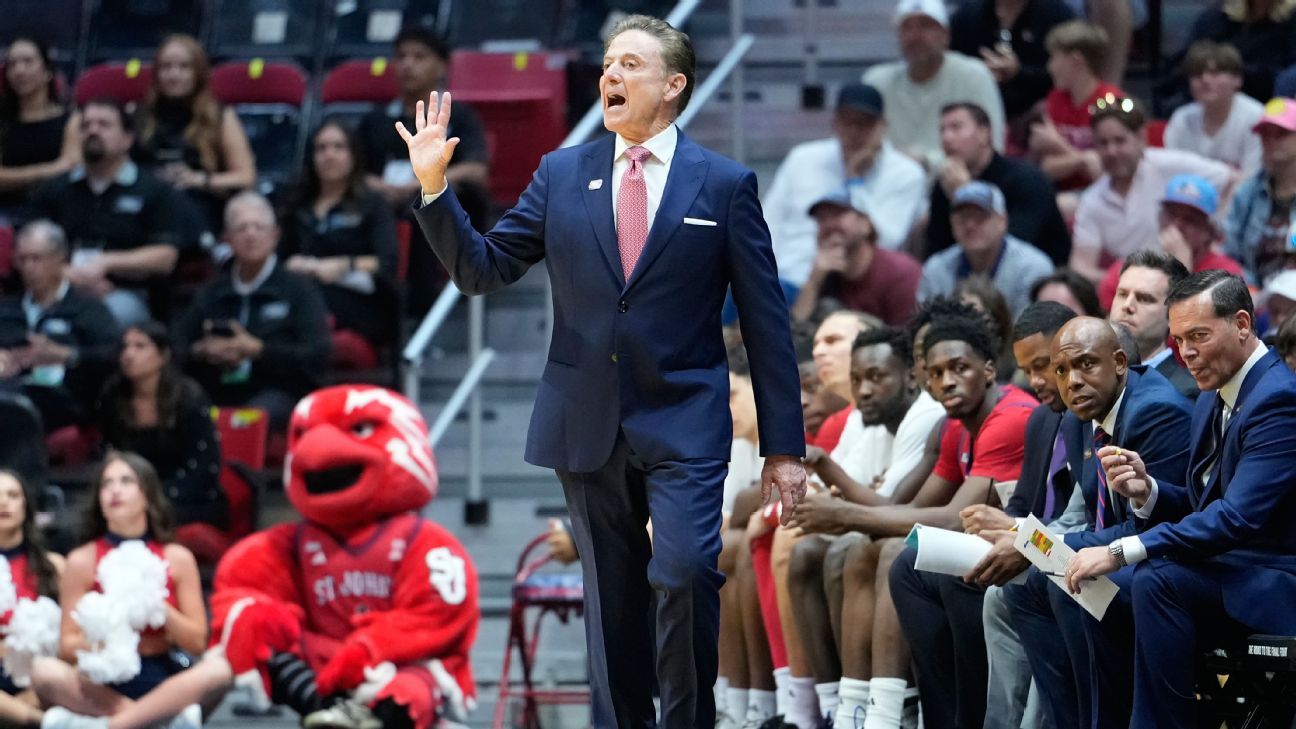
This St. John’s team can’t shoot.
The Red Storm are 182nd nationally in field goal percentage (45.2) and 225th from 3-point range (33.2).
It doesn’t seem to matter. Rick Pitino’s team (30-6) has been opportunistic, physical and fearless in reaching the Sweet 16, where it will play Duke on Friday.
It is reminiscent of Pitino’s 2012-13 Louisville team that shot just 33.3% from behind the arc (216th nationally) yet won the national title. It’s a far cry, however, from his underdog 1987 Providence team, which reached the Final Four thanks to his then-revolutionary idea of prioritizing the newly created 3-pointer. Those Friars hit 42.2% of them.
Pitino can win one way, or the other, or back again; from the Camelot of Kentucky to the late-career rehab of Iona College.
The years change, the teams change. The players, style of play, rules, roster construction, and even the cuts of his neatly tailored suits change.
One thing remains constant.
Pitino wins.
The case for Rick Pitino as the greatest college basketball coach of all time takes some contorting, but each year it gains credence. The 73-year-old coached his first game 50 years ago, in 1976 as an interim at Hawai’i. He now appears better than ever.
Pitino’s 915 victories, .743 winning percentage and two national titles will never compare numerically to, say, Mike Krzyzewski’s 1,202 victories, Adolph Rupp’s .822 win percentage or John Wooden’s 10 championships.
Part of that is by choice — Pitino spent eight seasons in the NBA, including six as head coach in New York and Boston. He also had various NCAA and personal scandals that made him a temporary pariah and, to some, permanently ruined his reputation.
His legacy will always be linked to scandal. He had that Louisville national title, along with 123 victories, “vacated” by the NCAA as a result of its investigation into allegations that a staffer provided escorts at on-campus parties for players and recruits. The program was also at the center of a federal fraud and bribery case involving Adidas.
For a stretch, he was essentially professionally exiled to Greece, where he coached pro ball for two seasons, winning a couple of titles there, too.
Outside the lines, Pitino is one thing. Inside them, though, is a different story. Had he just stayed at Kentucky in 1997 rather than jump to the Celtics — and kept his business in order (perhaps unlikely) — there is no telling what his career totals would be. UK was rolling, after all, winning another national title under Tubby Smith the season after Pitino left.
But he has always bounced around, rescuing six bottomed-out programs (Boston University, Providence, Kentucky, Louisville, Iona and St. John’s). In the season before his arrival, those teams were a combined 76-105 (.419).
No matter.
He led five of them back to the NCAA tournament within two seasons (or in UK’s situation, when a tournament ban concluded). At BU, it took four.
This isn’t to punish other great coaches who built national powers and then stuck with it. Maintaining a juggernaut isn’t simple and deserves credit. Yet, Pitino has proven it was him, not the institution, that made the difference.
Pitino has had talented players (especially the 1996 Kentucky national champions), but he has coached just three future NBA All-Stars — Donovan Mitchell, Jamal Mashburn and Antoine Walker.
This isn’t as impressive as Bob Knight, who won 902 games and three titles despite having just one player who would become an NBA all-star (Isiah Thomas), but it’s also not the Hall of Fame parade that Dean Smith (UNC), Krzyzewski (Duke) or Wooden (UCLA) had.
Pitino, a former New York point guard, is about basketball. He still conducts one-on-one development workouts. He still grinds game footage. He still finds the way to maximize what he has — sometimes with a full-court press, sometimes the old 2-3 zone he learned as an assistant under Jim Boeheim.
He still communicates, harshly but honestly, in a way, for example, that not only empowers current guard Dylan Darling to confidently call for the ball in the waning seconds of Sunday’s victory over Kansas, but allows Pitino to trust “Church Bells” — a nickname stemming from Pitino’s description of Darling’s, uh, fearlessness — to pull it off, even with his off hand.
Pitino’s career has bridged multiple eras; not just in style of play (he coached pre-shot clock and 3-point line), but style of pay. As an assistant at Hawai’i in the mid-1970s, the NCAA dinged him for giving players coupons to McDonald’s. Now, they can own a franchise.
Some of his best work has come recently.
He returned from his Greek purgatory to lead low-major Iona to two NCAAs in three seasons. At age 70, he took over St. John’s, and won consecutive Big East regular-season and tournament titles. Now, the Red Storm are in the Sweet 16 for the first time this century.
The players still listen. They still defend. They still hustle. They still believe.
They still win, even when they can’t shoot all that well.
That’s a pure college basketball coach, perhaps the best there has ever been.

Asda boss rejects profiteering claims as petrol price tops 150p

Britney Spears turns a new page after recent legal trauma

This Premium Sennheiser Soundbar Is $1,000 Off

-
 Entertainment1 week ago
Val Kilmer revived 1 year after death through AI
-

 Fashion7 days ago
China’s textile & apparel exports surge 17% to $50 bn in Jan-Feb 2026
-
 Business7 days ago
Flipkart group CFO to leave co amid IPO plans – The Times of India
-
 Sports7 days ago
Rating Adidas’ 2026 World Cup away shirts: Argentina, Spain, Mexico and more
-
 Business1 week ago
Video: The Effects of High Oil Prices
-
 Sports7 days ago
American Conference Commissioner Tim Pernetti thanks Trump for Army-Navy game executive order
-
Tech1 week ago
The Corsair 4000D RS PC Case Keeps Your System Cool
-
 Tech1 week ago
‘Uncanny Valley’: Nvidia’s ‘Super Bowl of AI,’ Tesla Disappoints, and Meta’s VR Metaverse ‘Shutdown’