

Business
What is the EU’s new border system EES – and how does it work?

Katy AustinTransport correspondent
 BBC
BBCThe next time you travel from the UK to Europe, you might notice some changes.
The EU’s much-delayed new digital border system, the Entry/Exit System or EES, will be gradually introduced this autumn.
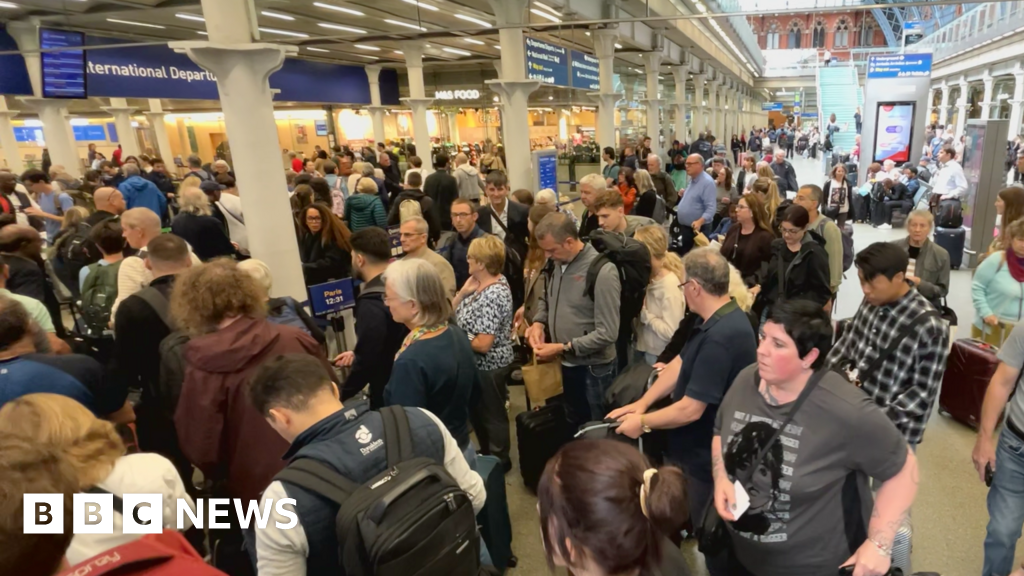
The system is meant to strengthen security and ultimately make travel smoother, but there are concerns it could lead to long queues when people first register.
What is EES and where is it being introduced?
EES is a digital system designed to keep track of when non-EU citizens enter and leave the Schengen Area.
This covers 29 European countries – mainly in the EU – which member citizens can travel across freely without border controls.
It includes many popular destinations for UK travellers, such as France, Spain, Portugal, Italy and Greece.
EES will eventually replace the current system which requires individual passports to be checked and stamped by a border officer.
When will EES start?
After being postponed several times, the European Commission confirmed in July that EES will begin on 12 October. It will be phased in gradually over six months.
At Dover, coach passengers will start using the new system on 12 October, followed by other tourist traffic on 1 November.
At Eurostar terminals, EES will be introduced more gradually.
Only a small number of business travellers will be invited to use the new system from 12 October. More passengers will be directed to use it over subsequent months.
Eurotunnel, which runs vehicle shuttles through the Channel Tunnel, is also expecting to introduce EES in stages from 12 October.
EES should be active at every Schengen border crossing point in all 29 participating countries by 10 April 2026.
What will passengers have to do under EES?
The first time they use the new system, people from most non-EU countries – including the UK – will have to register biometric information while having their passport scanned.
This may be done with a border officer, depending on where people travel to.
Flight passengers will register when they arrive at their destination airport.
But registration will be done as you leave the UK if you are crossing the English Channel by ferry from the port of Dover, taking the Eurotunnel shuttle to France, or getting the Eurostar train.
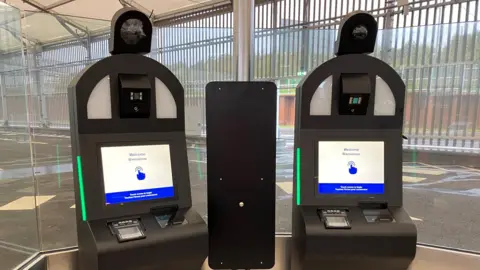
At these places, passengers will have to follow the instructions on kiosks – automated machines installed in dedicated areas.
The machines will scan each passport, then take fingerprints and a photo.
Children under 12 won’t have to provide fingerprints. Staff should be on hand to help.
The machine’s screen will also present travellers with four questions about their trip, such as confirming where they will be staying and that they have enough money.
However, at Eurotunnel, those questions will be asked by border officers instead, and only on a discretionary basis.

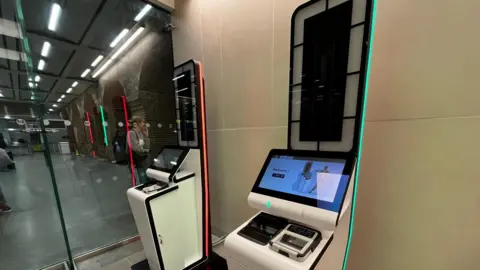
Eurostar has installed 49 EES kiosks in three areas around its London St Pancras terminal. Passengers will use them before presenting their ticket at the departures area.
But it says all passports will continue to be stamped manually until EES is fully rolled out in 2026.
Eurotunnel has installed more than a hundred kiosks at each side of the Channel.
Customers who are travelling in cars will be directed to drive up to a kiosk bearing their registration number, and provide their biometric information there. Coach passengers will go through the process with a border officer.
A mobile phone app has been developed to enable passengers to do part of the process before reaching the border. However, this won’t be widely used when EES is first introduced.
The EES registration will be valid for three years, with the details verified on each trip during that period.
What are the concerns about the introduction of EES?
Concerns have repeatedly been raised that the extra couple of minutes it takes for each traveller to complete the registration process could lead to big queues, particularly at space-constrained Dover.
However, bosses at cross-Channel travel hubs hope that the decision to introduce EES gradually, instead of with a “big bang” start, will reduce the risk of disruption.
The port of Dover previously planned to give ferry passengers tablet devices so they could register inside their vehicles, but will now use kiosks similar to those at Eurostar and Eurotunnel. The port has reclaimed some land from the sea to create more space for processing.
During the initial transition period, the port will be able to temporarily stand down EES if queues get too long, and revert to manual passport stamping.
Eurotunnel chief executive Yann Leriche says there will be no “chaos” or queues at the Channel tunnel, insisting his company has done extensive modelling and is fully prepared.
Similarly, Eurostar hopes its decision to limit EES initially to some business travellers before expanding its use will help to prevent queues.
What is ETIAS and when is that coming?
The EU is also introducing a new visa waiver system linked to passports called the European Travel Information and Authorisation System (ETIAS), which will build on the EES.
Citizens of non-EU countries who don’t need a visa to enter the EU – including people from the UK – will be able to apply online for authorisation before they travel.
ETIAS isn’t due to start until the end of 2026, but the final date has not yet been confirmed.
It will cost €20 (£17.47) per application, and will be valid for three years.
People aged under 18 and over 70 will need to apply, but won’t have to pay.

A UPS driver sits in his truck on April 15, 2026 in the Flatbush neighborhood of the Brooklyn borough in New York City.
Michael M. Santiago | Getty Images
United Parcel Service on Tuesday posted first-quarter earnings results that beat on the top and bottom lines.
Shares of the delivery giant sank roughly 5% in premarket trading.
Here’s how the company performed in its first quarter, compared with what Wall Street was expecting, based on a survey of analysts by LSEG:
- Earnings per share: $1.07 adjusted vs. $1.02 expected
- Revenue: $21.2 billion vs. $20.99 billion expected
For the quarter ended March 31, UPS reported net income of $864 million, or $1.02 per share, compared with $1.19 billion, or $1.40 per share, a year prior. Adjusting for one-time items, the company reported a profit of $906 million, or $1.07 per share. Revenue fell to $21.2 billion from $21.5 billion a year ago.
“The first quarter of 2026 marked a critical transition period for UPS in which we needed to flawlessly execute several major strategic actions and we delivered,” CEO Carol Tomé said in a statement. “With that behind us, we expect to return to consolidated revenue and operating profit growth, and adjusted operating margin expansion in the second quarter of this year.”
For its full-year 2026 outlook, the company reaffirmed its consolidated financial estimate of $89.7 billion in revenue and non-GAAP adjusted operating margin of 9.6%.
“It is early in the year to raise [guidance],” Tomé said on a call with analysts on Tuesday, adding that there are no indications to be concerned about the health of the business.
In its domestic segment, UPS said revenue dropped 2.3%, primarily due to an expected decline in volume.
UPS is also in the midst of a turnaround plan and enhancing the automation in its network. In the first three months of the year, UPS said it achieved $600 million in cost savings from its network efficiency program, with expectations to reach $3 billion in year-over-year savings in 2026.
Company executives added on the call with analysts that fuel surcharges have not had a material impact on UPS’ business and that it remains too early to determine exact impacts from the war in the Middle East.

A “For Lease” sign in the Financial District of San Francisco, California, US, on Wednesday, May 3, 2023.
Jason Henry | Bloomberg | Getty Images
A version of this article first appeared in the CNBC Property Play newsletter with Diana Olick. Property Play covers new and evolving opportunities for the real estate investor, from individuals to venture capitalists, private equity funds, family offices, institutional investors and large public companies. Sign up to receive future editions, straight to your inbox.
Despite the war with Iran and continued economic uncertainty in the U.S., demand for office space is recovering at a strong clip.
In the first quarter of this year, new in-person and virtual office tours reached their highest level since the pandemic began, as measured by the VTS Office Demand Index. The index is a future indicator of lease signings about a year or more out.
The index rose 18% from the fourth quarter 2025 and 13% from the same quarter one year ago.
“Although tested against a turbulent backdrop, demand for office space has seen an exceptional start to the year,” Nick Romito, CEO of commercial real estate software company VTS, said in a release. “What perhaps is most notable about this quarter’s positive performance is that it was led not just by tech’s sustained AI boom – but also by finance and legal companies entering the market as well.”
The surge in demand is curious, given that office-using employment is still down 2% from 2022, according to the Bureau of Labor Statistics. Usually, that would result in less office demand, but the drop in employment could also be giving employers more leverage to get workers back into the office.
Nationally, for all buildings, the office vacancy rate fell 14 basis points to 22.2% in the first quarter of this year from the previous quarter and is down 30 basis points from the last peak in Q2 2025, according to a report from JLL, a commercial real estate services and investment management company. Vacancy remains hyper-concentrated predominantly in larger-scale, aging buildings with financially constrained owners, with 10% of office buildings comprising more than 60% of total national vacancy.
As with everything in real estate, the office recovery is local. San Francisco and New York City are leading office demand, as AI tech employment rises quickly in the former and diversity of employment fuels the latter. Los Angeles also saw double-digit increases in demand on a quarterly basis, fueled by significant growth in the creative industry, according to VTS.
Cities seeing weaker demand include Boston, which was the worst-performing market in the report. Life science offices have taken a hit in that city, due to significant government funding cuts.
In addition, demand is contracting in Seattle, Washington, D.C., and Chicago, as they are not seeing strong employment growth.
“The AI boom continues to be a dominant headline for office, and markets that lack a major tech presence, or are without a primary growth lever in another industry, are seeing declines in demand,” Ryan Masiello, chief strategy officer of VTS, said in a release. “LA’s positive performance this time around was a new bright spot – and it remains to be seen if Los Angeles can sustain growth in the near term.”
Protesters have forced NatWest to halt its shareholder meeting, as the bank’s chairman defended its climate policy in response to investors claiming it has “backtracked” on commitments.
The annual general meeting (AGM) was being held on Tuesday morning but had to be stopped for about half an hour amid disruption during chairman Rick Haythornthwaite’s opening speech.
Protesters were singing and making statements about NatWest’s climate policies.
The boss heard a statement presented by ShareAction, backed by investors managing 1.4 trillion US dollars (£1 trillion) in assets, including the Church of England Pensions Board, Greater Manchester Pension Fund and Rathbones Investment Management.
The statement said investors are “concerned by the bank’s changed outlook on climate change” having “reduced the ambition of its fossil fuel policy and climate targets”.
“The bank dropped its commitment not to finance oil and gas majors lacking a credible transition plan or failing to report their overall emissions,” it said.
It called for Mr Haythornthwaite to meet the group of shareholders to discuss the bank’s climate strategy.
Campaigners including ShareAction are also calling for shareholders to vote against the re-election of the bank’s chair over concerns of climate backtracking, which the Church of England’s pensions body said it plans to do.
Mr Haythornthwaite responded to the statements saying that he “takes climate change very seriously, as does all of this board” and that he was happy to meet the group.
“We’ve had to wrestle with the questions of how do we balance supporting our customers in their transition efforts with managing the risks in what is an increasingly complex policy environment,” he said.
He stressed that the bank’s “overwhelming” balance of lending was on renewables and that oil and gas financing comprises 0.6% of total lending.
NatWest also retained targets to at least halve the climate impact of its financing activity by 2030, against a 2019 baseline.
“I don’t want to take what sounds like a backtracking as a major shift,” Mr Haythornthwaite said, adding that “these targets matter”.

UPS beats Wall Street estimates on top and bottom lines

Japan’s apparel imports rise 2.8% to $24.3 bn in FY 2025-26

Get Ready for More Brain-Scanning Consumer Gadgets

-

 Sports1 week ago
NCAA men’s gymnastics championship: All-time winners list
-

 Sports1 week ago
WWE WrestleMania 42 Night 2: Live match results and analysis
-

 Politics1 week ago
UK’s Starmer seeks to deflect blame over Mandelson appointment
-

 Fashion1 week ago
UK’s Sosandar returns to profitability amid robust FY26 performance
-
 Business1 week ago
No fuel shortage: Govt assures 100% domestic LPG, PNG, CNG supply amid Hormuz energy crunch – The Times of India
-

 Entertainment1 week ago
Lee Anderson, Zarah Sultana kicked out of UK Parliament for calling PM ‘liar’
-
 Business1 week ago
How Trump’s psychedelics executive order could unlock stalled cannabis reform
-
 Business7 days ago
Us-India Trade Talks: US–India trade deal: Where do talks stand & what to expect – explained – The Times of India