

Politics
‘Grave betrayal of diplomacy’: Iran’s president decries US-Israeli strikes, censures E3’s sanctions push

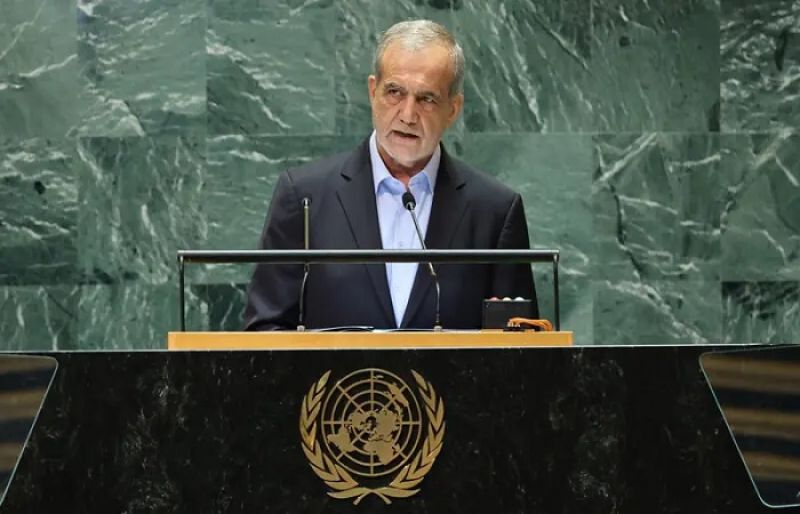

The president said the attacks, which struck Iranian cities, homes, and infrastructure while diplomatic talks were ongoing, represented “a grave betrayal of diplomacy and a weakening of efforts to establish peace and stability.”
“What you see in these images of killings and crimes is the massacre of children and women. It is a black record of slaughter carried out by Israel in our country against our people, including women, children, and youth, under the name of preserving peace and security in the region,” he said, holding out pictures of the victims.
Pezeshkian underscored Iran’s resilience, saying the country was “the world’s oldest continuous civilization” that has withstood the storms of history.
“Despite the harshest, longest, and heaviest economic sanctions, psychological warfare, media campaigns, and constant efforts to sow division, the Iranian people, from the very first bullet fired at their soil, stood united behind their brave armed forces, and today they continue to honor the blood of their martyrs,” he said.
The Iranian president said the strikes killed commanders, women, children, scientists, and national elites, while also damaging internationally-monitored facilities. He said the strikes constitute “a black record of crimes” carried out under the pretext of preserving regional security.
“Assassination of state officials, systematic targeting of journalists, and the killing of individuals solely because of their knowledge and expertise are flagrant violations of human rights and international law,” the Iranian president told delegates from around the globe.
Israel and the United States have shed the blood of thousands of innocent people in Gaza with the same approach, he said.
Pezeshkian accused Washington and Tel Aviv of deliberately undermining negotiations through military escalation.
The president stated that the foundation of all divine religions and human conscience is the golden rule: “Do not do unto others what you would not want done unto yourself.”
“Let us look at the past two years: the world has witnessed genocide in Gaza; the destruction of homes and repeated violations of sovereignty and territorial integrity in Lebanon; the devastation of Syria’s infrastructure; attacks on the people of Yemen; the forced starvation of emaciated children in their mothers’ arms; the stealthy assault on the sovereignty of nations, violations of states’ territorial integrity, and the open targeting of national leaders.”
“Would you accept such things for yourselves?”
The Iranian president warned that if such “dangerous violations” go unchecked, they will spread worldwide.
Call for ‘power through peace’
The president denounced what he called the “absurd and delusional” plan for a “Greater Israel,” accusing Israel of pursuing aggression and apartheid under the guise of “peace through power.”
“Today, after nearly two years of genocide, mass starvation, the continuation of apartheid inside the occupied territories, and aggression against neighboring countries, the absurd and delusional plan of a ‘Greater Israel’ is being shamelessly declared at the highest levels of this regime.”
He said such policies amount to “bullying and coercion — not peace, and not power.”
The Iranian president outlined an alternative vision for West Asia, calling for a “strong region” built on collective security, cultural diversity, joint investment in infrastructure and science, energy security, environmental protection, and the non-negotiable principles of sovereignty and territorial integrity.
“We seek not peace through force, but power through peace.”
He also reiterated Iran’s longstanding support for a West Asia free of weapons of mass destruction, criticizing nuclear-armed states for violating the Non-Proliferation Treaty (NPT) while pressuring Iran with “baseless accusations.”
“But we want our powerful Iran, alongside powerful neighbors, in a strong region with a bright future,” Pezeshkian said.
“We stand against mega projects that impose genocide, destruction, and instability on the region, and we defend a shared and hopeful vision: a vision that guarantees collective security through genuine mechanisms of defensive cooperation and joint responses to threats… a vision that seeks not ‘peace through force’ but ‘power through peace.’”
The president said in such a rich region, “there is no place for killing and bloodshed.”
“That is why, for many years, my country has been one of the staunchest supporters of creating a region free of weapons of mass destruction.”
“Yet those who themselves possess the largest nuclear arsenals, and who, in blatant violation of the NPT, make their weapons ever more lethal and destructive, have for years subjected our people to pressure with baseless accusations,” he said.
‘E3 trying to bully Iran’
Turning to the standoff over the so-called snapback mechanism of the 2015 nuclear deal, Pezeshkian denounced three European countries for attempting to reinstate annulled UN Security Council sanctions against Tehran, calling the move “illegal” and carried out “at the order of the United States.”
“Last week, three European countries, after failing, through a decade of broken promises and later by supporting military aggression, to bring the proud people of Iran to their knees, at the order of the United States, attempted through pressure, bullying, imposition, and blatant abuse to reinstate the annulled UN Security Council resolutions against Iran,” he said.
He accused the European powers of abandoning goodwill, bypassing legal obligations, and misrepresenting Iran’s remedial steps after the US withdrawal from the 2015 nuclear deal.
“They falsely presented themselves as ‘well-intentioned parties’ to the agreement, and labeled Iran’s sincere efforts as ‘insufficient.’ All of this was aimed at destroying the very JCPOA they themselves once called the greatest achievement of multilateral diplomacy,” he said.
The president said the move, which also faced opposition from some Security Council members, lacks international legitimacy and “will not be welcomed by the global community.”
He reiterated that Iran has never pursued nuclear weapons, citing a religious decree by Leader of the Islamic Revolution Ayatollah Seyyed Ali Khamenei.
Calling for a new approach to security, he urged world leaders to embrace “confidence building, mutual respect, and regional convergence” rather than force.
“I invite everyone to practice listening to one another instead of raising voices; to reconsider the intellectual foundations of polarization and political violence that today afflict not only the international community but also create tension and turmoil within societies; and to embrace, as the common ground of all beliefs and cultures, the principle of not imposing on others what we would not accept for ourselves.”
The Iranian president concluded by appealing for the restoration of the credibility of international institutions and the creation of a regional security framework in West Asia.
“Let us restore and rebuild the credibility of international institutions and legal mechanisms, and commit to establishing a system of regional security and cooperation in West Asia.”
- Reza Pahlavi, son of Iran’s late shah, says govt will fall.
- Netblocks says internet blackout lasted over 180 hours.
- Tasnim reports rioters torched education office in Isfahan.
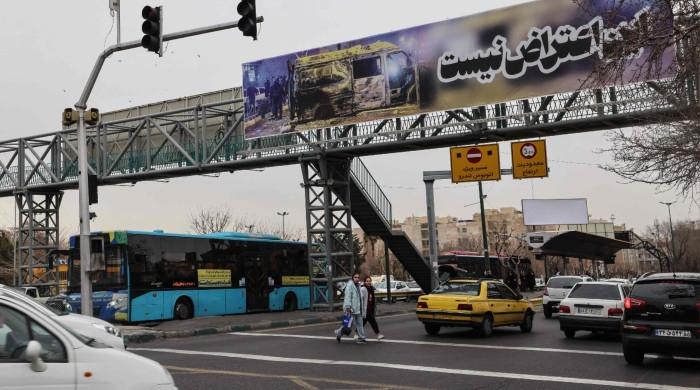
Tensions in Iran have subsided after three weeks of protests under an internet blackout, monitors said on Friday, a week after the start of the largest demonstrations in years challenging the country’s rulers.
The son of Iran’s late shah, however, said he was confident the government would fall and called for intervention, though the threat of new military action by the United States against Iran has appeared to have receded for the time being.
Protests sparked by economic grievances started with a shutdown in the Tehran bazaar on December 28 but turned into a mass movement demanding the removal of the system that has ruled Iran since the 1979 revolution.
People started pouring into the streets in big cities from January 8, but authorities immediately enforced a shutdown of the internet that has lasted over a week.
Reza Pahlavi, the son of Iran’s late shah, told a news conference in Washington that the government “will fall — not if, but when.”
“I will return to Iran,” he said.
Monitor Netblocks said that the “total internet blackout” in Iran had now lasted over 180 hours, longer than a similar measure that was imposed during the 2019 protests.
Amnesty International said this was being backed up by the use of heavily armed patrols and checkpoints to counter nationwide protests, with security forces visible in the streets.
‘Give Iran a chance’
Trump, who backed and joined Israel’s 12-day war against Iran in June, had not ruled out new military action against Tehran and made clear he was keeping a close eye on if any protesters were executed.
But a senior Saudi official told AFP on Thursday that Saudi Arabia, Qatar and Oman led “a long, frantic, diplomatic last-minute effort to convince President Trump to give Iran a chance to show good intention”.
While Washington appeared to have stepped back, the White House said on Thursday that “all options remain on the table for the president”.
Attention had focused on the fate of a single protester, Erfan Soltani, a 26-year-old who rights activists and Washington said was set to be executed as early as Wednesday.
The Iranian judiciary, however, said Soltani had not been sentenced to death, and his charges meant he did not risk capital punishment.
Rights groups have estimated that up to 20,000 people have been arrested. Security officials cited by the Tasnim news agency on Friday said around 3,000 people were arrested.
‘All Iranians united’
The US Treasury on Thursday announced new sanctions targeting Iranian officials including Ali Larijani, secretary of Iran’s Supreme Council for National Security.
Russian President Vladimir Putin, meanwhile, held telephone talks with Iranian President Masoud Pezeshkian in what the Kremlin described as “efforts to facilitate de-escalation”.
At the UN Security Council in New York, Iranian-American journalist Masih Alinejad, invited to address the body by Washington, said “all Iranians are united” against the government in Iran.
Iran’s representative at the meeting Gholamhossein Darzi accused Washington of “exploitation of peaceful protests for geopolitical purposes.”
There were, however, indications of unrest in some areas.
The state-affiliated Tasnim news outlet reported that rioters set fire to a local education office in Falavarjan County, in central Isfahan Province, on Thursday.
An elderly resident of a town in Iran’s northwestern region, where many Kurdish Iranians live and which has been the focus for many of the biggest flare-ups, said sporadic protests had continued, though not as intensely.
Describing violence earlier in the protests, she said: “I have not seen scenes like that before.”
The state-owned Press TV cited Iran’s police chief as saying calm had been restored across the country.
Tasnim news also reported what it described as the arrest of a large number of leaders of recent riots in the western province of Kermanshah, and the arrest of five people accused of vandalising a gas station and a base belonging to the Basij in the southeastern city of Kerman.
- New Delhi incurs $120m losses after exiting port development deal.
- Congress leader terms move “a new low” in India’s foreign policy.
- Experts say actions raise concerns about India’s role at Chabahar.
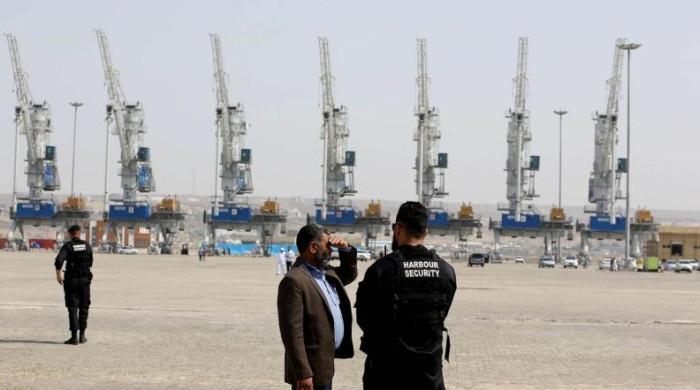
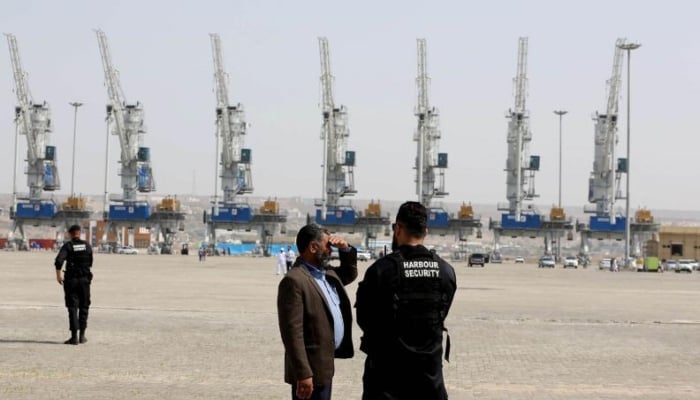
The Indian government, led by Prime Minister Narendra Modi, has come under heavy fire at home after it withdrew from the Chabahar port agreement with Iran, with critics arguing the move was a strategic retreat rather than a proactive foreign policy decision.
New Delhi was forced to abandon its involvement in the port after the United States imposed a 25% tariff on countries doing business with Tehran, The Economic Times reported on Thursday.
According to the publication, India’s withdrawal was carried out without any formal announcement, resulting in the loss of $120 million already paid to Iran.
The amount had been transferred before the decision to disengage and is now considered unrecoverable, the report stated.
The state-run company working at the port, India Ports Global Limited (IPGL), saw its board of directors submit collective resignations after the decision, while the company’s official website has also been shut down.
Congress party leader Pawan Khera termed the move “a new low” in the Modi-led government’s foreign policy.
“So the question is not of Chabahar Port or of Russian oil. The question is: Why is Modi allowing USA to arm-twist India?” he asked in an X post.
India assumed responsibility in 2024 for developing Chabahar port under a 10-year arrangement with Iran.
Meanwhile, a foreign journal reported that the $120 million already paid to Iran can now be used by it at its discretion for the port’s construction and development.
Observers described India’s withdrawal from Chabahar port as another major setback for New Delhi.
The Congress party sharply criticised the Modi-led government over the decision, saying the Indian prime minister “has once again surrendered to Trump”.
“$120 million of India’s taxpayers’ money was invested by the Modi government in this strategically important project, but now it’s all gone up in smoke,” read a post on the party’s X handle.
The Indian opposition party recalled Modi hailing the agreement as “a major strategic win”, saying India’s control over the port has been relinquished, with complete silence from the government.
“Unfortunately, Modi has bowed before Trump’s pressure and compromised India’s national interest,” the party stated.
Meanwhile, economic affairs experts believe the latest actions reinforced concerns surrounding India’s role at Chabahar.
They voiced concerns that India was using the port for nefarious objectives, saying that IPGL’s conduct suggested it was created primarily to acquire control of Chabahar.
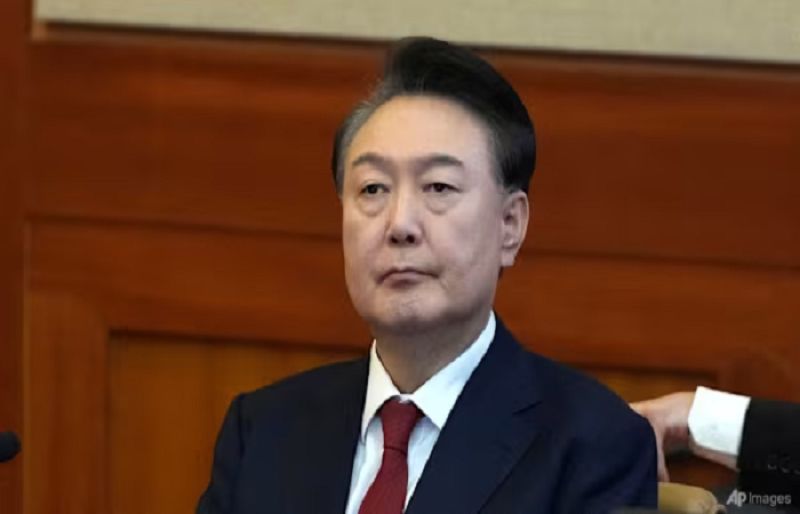

A South Korean court on Friday sentenced former President Yoon Suk Yeol to five years in prison on charges that included obstructing attempts by authorities to arrest him following his failed bid to impose martial law in December 2024.
The Seoul Central District Court found Yoon guilty of mobilising the presidential security service to block authorities from executing an arrest warrant that had been legally issued by a court to investigate him for his martial law declaration.
In televised proceedings, he was also found guilty of charges that included fabricating official documents and failing to comply with the legal process required for martial law.
The ruling is the first related to the criminal charges Yoon faces over his botched martial law declaration.
“The defendant abused his enormous influence as president to prevent the execution of legitimate warrants through officials from the Security Service, which effectively privatised officials … loyal to the Republic of Korea for personal safety and personal gain,” the lead judge on the three-justice panel said.
Speaking outside the court immediately after the decision, one of Yoon’s lawyers, Yoo Jung-hwa, said the former president would appeal the ruling. “We express regret that the decision was made in a politicised manner,” she said.
He could face the death sentence in a separate trial on a charge of masterminding an insurrection by declaring martial law without justification.
Yoon has argued it was within his powers as president to declare martial law and that the action was aimed at sounding the alarm over the obstruction of government by opposition parties.
Yoon, who also denied Friday’s charges, could have faced up to 10 years in jail over the obstruction charges related to when he barricaded himself inside his residential compound in January last year and ordered the security service to block investigators.
He was finally arrested in a second attempt involving more than 3,000 police officers. Yoon’s arrest was the first ever for a sitting president in South Korea.
Parliament, joined by some members of Yoon’s conservative party, voted within hours to overturn his surprise martial law decree and later impeached him, suspending his powers.
He was removed from office in April last year by the Constitutional Court, which ruled he violated the duties of his office.
While Yoon’s bid to impose martial law lasted only about six hours, it sent shockwaves through South Korea, which is Asia’s fourth-largest economy, a key US security ally, and long considered one of the world’s most resilient democracies.


Princess Kate starts driving herself to events, ditches drivers

Syracuse AD Wildhack: College football needs wholesale changes

Hassett pivots to possible ‘Trump cards’ amid credit card interest rate battle with banks

-

 Entertainment1 week ago
Why did Nick Reiner’s lawyer Alan Jackson withdraw from case?
-

 Sports6 days ago
Clock is ticking for Frank at Spurs, with dwindling evidence he deserves extra time
-
 Business1 week ago
Trump moves to ban home purchases by institutional investors
-

 Tech4 days ago
New Proposed Legislation Would Let Self-Driving Cars Operate in New York State
-
Sports7 days ago
Commanders go young, promote David Blough to be offensive coordinator
-

 Fashion6 days ago
South India cotton yarn gains but market unease over US tariff fears
-

 Entertainment3 days ago
X (formerly Twitter) recovers after brief global outage affects thousands
-
 Fashion6 days ago
China’s central bank conducts $157-bn outright reverse repo operation