

Tech
Why Everyone Is Suddenly in a ‘Very Chinese Time’ in Their Lives


In case you didn’t get the memo, everyone is feeling very Chinese these days. Across social media, people are proclaiming that “You met me at a very Chinese time of my life,” while performing stereotypically Chinese-coded activities like eating dim sum or wearing the viral Adidas Chinese jacket. The trend blew up so much in recent weeks that celebrities like comedian Jimmy O Yang and influencer Hasan Piker even got in on it. It has now evolved into variations like “Chinamaxxing” (acting increasingly more Chinese) and “u will turn Chinese tomorrow” (a kind of affirmation or blessing).
It’s hard to quantify a zeitgeist, but here at WIRED, chronically online people like us have been noticing a distinct vibe shift when it comes to China over the past year. Despite all of the tariffs, export controls, and anti-China rhetoric, many people in the United States, especially younger generations, have fallen in love with Chinese technology, Chinese brands, Chinese cities, and are overall consuming more Chinese-made products than ever before. In a sense the only logical thing left to do was to literally become Chinese.
“It has occurred to me that a lot of you guys have not come to terms with your newfound Chinese identity,” the influencer Chao Ban joked in a TikTok video that has racked up over 340,000 likes. “Let me just ask you this: Aren’t you scrolling on this Chinese app, probably on a Chinese made phone, wearing clothes that are made in China, collecting dolls that are from China?”
Everything Is China
As is often the case with Western narratives about China, these memes are not really meant to paint an accurate picture of life in the country. Instead, they function as a projection of “all of the undesirable aspects of American life—or the decay of the American dream,” says Tianyu Fang, a PhD researcher at Harvard who studies science and technology in China.
At a moment when America’s infrastructure is crumbling and once-unthinkable forms of state violence are being normalized, China is starting to look pretty good in contrast. “When people say it’s the Chinese century, part of that is this ironic defeat,” says Fang.
As the Trump administration remade the US government in its own image and smashed long-standing democratic norms, people started yearning for an alternative role model, and they found a pretty good one in China. With its awe-inspiring skylines and abundant high-speed trains, the country serves as a symbol of the earnest and urgent desire among many Americans for something completely different from their own realities.
Critics frequently point to China’s massive clean energy investments to highlight America’s climate policy failures, or they point to its urban infrastructure development to shame the US housing shortage. These narratives tend to emphasize China’s strengths while sidelining the uglier facets of its development—but that selectivity is the point. China is being used less as a real place than as an abstraction, a way of exposing America’s own shortcomings. As writer Minh Tran observed in a recent Substack post, “In the twilight of the American empire, our Orientalism is not a patronizing one, but an aspirational one.”
Part of why China is on everyone’s mind is that it’s become totally unavoidable. No matter where you live in the world, you are likely going to be surrounded by things made in China. Here at WIRED, we’ve been documenting that exhaustively: Your phone or laptop or robot vacuum is made in China; your favorite AI slop joke is made in China; Labubu, the world’s most coveted toy, is made in China; the solar panels powering the Global South are made in China; the world’s best-selling EV brand, which officially overtook Tesla last year, is made in China. Even the most-talked about open-source AI model is from China. All of these examples are why this newsletter is called Made in China.












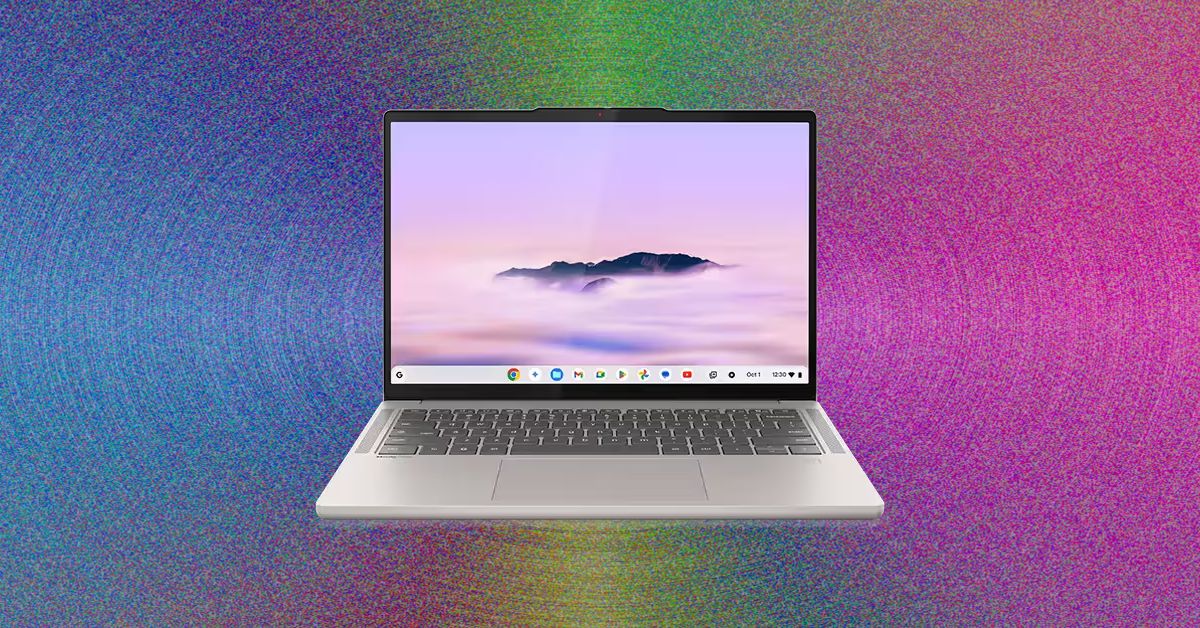
I was delighted to see that the Acer Chromebook Plus 516 didn’t skimp on a crappy touchpad. That goes a long way toward improving the experiencing of actually using the laptop on a moment-by-moment basis. I wasn’t annoyed every time I had to click-and-drag or select a bit of text. This one’s biggest weakness is definitely the screen, which is true of just about every cheap Chromebook I’ve tested. The colors are ugly and desaturated, giving the whole thing a sickly green tint. It’s also not the sharpest in the world, as it’s stretching 1920 x 1200 pixels across a large, 16-inch screen. But in terms of usability and performance, the Acer Chromebook Plus 516 is a great value, combining an Intel Core i3 processor with 8 GB of RAM and a 128 GB of storage. For a Chromebook that’s often on sale for $350, it’s a steal.
While we’re here, let’s go even cheaper, shall we? Asus has two dirt-cheap Chromebooks that I tested last year that I was mildly impressed by. The Asus Chromebook CX14 and CX15. Notice in the name that these are not “Chromebook Plus” models, meaning they can be configured with less RAM and storage, and even use lower-powered processors. That’s exactly what you get on the cheaper configurations of the CX14 and CX15, which is how you sometimes get prices down to as low as $130. I definitely recommend the version with 8 GB of RAM, but regardless of which you choose, the both the CX14 and larger CX15 are mildly attractive laptops. You’d know that’s a big compliment if you’ve seen just how ugly Chromebooks of this price have been in the past.
With these, though, I appreciate the relatively thin bezels and chassis thickness, as well as the larger touchpad and comfortable keyboard. The CX15 even comes in a striking blue color. The touchpad isn’t great, nor is the display. Like the Acer Chromebook Plus 516, it suffers from poor color reproduction and only goes up to 250 nits of brightness. It only has a 720p webcam too, which makes video calls a bit rough. But that’s going to be true of nearly all the competition (and there isn’t much).
Of the two models, I definitely prefer the CX14 though, as it doesn’t have a numberpad and off-center touchpad, which I’ve always found to be awkward to use. Look—no one’s going to love using a computer that costs the less than $200, but if it’s what you can afford, the Asus Chromebook CX14 will at least get you by without too much frustration.
Whatever you do, don’t just head over to Amazon and buy whatever ancient Chromebook is selling for $100 for your kid. It’s worth the extra cash to get something with better battery life, a more modern look, and decent performance.
Other Good Chromebooks We’ve Tested
We’ve tested dozens and dozens of Chromebooks over the past years, having reviewed every major release across the spectrum of price. Unlike Macs and Windows laptops, Chromebooks tends to stick around a bit longer though, and aren’t refreshed as often. I stand by my picks above, but here are a few standouts from our testing that are still worth buying for the right person.
Photograph: Daniel Thorp-Lancaster

Two of Big Tech’s most influential billionaires, Sam Altman and Elon Musk, will go head-to-head in a highly anticipated trial beginning April 27. In Musk v. Altman, a judge, advised by a jury, will ultimately determine whether OpenAI has strayed from its founding mission to ensure that artificial general intelligence (AGI) benefits humanity, and the ruling could influence how the world’s leading AI developer controls and distributes its technology. For now, you can learn more about the trial here.
On the Panel
On May 8, a panel of WIRED experts will go live to answer your questions about this consequential case.
- Zoë Schiffer: WIRED’s director of business and industry, who oversees coverage of business and Silicon Valley.
- Maxwell Zeff: a senior writer at WIRED covering the business of artificial intelligence. He writes the weekly Model Behavior newsletter, which focuses on the people, communities, and companies behind Silicon Valley’s AI scene.
- Paresh Dave: a senior writer at WIRED covering the inner workings of Big Tech companies. He writes about how apps and gadgets are built and about their impacts while giving voice to the stories of the underappreciated and disadvantaged.
Ask a Question
Submit all your burning questions about this historic legal battle at WIRED’s next, subscriber-only livestream scheduled for May 8 at noon ET / 9 PT. To leave questions in advance as the trial unfolds, head to the comment section below.
Become a Subscriber
The event will be streamed right here. For subscribers who are not able to join, a replay of the livestream will be available after the event. Not a subscriber yet? Subscribe now to get access to this livestream, plus full access to WIRED.
In the meantime, check out past livestreams on Big Tech and the military, the future of electric vehicles, and more.
A case seeking compensation for approximately 59,000 businesses and organisations using the Microsoft Windows Server operating system in non-Microsoft public clouds is going ahead.
The Competition Appeal Tribunal (CAT) has ruled to certify a £2bn legal action against Microsoft over its cloud computing and software practices. The collective action court case, brought by digital markets regulation expert Maria Luisa Stasi, accuses Microsoft of overcharging UK businesses and organisations that use its Windows Server on rival cloud services.
CAT dismissed Microsoft’s arguments against certification and granted a Collective Proceedings Order on an opt-out basis, allowing the case to head to trial.
Speaking to Computer Weekly at the end of last year, Stasi discussed Microsoft’s dominance. “Microsoft is dominant on some parts of the [IT infrastructure] stack and is using this power to impose things that otherwise will be difficult to accept for business users, and the reality is that they can do that because they limit choice for people,” she said.
“For years, Microsoft’s practices have had real financial impact on both public and private organisations. I’m now looking forward to preparing for trial and getting their money back on their behalf.”
In March this year, the UK Competition and Markets Authority announced it would launch a Strategic Market Status investigation into Microsoft, probing its software licensing practices in the cloud market.
The class action from Stasi involves two aspects of Microsoft licensing. The first is pricing abuse of Microsoft Service Provider License Agreement (SPLA) and concerns Microsoft charging wholesale prices for Windows Server under SPLAs that are higher than those for equivalent licences charged to Azure users.
The second is abuse of re-licensing, which is where Microsoft allows organisations with on-premise Windows Server licences to deploy the server operating system on Azure, without the need to pay re-licensing fees. This is not possible if the customer chooses to deploy Windows Server on a cloud service provider that is listed as approved by Microsoft. Re-Licensing Abuse operates by way of the Azure Hybrid Benefit which is granted to the holder of an on-premise licence.
“We are very pleased with the tribunal’s decision, including its confirmation that Dr Stasi’s action should proceed on an opt-out basis, as sought in her application,” said James Hain-Cole, partner at law firm Scott+Scott, which is leading on the case against Microsoft.
“Certification of this claim is a pivotal step in securing compensation for thousands of businesses and organisations,” he added. “The decision illustrates the importance of the regime for UK businesses who, like consumers, require and deserve the access to justice that it was designed to offer. Looking ahead to the trial, we are proud to be supporting Dr Stasi’s efforts to provide access to justice for those organisations that have suffered as a result of Microsoft’s anti-competitive practices, which remains the target of competition regulators around the world.”
In its ruling, the court dismissed Microsoft’s arguments and allowed the case to head to trial. It also concluded that the claim “comfortably crosses the hurdle of having a real prospect of success”.


US CBP to soon launch electronic system for importers to claim refunds

US’ Gap & FIT launch programme to mentor fashion students

Nasa unveils new space telescope to probe mysteries of ‘dark energy’

-

 Fashion6 days ago
France’s LVMH Q1 revenue falls 6%, shows resilience amid Iran war
-

 Entertainment7 days ago
Is Claude down? Here’s why users are seeing errors
-

 Sports1 week ago
PSL 11: Peshawar Zalmi win toss, opt to field first against Quetta Gladiators
-

 Tech1 week ago
The Deepfake Nudes Crisis in Schools Is Much Worse Than You Thought
-

 Tech1 week ago
Human-machine teaming dives underwater
-
 Tech1 week ago
Bremont Is Sending a Watch to the Moon’s Surface
-
 Business1 week ago
BP sees ‘exceptional’ oil trading result as Iran war sends crude costs soaring
-
 Business1 week ago
Standard Life buys rival in £2b deal to create savings giant