

Fashion
Missoni: Hemlines shorten, as fashion travels from sea to city

Published
September 24, 2025
For Spring/Summer 2026, Alberto Caliri, Missoni‘s creative director, has conceived an everyday wardrobe. Moods and attitudes were ‘Missoni-fied’ through relentless exploration of colour and materials and the vibrant, composite rhythm of the patterns, resulting in garments designed to be worn day after day, in real life.
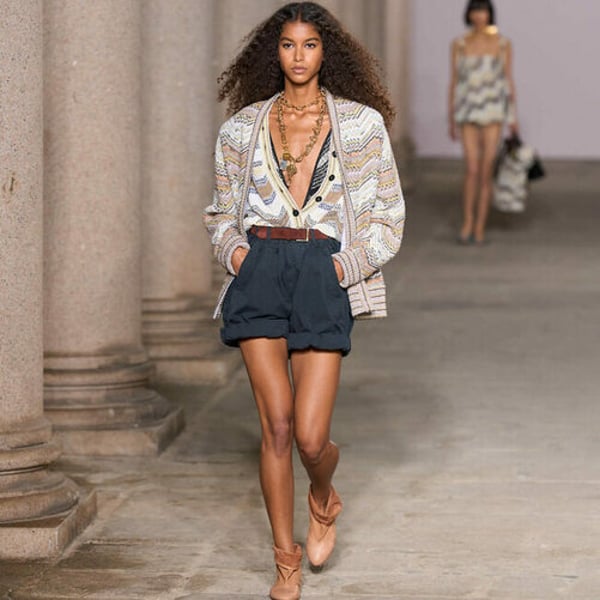
“In the proposal for next summer, I chose to start from the beachwear collection and bring it into an urban context, guided by an idea of lightness and versatility. I have reprised the very short silhouettes of my debut, also because we feel it is right to give continuity to a style we believe in rather than change it every six months,” the designer told FashionNetwork.com.
“I realise that our work is changing, shifting from pure proposition to listening to what the market is asking for. Our offering for next spring/summer is definitely very young, but it still leaves room for different interpretations.”

The horizon into which the collection expanded is the sea, understood not so much as the beach as the flow of days spent in swift succession, of occasions that carry one from the shoreline to the city and back again. Binding it all together was a sense of spontaneity: the pure instinct to dress by blending new garments with inherited pieces, things found in a wardrobe and instantly made one’s own: his cardigan and blouson, the striped shirt, the cashmere waistcoat, the shorts, even the terry towel.

The stylistic gesture was decisive, asserting as its identifying signature a silhouette reiterated from the previous season: voluminous yet abbreviated, with bare legs. Everything shortened, to the point that bikini briefs replaced trousers, which otherwise were shorts with rolled hems.
The impulse to shorten was pervasive: even tactile jumpers and blazers broadened at the shoulders only to contract at the hem, while mini dresses became backless T-shirts. The twinset was refreshed, taking the form of a waistcoat coordinated with a little sundress.

In addition to the wonderful ready-to-wear, many accessories stood out on the catwalk: a multitude of bags, small berets, soft ankle boots, flat shoes, and oversized jewellery.
“We are expanding our universe more and more in this area. We want women to be able to carry Missoni with them at all times, without necessarily wearing a dress or a cardigan from the label,” Caliri concluded.
This article is an automatic translation.
Click here to read the original article.
Copyright © 2025 FashionNetwork.com All rights reserved.








The increase was driven primarily by higher reinvested earnings and intra-company loans, indicating continued engagement by existing investors with Bangladesh.
Reinvested earnings rose by 318.25 per cent, from $103.79 million in 2024 to $434.10 million in 2025, while intra-company loans increased by 25.68 per cent, from $621.96 million to $781.68 million.
Bangladesh’s net FDI inflows increased by 39.36 per cent last year to $1,770.42 million compared with $1,270.39 million in 2024, the Bangladesh Bank said.
The increase was driven primarily by higher reinvested earnings and intra-company loans.
Reinvested earnings rose by 318.25 per cent, from $103.79 million in 2024 to $434.10 million in 2025, while intra-company loans rose by 25.68 per cent.
Equity capital remained broadly stable, rising by 1.84 per cent, from $544.64 million to $554.64 million in 2025, a release from Bangladesh Investment Development Authority said.
Greenfield project announcements declined by 16 per cent in 2025.
Fibre2Fashion News Desk (DS)
The company’s adjusted EBITDA, excluding Employee Stock Option Plan (ESOP) expenses, rose around 14 per cent YoY to ₹468 crore, while EBITDA margin improved by 20 basis points to around 9.3 per cent. Excluding the reciprocal tariff impact of around ₹36 crore and incremental losses of around ₹13 crore in Bihar and Guatemala, adjusted EBITDA margin stood at around 10.3 per cent.
Pallab Banerjee, managing director, Pearl Global Industries, said: “FY26 marked the company’s second consecutive year of double-digit growth and improved profitability. This performance further solidifies the position of Pearl Global’s diversified operating model and disciplined execution across geographies.”
Pearl Global Industries has reported its highest-ever FY26 revenue of ₹5,025 crore (~$523.93 million), up 11.5 per cent YoY, driven by volume growth and value-added products.
PAT rose 17 per cent to ₹270 crore (~$28.15 million), while Q4 revenue hit ₹1,314 crore (~$137 million).
The company shipped 78.1 million pieces.
Its net worth stands at ₹1,438 crore (~$149.93 million).
He said that geopolitical shifts and Gulf conflicts could lead to energy cost escalation, affecting raw material and logistics costs. However, the company remains prepared to manage these headwinds, supported by its diversified manufacturing base, strong order book, and broad market presence.
The profit after tax (PAT) increased 17 per cent YoY to ₹270 crore (~$28.15 million), the company said in a press release.
On a standalone basis, FY26 revenue stood at ₹1,081 crore, while adjusted EBITDA was ₹67 crore, with EBITDA margin improving by 60 basis points to 6.2 per cent, mainly due to cost restructuring. Standalone PAT rose to ₹69 crore from ₹55 crore in the previous year.
The company’s net worth stood at ₹1,438 crore (~$149.93 million) as of March 31, 2026, compared with ₹1,146 crore a year earlier.
“In FY26, Group delivered another year of resilient performance against a complex geopolitical backdrop. Group achieved, among others, two major milestones this year: revenue crossed INR 5,000 crore mark and installed capacity surpassed 100 million pieces per annum,” said Pulkit Seth, vice-chairman and non-executive director, PGIL.
Seth added that the global apparel industry faced tariff-related disruptions during FY26, with the company’s India operations impacted by tariffs and penal duties imposed by the US. However, he added that Pearl Global leveraged its diversified, multi-country manufacturing presence to mitigate these challenges and deliver double-digit growth.
For the fourth quarter (Q4) of FY26, PGIL posted its highest-ever quarterly revenue of ₹1,314 crore (~$137 million), up 6.9 per cent YoY. Adjusted EBITDA rose 13.7 per cent to ₹135 crore, with margin at 10.3 per cent, the highest EBITDA margin recorded by the company in any quarter. PAT for the quarter stood at ₹81 crore, up 24.6 per cent YoY, PGIL said in a press release.
Standalone revenue during the quarter stood at ₹304 crore, adjusted EBITDA at ₹24 crore, and PAT at ₹14 crore.
PGIL shipped its highest-ever volumes in Q4 FY26 and FY26, at 22 million pieces and 78.1 million pieces respectively. Its annual installed capacity crossed 100 million pieces, reaching around 101 million pieces.
The ongoing capex in Bangladesh is expected to be completed by the first half of FY27 and will add around 6-7 million pieces of capacity during the year.
Fibre2Fashion News Desk (SG)


After provinces, Centre lifts austerity-driven business-hour curbs until May 31

Vietnam’s flat apparel exports hide the real trade signal

A Danish Couple’s Maverick African Research Finds Its Moment in RFK Jr.’s Vaccine Policy

-

 Entertainment5 days ago
Conan O’Brien hat tricks as Oscar host
-

 Tech1 week ago
Could Contact-Tracing Apps Help With the Hantavirus? Not Really
-

 Tech1 week ago
I Tried the Best Captioning Smart Glasses, and Only One Leads the Pack
-

 Fashion5 days ago
Italy’s Zegna Group’s Q1 growth boosted by strong organic performance
-

 Sports1 week ago
Bobby Cox, legendary Atlanta Braves manager who led 1995 World Series champions, dead at 84
-

 Entertainment1 week ago
Martin Short: Facing tragedy with joy
-

 Entertainment1 week ago
Tom Brady gets back at Kevin Hart during Netflix roast
-

 Entertainment1 week ago
Martha Stewart: How to make an omelet