

Politics
Any aggression will be met with ‘decisive response’

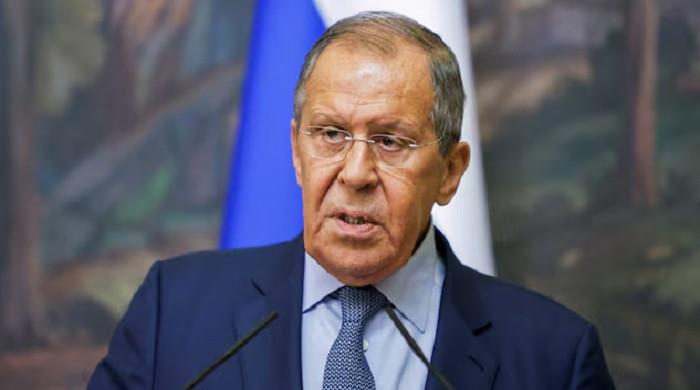
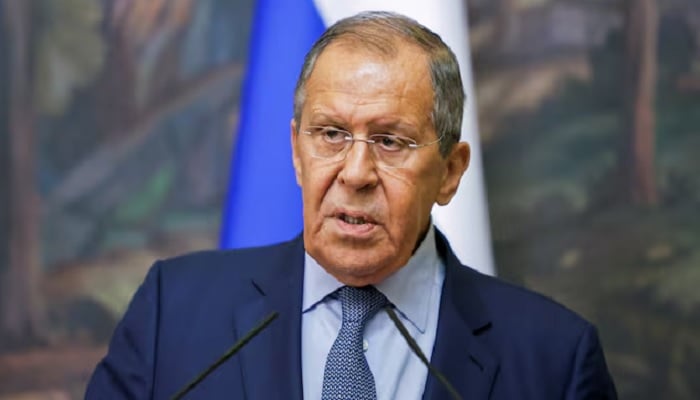
- Russia’s top diplomat addresses UN amid rising Europe tension.
- He warns of militaristic rhetoric, plays down drone incursions.
- US military action near Venezuela “alarming,” he says.
Russian Foreign Minister Sergei Lavrov told the West on Saturday that any aggression against Moscow would face a “decisive response,” warning against attempts to down aircraft in Russian airspace and accusing Germany of militaristic rhetoric.
As Russia’s war rages in Ukraine, tensions have mounted along NATO’s eastern flank in recent weeks as Estonia said Moscow sent three fighter jets into its airspace and NATO warplanes shot down Russian drones over Poland.
“Any aggression against my country will be met with a decisive response. There should be no doubt about this among those in NATO and the EU who … are telling their voters that war with Russia is inevitable,” he told the United Nations General Assembly.
The spate of airspace incursions linked to Russia has unnerved countries in eastern Europe, where Russia is seen as the biggest threat since the end of the Cold War. Hopes have dimmed of any imminent end to Moscow’s war in Ukraine.
US President Donald Trump said this week that he endorsed the idea of shooting down Russian jets that violate NATO airspace, part of a rhetorical shift that saw him mock Russia’s military performance in Ukraine and call it a paper tiger.
Lavrov brushed off Trump’s most recent remarks during a press conference that followed his General Assembly speech, but issued a warning about any moves against aircraft inside Russia.
“If there are attempts to down any flying object, any object… in our airspace, then I think people will very much regret undertaking such an egregious violation of our territorial integrity and sovereignty,” he said.
He said that only the “politically blind” would expect Ukraine to one day return to the borders it had before Russia invaded in February 2022, an indirect response to Trump’s assertion that Kyiv could retake all its occupied land from Russia.
Lavrov also singled out German Chancellor Friedrich Merz, referring to what he said was “militaristic rhetoric” and said Moscow was alarmed by remarks by politicians in EU and NATO capitals of a looming World War III as a “likely scenario.”
Russia hopes for ‘frank dialogue’
Despite taking aim at NATO and the European Union, Lavrov made clear Moscow remained hopeful of “frank dialogue” with the United States under Trump despite the US president’s recent shifting stance.
The US and Russia, he said, will hold a third round of talks in the coming months aimed at improving each other’s embassy operations, which have been severely curtailed by a decade of tit-for-tat diplomatic expulsions and other curbs.
Lavrov met US Secretary of State Marco Rubio on Wednesday on the sidelines of the annual gathering of world leaders at the U.N. General Assembly.
Lavrov said he did not see economic relations between Russia and India as under threat, as Trump has placed tariffs on products from India, calling on it and China to stop purchasing Russian oil.
Russia concerned over US buildup near Venezuela
Despite his cautious tone on Trump, Lavrov voiced alarm over a US naval build-up and military action in international waters around Venezuela to combat drug cartels, describing the situation as “very serious.”
Without naming the US, Lavrov questioned whether “certain creative actors” could try to use a proposed draft UN Security Council resolution to create a larger international force to fight gangs in Haiti to justify an attack within Venezuela.
The draft text being considered by the 15-member body has been put forward by the US and Panama. It needs at least nine votes and no vetoes by Russia, China, the US, France or Britain to pass.
“I cannot rule out that certain creative actors could think of getting a mandate at the Security Council and later say that there are gangs from Haiti harboured in Venezuela. I cannot rule that out,” said Lavrov.
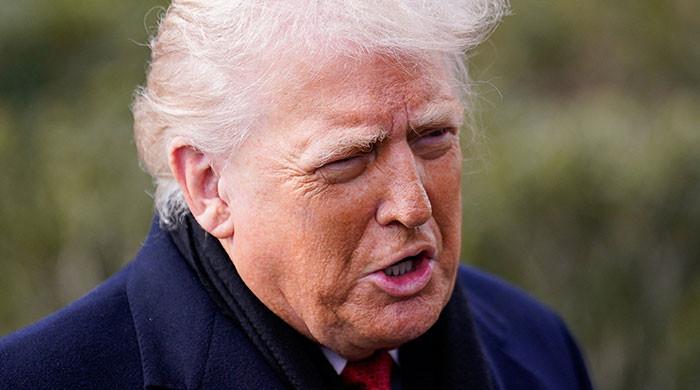
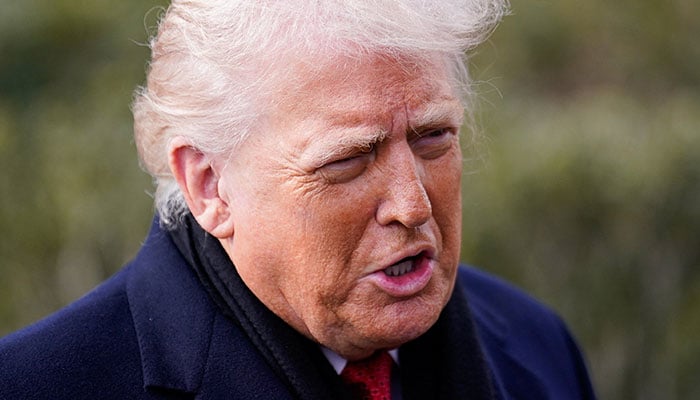
- US lawmakers visit Denmark to back Copenhagen and Greenland.
- Denmark strongly rejects Trump’s takeover idea.
- Lawmakers say most Americans do not support plan.
COPENHAGEN: US President Donald Trump on Friday warned that he could slap tariffs on countries that do not support his Greenland takeover plans, as US Congress members visited Copenhagen to give their backing for Denmark and its autonomous Arctic island.
The bipartisan delegation, on a two-day trip to the Danish capital, said the US president’s long-held territorial ambitions – strongly rejected by Denmark – were not shared by the American people.
Europeans have also been showing their backing for Greenland, in a military reconnaissance mission that a Danish general said Washington was invited to and which was linked to what Russia does after the war in Ukraine.
Trump, again insisting the United States needed mineral-rich Greenland for its “national security”, warned that he “may put a tariff” on countries that oppose that stance.
The 11 visiting US lawmakers held talks with Danish Prime Minister Mette Frederiksen and her Greenlandic counterpart Jens-Frederik Nielsen, as well as Denmark’s foreign and defence ministers, parliamentarians and business leaders.
Republican Senator Lisa Murkowski said there was “good dialogue” and stressed it was important to “nurture” ties between the United States, Denmark and Greenland.
“The vast majority” of Americans do not agree that it is a good idea for the United States to acquire Greenland, she told reporters.
“Greenland needs to be viewed as our ally, not as an asset,” she added.
One idiot
The visit follows a meeting in Washington on Wednesday at which Danish representatives said Copenhagen and Washington were in “fundamental disagreement” over Greenland’s future.
Democratic Senator Chris Coons said the purpose of the Congress members’ visit was to “listen respectfully to our friends, our trusted allies and partners here in Denmark and from Greenland”.
The lawmakers were then to return to the United States “and share those perspectives so that we can lower the temperature and have a more constructive dialogue about the best path forward”, he said.
In Greenland’s capital, Nuuk, residents welcomed the show of support.
“Congress would never approve of a military action in Greenland. It’s just one idiot speaking,” a 39-year-old union representative told AFP.
“If he (Trump) does it, he’ll get impeached or kicked out. If people in Congress want to save their own democracy, they have to step up,” said the union rep, speaking on condition of anonymity.
Demonstrations
Trump has repeatedly criticised Denmark – a NATO ally – for, in his view, not doing enough to ensure Greenland’s security.
The US president has pursued that argument, despite strategically located Greenland – as part of Denmark – being covered by NATO’s security umbrella.
The head of Denmark’s Joint Arctic Command, Major General Soren Andersen, said the United States were invited to the military mission, which he said was “about Russia”.
“When the war in Ukraine is over, hopefully with a good result for Ukraine, it is our expectation that Russia will move the resources they have been using in Ukraine to other theatres, including in the Arctic,” he told AFP.
“So, in order to prepare for that, we simply have to step up, train, and that is what we are doing up here.”
But Andersen said he had not seen any Russian or Chinese combat ships in the area in the two and a half years he has been commander.
Military personnel were more visible in Nuuk on Friday, an AFP journalist said, days after Denmark said it was beefing up its defence on the island.
The White House has said Trump’s aim to take over Greenland would not be affected by the European military presence, which French armed forces minister Alice Rufo said was a sign that the continent was prepared to defend sovereignty.
Britain, Finland, France, Germany, the Netherlands, Norway and Sweden have announced the deployment of small numbers of military personnel to prepare for future exercises in the Arctic.
Large demonstrations are planned across Denmark and Greenland on Saturday to protest against Trump’s plan.
Thousands of people have taken to social networks to say they intend to take part in the protests organised by Greenlandic associations in Nuuk and Copenhagen, Aarhus, Aalborg and Odense.
- Reza Pahlavi, son of Iran’s late shah, says govt will fall.
- Netblocks says internet blackout lasted over 180 hours.
- Tasnim reports rioters torched education office in Isfahan.
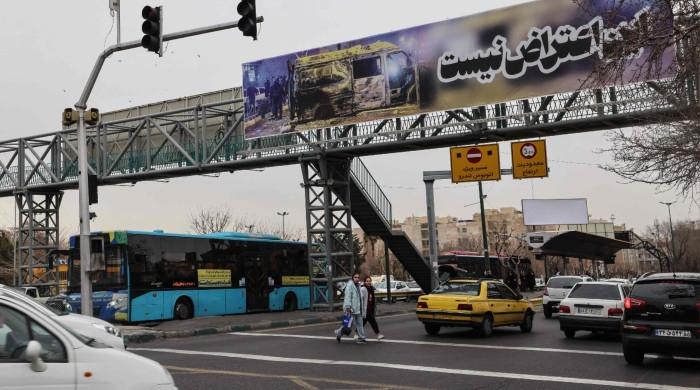
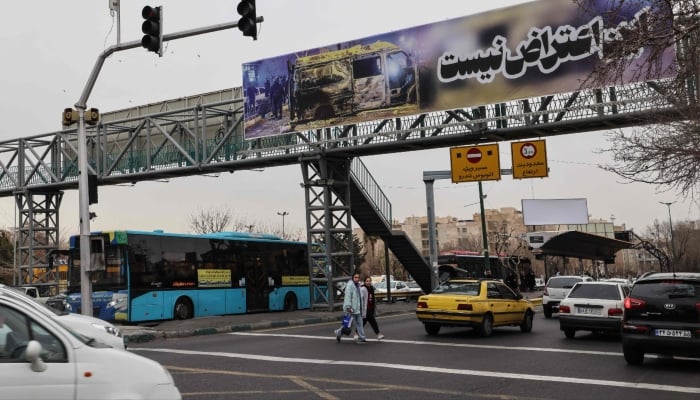
Tensions in Iran have subsided after three weeks of protests under an internet blackout, monitors said on Friday, a week after the start of the largest demonstrations in years challenging the country’s rulers.
The son of Iran’s late shah, however, said he was confident the government would fall and called for intervention, though the threat of new military action by the United States against Iran has appeared to have receded for the time being.
Protests sparked by economic grievances started with a shutdown in the Tehran bazaar on December 28 but turned into a mass movement demanding the removal of the system that has ruled Iran since the 1979 revolution.
People started pouring into the streets in big cities from January 8, but authorities immediately enforced a shutdown of the internet that has lasted over a week.
Reza Pahlavi, the son of Iran’s late shah, told a news conference in Washington that the government “will fall — not if, but when.”
“I will return to Iran,” he said.
Monitor Netblocks said that the “total internet blackout” in Iran had now lasted over 180 hours, longer than a similar measure that was imposed during the 2019 protests.
Amnesty International said this was being backed up by the use of heavily armed patrols and checkpoints to counter nationwide protests, with security forces visible in the streets.
‘Give Iran a chance’
Trump, who backed and joined Israel’s 12-day war against Iran in June, had not ruled out new military action against Tehran and made clear he was keeping a close eye on if any protesters were executed.
But a senior Saudi official told AFP on Thursday that Saudi Arabia, Qatar and Oman led “a long, frantic, diplomatic last-minute effort to convince President Trump to give Iran a chance to show good intention”.
While Washington appeared to have stepped back, the White House said on Thursday that “all options remain on the table for the president”.
Attention had focused on the fate of a single protester, Erfan Soltani, a 26-year-old who rights activists and Washington said was set to be executed as early as Wednesday.
The Iranian judiciary, however, said Soltani had not been sentenced to death, and his charges meant he did not risk capital punishment.
Rights groups have estimated that up to 20,000 people have been arrested. Security officials cited by the Tasnim news agency on Friday said around 3,000 people were arrested.
‘All Iranians united’
The US Treasury on Thursday announced new sanctions targeting Iranian officials including Ali Larijani, secretary of Iran’s Supreme Council for National Security.
Russian President Vladimir Putin, meanwhile, held telephone talks with Iranian President Masoud Pezeshkian in what the Kremlin described as “efforts to facilitate de-escalation”.
At the UN Security Council in New York, Iranian-American journalist Masih Alinejad, invited to address the body by Washington, said “all Iranians are united” against the government in Iran.
Iran’s representative at the meeting Gholamhossein Darzi accused Washington of “exploitation of peaceful protests for geopolitical purposes.”
There were, however, indications of unrest in some areas.
The state-affiliated Tasnim news outlet reported that rioters set fire to a local education office in Falavarjan County, in central Isfahan Province, on Thursday.
An elderly resident of a town in Iran’s northwestern region, where many Kurdish Iranians live and which has been the focus for many of the biggest flare-ups, said sporadic protests had continued, though not as intensely.
Describing violence earlier in the protests, she said: “I have not seen scenes like that before.”
The state-owned Press TV cited Iran’s police chief as saying calm had been restored across the country.
Tasnim news also reported what it described as the arrest of a large number of leaders of recent riots in the western province of Kermanshah, and the arrest of five people accused of vandalising a gas station and a base belonging to the Basij in the southeastern city of Kerman.
- New Delhi incurs $120m losses after exiting port development deal.
- Congress leader terms move “a new low” in India’s foreign policy.
- Experts say actions raise concerns about India’s role at Chabahar.
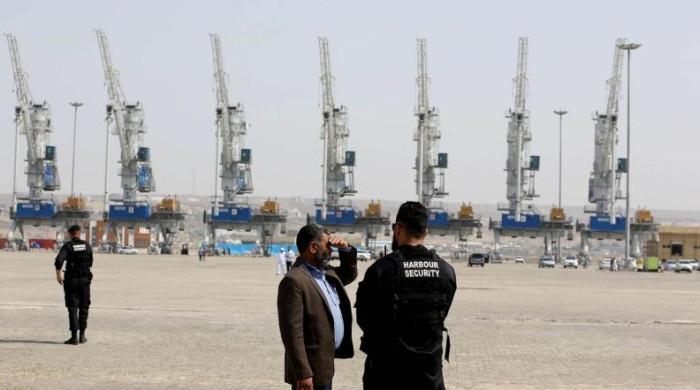
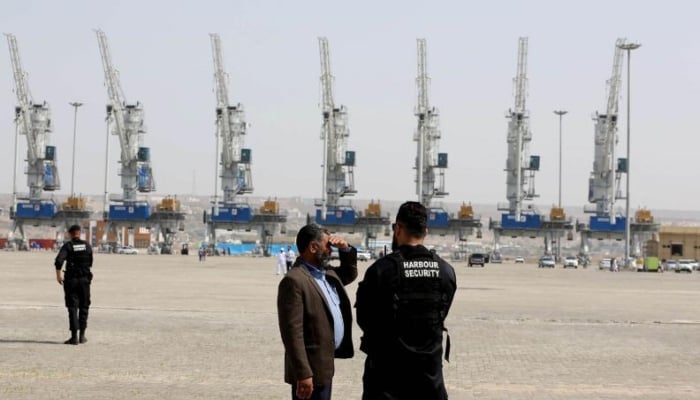
The Indian government, led by Prime Minister Narendra Modi, has come under heavy fire at home after it withdrew from the Chabahar port agreement with Iran, with critics arguing the move was a strategic retreat rather than a proactive foreign policy decision.
New Delhi was forced to abandon its involvement in the port after the United States imposed a 25% tariff on countries doing business with Tehran, The Economic Times reported on Thursday.
According to the publication, India’s withdrawal was carried out without any formal announcement, resulting in the loss of $120 million already paid to Iran.
The amount had been transferred before the decision to disengage and is now considered unrecoverable, the report stated.
The state-run company working at the port, India Ports Global Limited (IPGL), saw its board of directors submit collective resignations after the decision, while the company’s official website has also been shut down.
Congress party leader Pawan Khera termed the move “a new low” in the Modi-led government’s foreign policy.
“So the question is not of Chabahar Port or of Russian oil. The question is: Why is Modi allowing USA to arm-twist India?” he asked in an X post.
India assumed responsibility in 2024 for developing Chabahar port under a 10-year arrangement with Iran.
Meanwhile, a foreign journal reported that the $120 million already paid to Iran can now be used by it at its discretion for the port’s construction and development.
Observers described India’s withdrawal from Chabahar port as another major setback for New Delhi.
The Congress party sharply criticised the Modi-led government over the decision, saying the Indian prime minister “has once again surrendered to Trump”.
“$120 million of India’s taxpayers’ money was invested by the Modi government in this strategically important project, but now it’s all gone up in smoke,” read a post on the party’s X handle.
The Indian opposition party recalled Modi hailing the agreement as “a major strategic win”, saying India’s control over the port has been relinquished, with complete silence from the government.
“Unfortunately, Modi has bowed before Trump’s pressure and compromised India’s national interest,” the party stated.
Meanwhile, economic affairs experts believe the latest actions reinforced concerns surrounding India’s role at Chabahar.
They voiced concerns that India was using the port for nefarious objectives, saying that IPGL’s conduct suggested it was created primarily to acquire control of Chabahar.


NCAA tabs flag football as an emerging sport for women

This Jackery Power Station Can Save You in an Emergency, and It’s on Sale for $199

Novo Nordisk shares rise 8% after Wegovy obesity pill has ‘solid’ launch

-

 Tech4 days ago
New Proposed Legislation Would Let Self-Driving Cars Operate in New York State
-

 Sports6 days ago
Clock is ticking for Frank at Spurs, with dwindling evidence he deserves extra time
-
Sports7 days ago
Commanders go young, promote David Blough to be offensive coordinator
-

 Fashion6 days ago
South India cotton yarn gains but market unease over US tariff fears
-

 Fashion6 days ago
China’s central bank conducts $157-bn outright reverse repo operation
-

 Entertainment3 days ago
X (formerly Twitter) recovers after brief global outage affects thousands
-

 Sports6 days ago
US figure skating power couple makes history with record breaking seventh national championship
-
 Business7 days ago
SoftBank reduces Ola Electric stake to 13.5% from 15.6% – The Times of India