

Business
A Universal-DreamWorks movie is bringing the winning formula of kids content frenzy to the big screen


Laila Lockhart Kraner stars as Gabby in Universal and Dreamworks Animations’ “Gabby’s Dollhouse: The Movie.”
Universal | Dreamworks Animation
A young girl named Gabby, alongside her menagerie of animated cat friends, is making the leap from streaming to the big screen.
Universal and DreamWorks Animation’s “Gabby’s Dollhouse: The Movie” is the latest kid’s TV show to head to the box office, following in the footsteps of Paramount’s Paw Patrol and SpongeBob SquarePants franchises.
“We felt like the franchise had gotten to the point where there was enough fandom to justify a theatrical event, and we wanted to expand the world,” Margie Cohn, president of DreamWorks Animation, told CNBC.
Children’s programming has become an increasingly important piece of the media landscape in recent years. As linear TV has given way to streaming, studios are looking for ways to drive and sustain subscriber growth. For “Gabby’s Dollhouse,” establishing a theatrical presence increases awareness of the brand, stirs up fresh excitement from existing fans and spurs new opportunities for products in the retail market.
“Gabby’s Dollhouse,” created by “Blue’s Clues” veterans Traci Paige Johnson and Jennifer Twomey, launched on Netflix in 2021. It’s already run for 11 seasons, and a 12th is on due out in November. Each season has six to 10 episodes, about 25 minutes each.
It’s been the most-viewed streaming original series for kids this year, according to Nielsen.
Each episode begins with a live-action Gabby, played by Laila Lockhart Kraner, as she unboxes a miniature package that sparks an adventure in her magical dollhouse. She dons her cat-ear headband, shrinks down to become an animated character and joins her cat friends, called Gabby’s cats. Like a lot of preschool shows, Gabby pauses to ask the audience questions and invite them to play along.
Those elements all appear in the full-length feature film, which arrived in theaters Friday. It melds animation and live-action, but at a bigger scale.
Cohn said the goal was to create a theatrical experience, akin to a “‘Rocky Horror Picture Show’ for little kids.’ Invite them to sing, dance, clap.”
“Gabby’s Dollhouse: The Movie” debuts at a time when the movie calendar has limited family-friendly options. The most recent major releases in this genre were Disney’s “Freakier Friday” and Universal’s “The Bad Guys 2,” both of which were released in early August.
While there has been a steady stream of family-friendly fare in recent years, it comes after a considerable dry spell caused by the pandemic and dual Hollywood labor strikes shutting down production. At the same time, consumers’ habits shifted as streaming services grew in popularity and studios shortened the time it took for movies released in cinemas to reach the home market.
But younger viewers are some of the most engaged, and a primary driver to get families out to the theater.
Kids are some of the most fervent streaming users, too, as they tend to watch the same content over and over again, leading to high engagement. That’s why kid-friendly shows have offer a unique value proposition for studios even as traditional linear television and the theatrical landscape has become less reliable.
Presenting their favorite characters in more places can mean spreading the wealth and ultimately fueling their appetites for more.
“One need only look at the big screen-small screen synergies that were created by ‘KPop Demon Hunters’ to see how ‘Gabby’s Dollhouse: The Movie’ could similarly make the leap from a small screen 2021 series into a big screen cinematic event in 2025,” said Paul Dergarabedian, senior media analyst at Comscore.
Heading to the big screen
A global theatrical release not only serves the strong domestic market, but extends the reach of “Gabby’s Dollhouse” internationally. Cohn noted that Europe is one region where the show is gaining traction.
“As a relatively new franchise with notable reach into the marketing world aimed at today’s youngest generations, this is a film that should capture the interest of that audience and continue showcasing its strengths as a fresh brand,” said Shawn Robbins, director of analytics at Fandango and founder of Box Office Theory.
And it can be a relatively affordable way to extend a franchise’s reach.
“Gabby’s Dollhouse: The Movie” had a production budget of just over $30 million, a small investment for the likes of Universal and DreamWorks Animation compared to other theatrical kids films. For example, franchise films from Disney’s Pixar and Universal’s other animation arm, Illumination, can cost upwards of $200 million to create.
Still from Universal and Dreamworks Animation’s “Gabby’s Dollhouse: The Movie.”
Universal | Dreamworks Animation
“At DreamWorks, we know how to make a budget fit,” Cohn said. “We make some really big, high-budget, all-audience animated films. But then we also do smaller films like ‘Captain Underpants’ or the most recent one with ‘Dog Man.’ We know how to make high-quality movies for a lower price point.”
Paramount’s two Paw Patrol films had similarly small budgets, according to media reports. “Paw Patrol: The Movie,” released in 2021, generated $40 million domestically and more than $145 million globally, according to data from Comscore. Meanwhile, 2023’s “Paw Patrol: The Mighty Movie” collected $65 million domestically and $200 globally.
Box office analysts estimated “Gabby’s Dollhouse: The Movie” would collect between $15 million and $25 million during its opening weekend.
More than just a movie
While theatrical revenues are important, bringing “Gabby’s Dollhouse” to the big screen is part of a wider strategy. The content is part of an interconnected ecosystem that includes toys, books, merchandise and live events.
“I came from Nickelodeon,” Cohn said. “We studied the audience a lot, and we knew that they liked to watch a show, but then they wanted to play it, iterate on it, and experience the characters and ideas in their own way, in their own form. And so we developed the Gabby franchise to let them do just that.”
DreamWorks partnered with toy company Spin Master to manufacture a line of toys tied to “Gabby’s Dollhouse.” The range of products includes playsets, figures, plush toys, games and puzzles. Since launching the line, Spin Master has sold nearly 3 million dollhouses tied to the show.
Cohn said DreamWorks Animation “nurtured and brewed success” for “Gabby’s Dollhouse” with through the Spin Master partnership as well as through the production of YouTube shorts, grassroots marketing and a traveling live show presented by Walmart.
“The series just grew and grew and grew,” Cohn said. “And then it gets to a certain point you’re able to deliver on bigger strategic franchise expansion with live entertainment and shows in museums and presence in the parks and music, you know, all that comes when you have a property that kids respond to.”
“Gabby’s Dollhouse” has been a top five preschool toy property for five of the last eight quarters, according to data from Circana. It has been a top 10 property for 10 straight quarters.
In addition to toys, “Gabby’s Dollhouse” has merchandise collections with Walmart, Target and Amazon, that include apparel, home goods, games and even toothbrushes. As the film heads to theaters, audiences will be able to buy themed popcorn buckets, drink tumblers and other specialty items.
The franchise has also become part of Universal’s theme parks, with character meet-and-greets with Gabby and retail areas where guests can buy headbands, plush and apparel.
And Universal isn’t stopping there. “Gabby’s Dollhouse: The Movie” sets up a bigger future for Gabby and a potential spin-off series. As the film credits roll, Gabby puts the finishing touches on a new dollhouse — a dog dollhouse that she says her little sister will love.
When asked about what “Gabby Dollhouse” fans can expect following the reveal, Cohn teased, “You’re gonna have to wait and see.”
Disclosure: Comcast is the parent company of Fandango and NBCUniversal, which owns CNBC. Versant would become the new parent company of Fandango and CNBC upon Comcast’s planned spinoff of Versant.







Business
Hormuz flashpoint: Why Indian-flagged ships are in focus as Middle East tensions hit global shipping – The Times of India
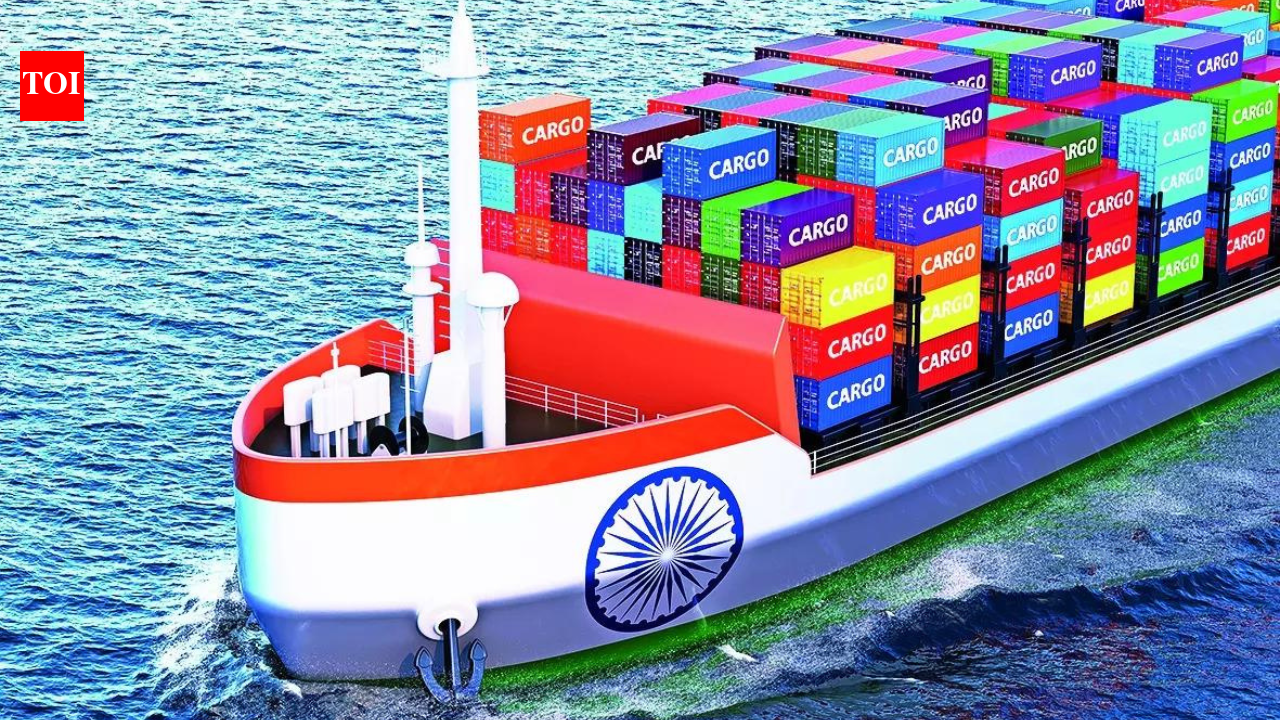
As tensions rise in Middle East and vessel safety in the Strait of Hormuz comes under renewed focus, the flag a ship flies has emerged as a key factor in maritime security, regulation and state protection.Flagging a vessel means it is registered with a country and must comply with that nation’s maritime laws and regulations. It also gives the flag state powers to investigate and penalise violations of domestic and international laws. Since regulations differ across countries, shipowners often choose jurisdictions that best suit operational and commercial needs, according to an ET report.An Indian-flagged vessel is a commercial ship registered with the Directorate General of Shipping and authorised to fly the national flag. Such vessels are governed by the Merchant Shipping Act and operate under Indian jurisdiction as a sovereign extension on the high seas.These ships are taxed by Indian authorities and must comply with Indian maritime safety, labour and environmental rules. To qualify for Indian flagging, vessels must come to domestic waters for registration and the owning company must be incorporated in India.Indian-flagged ships also receive strategic backing. India protects their interests through naval and diplomatic intervention when required. Experts say this creates a higher compliance burden than “Flag of Convenience” jurisdictions such as Panama and St Kitts.According to Rajeev Kumar Yadav, as quoted ET, director at Vertex Marine Services, Flag of Convenience systems allow vessels to be flagged from anywhere in the world within “3-4 days”.Indian-flagged ships calling at domestic ports can also benefit from lower port levies and tax liabilities, along with priority in government cargo movement and public sector charter contracts.During the Iran crisis, more than two dozen Indian ships were stranded west of the Strait of Hormuz after strict high-risk area classifications were imposed. The Indian Navy escorted several tankers to safety, though some vessels remain in the Persian Gulf.No direct attacks have been reported on Indian-flagged vessels so far, largely due to India’s balanced diplomatic approach in the crisis.However, being Indian-flagged does not give the government powers to decide freight rates or commercial destinations. The state’s role is limited to enforcing civil, criminal and regulatory laws onboard, along with international safety, environmental and labour compliance norms.India’s flagged fleet has been expanding. The Indian-flagged vessel fleet reached 14.2 million Gross Tonnage (GT) in March, with 92 vessels of 1.5 million GT joining during FY26.The long-term Maritime Amrit Kaal Vision 2047 aims to sharply raise India’s share of the global flagged fleet and increase utilisation of Indian-flagged ships from about 7 per cent currently to 30-40 per cent by 2047.
Brent crude sinks by a tenth after Iran says the key waterway is open for commercial ships for the rest of the ceasefire.
Source link
Oil prices tumbled on Friday after Iranian officials said they would allow commercial traffic to resume in the Strait of Hormuz. This lifted equity markets in Europe and New York, where major indices hit new records.
Citing the ceasefire between Israel and Lebanon, Iran’s Foreign Minister Abbas Araghchi said Tehran would lift its blockade on shipping through the key Gulf energy trade route.
“In line with the ceasefire in Lebanon, the passage for all commercial vessels through Strait of Hormuz is declared completely open for the remaining period of ceasefire,” Araghchi said.
Traffic in the strategic waterway, through which one-fifth of the world’s crude oil normally flows, has been disrupted by Iran since the US-Israeli offensive began on Feb. 28. At one point, this sent oil prices to a peak of nearly $120 a barrel and roiled the global economy.
Both Brent, the benchmark international contract, and its US equivalent WTI fell below $90 per barrel following Tehran’s announcement. Brent later cut its losses and finished at $90.38 a barrel, down 9.1%.
‘Immediate impact’
“This news is having an immediate impact on markets,” said Kathleen Brooks, research director at XTB.
The move also sent a jolt through equity markets, extending a rally in New York. There, equities have pushed ever higher since late March in anticipation of a breakthrough in the Middle East crisis.
“We had seen a big move the last two weeks, and now it’s just really pricing completely out the worst-case scenario, said Angelo Kourkafas, from Edward Jones.
Kourkafas also pointed to underlying strength in the US economy that should get more attention in the coming period as geopolitical concerns ebb.
“Geopolitical developments are moving in the right direction, and at the same time, the earning strength is hard to ignore,” Kourkafas said.
The broad-based S&P 500 finished at 7,126.06, up 1.2% for the day and 4.5% for the week.
‘Good news’
Earlier, European stocks closed higher, with both Frankfurt and Paris gaining 2%.
US President Donald Trump cheered the reopening of the Strait of Hormuz in an interview with AFP.
“We’re very close to having a deal,” Trump said in a brief telephone call with AFP from Las Vegas. He added there were “no sticking points at all” left with Tehran.
But Iran quickly pushed back on one key point.
Iran’s foreign ministry said Friday that its stockpile of enriched uranium would not be transferred “anywhere.” It rejected an earlier claim by Trump that the Islamic Republic had agreed to hand it over.
Shipping industry figures, meanwhile, gave a cautious welcome to Iran’s announcement.
A spokesman for German transportation giant Hapag-Lloyd, which has ships stuck in the Gulf, told AFP by phone that the reopening was “in general… good news.”
But he cautioned that shippers still needed details of what route vessels could take and in what order, citing fears of mines.
“One thousand ships cannot just go now to the entrance of the strait, that will be chaos. They (the Iranians) need to give clear orders,” said the spokesman, Nils Haupt.
“We would be ready to go very soon if some of these open questions can be solved within the weekend.”


‘The Naked Gun’ actor Paul Walter Hauser bloodies opponent at Maple Leaf Pro’s first US show

Iran says no date set for next round of negotiations with US
Hormuz flashpoint: Why Indian-flagged ships are in focus as Middle East tensions hit global shipping – The Times of India

-

 Politics1 week ago
Indian airlines hit hardest after Dubai limits foreign flights until May 31
-

 Entertainment5 days ago
Palace left in shock as Prince William cancels grand ceremony
-

 Sports5 days ago
The case for Man United’s Fernandes as Premier League’s best
-

 Politics1 week ago
Chinese, Taiwanese will unite, Xi tells Taiwan opposition leader
-

 Entertainment1 week ago
Dua Lipa hits major career high ahead of wedding with Callum Turner
-
 Business5 days ago
UK could adopt EU single market rules under new legislation
-
 Business1 week ago
He paid $248 in illegal tariffs for this coat. Will he ever get it back?
-

 Sports7 days ago
Lamar Jackson hits back at critics with faithful message on social media