

Politics
Trump willing to meet Putin without prior talks with Zelensky

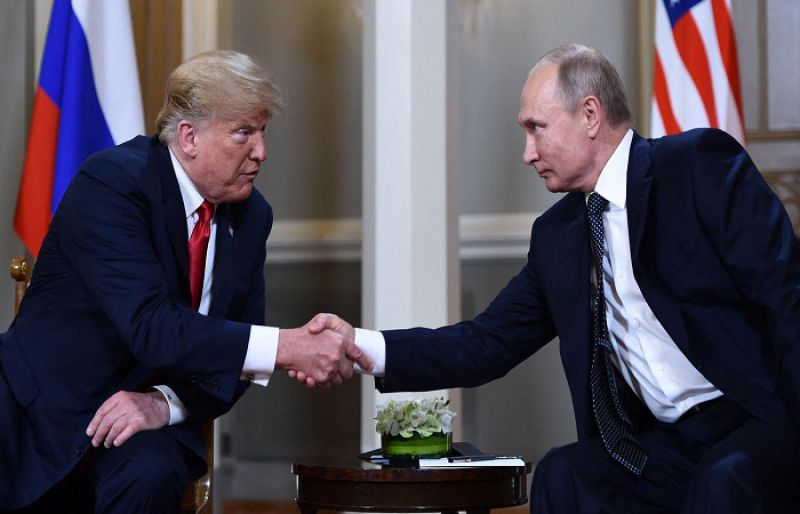

U.S. President Donald Trump has expressed his willingness to meet Russian President Vladimir Putin to discuss the Ukraine conflict, even if Putin has not first held talks with Ukrainian President Volodymyr Zelensky.
This statement signals a departure from Trump’s earlier position, which required a meeting between Putin and Zelensky as a prerequisite for any direct engagement with the Kremlin.
Trump has set a Friday deadline for Moscow to agree to a ceasefire in Ukraine, warning of additional sanctions if the demand is not met.
However, when asked by reporters in the Oval Office whether that deadline still stands, Trump gave an ambiguous response.
“That’s going to be up to him (Putin),” he said. “We’ll see what he has to say.”
Since his return to the White House in January, Trump has increased pressure on Russia to end its military offensive against Ukraine.
The Kremlin said Thursday that Putin was set to attend a summit with Trump in the “coming days”, but the Russian leader essentially ruled out including Zelensky.
On Thursday, Zelensky insisted that he had to be involved in any talks.
When Trump was asked if Putin was required to meet Zelensky before a summit, the US president said simply: “No, he doesn’t.”
Putin has named the United Arab Emirates as a potential location for the summit, but this was not confirmed by Washington.
The summit would be the first between sitting US and Russian presidents since Joe Biden met Putin in Geneva in June 2021.
Three rounds of direct Russia–Ukraine talks in Istanbul have failed to yield any progress towards a ceasefire. The two sides remain far apart on the conditions they have set to end the more than three-year-long conflict.
Trump and Putin last sat together in 2019 at a G20 summit meeting in Japan during Trump’s first term.
They have spoken by telephone several times since the tycoon returned to the White House this year.
Kremlin aide Yuri Ushakov said that “next week has been set as a target date”, adding that both sides have agreed the venue “in principle”, without naming it.
However, Washington later denied that a venue or date had been set.
“No location has been determined,” a White House official said, while agreeing that the meeting “could occur as early as next week.”
Tens of thousands of people have been killed since Russia launched its military offensive on Ukraine in February 2022.
Russian bombardments have forced millions of people to flee their homes and have destroyed swathes of eastern and southern Ukraine.
Putin has resisted multiple calls from the United States, Europe and Kyiv for a ceasefire.
At talks in Istanbul, Russian negotiators outlined hardline territorial demands for halting its advance — calling for Kyiv to withdraw from some territory it still controls and to renounce Western military support.
Reports of the possible summit came after US special envoy Steve Witkoff met Putin in Moscow on Wednesday.
Witkoff proposed a trilateral meeting with Zelensky, but Putin appeared to rule out direct talks with the Ukrainian leader.
“Certain conditions must be created for this,” Putin told reporters. “Unfortunately, we are still far from creating such conditions.”
The former KGB agent, who has ruled Russia for over 25 years, said in June that he was ready to meet Zelensky, but only during a “final phase” of negotiations on ending the conflict.
In his regular evening address on Thursday, Zelensky said “it is only fair that Ukraine should be a participant in the negotiations.”
The Ukrainian leader spoke with French President Emmanuel Macron, German Chancellor Friedrich Merz and the European Commission President Ursula von der Leyen as he called for the continent to be included in any potential peace talks.
“Ukraine is an integral part of Europe — we are already in negotiations on EU accession.
Therefore, Europe must be a participant in the relevant processes,” Zelensky said on social media after the conversation with Merz.
He also said that Ukrainian, European and US security advisers would hold an online meeting on Thursday “to align our joint views.”
“Ukraine is not afraid of meetings and expects the same brave approach from the Russian side. It is time we ended the war,” he said.
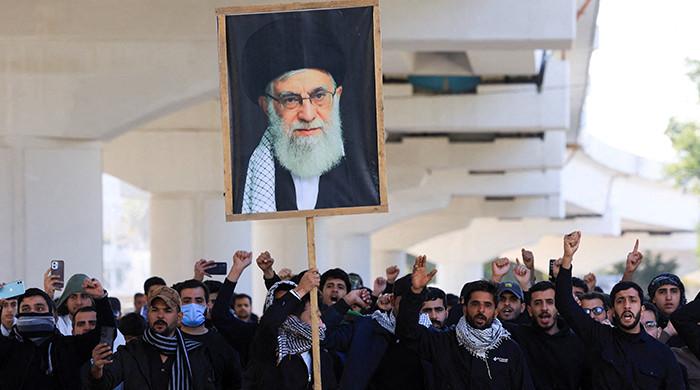
A number of Iranian senior leaders, including Supreme Leader Ayatollah Ali Khamenei, have embraced martyrdom in the “unprovoked and unwarranted” airstrikes by Israel and the United States.
As crowds gathered in Tehran, explosions rang out, and the Israeli military announced that it was again striking targets in the heart of the city — as more blasts were heard in Jerusalem, Riyadh, Dubai, Doha and Manama.
Iran’s President Masoud Pezeshkian declared Khamenei’s assassination a “declaration of war against Muslims” and warned: “Iran considers it its legitimate duty and right to avenge the perpetrators and masterminds of this historic crime.”
Iranian state media have confirmed the killing of several senior figures:
1. Ayatollah Ali Khamenei, supreme leader of Iran
2. Ali Shamkhani, representative of the Supreme Leader in the Supreme Defence Council
3. General Abdolrahim Mousavi, Iran’s Armed Forces chief of staff
4. Major General Mohammad Pakpour, commander-in-chief of the Islamic Revolution Guards Corps (IRGC)
5. Aziz Nasirzadeh, Minister of Defence
6. Gholamreza Rezaian, police intelligence chief of Iran
Separately, the daughter, son-in-law, and granddaughter of Ali Khamenei also embraced martyrdom in the US and Israeli airstrikes.
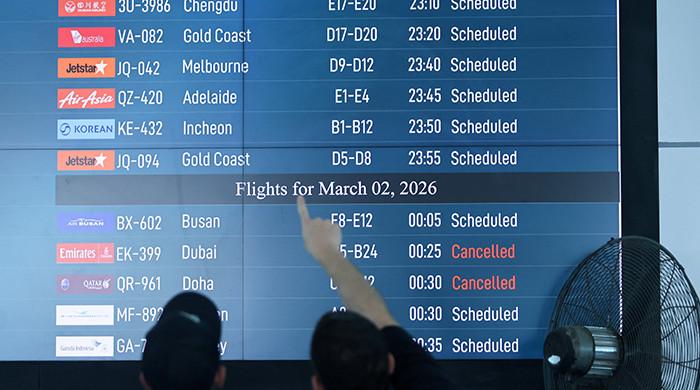
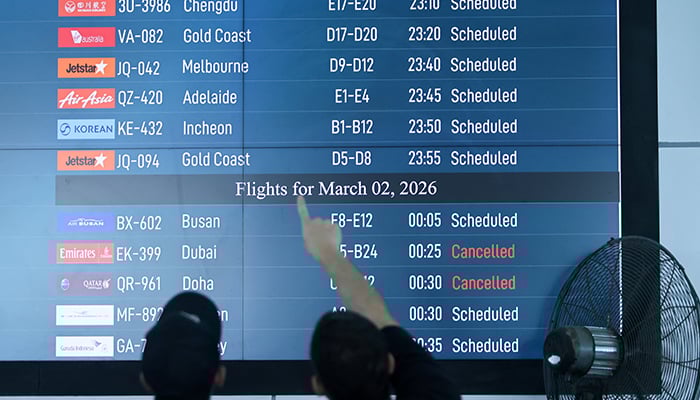
- Middle Eastern airport hubs remain closed or restricted.
- Airlines reroute or cancel flights, affecting global schedules.
- Risk of prolonged disruption due to regional conflicts.
DUBAI: Global air travel remained heavily disrupted on Sunday as continued air strikes kept major Middle Eastern airports, including Dubai, the world’s busiest international hub, closed in one of the sharpest aviation shocks in recent years.
Key transit airports including Dubai and Abu Dhabi in the UAE, and Doha in Qatar, were shut or severely restricted as much of the region’s airspace remained closed, with the Gulf grappling with uncertainty after U.S. and Israeli strikes killed Iranian Supreme Leader Ayatollah Ali Khamenei on Saturday.
Israel said it launched another wave of strikes on Iran on Sunday, while loud blasts were heard for a second day near Dubai and over Doha, after Iran launched retaliatory air attacks on the neighbouring Gulf states.
Dubai International Airport sustained damage during Iran’s attacks, while airports in Abu Dhabi and Kuwait were also hit. Thousands of flights have been affected across the Middle East since the U.S. first launched attacks on Iran on Saturday, according to data on FlightAware, a flight tracking platform.
Ripple effects
The airport closures have rippled far beyond the Middle East. Dubai and neighbouring Doha sit at the crossroads of east-west air travel, funnelling long-haul traffic between Europe and Asia through tightly scheduled networks of connecting flights.
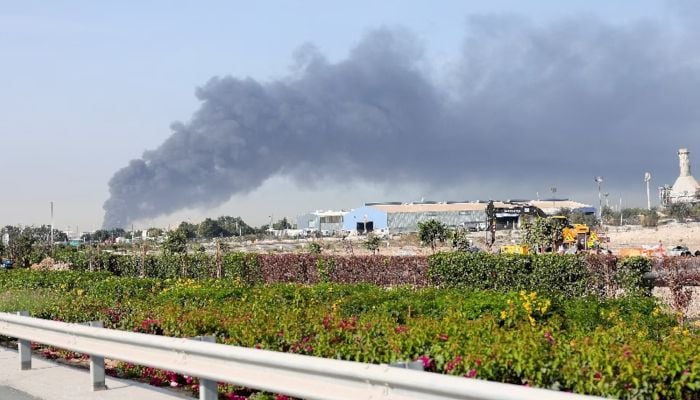
With those hubs idle, aircraft and crews remained stranded out of position, disrupting airline schedules worldwide.
“It’s the sheer volume of people and the complexity,” said UK-based aviation analyst John Strickland.
“It is not only customers, it is the crews and aircraft all over place.”
Airlines across Europe, Asia and the Middle East cancelled or rerouted flights to avoid closed or restricted airspace, lengthening journeys and driving up fuel costs. The disruption has been intensified by the loss of Iranian and Iraqi overflight routes, which had grown more important since the Russia-Ukraine war forced airlines to avoid both countries’ airspace.
The Middle East airspace closures were squeezing airlines into narrower corridors, with fighting between Pakistan and Afghanistan adding a further risk, said Ian Petchenik, communications director at Flightradar24.
“The risk of protracted disruption is the main concern from a commercial aviation perspective,” Petchenik said.
“Any escalation in the conflict between Pakistan and Afghanistan that results in the closure of airspace would have drastic consequences for travel between Europe and Asia.”
Middle East flights halted
Airspace over Iran, Iraq, Kuwait, Israel, Bahrain, the UAE and Qatar remained virtually empty, maps by flight-tracking service Flightradar24 showed, and air strikes kept major Middle Eastern airports, including Dubai, Abu Dhabi and Doha shut or severely restricted.
Below is the latest on flights listed by airline in alphabetical order:
Aegean Airlines
Greece’s largest carrier suspended flights to and from Tel Aviv in Israel, Beirut in Lebanon and Erbil in Iraq until March 2.
Air Astana
The group cancelled all flights to the Middle East through March 3.
Air Canada
The airline said it has cancelled flights from Canada to Israel until March 8 and flights to Dubai until March 3.
Air Europa
The Spanish airline cancelled its flights to Tel Aviv on Sunday and Monday and is monitoring the situation to assess operations from Tuesday.
Air France KLM
Air France cancelled flights to and from Tel Aviv in Israel and Beirut in Lebanon for Saturday.
Its Dutch arm KLM said late on Saturday that this weekend’s flights to and from Dubai, Dammam and Riyadh have been cancelled. It had already brought forward suspension of its Amsterdam–Tel Aviv service to Saturday.
Air India
The carrier cancelled flights scheduled for Sunday from Delhi, Mumbai and Amritsar to London, New York, Chicago, Toronto, Frankfurt and Paris. It added that more flights to London, Birmingham, Amsterdam, Zurich, Milan, Vienna, Copenhagen and Frankfurt had been cancelled.
Azerbaijan Airlines
The airline has suspended flights to and from Dubai, Doha, Jeddah and Tel Aviv.
British Airways
IAG-owned British Airways said it has cancelled flights to Tel Aviv and Bahrain until March 3 and its flight to Amman on Saturday.
Cathay Pacific
Hong Kong’s Cathay Group, parent of Cathay Pacific Airways, suspended operations in the region, affecting passenger flights to and from Dubai and Riyadh, as well as freighter service at Al Maktoum airport. That is Dubai’s second airport after Dubai International Airport, the primary hub that handles most passenger traffic.
Emirates
Owing to multiple regional airspace closures, Emirates has suspended all operations to and from Dubai until 3pm UAE time on March 2.
Etihad
The UAE’s Etihad said flights scheduled to depart Abu Dhabi were suspended until 2pm local time on Sunday.
Flydubai
The airline said it had temporarily suspended all flights to and from Dubai until 3pm local time on Sunday.
Iberia Express
The Spanish airline owned by Iberia Group cancelled a flight to Tel Aviv scheduled for Saturday at 5pm local time.
IndiGo
IndiGo, India’s biggest airline, said it had extended a temporary suspension of select international flights using Middle East airspace until Monday.
ITA Airways
ITA Airways suspended flights to and from Tel Aviv and said it would not use the airspace of Israel, Lebanon, Jordan, Iraq and Iran until March 7. Flights to and from Dubai were suspended until March 1.
Japan Airlines
Japan Airlines cancelled a flight on Saturday from Tokyo Haneda to Doha as well as a return flight on March 1, Nikkei said.
LOT Polish Airlines
The airline suspended flights to Tel Aviv until March 15 and cancelled flights to Dubai and Riyadh until March 2.
Lufthansa
The German airline flights to and from Tel Aviv in Israel, Beirut in Lebanon and Oman until March 7 and flights to and from Dubai on Saturday and Sunday.
It also said it would not fly through Israeli, Lebanese, Jordanian, Iraqi and Iranian airspace until March 7.
Norwegian Air
The Nordic airline suspended all flights to and from Dubai until March 4, a company spokesperson said. The carrier did not suspend flights to Tel Aviv in Israel or Beirut in Lebanon because these destinations are only active in summer, he added.
Pegasus Airlines
The airline said that flights to Iran, Iraq, Jordan and Lebanon were cancelled up to and including March 2.
Qatar Airways
The airline said flights remain temporarily suspended owing to the closure of the Qatari airspace. It will provide a further update by 9am local time on Monday.
Scandinavian Airlines
The airline told Reuters it had suspended its flight to Tel Aviv from Copenhagen on Saturday. No decision had been made regarding flights on later dates.
Turkish Airlines
The airline cancelled flights to Qatar, Kuwait, Bahrain, the United Arab Emirates and Oman on Saturday and flights to Lebanon, Syria, Iraq, Iran and Jordan until March 2.
Virgin Atlantic
Virgin Atlantic said it will temporarily avoid Iraqi airspace, resulting in some pre-planned rerouting of flights and has cancelled its VS400 service from London Heathrow to Dubai on Saturday.
Wizz Air
The Hungarian carrier halted flights to and from Israel, Dubai, Abu Dhabi and Amman with immediate effect until March 7.
It added that operational decisions would continue to be reviewed and the flight schedule could be adjusted as the situation evolves.
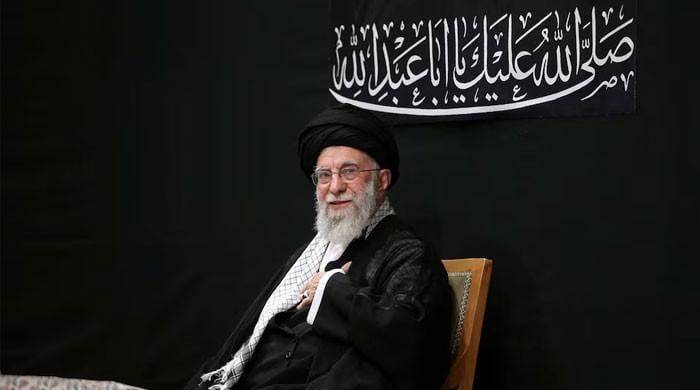
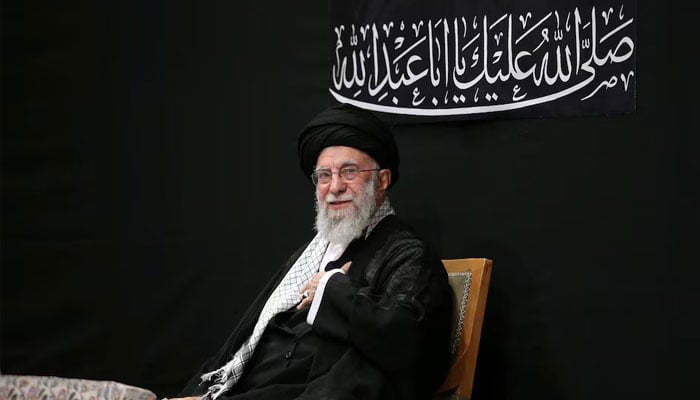
CIA intelligence indicating Ayatollah Ali Khamenei would attend a meeting of top Iranian officials helped guide strikes in a US and Israeli attack that killed Iran’s supreme leader, the New York Times reported Sunday.
Khamenei was martyred in the strikes on capital Tehran, Iranian state media confirmed on Sunday, after the US and Israel vowed to seek regime change in the Islamic republic.
The American intelligence agency had been tracking Khamenei for months, the Times reported, citing people familiar with the operation, and learned that a meeting of top Iranian officials was set for Saturday morning at a leadership compound in the heart of Tehran.
Washington and Tel Aviv originally planned to launch strikes on Iran at night, but officials adjusted the plan based on the CIA intelligence, according to the Times.
The US gave the information to Israel, who planned to carry out the attack on Iranian leadership, the newspaper reported.
The operation began about 6am in Israel (0400 GMT), and long-range missiles struck the compound about 9:40am, the Times said.
Senior Iranian national security officials were in one building at the compound, and Khamenei was in a nearby building.
In addition to Khamenei, two top Iranian military leaders were killed in the bombing: the chief of the Revolutionary Guards, General Mohammad Pakpour, and another top security adviser, Ali Shamkhani, Iran’s judiciary confirmed.
Iran has since retaliated, with reported strikes across the Gulf, including in the Emirati capital Abu Dhabi and near regional US military bases, as the threat of a larger regional conflict grows.
US President Donald Trump, meanwhile, has said the American military’s bombing will continue “as long as necessary.”


Broadway and Hollywood composer Marc Shaiman on his new memoir, and being a “sore winner”

2026 NFL combine buzz: Intel on free agency, trades, QBs

Neil Sedaka: An appreciation – CBS News

-
 Business1 week ago
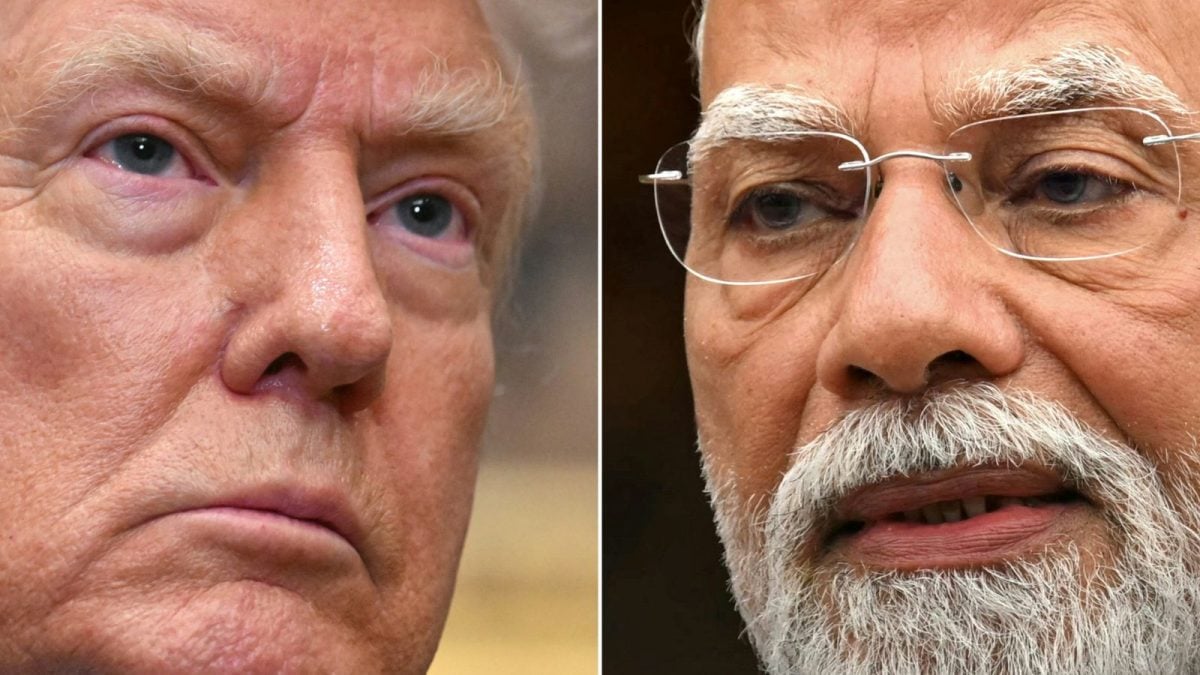
US Top Court Blocks Trump’s Tariff Orders: Does It Mean Zero Duties For Indian Goods?
-

 Fashion1 week ago
ICE cotton ticks higher on crude oil rally
-

 Entertainment1 week ago
The White Lotus” creator Mike White reflects on his time on “Survivor
-

 Politics1 week ago
Pakistan carries out precision strikes on seven militant hideouts in Afghanistan
-
 Business1 week ago
Eye-popping rise in one year: Betting on just gold and silver for long-term wealth creation? Think again! – The Times of India
-

 Sports1 week ago
Brett Favre blasts NFL for no longer appealing to ‘true’ fans: ‘There’s been a slight shift’
-

 Entertainment1 week ago
Viral monkey Punch makes IKEA toy global sensation: Here’s what it costs
-

 Sports1 week ago
Kansas’ Darryn Peterson misses most of 2nd half with cramping