

Politics
Afghanistan’s water crisis goes regional

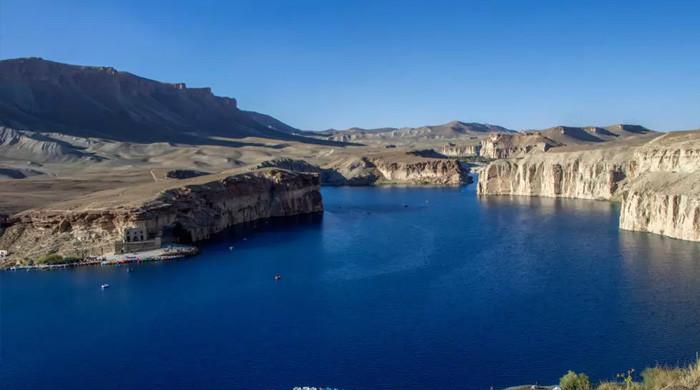
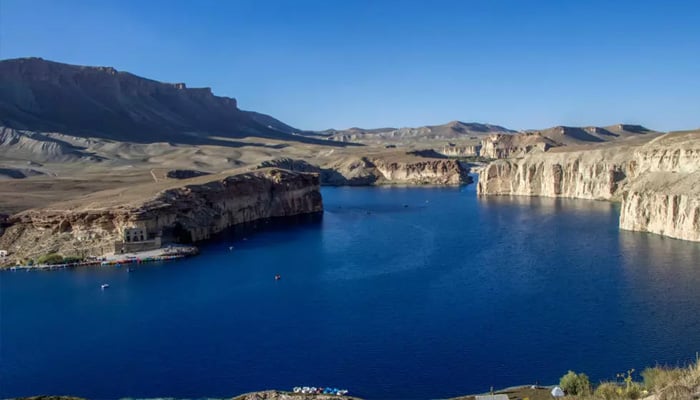
Over four decades of war, Afghanistan wielded limited control over five major river basins that flow across its borders into downstream neighbouring nations.
But as Taliban authorities swept to power and tightened their grip on the country, they have pushed for Afghanistan’s water sovereignty, launching infrastructure projects to harness precious resources in the arid territory.
Dams and canals have sparked tensions with neighbouring states, testing the Taliban government’s efforts to build strong regional ties, as they remain largely isolated on the global stage since their 2021 takeover.
At the same time, the region is facing the shared impacts of climate change intensifying water scarcity, as temperatures rise and precipitation patterns shift, threatening glaciers and snowpack that feed the country’s rivers.
Here are key points about Afghanistan’s transboundary water challenges:
Central Asian states to the north
Afghanistan is emerging as a new player in often fraught negotiations on the use of the Amu Darya, one of two key rivers crucial for crops in water-stressed Central Asia, where water sharing relies on fragile accords since Soviet times.
Central Asian states have expressed concern over the Qosh Tepa mega canal project that could divert up to 21% of the Amu Darya’s total flow to irrigate 560,000 hectares of land across Afghanistan’s arid north, and further deplete the Aral Sea.
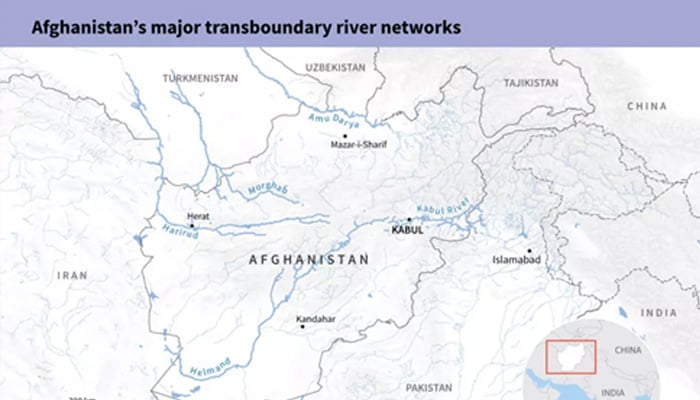
Uzbekistan and Turkmenistan are likely to face the biggest impact, both joined by Kazakhstan in voicing alarm, even as they deepen diplomatic ties with the Taliban authorities — officially recognised so far by only Russia.
“No matter how friendly the tone is now,” water governance expert Mohd Faizee warned, “at some point there will be consequences for Uzbekistan and Turkmenistan when the canal starts operating”.
Taliban officials have denied that the project will have a major impact on the Amu Darya’s water levels and pledged it will improve food security in a country heavily dependent on climate-vulnerable agriculture and facing one of the world’s worst humanitarian crises.
“There is an abundance of water, especially when the Amu Darya floods and glacial meltwater flows into it” in the warmer months, said project manager Sayed Zabihullah Miri, during a visit to the canal works in Faryab province, where diggers carved into a drought-ridden plain dotted with camels and locusts.
Iran to the west
Iran is the only country with which Afghanistan has a formal water sharing treaty, agreed in 1973 over the Helmand river, which traverses Taliban heartland territory, but the accord was never fully implemented.
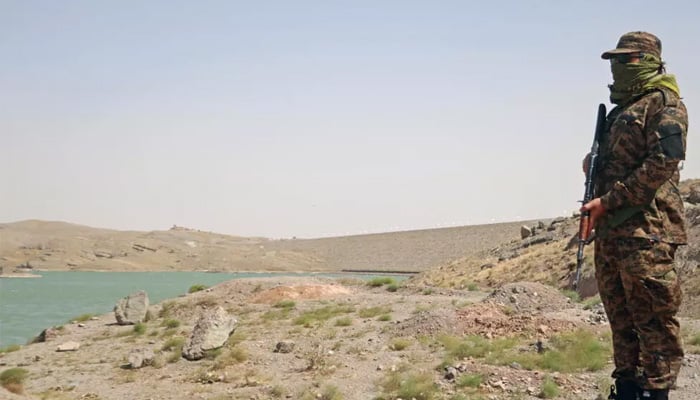
Longstanding tensions over the river’s resources have spiked over dams in southern Afghanistan, particularly in periods of drought, which are likely to increase as climate shocks hit the region’s water cycle.
Iran, facing pressure in its parched southeastern region, has repeatedly demanded that Afghanistan respect its rights, charging that upstream dams restrict the Helmand’s flow into a border lake.
The Taliban authorities insist there is not enough water to release more to Iran, blaming the impact of climate pressures on the whole region.
They also argue long-term poor water management has meant Afghanistan has not gotten its full share, according to an Afghanistan Analysts Network report by water resources management expert Assem Mayar.
Iran and Afghanistan have no formal agreement over their other shared river basin, the Harirud, which also flows into Turkmenistan and is often combined into a single basin with the Morghab river.
While infrastructure exists on the Afghan portions of the basin, some has not been fully utilised, Faizee said.
But that could change, he added, as the end of conflict in Afghanistan means infrastructure works don’t incur vast security costs on top of construction budgets, lifting a barrier to development of projects such as the Pashdan dam inaugurated in August on the Harirud.
Pakistan to the east
Water resources have not topped the agenda in consistently fraught relations between Afghanistan and Pakistan.
Afghanistan’s Kabul river basin, which encompasses tributaries to the greater Indus basin and feeds the capital and largest city, is shared with Pakistan.
The countries, however, have no formal cooperation mechanism.
With the Afghan capital wracked by a severe water crisis, the Taliban authorities have sought to revitalise old projects and start new ones to tackle the problem, risking fresh tensions with Pakistan.
But the lack of funds and technical capacity means the Taliban authorities’ large water infrastructure projects across the country could take many years to come to fruition — time that could be good for diplomacy, but bad for ordinary Afghans.
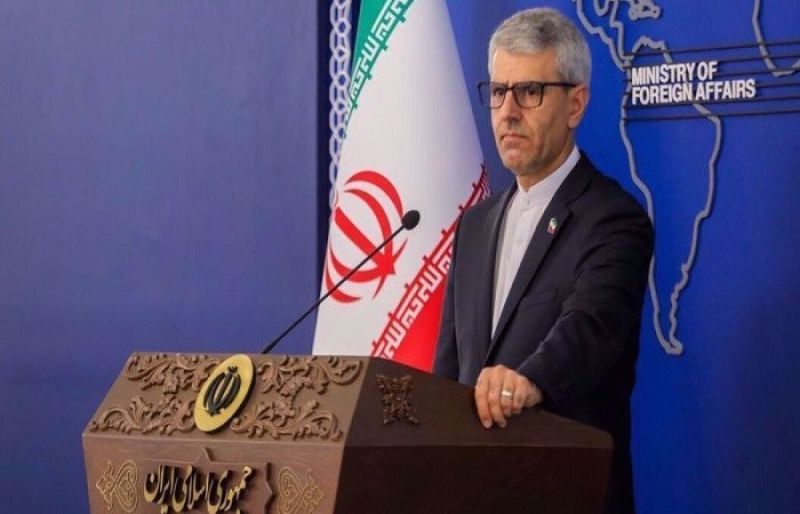

Iran’s foreign ministry spokesman says confronting US-Israeli threats leaves the country no option but military retaliation, while stressing it has no issue with the American people.
In an interview with the US public radio (NPR) published on Sunday, Esmaeil Baghaei discussed the country’s positions on the current developments following the recent US-Israeli aggression.
“This is an unjust war imposed on our nation, and we have no other choice other than fighting against this injustice,” he said.
He emphasized that these military actions are unwarranted and unprovoked, and pointed out they arrived while the US and Iran were making progress in diplomatic negotiations over nuclear issues.
Baghaei stated that the conflict is the United States administration’s preferred war.
He noted that according to the Omani mediator’s remarks on Friday, a deal was close, and Iran was slated to meet the American delegation in Vienna the previous day to discuss technical details—emphasizing that Iran did not initiate the war.
He referred to the assassination of the Leader of the Islamic Revolution Ayatollah Seyed Ali Khamenei, saying, “he was not only a political leader. He was also a high-ranking religious jurist with tens of millions of followers, even outside Iran, across the region.”
In response to a question on who is leading the country now, the Iranian diplomat explained that an interim council now governs Iran, composed of the head of the judiciary, the president, and a member of the council of experts, which will be responsible for electing a new leader.
Responding to a question about whether Iran’s leadership can withstand aggressive US sanctions, President Trump’s calls for regime change, Israeli pressure and domestic opposition, Baghaei said a foreign power cannot dictate changes to a nation’s system of governance.
He added that Iranians have historically united against foreign aggression and domination, fighting to protect their freedom, independence, dignity and sovereignty.
Reacting to the death of at least three Americans, Baghaei said “I have said many times that we have no problem with the American people. And we believe that this is not their war.”
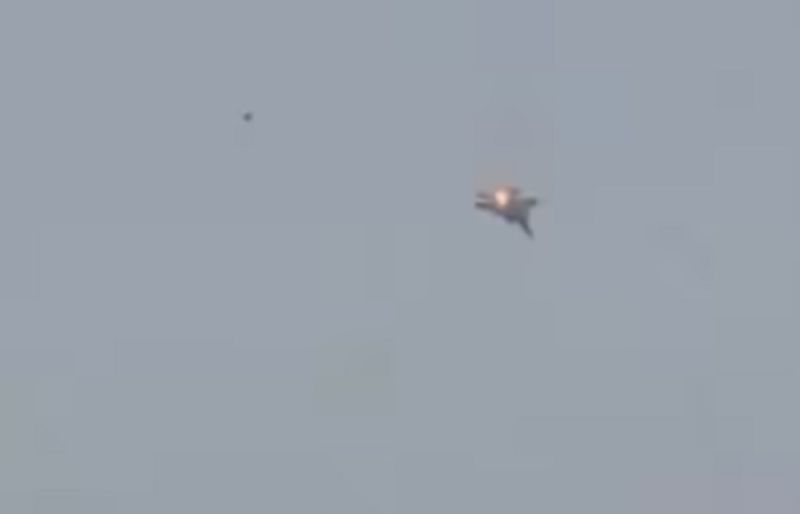

Iranian Armed Forces have shot down an advanced US F-15 fighter jet near the border with Kuwait – the first downing of an American fighter jet in the past 27 years.
“An F-15 fighter jet [belonging] to the intruding US army which intended to attack the country has been targeted by the Islamic Republic of Iran’s Air Defense and brought down,” Iran’s Khatam Al-Anbiya Air Defense Base said in a statement on Monday.
It added that the jet’s debris has been crashed in Kuwaiti soil.
Kuwait’s Defense Ministry on Monday confirmed the jet’s crash with its video footage widely being circulated in global media.
An American F-117 fighter jet was downed by former Yugoslavia during the Kosovo war some 27 years ago.
No American fighter jet has been officially destroyed since then despite significant progress made in airplane technology.
Iranian retaliatory attacks comes amid three days of aggression against the country, which has killed at least 555 people, including more than 145 children in a strike on an elementary school in Hormozgan Province in addition to Iranian officials, according to the Red Crescent Society.
The IRGC and the Army have targeted strategic sites in the Israeli-occupied territories as well as US-operated bases across West Asia, including the Fifth Fleet in Bahrain, along with key installations in Qatar and the United Arab Emirates (UAE) for their role in supporting aggression against Iran.
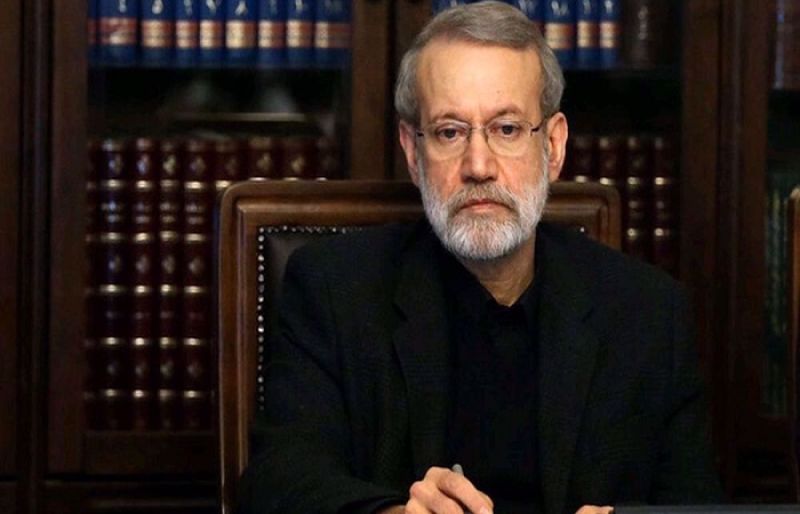
Secretary of Iran’s Supreme National Security Council (SNSC) Ali Larijani says the Islamic Republic will hold no negotiations with the United States after Washington and Tel Aviv waged war against the country.
Larijani made the remark in a post on his X account on Monday in response to a report by The Wall Street Journal claiming that he had started new efforts to resume talks with the US.
The US and Israel started a fresh round of aerial aggression on Iran on Saturday, some eight months after they carried out unprovoked attacks on the country.
The Saturday attacks led to the martyrdom of Leader of the Islamic Revolution Ayatollah Seyyed Ali Khamenei.
The Iranian administration on Sunday declared 40 days of public mourning and seven days of holidays following the Leader’s martyrdom.
The aggression was launched as Tehran and Washington had held three rounds of indirect negotiations in the Omani capital of Muscat and the Swiss city of Geneva and planned to open technical talks in Vienna, Austria, last Monday.
Iran began to swiftly retaliate against the strikes by launching barrages of missile and drone attacks on the Israeli-occupied territories as well as on US bases in regional countries.
On the second day of the joint aggression, US President Donald Trump claimed that Iranian authorities wanted to hold talks with Washington.
In another post on X, Larijani said the US president had caused turmoil in the region as a result of his “pipe dreams” and is now concerned about more losses on the American servicemen.
The top Iranian security official added that Trump changed the self-made slogan of “America First” to “Israel First” through his illusion-driven performance and sacrificed the American soldiers for the sake of Israel’s ambitions.
Larijani emphasized that the American soldiers and their families are bearing the brunt of Trump’s lie mongering and his ill nature.
“Today, the Iranian nation is defending itself. Iran’s Armed Forces have not launched any aggression,” the SNSC secretary pointed out, emphasizing it was not Iran that initiated the war.
Iran has reaffirmed its policy to promote peace in the region but pledged that it will not hesitate to defend its territorial integrity against any act of aggression.
Iranian officials have also already called on the country’s neighbors not to allow their soil to be used by the US and Israel for any attack against the Islamic Republic, warning to retaliate.


US’ Old Navy launches little navy, a new newborn essentials collection

Charles Barkley scolds sports fans for getting wrapped up in Olympic hockey frenzy
Limited flights leave UAE while disruption continues amid Iran strikes

-
 Politics1 week ago
Pakistan carries out precision strikes on seven militant hideouts in Afghanistan
-

 Tech1 week ago
These Cheap Noise-Cancelling Sony Headphones Are Even Cheaper Right Now
-

 Sports1 week ago
Kansas’ Darryn Peterson misses most of 2nd half with cramping
-

 Entertainment1 week ago
Viral monkey Punch makes IKEA toy global sensation: Here’s what it costs
-
Sports1 week ago
Mike Eruzione and the ‘Miracle on Ice’ team are looking for some company
-
 Business6 days ago
Households set for lower energy bills amid price cap shake-up
-

 Politics1 week ago
Trump says he will raise US global tariff rate from 10% to 15%, following court ruling
-
 Entertainment1 week ago
Talking minerals and megawatts