

Business
AI is moving into the apartment market, taking over work orders, lease renewals, showings and more


Angel Santana Garcia | Istock | Getty Images
A version of this article first appeared in the CNBC Property Play newsletter with Diana Olick. Property Play covers new and evolving opportunities for the real estate investor, from individuals to venture capitalists, private equity funds, family offices, institutional investors and large public companies. Sign up to receive future editions, straight to your inbox.
The days of landlords knocking on doors for monthly rent checks, or tenants going after landlords to fix a leaky toilet are slowly coming to an end. Technology has been stepping in to address the needs of tenants, landlords and large multifamily operators, and now artificial intelligence is turning that slow progress into a rental revolution.
Work orders, lease renewals, tours and even investor due diligence are being taken over by software and AI. As with the start of any technology, it has been largely fragmented among a multitude of vendors. The integration of all that technology is a huge opportunity for startups and the venture capitalists backing them.
Rent tech
One of the more mature categories for AI in the apartment space is virtual agents talking to prospective residents. This is where agentic AI comes in — meaning AI that can act autonomously and make its own decisions depending on what the consumer asks. There are still, however, just a handful of companies using that advanced level of machine learning.
AI is also proving useful on the investment side of the multifamily business, specifically underwriting and acquisitions. For example, investors looking to purchase a large property have to go through all the leases and load those into a rent roll.
“If you’re buying a property that hasn’t been professionally managed, where those aren’t all loaded into some market-leading software product, somebody may have to manually go through all those leases and capture all the information. Well, AI is great for that, right?” said John Helm, founder and partner at RET Ventures, a fund focusing on AI in both real estate and rent tech.
Instead, according to Helm, you can feed leases into an AI model, and it will spit out a summary of all the data the investor needs. They can then load that directly into an underwriting model and value the property.
RET Ventures said it doesn’t rely on endowments or pension funds for its capital, but instead the consumers of the products of the companies they invest in — so-called strategic limited partners.
“We have 60 multifamily operators that have about over 3 million units in our fund,” he said.
Property management
AI can also help with property development and accounts payable. Multifamily developers will often have multiple vendors, from landscaping to plumbing to heating. Many still use paper invoices.
One of RET’s portfolio companies is PredictAP. It takes all those invoices, reads them and then repopulates all the necessary data into the company’s payables system to make the process and payments more efficient. None of it needs to be manually coded by a human.
Funnel
Tyler Christiansen likens the multifamily industry to car dealerships. Every renter interaction was siloed to an individual property. As CEO of Funnel, which is backed by RET Ventures, his aim is to streamline the apartment marketing and leasing process, “enabling multifamily professionals to generate more profits, efficiency, and insight across their portfolios,” according to the company website.
Funnel works with large apartment real estate investment trusts such as Camden Property Trust, MAA and Essex Property Trust, as well as Cortland, which owns 90,000 apartments. Christiansen said that rather than the renter’s relationship being with the community, the renter’s relationship is really with the brand. He calls that “centralization” in the industry.
“And then AI, what makes it unique within Funnel is that rather than automating interactions simply at a community level, we’re really opening up automations across the portfolio,” said Christiansen.
One example would be if a tenant is not renewing a lease at one community because they are moving to a different market, Funnel’s AI system would open up the possibility of cross-selling that person into another client community.
Headwinds
Despite the progress, the technology is still in its infancy, and it’s expensive. Apartment operators and investors are in the experimental phase. It remains to be seen how much they will invest.
Plus, the multifamily industry is highly fragmented. There are close to 50 million rental units in the U.S., the majority owned by small, often mom-and-pop landlords. The largest apartment REITs own roughly between 50,000 and 100,000 units each, with a few larger private operators, like Blackstone and Greystar.
“I guess the challenge is going to be, probably in the next several years, really sifting through everything and understanding where there are real businesses that could grow into this. You’re still seeing a lot of these tools just starting to get deployed,” said Helm.






Business
Oil Prices: US, Israel attack Iran: With oil prices up, forex volatility set to continue – The Times of India

MUMBAI: The rupee is likely to come under renewed pressure when forex markets open on Wednesday as the conflict in West Asia has worsened the trade and energy situation beyond expectations of analysts.On Tuesday, the Indonesian rupiah, South Korean won and Thai baht each fell by more than 1%, leading losses in Asia, while broader emerging-market currency indices dropped about 0.5% in their worst session since Nov 2024. The selloff followed a sharp escalation in the conflict, with Iran moving to effectively choke tanker traffic through the Strait of Hormuz, sending crude prices up roughly 9% in London trading. The spike in oil heightened concerns over inflation, wider current account deficits and delayed rate cuts in oil-importing economies. Investors rushed into the US dollar and gold, pushing the dollar to multi-month highs and triggering capital outflows from riskier assets.According to KN Dey, forex consultant, the rupee is most likely to breach 92 level this week. “Oil prices have risen sharply and supply chains are getting disrupted. Most Asian currencies have already fallen, with the Korean won and the Malaysian ringgit down over 1%. The rupee will open under pressure and a gap-down start is likely. Stop-loss levels could trigger early, adding to volatility,” he said. “Going ahead would be very tough, RBI’s intervention would only act as a speedy breaker.“What has worsened the conflict situation is that it has created a supply-chain crisis. “Beyond the immediate risk to oil and gas supplies from the Gulf, the broader concern is how the conflict may influence trade behavior across Asia,” said Choon Hong Chua, senior director, Moody’s. “This raises the risk of selective export restrictions, informal boycotts, and tighter customs scrutiny as govts seek to limit exposure to secondary sanctions or political repercussions,” he added.
Business
Iran Conflict: Middle East tensions: Global insurers exit Iranian waters as conflict deepens – The Times of India

MUMBAI: India’s trade and energy supplies face fresh risks after reinsurers and Protection & Indemnity (P&I) clubs announced cancellation of war risk insurance for vessels transiting the Strait of Hormuz and Iranian waters, following an escalation in the Iran conflict. The cancellations, effective from this week, have left over 150 vessels stranded and disrupted a corridor that handles nearly one-fifth of global oil flows.P&I clubs are mutual, non-profit insurance associations owned by shipowners. They provide third-party liability cover through a pooled premium for risks such as cargo damage, pollution, crew injuries and collisions that are not covered under hull insurance. The clubs also provide legal support and dispute resolution across jurisdictions.“The industry is currently in a wait-and-watch mode, as much depends on how long the conflict persists. If it turns prolonged, insurers are likely to come together to create additional capacity for war-risk cover. Typically, there is an immediate surge in demand when hostilities break out, but that demand tends to ease quickly if the situation stabilises in a short span,” said Tapan Singhel, MD & CEO, Bajaj General Insurance.
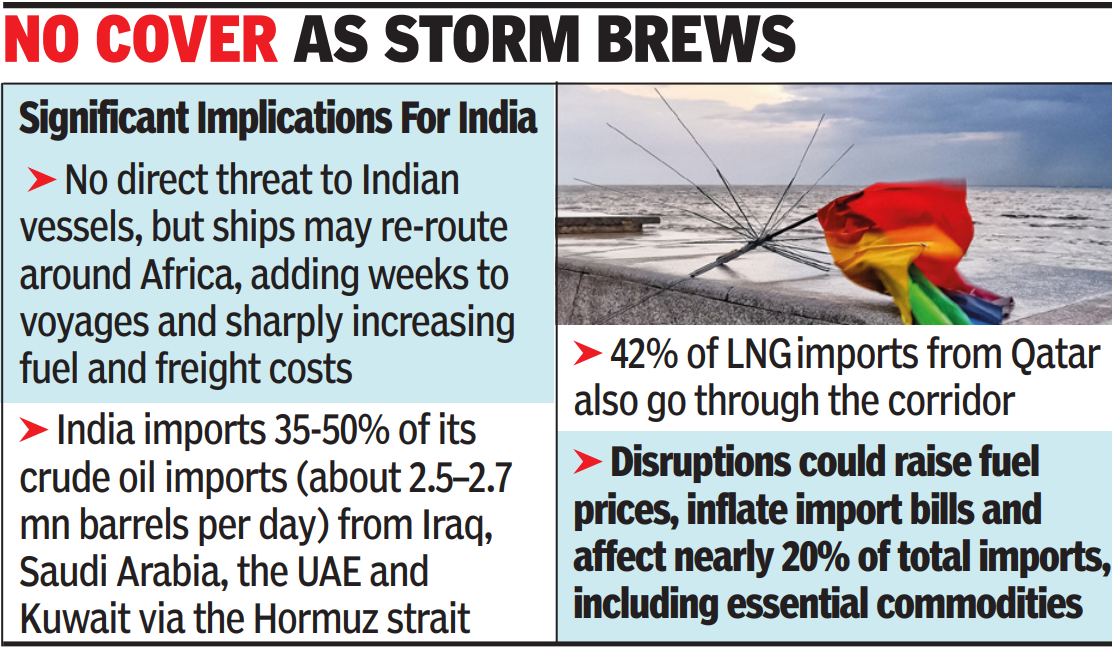
Brokers said that in the past when international reinsurers ceased to provide cover for some risks like terrorism the Indian market had provided the capacity by building an insurance pool where domestic companies come together and share the risks. However, this tie state-owned reinsurer GIC Re, which leads domestic marine pools, has itself issued cancellation notices for marine hull war risk covers effective March 3, 2026, mirroring global reinsurers and P&I clubs. The crisis has brought marine insurance centerstage, the share of this line of non-life had shrunk to around 2% of industry premium as risks ebbed due to containarisation and more safety in transport. The size of the premium also determines the capacity of the industry to provide large covers.Their role is central to global shipping. Without P&I cover, shipowners face potentially unlimited liabilities in the event of accidents, pollution or war-related damage. In high-risk zones, the absence of insurance effectively halts voyages, as operators are unwilling to expose vessels to uninsured losses. In previous crises in the Red Sea, war risk exclusions by insurers sharply curtailed traffic and drove up freight rates.In the current episode, major P&I clubs and reinsurers have issued notices cancelling war risk cover for Iranian waters, the Persian Gulf and the Strait of Hormuz, citing tanker damage, casualties and threats from Iranian forces. Reports of VHF warnings and GPS disruptions have added to concerns. Insurers have invoked standard cancellation clauses following US and Israeli strikes on Iran, with broader policy implications if the conflict further widens.Fresh war risk cover may be available, but at sharply higher premiums. Rates that were around 0.25% of vessel value have surged multiple times, rendering transits commercially unviable for many operators. Even where cover is available, shipowners remain wary of risks such as seizures or missile strikes.

The UK economy could face a “very significant” hit from the conflict in Iran, the official budget watchdog has warned.
The Office for Budget Responsibility (OBR) said that the outlook for inflation would be “particularly uncertain” following spikes in gas and oil prices in recent days following attacks in the Middle East.
It came as the budget watchdog reduced its inflation forecast for this year, indicating that UK inflation will drop to target levels quicker than previously expected.
The OBR also cut its economic growth forecast for this year and revealed a worsening unemployment outlook for the next three years.
In its latest projections alongside the Chancellor’s spring statement, the organisation however highlighted that recent volatility in the Middle East could have an impact on a number of its projections.
The forecasts were prepared before days of recent attacks as part of an intensifying conflict between US-Israeli forces and Iran.
On Tuesday, the OBR said: “Conflict in the Middle East, which escalated as we were finalising this document, could have very significant impacts on the global and UK economies.”
David Miles, from the OBR’s budget responsibility committee, said its predictions that inflation will fall to target levels early this year have become more uncertain after jumps in oil and gas prices linked to recent attacks in the Middle East.
He said: “I think what will happen to inflation is particularly uncertain in the past few days.
“Our central expectation had been that inflation would fall back towards the Bank of England’s 2% target early this year and will be around that level at the end of the year.
“There must be more uncertainty around that right now.”
The trimmed-down inflation projections indicated that this will slow to 2.3% for 2026, down from a previous 2.5% forecast.
Experts said the lower-than-expected rate is partly down to “greater slack in the economy” and falling food and energy prices.
As a result, the OBR indicated that inflation will drop to the 2% target rate set by the Bank of England and the Government later this year.
The Bank has already suggested that inflation – the rate at which the price of goods and services rises – could fall below 2% by April.
The OBR said inflation is expected to remain at the 2% target from 2027 onwards, assuming this is not knocked off course by the potential jump in energy costs.
It came as the Chancellor Rachel Reeves told MPs in Parliament that the OBR said the UK economy would grow more slowly than previously expected in 2026, although growth will pick up in the following years.
UK gross domestic product (GDP) is expected to grow by 1.1% in 2026, as the OBR cut its previous prediction of 1.4% from last November.
The budget watchdog said the downgrade was linked to a growth slowdown late last year, loosening in the labour market and subdued data from recent business surveys.
However, it also lifted its forecasts for growth for both 2027 and 2028, with the economy to expand by 1.6% in both years.
The Chancellor said she had the “right economic plan” for the UK as she laid out her spring statement on Tuesday.
Ms Reeves also said that unemployment is “set to peak later this year” before reducing over the following years.
The OBR said that the UK unemployment rate is on track to peak at about 5.33% in 2026.
Latest data from the Office for National Statistics (ONS) showed that unemployment lifted to a five-year-high of 5.2% in the three months to December.
The OBR had previously predicted that the jobless rate would increase to 4.9% in 2026.
New forecasts show that unemployment is then on track to hit 4.9% in 2027 and 4.4% in 2028.
It had previously forecast it would be 4.6% in 2027 and 4.3% the following year.
The new forecasts have also reduced the Government’s borrowing projections for each year until 2031, in a potential boost for the Chancellor.
Reduced borrowing costs, linked to an easing in the yield on Government bonds, also meant that the Government’s headroom to meet its fiscal rules widened to £23.6 billion, compared with £21.7 billion in November’s budget.
Elliott Jordan-Doak, senior UK economist at Pantheon Macroeconomics, said: “There were few major surprises in today’s spring statement, with the Chancellor delivering the well-flagged ‘boring budget’ that we and the market were expecting.”
He added: “Chunks of the fiscal forecasts now look dated because of the rapid escalation of events in the Middle East.”
Peter Arnold, EY UK chief economist, said: “The underlying improvement in the UK’s fiscal position was supported by higher actual and expected tax receipts, driven in large part by a stronger equity market performance since November.
“There may now be doubts around how long this stock market performance can be sustained if the conflict in the Middle East is prolonged and global equity market volatility continues.”


Legendary Auburn coach Bruce Pearl backs Trump on Iran strikes, rips Obama and Biden over their strategy
Oil Prices: US, Israel attack Iran: With oil prices up, forex volatility set to continue – The Times of India

See Zara Larsson reply cheekily to fan’s insensitive TikTok post

-

 Politics6 days ago
What are Iran’s ballistic missile capabilities?
-

 Politics6 days ago
US arrests ex-Air Force pilot for ‘training’ Chinese military
-
 Business1 week ago
Households set for lower energy bills amid price cap shake-up
-

 Sports1 week ago
Top 50 USMNT players of 2026, ranked by club form: USMNT Player Performance Index returns
-

 Sports6 days ago
Sri Lanka’s Shanaka says constant criticism has affected players’ mental health
-
 Business1 week ago
Lucid widely misses earnings expectations, forecasts continued EV growth in 2026
-

 Fashion5 days ago
Policy easing drives Argentina’s garment import surge in 2025
-
 Business5 days ago
Attock Cement’s acquisition approved | The Express Tribune