

Business
As EU and India move closer, where does Pakistan stand? | The Express Tribune

Islamabad should prepare for comprehensive trade deal with Brussels rather than relying on preferences alone
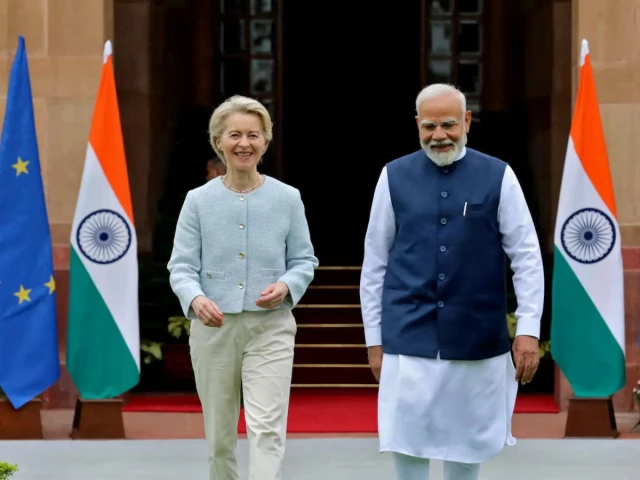
European Commission President Ursula von der Leyen and India’s Prime Minister Narendra Modi arrive for a photo opportunity ahead of their meeting at the Hyderabad House in New Delhi, India, on Feb 28, 2025. PHOTO: REUTERS
ISLAMABAD:
At a time when headlines are dominated by higher tariffs and economic nationalism, the proposed free trade agreement between the European Union and India sends a different signal. It suggests that global trade is not ending but changing shape. Countries still seek access to large markets, predictable rules, and reliable partners. The EU-India talks reflect this search for stability in an uncertain global economy.
Negotiations between the two sides have continued for nearly two decades, with long periods of slow progress. What finally created momentum was a shift in the global trade environment. The United States raised tariffs on several partners, with some affected more than others. Indian exports to the US, particularly textiles and clothing, faced an additional tariff of up to 50%. This disrupted orders and encouraged buyers to look for alternative suppliers.
The EU also faced new US tariffs of around 15% on products such as cars, machinery, pharmaceuticals, and luxury goods, many of which face high protection in India. As a result, both sides saw greater value in advancing their own agreement and reducing dependence on the US market. The economic base for such a deal is already substantial. Bilateral trade in goods stands at around $136 billion. The EU is India’s largest trading partner, accounting for about 17% of India’s goods exports, valued at roughly $76 billion, while India imports around $60 billion from the EU. India’s exports to Europe are also diverse, spanning electronics, chemicals, fuels, machinery, iron and steel, pharmaceuticals, gems and jewellery, as well as textiles and clothing. This diversity gives India a strong platform to benefit from deeper market access.
For Pakistan, these developments naturally raise important questions. The EU is Pakistan’s largest export market, absorbing more than 27% of its exports, or about $8.8 billion in fiscal year 2025. Pakistan currently enjoys duty-free access on over 85% of its exports under the GSP Plus scheme, which is secured until at least December 2027 and is now under consideration for renewal.
Pakistan’s exports to Europe are, however, highly concentrated. Around 70% consists of knitted and woven garments and home textiles such as shirts, jeans, bed linen, and towels. In these products, Pakistan currently benefits from a preference margin of around 5-9%. If the EU grants India similar or better access under an FTA, this margin could narrow, intensifying competition. For most other industrial products, EU tariffs are already low, limiting the value of preferences. There is also discussion around Basmati rice. Some fear that an EU-India agreement or changes to GSP Plus could hurt Pakistan’s rice exports. In practice, Pakistan’s main Basmati varieties already enter the EU at zero duty under the WTO commitments, and this is unlikely to change as a result of an EU-India deal. The more relevant concern relates to geographical indications. If India secures exclusive recognition for Basmati limited to its own varieties, Pakistan could face marketing and labelling challenges in Europe. This is primarily a legal and diplomatic issue, not a tariff one, and it requires active engagement.
The broader lesson lies in the changing nature of trade agreements. The EU-India deal is expected to cover over 95% of goods trade and extend into services, investment, and standards, aiming at deep and long-term integration. Pakistan’s agreements, by contrast, often cover less than 5% of tariff lines and rarely go beyond goods, limiting their economic impact. Even the agreement with China, Pakistan’s largest FTA, covers less than one-third of bilateral trade. India has also moved faster in building a network of trade agreements. In recent years, it has concluded or advanced deals with partners such as the UAE, the UK, and the EFTA countries, alongside existing agreements with Japan, South Korea, Australia, and Asean. Pakistan, by comparison, lacks FTAs with most major economies and remains relatively less integrated into global trade networks.
Another lesson is the risk of relying too heavily on unilateral preference schemes. GSP-type arrangements are conditional and subject to monitoring. They can be suspended or withdrawn. Many countries, including Vietnam and India, have therefore shifted towards reciprocal FTAs to secure more stable market access and greater policy certainty. The positive side is that Pakistan is now better placed to rethink its strategy. Gradual tariff reductions have lowered adjustment costs and made reciprocal agreements more feasible. This creates space to deepen existing agreements and pursue new ones with large markets such as the EU and the UK.
There is no immediate crisis. An EU-India agreement will still take time to enter into force, and tariff reductions will be phased in over several years. This provides Pakistan with some breathing room. That time should be used to improve export competitiveness by addressing practical constraints such as high energy costs, taxation, and access to finance. In the near term, safeguarding GSP Plus remains important. At the same time, Pakistan should prepare seriously for a comprehensive trade agreement with the EU rather than relying on preferences alone. The global trading system is reorganising around deeper partnerships and clearer rules. As others move ahead, standing still is not a safe option. Pakistan must choose between shaping its place in the emerging trade landscape or adjusting to decisions made by others.
The writer is a member of the Steering Committee on the Implementation of National Tariff Policy 2025-30. He has previously served as Pakistan’s ambassador to the WTO





Business
Why is stock market up today? Sensex rises over 1,000 points; Nifty50 above 23,700 – top reasons for rally – The Times of India

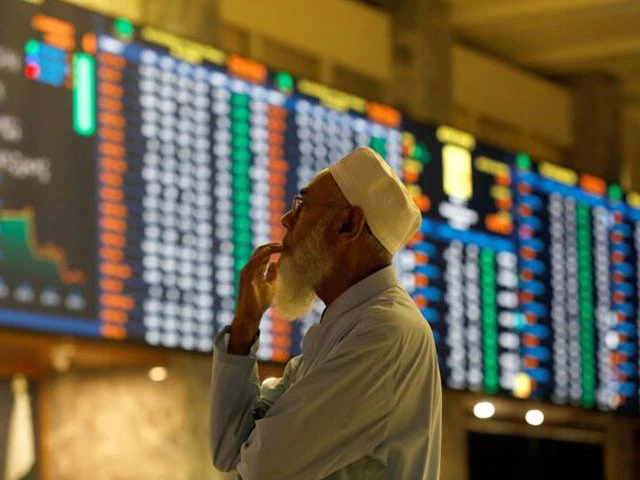
Stock market rally today: Sensex and Nifty50 rallied strongly in trade on Thursday as firm global cues and possible steps to stem rupee’s fall boosted confidence. Both benchmarks rose over 1%, even as global and domestic challenges continued to weigh on sentiment.The sharp upswing added more than Rs 4 lakh crore to the total market capitalisation of companies listed on the BSE, pushing the overall valuation closer to Rs 463 lakh crore.Despite the bullish undertone in equities, several risk factors continue to keep investors on edge. The rupee touched a fresh record low after breaching the 95.8 mark against the US dollar for the first time, surpassing its previous lifetime low of 95.7950 recorded on Wednesday. The currency has weakened around 1.4 per cent so far this week and has hit new lows in every trading session from Tuesday through Thursday.
Why is stock market rising today? Top reasons
Tax on bonds to be cut?One of the key factors supporting market sentiment was a report suggesting that the government is evaluating a proposal to substantially reduce taxes on bond investments made by foreign investors to bring policies more in line with global standards and attract overseas capital inflows. According to a Bloomberg report, the proposal was recommended by the Reserve Bank of India and is under active consideration by the Finance Ministry.Following the report, the rupee recovered part of its earlier losses and government bond prices strengthened, leading to a decline of 2 basis points in the benchmark 10-year bond yield to 7.03 per cent. Expectations that such a move could revive foreign institutional investor inflows after sustained selling pressure appeared to lift overall market sentiment.Robust corporate earnings support sentimentA number of large companies have posted solid March-quarter results this earnings season, with Morgan Stanley stating that the earnings cycle appears to be recovering after a six-quarter mid-cycle slowdown. The brokerage expects profit growth to gather momentum further, supported by reflationary measures from the government and the Reserve Bank of India, including interest-rate cuts, banking sector deregulation and liquidity support.It also pointed to strong capital expenditure trends across sectors such as energy, defence, semiconductors, fertilisers and data centres, along with major tax reductions and a relatively growth-supportive fiscal stance.Markets closely tracking the US-China meetingInvestor attention is also firmly focused on the meeting between US President Donald Trump and Chinese President Xi Jinping following Trump’s arrival in China, amid years of geopolitical tensions between the world’s two largest economies.According to an ET report, Shaun Rein of China Market Research Group described the meeting as highly significant, noting that it marks the first visit by a US president to China in nine years since trade tensions escalated during the 2017-18 period. He said countries across the world, including India, the US, Europe and Africa, have been impacted by the prolonged geopolitical divide between Washington and Beijing.Positive trend across global marketsMost major global markets traded with gains, helping improve overall investor sentiment. South Korea’s Kospi surged nearly 2 per cent, while Hong Kong’s Hang Seng posted modest gains. In contrast, Japan’s Nikkei and China’s Shanghai Composite ended sharply lower.European equities had also finished higher in the previous session, with France’s CAC, the UK’s FTSE and Germany’s DAX advancing by as much as 0.75 per cent. On Wall Street, US markets closed firmly in positive territory, led by technology stocks, with the Nasdaq climbing more than 1 per cent.Cooling bond yields aid equitiesUS Treasury yields eased marginally, providing some relief to equity markets. The benchmark 10-year US Treasury yield slipped to 4.455 per cent, while the 30-year bond yield declined to 5.027 per cent. The yield on the 2-year Treasury note, which generally reflects expectations around future Federal Reserve rate decisions, fell to 3.965 per cent.Lower bond yields often reduce the attractiveness of fixed-income investments, prompting investors to shift towards equities and other risk assets, which can support stock market gains.(Disclaimer: Recommendations and views on the stock market, other asset classes or personal finance management tips given by experts are their own. These opinions do not represent the views of The Times of India.)

Some economists said the March figures pointed to signs of so-called “front loading”, suggesting that businesses and consumers were bringing forward activity ahead of expected shortages in supply or price increases, including in car sales and rentals.
Quantexa, a financial data platform, won the £175m contract to spot fraud and tax return errors.
Source link


It Sure Seems Like These Instagram Ads Think You’re Doing Cocaine All Wrong
Why is stock market up today? Sensex rises over 1,000 points; Nifty50 above 23,700 – top reasons for rally – The Times of India

US LMI sees fastest level of expansion since March 2022 in April 2026

-

 Tech6 days ago
A new frontier: Identity stack evolves for agentic systems | Computer Weekly
-

 Tech6 days ago
‘Orbs,’ ‘Saucers,’ and ‘Flashes’ on the Moon: Pentagon Drops New UFO Files
-

 Tech6 days ago
Nick Bostrom Has a Plan for Humanity’s ‘Big Retirement’
-

 Fashion6 days ago
New orders in German manufacturing up 5% MoM in Mar 2026: Destatis
-

 Sports6 days ago
Shaheen Afridi achieves landmark feat during opening Test against Bangladesh
-

 Tech6 days ago
What Microsoft Executives Really Thought About OpenAI in 2018
-

 Entertainment6 days ago
Rihanna embraces new tattoo given by children
-

 Tech6 days ago
The Canvas Hack Is a New Kind of Ransomware Debacle