Business
Ask Dhirendra: ‘If I know markets go up in the long run, why do short-term losses bother me so much?’ – The Times of India

“‘If I know markets go up in the long run, why do short-term losses bother me so much?’This is one of the most honest questions an investor can ask.On paper, you know the logic. You’ve seen all the charts: “Sensex 100 to 70,000”, “Nifty over 20–25 years”, “equity beats inflation in the long run”. You nod wisely when someone says, “Equity is for the long term.”And then one fine day, you open your app, see your portfolio down 8–10 per cent, and your stomach drops.The mind says, “Long term”.The heart says, “Bas, ab yeh band karo.”Let’s start with some sympathy: there is nothing wrong with you. Your brain is not designed for SIPs; it is designed for survival.When our ancestors saw red (blood, fire, and danger) the correct response was to panic and run. Today, your app shows red numbers, and your brain uses the same wiring: “Danger, danger, get out.” The problem is that the stock market is the only place where running at the wrong time converts a temporary fall into a permanent loss.It helps to see what “short term” and “long term” actually look like in numbers.

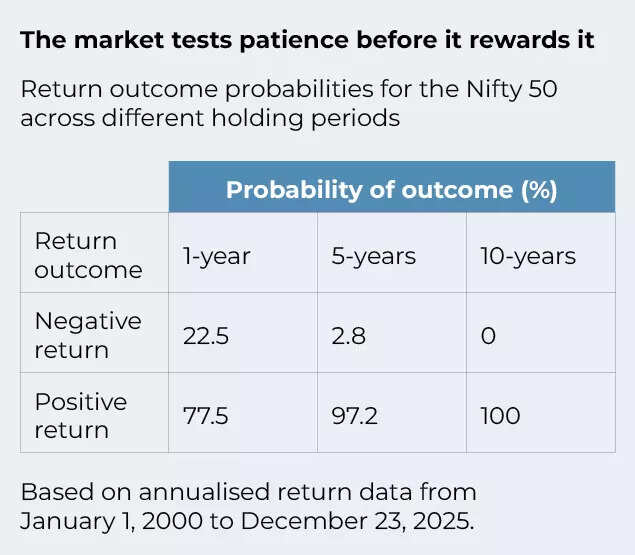
The market tests patience before it rewards it
When we look at this kind of data at Value Research, the pattern is always similar. Over the course of a year, losses are frequent. Over ten-year periods, they shrink dramatically. So the market is not misbehaving when it falls in a single year. It’s behaving exactly like a market. It is unrealistic to expect a smooth, linear upward graph.There’s another uncomfortable truth. You don’t look at your portfolio like a long-term investor; you look at it like a daily scorecard. Every time you open the app, the number on top becomes a verdict on your intelligence. Up means “I am smart”; down means “I am stupid.” Of course, you don’t want to feel stupid for three months in a row.Now we put some more structure on this feeling.Imagine you start a ₹10,000 monthly SIP in a good, diversified equity fund for 15–20 years. Somewhere along the way, there is a year when the market is down 20 per cent.There are only three things that can happen in that year:
- You panic and stop your SIP or redeem.
- You grit your teeth and do nothing.
- You not only continue but increase your investments.

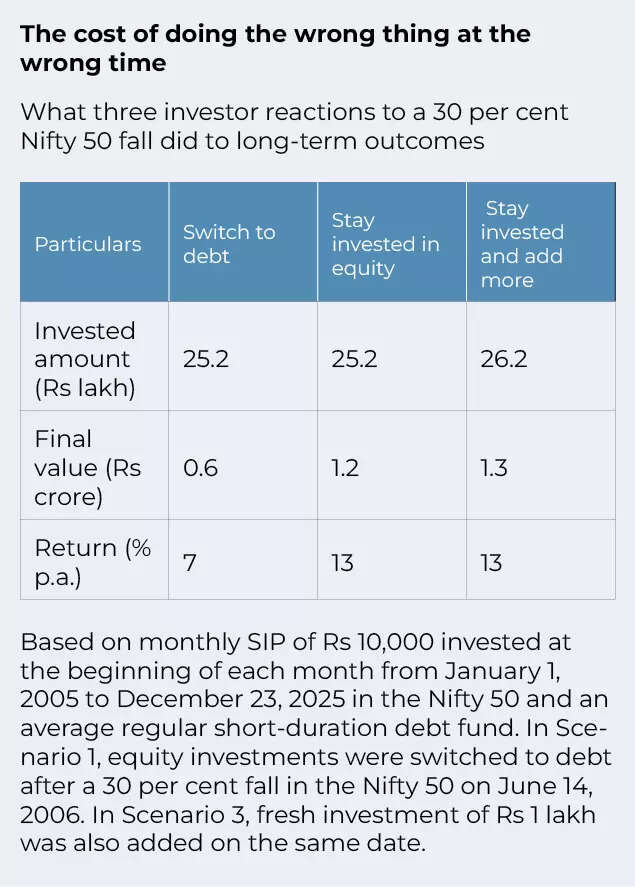
The cost of doing the wrong thing at the wrong time
When we run such scenarios at Value Research, the surprising part is this: the investor who simply does nothing in bad years often beats the one who keeps jumping around trying to avoid pain.So why can’t we “do nothing” easily?Partly because we confuse volatility with failure, a minus 10 per cent year feels like a verdict on our choice rather than a normal part of the journey. And partly because we mix up time horizons. We say, “This is for my retirement in 2045,” and then behave as if the performance over the last 45 days is all that matters.One practical way to calm yourself is to separate money by purpose. If you put all your money into the market and then need some of it next year, of course, every fall will feel catastrophic. But if you’ve done the boring work—kept an emergency fund, kept short-term money in safer avenues—then the equity money is truly long-term. You’re not going to need it next Diwali, so you don’t have to judge it every Diwali.Another trick is to change what you watch.Instead of staring at the absolute value, look at two different things:
- How much time do you have left before you actually need this money?
- How much of your target have you already accumulated?
At Value Research, our planning tools and advice try to shift people from “portfolio value today” to “probability of meeting your goal over time”. It’s much easier to tolerate a bad year in the market if you see that you’re still broadly on track for your long-term destination.And finally, accept this: you don’t have to enjoy seeing losses. You just have to not overreact to them. The test of a good investment is not whether it goes up every quarter; it’s whether it helps you reach your goals over ten or twenty years, without making you do something foolish in between.So if you know markets go up in the long run but short-term losses still bother you, that just means you’re human. Good. Stay human. Just put a system around your humanity:
- Keep your emergency and near-term money out of harm’s way.
- Use equity only for genuinely long-term goals.
- Decide your SIPs when you are calm, and refuse to renegotiate them with your panicked future self.
Red numbers on a screen are not a verdict on your intelligence. Most of the time, they’re just the market’s way of asking, “Did you really mean it when you said long term?”If the answer is yes, close the app and let time do the arguing for you.If you have any queries for Dhirendra Kumar you can drop us an email at: toi.business@timesinternet.in(Dhirendra Kumar is Founder and CEO of Value Research)