

Business
Auto sector profits to hit Rs6.6billion | The Express Tribune

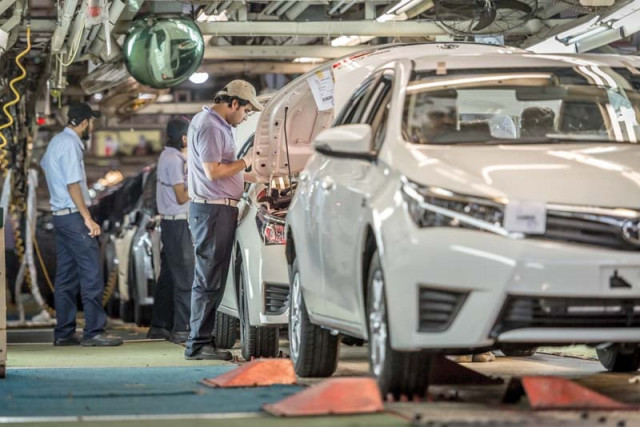
Report projects earnings to annual 21% amidst stable macros and lower interest rates
Pakistan is seeing a massive growth in car sales. In 2020, car sales amounted to 184,099 units in 10 months with Indus Motor’s share being 52,987. PHOTO: IMC/Filw
KARACHI:
In a significant shift for the Pakistani automotive landscape, industry experts are projecting a 21% year-on-year increase in earnings for the second quarter of the 2026 fiscal year. According to the latest research preview from Optimus Capital Management, the sector’s total Profit After Tax (PAT) is estimated to reach approximately Rs6.6 billion. This projection is being driven by a dramatic 76% surge in sales volumes as lower interest rates and stable macroeconomic conditions revitalise consumer demand.
While the volume of vehicles hitting the road has increased to 17,833 units, the financial success is tempered by a sharp 188% spike in distribution costs and a 25% dip in secondary income, which has caused overall net margins to shrink by 2% points to 6.9%.
Optimus analyst Muhammad Talha noted that passenger cars now dominate overall volumes among Pakistan Automotive Manufacturers Association (PAMA) members. He said intense competition has saturated the SUV and light commercial vehicle segments, where newer technology-focused new energy vehicles are competing aggressively, offering consumers a wider range of options.
The report highlighted shifting competitive dynamics as the sector prepares for new model launches by entrants such as Jaecoo and BYD. Honda Atlas Cars emerged as the standout performer during the quarter, with HR-V and BR-V sales rising 141% year-on-year, driven largely by strong demand for the HR-V HEV variant. As a result, Honda’s quarterly profit is expected to jump 152% to Rs1.4 billion, while its passenger car market share is projected to increase by nearly four percentage points.
Indus Motor Company, meanwhile, is facing increased pressure in the high-end SUV segment. While Corolla and Yaris maintained a combined market share of around 23.8%, Fortuner and Corolla Cross lost 25.9 percentage points of market share due to new competition. Despite this, Indus Motor is still expected to post a quarterly profit of Rs5.1 billion and announce a dividend of Rs40 per share.
Looking ahead, reliance on the passenger car segment has deepened, with Toyota Yaris and Honda City accounting for about 84% of total sector volumes. Talha described the sector outlook as neutral, noting that future performance will depend on innovation and localisation.
Auto sector analyst Mashood Ai Khan told The Express Tribune that interest rates have fallen from 24% to 11% and are expected to drop into single digits over the next six months, which should further support car financing and sales.
He added that Japanese brands retain an advantage due to higher localisation, while Korean and Chinese manufacturers may face price pressures after June 2026, when tax relief under the current policy expires. Localisation, he said, will remain critical for competitiveness, alongside proposed reductions in electricity tariffs to lower manufacturing costs.








Sir Keir Starmer says it is “deeply concerning” the rapper is set to headline a festival after recent antisemitic comments.
Source link
Business
Stock markets outlook: Dalal Street braces for swings as RBI MPC decision, war risks weigh on sentiment–Check key triggers – The Times of India

Domestic equities are expected to remain volatile this week as investors track the Reserve Bank’s monetary policy decision, global macroeconomic cues and evolving developments in the West Asia conflict, analysts said, according to PTI.Market participants will also keep a close watch on crude oil price movements and foreign fund flows, which continue to influence sentiment.Vinod Nair, Head of Research at Geojit Investments Ltd, said the RBI’s Monetary Policy Committee (MPC) meeting will be the key domestic trigger, with investors focusing on the central bank’s stance on inflation and growth.“A rate pause is near-certain consensus, the central bank walks a tightrope between crude-driven inflation risks and a four-year low Manufacturing PMI signalling a softening growth impulse. The governor’s commentary on the rate cycle trajectory and FY27 projections will be closely monitored.“Globally, the US March CPI reading will carry significant importance, as it buries residual Fed rate-cut hopes, strengthens the dollar and tightens financial conditions for emerging markets, including India,” Nair said.He added that geopolitical developments in West Asia will remain the dominant factor shaping market direction.“Indian markets return after a three-day gap and remain acutely vulnerable to weekend war developments, with crude trajectory and any credible ceasefire signal being the decisive variable that could either trigger a sharp relief rally or extend the current sell-on-rise mode,” he said.In the previous holiday-shortened week, the BSE Sensex declined 263.67 points, or 0.35%, while the NSE Nifty fell 106.5 points, or 0.46%.Siddhartha Khemka, Head of Research (Wealth Management) at Motilal Oswal Financial Services Ltd, said investor sentiment will remain closely linked to developments in the West Asia conflict.Brent crude prices have stayed elevated near $107 per barrel, fuelling concerns around imported inflation. Currency pressures have also intensified, with the rupee weakening sharply before recovering towards Rs 93 against the US dollar following RBI intervention, he noted.Foreign institutional investor (FII) outflows remain a key overhang, with March witnessing heavy selling of Rs 1.2 lakh crore, among the highest monthly outflows in recent years.“Investors will monitor the US Federal Open Market Committee (FOMC) meeting minutes, GDP data, and initial jobless claims for further cues on growth and the policy trajectory.“Overall, markets are expected to remain volatile as geopolitical developments, crude price movements, FII flows and global macro data continue to drive sentiment,” Khemka said.Analysts said any signs of de-escalation in the West Asia conflict could ease crude prices and stabilise the currency, offering relief to markets, while further escalation may prolong risk aversion and keep pressure on foreign flows.

One elderly couple had to find £1,000 for an oil delivery and suppliers are not giving quotes, a councillor says.
Source link


Actress Tori Spelling hospitalized after Southern California crash; authorities investigating cause

With Messi goal, Inter Miami open new stadium with dream moment

Justin Bieber ignites documentary release speculations ahead of Coachella

-

 Sports1 week ago
USMNT handed reality check by Doku, Belgium ahead of World Cup
-

 Sports1 week ago
2026 NCAA men’s hockey tournament: Schedule, results
-

 Fashion1 week ago
EU apparel imports slump 15.48% YoY in Jan; Bangladesh hardest hit
-
Uncategorized3 days ago
[CinePlex360] Please moderate: “Trump signals p
-
Uncategorized6 days ago
[CinePlex360] Please moderate: “Further tariff
-

 Tech2 days ago
Our Favorite iPad Is $50 Off
-

 Entertainment1 week ago
The Avett Brothers’ bassist explains why he wrote a book about John Quincy Adams
-

 Sports1 week ago
Man City show why they are worthy WSL title winners as tired United wilt