Connect with us

Business

Bank of England must ‘be very alert’ to Trump tensions, says governor

Published

on

Bank of England must ‘be very alert’ to Trump tensions, says governor
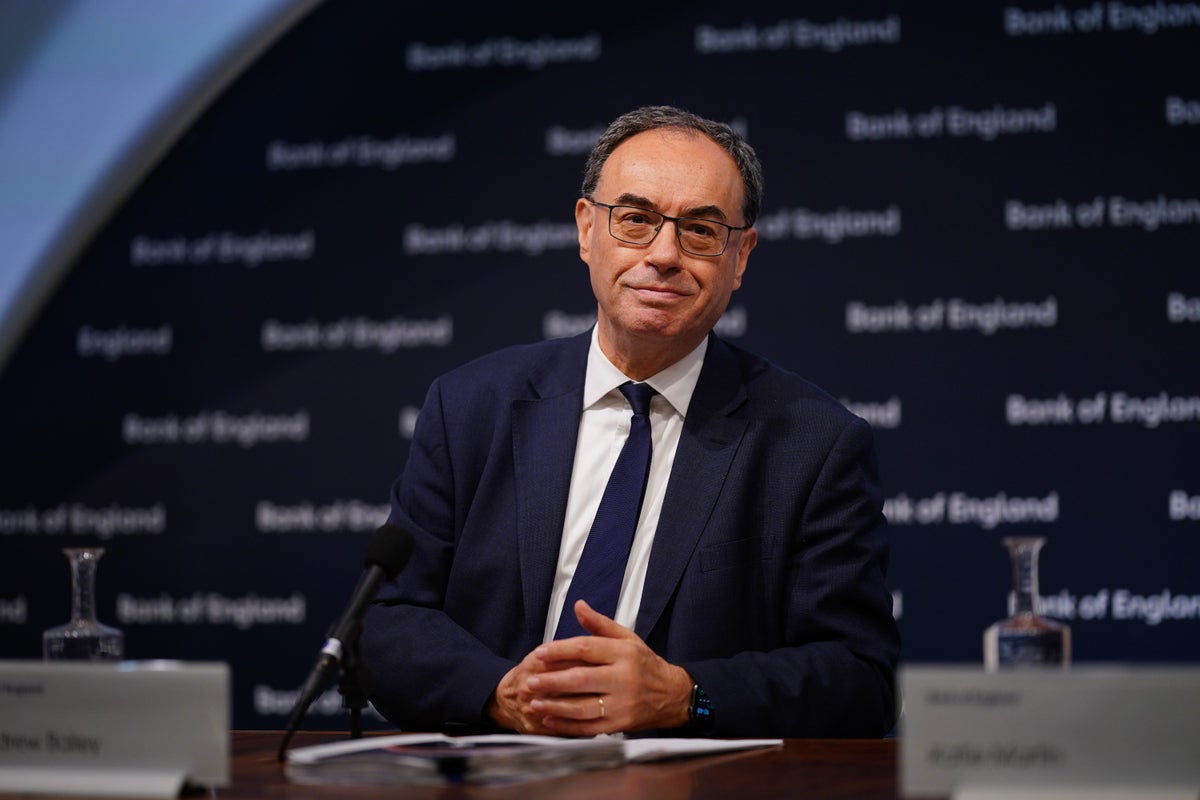


The governor of the Bank of England has said the central bank has “to be very alert” to the potential impact from heightened geopolitical tensions as President Donald Trump seeks to seize control of Greenland.

Andrew Bailey told MPs at Parliament’s Treasury Committee that the tensions would have consequences for global financial stability.

However, he highlighted that the Bank believes global financial markets have been “more muted” in response to Mr Trump’s plans and his threats to hit opposing countries with tariffs.

Earlier this week, the President said the UK and other countries pushing back would face 10% tariffs on all products from next month, with this to increase to 25% from June 1, until a deal is reached for Washington to purchase Greenland.

On Tuesday, Mr Bailey said: “The level of geopolitical uncertainty and geopolitical issues is a big consideration because they can have financial stability consequences.

“Let me put that in a bit of context in two respects. One, having said that, growth in the world economy was a lot more stable than we thought it would be.

“The second point is about financial markets and is a fairly similar point, that we worry considerably about how markets react to those things.

“Market reactions have actually been more muted than we would have feared and expected.

“Overriding those points, I take neither of those as a point of assurance. We have to be very alert to these things.”

Financial markets have been weaker so far this week as investors and traders digest Mr Trump’s tariff threats, which would cause further trade disruption.

The FTSE 100 Index dropped by around 120 points soon after opening on Tuesday, falling by 1.2% to 10,075 points.

This followed a 0.4% fall on Monday while Germany’s Dax and France’s Cac 40 also slid in value.


Source link

Continue Reading
Click to comment

Leave a Reply

Your email address will not be published. Required fields are marked *

Business

Toy sellers’ keep close watch on under 16s social media ban

Published

on

Toy sellers’ keep close watch on under 16s social media ban


Kevin PeacheyCost of living correspondent

Getty Images A Lego creation of a Formula 1 car and driver taken from above.Getty Images

The link between toys and sports has proved successful for the sector

UK toy sales have risen for the first time in five years, but sellers are braced for the potential impact of any social media ban for under-16s.

The value of toy sales rose by 6% last year, compared with the previous year, according to research company Circana, bringing some much-needed cheer for a sector that has struggled since the pandemic.

The rebound has been driven by the so-called kidult market – which relates to players over the age of 12, some of whom are influenced by trends on social media.

But experts gathered at the annual Toy Fair in London on Tuesday said that films, video games and playground chat could still help push further growth in 2026.

Cost of living pressures have loomed over families in recent years, although spending on children – particularly at Christmas – has remained a priority for many.

Covid lockdowns brought a boost to the sector when toys and games became central to keeping children and adults entertained at home.

Sales dipped since then, until last year when the number of toys sold rose by 1% compared with 2024, according to Circana.

With kidults spending more, the value of sales rose by 6% – the first increase since 2020, according to Circana. It valued the UK market at £3.9bn last year.

Melissa Symonds, executive director of UK toys at Circana, described last year as a “clear turning point” for the sector.

Cinema, streaming, video game and sport tie-ins – such as Minecraft and Formula 1 – all proved successful.

Symonds said that excluding the unusual circumstances of the pandemic, last year recorded the first organic growth since 2016.

Social media trends

Kidults accounted for 17% of the toy market in 2016, but this had risen to 30% by last year.

Building sets, predominantly Lego, has appealed to adults, but trends amplified on social media have also led to a 12% growth in collectibles across generations. Pokémon, K-Pop Demon Hunters, and Hello Kitty have all proved to be “market-moving trends”, according to Circana.

Symonds said the industry would be considering the impact of the social media ban for under-16s in Australia, and the potential for a similar ban in the UK.

She said manufacturers and retailers may need to reconsider how some of these toys were marketed if bans were brought in more widely.

Kerri Atherton, from the British Toy and Hobby Association – which is hosting its annual trade fair at London’s Olympia, said it was still too early to know what the fallout would be.

She described 2025 as a pivotal moment for the UK toy sector, but said businesses and consumers still faced financial challenges going into 2026.


Source link

Continue Reading

Business

Silver prices soar! White metal adds over Rs 85,000 so far in 2026; is it the right time to buy? – The Times of India

Published

on

Silver prices soar! White metal adds over Rs 85,000 so far in 2026; is it the right time to buy? – The Times of India


Silver made a stellar debut in 2026, soaring over 35%, or nearly Rs 85,000 per kg, investors rush towards the precious metal amid tightening supplies and escalating geopolitical tensions involving the US, Iran and Greenland. The white metal’s momentum further strengthened after MCX silver futures decisively crossed the Rs 3 lakh per kg milestone. During the latest trading session, prices advanced by more than 2.5%, rising nearly Rs 8,000 to settle at Rs 3,19,949 per kg. The fresh uptick followed renewed strains between the US and the European Union after US President Donald Trump threatened to acquire Greenland and impose punitive tariffs on Europe. Here’s what experts are sayingAamir Makda, commodity and currency analyst at Choice Broking, told ET, “silver at $94 per troy ounce, a level once considered unthinkable, is driven by a “perfect storm” of industrial scarcity and geopolitical shifts. Looking at Technical charts, we are expecting further upward momentum in Silver and immediate support would be at 20-DEMA level placed at Rs 255,100,” Makda, however, flagged early signs of fatigue in the rally. “Although in recent sessions, with a price up move, a bearish RSI divergence has emerged, and it is a classic “Red flag” warning,” he said, explaining that while prices are making new highs, the underlying momentum is weakening. He also highlighted a drop in open interest to 9,850 lots in the March contract, even as prices climbed, indicating long unwinding in silver. Traders holding long positions, he said, should consider booking profits at current levels. Jigar Trivedi, senior analyst at Reliance Securities, said the market may now enter a phase of time-based consolidation. While he acknowledged the possibility of near-term consolidation, Trivedi said the prevailing political and geopolitical environment could still push prices higher, potentially towards the psychological level of $100 per ounce. He noted that the broader international trend remains firmly bullish, though the risk–reward equation currently stands evenly balanced at 1:1 after the sharp rise over the past 13–14 months. In rupee terms, he identified Rs 3,30,000 per kg as the next important resistance. From an investment lens, the recent breakout is being seen as part of a longer-term structural trend rather than a short-lived spike. Justin Khoo, Senior Market Analyst at VT Market, said the move is supported by supply constraints and strong industrial demand, particularly from solar energy, electronics and electric vehicle segments. While elevated prices increase volatility, he said investors should focus on strategic positioning instead of chasing record highs. Tactical profit-taking may suit short-term traders, but for long-term investors, he said silver continues to act as a hedge against inflation and market uncertainty. Khoo added that the broader approach should be to buy on meaningful declines while maintaining core holdings, with risk management remaining central. Although the trend still points to further upside, disciplined entry and exit strategies are increasingly important at current levels. Akshat Garg, head of research and product at Choice Wealth, said new investors could consider silver ETFs as part of a diversified multi-asset portfolio to tap into the metal’s structural strengths. Existing investors, he said, should avoid exiting at current levels, as the underlying support remains intact.Garg further added citing experts that new investors should allocate 5–10% to silver and gold ETFs within a broader portfolio, viewing the exposure as diversification rather than a momentum-driven trade. Existing holders, he said, should remain invested through volatility, as institutional flows, ETF participation and long-term fundamentals continue to provide support through 2026. Analysts also point to silver’s dual identity as both a monetary hedge and an industrial commodity. With more than half of demand now coming from sectors such as solar power, electric vehicles, data centres and electrification, and with supply constrained by limited mine output and recycling, the market remains tight. This structure, they say, positions silver to potentially outperform gold during growth phases while still offering protection during volatile periods.(Disclaimer: Recommendations and views on the stock market, other asset classes or personal finance management tips given by experts are their own. These opinions do not represent the views of The Times of India)


Source link

Continue Reading

Business

Global markets rattled as Trump issues Greenland threats

Published

on

Global markets rattled as Trump issues Greenland threats


Global stock markets experienced significant declines as tensions escalated following Donald Trump’s renewed threats to acquire Greenland.

The FTSE 100 Index plunged over 120 points, shedding 1.3 per cent to reach 10068.4 shortly after opening on Tuesday, compounding a 0.4 per cent decline from Monday.

Across Europe, major indices also registered substantial losses, with Germany’s Dax down 1 per cent and France’s Cac 40 off 0.9 per cent in early trading, mirroring sharp overnight declines in Asia.

The controversy began on Saturday when Mr Trump threatened to impose tariffs of up to 25 per cent on nations, including the UK, that do not back his Greenland acquisition plans.

Mr Trump, who is en route to Davos, Switzerland, for the World Economic Forum, intensified his rhetoric concerning the acquisition of the Arctic territory.

Through a series of posts on his Truth Social platform overnight on Tuesday, he further articulated his desire to take over Greenland, a territory belonging to America’s Nato ally, Denmark.

US financial markets were closed on Monday for Martin Luther King Jr Day, but futures trading pointed to steep falls when equity trading reopens on Tuesday.

The FTSE 100 Index dropped more than 120 points soon after opening on Tuesday, down 1.3 per cent at 10068.4, after a 0.4 per cent fall on Monday (PA Wire)

Gold prices soared to another new record as investors sought out the safe haven asset, hitting $4,728 (£3,507) per ounce during morning trading on Tuesday.

Kathleen Brooks, a research director at XTB, said: “What happens next for financial markets will ultimately depend on President Trump’s actions in the coming days.

“The president posted a picture of himself holding a US flag on Greenland, suggesting that the territory will be owned by the US this year.

“However, he also said that he will hold a Greenland meeting at Davos, after a good conversation with the Nato secretary general and former Dutch PM Mark Rutte.

“For now, Trump is sticking to his guns and said that there is ‘no going back’ on his Greenland pledge.

“Thus, the meeting in Davos later this week will be critical.”

Yields on UK Government bonds, also known as gilts, edged higher amid a wider sell-off as Japan’s government bonds plunged, triggered by news of a snap election to be held on 8 February.

The pound continued to rise against a weak US dollar, up 0.4 per cent at $1.348, but was 0.3 per cent lower at €1.15.


Source link

Continue Reading

Trending