Business
Bank of England warns of AI bubble risk

Archie MitchellBusiness reporter

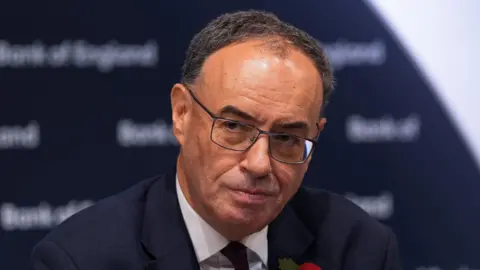
The Bank of England has warned of a “sharp correction” in the value of major tech companies with growing fears of an artificial intelligence (AI) bubble.
It said share prices in the UK are close to the “most stretched” they have been since the 2008 global financial crisis, while equity valuations in the US are reminiscent of those before the dotcom bubble burst.
The central bank’s financial stability report warned valuations are “particularly stretched” for companies focused on AI.
In its report the Bank also announced plans to lower the amount of capital High Street banks need to hold in a bid to boost lending and spur economic growth.
It marks the first reduction in the amount lenders need to hold since the 2008 financial crisis, and followed stress tests showing they would be able to withstand a crisis scenario with unemployment doubling, house prices plummeting and the economy contracting by 5%.
AI bubble fears
The Bank said the growth of the AI sector in the next five years would be fuelled by trillions of dollars of debt, raising financial stability risks if the value of the companies falls.
It cited industry figures forecasting spending on AI infrastructure could top $5tn (£3.8tn) and said much of this would be funded by AI firms themselves, but around half would come from outside sources, mostly through debt.
“Deeper links between AI firms and credit markets, and increasing interconnections between those firms, mean that, should an asset price correction occur, losses on lending could increase financial stability risks,” it said.
The Bank of England is the latest institution to sound the alarm over a potential crash in the value of AI firms reminiscent of previous incidents such as the dotcom bubble.
Jamie Dimon, the chief executive of US bank JP Morgan, told the BBC in October he was “far more worried than others” about the risk of a serious market correction in the coming years.
The International Monetary Fund and the Organization for Economic Co-operation and Development have also warned of price corrections.
The dotcom booms refers to a period in the late 1990s, during which the values of early internet companies surged on a wave of optimism for what was then a new technology, before the bubble burst in early 2000 – with many share prices collapsing.
This led to some companies going bust, resulting in job losses.
A drop in share prices can also hit the value of people’s savings including their pension funds.
Fears over an AI-related stock market correction come as Chancellor Rachel Reeves used her Budget to encourage savers to pile cash into stocks and shares by reducing the amounts which can be saved in cash Isas.
Bank of England governor Andrew Bailey has previously raised fears about a potential financial crash, warning after the collapse of two US companies that “alarm bells” were ringing.
On Tuesday he said the AI sector in the US is “very concentrated”, making up a large portion of the value of the country’s stock market.
But he added: “There is a difference to the dotcom situation in that these companies have got positive cash flows, they are not created on hope.
“But, as we see, and we saw last week in the debate about whether Google is moving onto Nvidia’s patch, it doesn’t mean to say everybody is going to win, it doesn’t mean to say everyone is going to win equally.
“It is important to be clear it is not inconsistent, quite consistent in fact that AI turns out to be the next general purpose technology in terms of prompting productivity growth across economies. I hope it is, but we’ll see.”
Global risks
The central bank also said the risks to financial stability had risen during 2025, citing geopolitical tensions, global trade wars and rising borrowing costs for governments.
It said growing tension between countries had specifically raised the prospect of cyber-attacks and other disruptions.
After assessing High Street lenders’ ability to cope in a crisis situation, the Bank has proposed lowering the benchmark for Tier 1 capital requirements for firms to 13% from the 14% level it has been at since 2015. The requirement refers to the buffer banks must hold in case of any losses from risky lending.
The central bank said this would still give firms a £60bn buffer against their minimum requirements so they would be able to continue lending to households and companies.
The Bank’s Financial Policy Committee said lowering the threshold would make it easier for lenders to offer loans to households and businesses. The changes are due to come into force in 2027.
Elsewhere in the financial stability report, the Bank warned homeowners coming off fixed-rate mortgages in the next two years face a £64 increase in their monthly repayments.
The central bank said the typical owner-occupier coming off a fixed rate would see an 8% jump in their bills as the impact of higher interest rates continues to bite.
In total, 3.9 million people, or 43% of mortgage holders, are expected to refinance at higher rates by 2028, the Bank said.
But a third will see their monthly payments fall in that period, it added, with interest rates having fallen significantly since a spike in 2022.
The Bank of England’s base rate, which influences the cost of borrowing for individuals, including mortgages, has fallen from 5.25% in 2024 to its current 4%.