Fashion
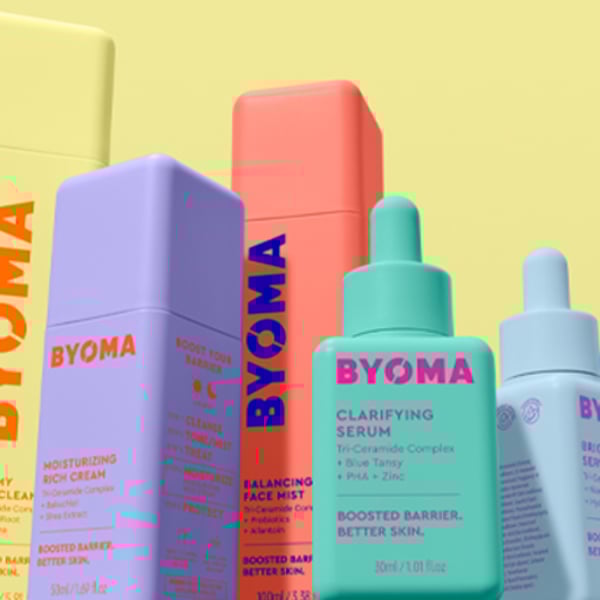
Bansk Group acquires majority stake in skincare brand Byoma
Published
September 10, 2025
Bansk Group announced on Wednesday it has acquired a majority stake in affordable skincare brand Byoma.
The New York-based consumer brands private investment firm acquired the Byoma stake from Yellow Wood Partners, a fellow private equity firm focused on consumer brands.
Terms of the transaction were not disclosed.
The Scottish skincare brand will continue to be helmed by founder and chief executive officer, Marc Elrick, following the transaction.
“Byoma was founded on the principle that most skin concerns originate from a compromised skin barrier. Therefore, we created Byoma to offer products specifically formulated to strengthen and maintain the skin barrier whilst delivering transformational results,” said Elrick, who launched the science-focused skincare brand in 2022.
“Over the past three years, we’ve developed strong, sustained momentum and have established Byoma as a key growth driver and top five skincare brand at leading retailers across markets while building trust and credibility with consumers. This transaction unlocks an accelerated growth trajectory in our journey. In Bansk, we’ve found a partner that intimately understands today’s consumer landscape and shares our values and growth ambitions. With Bansk’s deep expertise scaling purpose-driven consumer brands, we are incredibly excited to continue to challenge and redefine the beauty landscape for consumers globally.”
Byoma joins Bansk’s current investment folio, which includes fellow beauty brands Amika, Eva NYC, and Ethique.
“Byoma is redefining what skincare can be – backed by science, led by purpose, and deeply connected to its community,” said Chris Kelly, senior partner at Bansk.
“In what can often be a sterile and confusing category for consumers, Byoma stands apart by simplifying the skincare journey and delivering efficacious, prestige formulations at an accessible price point. Today’s consumers are more intentional than ever, seeking products that are not only effective but also transparent, inclusive, and rooted in real education. We’re excited to partner with Marc and the team to accelerate Byoma’s mission and bring its barrier-boosting formulas to even more consumers.”
Copyright © 2025 FashionNetwork.com All rights reserved.
Fashion
Santiago Cucci on IKKS: ‘It’s time for us to refocus on our flagship brand’
Published
December 14, 2025
In October, this was not necessarily the frontrunner in the race to take over the IKKS Group. The French premium ready-to-wear specialist, owner of the eponymous brand as well as One Step and I.Code, attracted around a dozen bidders after being placed in receivership at the start of autumn, including the respective owners of The Kooples, Pimkie, Morgan and Caroll.
But in the home stretch, the duo of Michaël Benabou, co-founder of VeePee (then called Vente Privée) and head of the investment company Financière Saint James, and Santiago Cucci, a specialist in premium ready-to-wear and former head of the Levi’s and Dockers brands, who for a time supported the leadership of Dutch label G-Star, strengthened their bid. The entrepreneur, a sports enthusiast who knows the case well, having taken over as chairman of the HoldIKKS holding company last year, knows that competitions are decided right up to the last minute. Despite the loss of almost half the workforce, their offer, which safeguards 546 jobs and includes 119 directly operated stores, won the backing of the group’s works council (CSE) and was formally approved by the Paris Court for Economic Activities.
A few hours after the decision was made official, Cucci outlined his roadmap for IKKS to FashionNetwork.com.
FashionNetwork.com: What was your reaction to the announcement of the court’s decision?
Santiago Cucci: We’re delighted to be taking over this iconic brand. I think it’s a brand that touches the hearts of the French. We all have a history with IKKS, whether from our younger years or through our children, often tied to festive moments. This means there’s a whole generation entering adulthood already very familiar with the brand and feeling positively towards it. That’s the capital we’re taking on today. And this affinity extends well beyond end consumers: of the 118 affiliates we contacted, 116 said yes.
FNW: Because beyond the 119 directly operated stores, you had to convince partners to come on board…
SC: Whether with affiliates, suppliers we had to renegotiate with, or across the entire value chain through to consumers, I believe the whole ecosystem still holds the brand in very high regard. Our job now is to make the brand desirable, using digital tools that deliver a strong and seamless customer experience.
FNW: You’re keeping 546 jobs, many of them in stores. What are the next steps, particularly on the social front?
SC: As we’re taking over the company, on Monday I’ll be in Saint-Macaire to meet the employees who are part of the project. We’ll be putting together a new management team across most functions over the next few weeks. I would like to thank the management team, who have done their utmost to steer the company through difficult conditions in recent years. In our takeover plan, we have committed to investing 700,000 euros to acquire the brand’s assets and inventories, and 700,000 euros to contribute to the PSE. Matters concerning those who are leaving will be handled by the court-appointed liquidator. However, we intend to rehire a few people to help secure the path forward over the coming months.
FNW: In your plan, a number of activities were to be discontinued. Where are you going to focus your efforts?
SC: We’re refocusing on IKKS’s adult business. We’re putting the junior business on hold. Even though that’s the brand’s roots, in France the leading player in the junior market is the second-hand segment. We have to accept that reality. But those consumers who were juniors are now adults and already have a relationship with the brand. At the same time, the group had been managing I.Code and One Step. It’s time to refocus on the flagship and discontinue the two brands and childrenswear. It’s important to note that the junior segment accounts for 82% of IKKS’s losses.

=
FNW: Does this mean that you think the adult part of IKKS, the core on which you’re refocusing, could be profitable fairly quickly?
SC: You’re right. As early as the first year—2026, which will be a transitional year—we have a profitable business model, with reinvestment back into the company.
FNW: Alongside the buyout, you announced a 16 million euro investment package. What are your investment priorities?
SC: We’ve budgeted almost 17 million euros to get the supply chain engine up and running again. It’s a real machine. We’re going to invest in boosting the brand’s desirability, and in IT infrastructure that is from another era, which we’ll upgrade in the first quarter. In my experience, I’ve always been quick to transform companies.
FNW: What will you bring over from your experience at Levi’s and Dockers? What do you think is essential to the successful evolution of a brand?
SC: We’re going to clarify the brand’s identity and values. We’ll enhance the customer experience, particularly by engaging more meaningfully with our community and relying a little less on promotions alone. To do this, we’ll invest in infrastructure and in our go-to-market. We’ll invest in production capabilities so we can be more flexible and hold inventory that matches market needs. We want to be less dependent on promotional periods.
FNW: Is the idea also to reduce the share of revenue coming from markdowns?
SC: You have to be clear about prices. You can’t set a price and then run permanent promotions afterwards. So we’re going to bring more clarity for consumers to the pricing structure, especially at the start of the season. By the way, the design team has done a great job, which is why we’re keeping them on. Now we’re going to make this offer more visible, with a pricing structure that has to be logical. Encouragingly, the results for this reworked adult offer are positive.
This article is an automatic translation.
Click here to read the original article.
Copyright © 2025 FashionNetwork.com All rights reserved.
Fashion
Daveed Baptiste wins 2025 Empowered Vision Award
Published
December 14, 2025
Designer Daveed Baptiste has been named the recipient of the 2025 Empowered Vision Award, presented by The Andréa W. and Kenneth C. Frazier Family Foundation in partnership with the Council of Fashion Designers of America (CFDA).
The announcement was made Thursday evening at a cocktail reception at the W Union Square in New York City, where artistic director and cultural advocate Edward Buchanan and supermodel Imaan Hammam revealed Baptiste as this year’s honouree. The event drew members of the fashion industry, media, and design community to celebrate the award’s mission of supporting and elevating Black designers.
“Daveed Baptiste ultimately distinguished themselves through clear, thoughtful storytelling and a disciplined, vulnerable approach to building and strengthening their tools to lead a business,” said Milton Dixon III, program director of the Empowered Vision Award.
“We’re proud to support a designer whose work speaks to the future of fashion, and we’re excited to move forward with them over the next year of mentorship and continued investment.”
The Empowered Vision Award includes a $100,000 financial grant, along with a year-long mentorship program valued at an additional $100,000. The initiative is designed to provide emerging Black designers with critical funding, industry guidance, and strategic support to help scale their businesses and build a global presence
Copyright © 2025 FashionNetwork.com All rights reserved.
Fashion
US textile imports steady as Cambodia, Bangladesh gain market share
China retained its position as the largest supplier with a **.** per cent market share, followed by Vietnam at **.** per cent. However, China’s share continued to slide month after month, reflecting a structural shift in sourcing. American buyers are increasingly diversifying towards Southeast and South Asia to reduce tariff exposure, mitigate geopolitical risk, counter rising production and labour costs, and build more resilient supply chains.
During January–September ****, apparel imports—the dominant product category—rose by *.** per cent to $**.*** billion, compared with $**.*** billion in the corresponding period of ****. In contrast, non-apparel imports fell by *.** per cent to $**.*** billion, as slower housing activity, cautious consumer spending, and order rationalisation by retailers softened demand for home textiles, industrial textiles, and made-ups.
-
Politics7 days agoThailand launches air strikes against Cambodian military: army
-
Fashion7 days agoGermany’s LuxExperience appoints Francis Belin as new CEO of Mytheresa
-
Politics7 days agoZelenskiy says Ukraine’s peace talks with US constructive but not easy
-
Tech1 week agoWIRED Roundup: DOGE Isn’t Dead, Facebook Dating Is Real, and Amazon’s AI Ambitions
-
Politics1 week ago17 found dead in migrant vessel off Crete: coastguard
-
Business4 days agoRivian turns to AI, autonomy to woo investors as EV sales stall
-
Politics4 days agoTrump launches gold card programme for expedited visas with a $1m price tag
-
Tech5 days agoJennifer Lewis ScD ’91: “Can we make tissues that are made from you, for you?”