

Sports
Barnwell: The NFL-altering Micah Parsons trade, and what comes next for the Cowboys and Packers

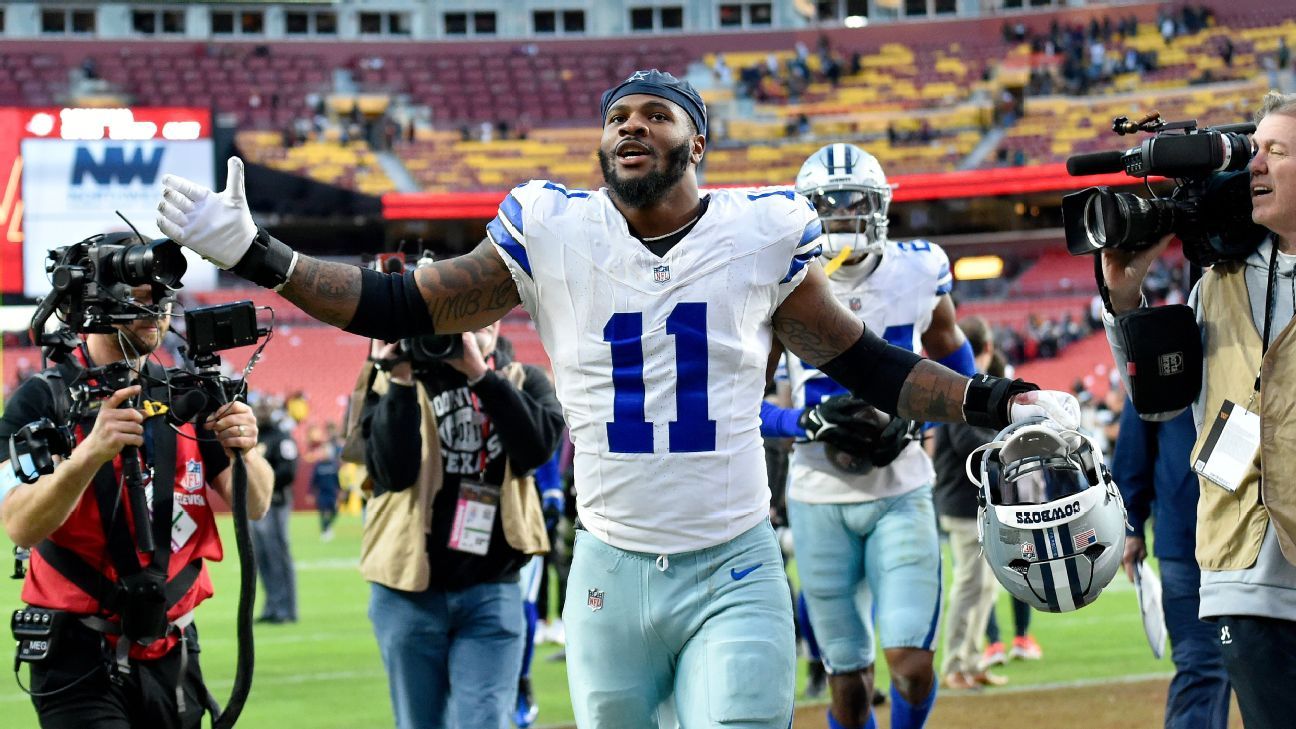
The quickest way to make a boring, redundant soap opera more exciting is a shocking twist. After months of publicly flirting with the idea of trading star edge rusher Micah Parsons, Jerry Jones and the Dallas Cowboys talked themselves into the most unexpected of moves Thursday afternoon — shipping Parsons to the Green Bay Packers for two first-round picks and defensive tackle Kenny Clark. It would be the most stunning trade of the year for just about any other city in America besides Dallas, which has now seen its sports teams deal away two young cornerstones in Parsons and NBA standout Luka Doncic in a matter of eight months.
Like Doncic, Parsons is the sort of young superstar at a critical position who isn’t supposed to ever hit the market. Organizations pray that they’ll land someone as impactful in the draft as Parsons. Even while missing four games last season with a high ankle sprain, the Penn State product became the second player in NFL history to rack up 12 or more sacks in each of his first four seasons. The only other one to do that is another player Packers fans came to love: Reggie White.
The Packers hope Parsons becomes the third in a series of defensive stars who were underappreciated by their prior teams before joining Green Bay and firmly establishing themselves as no-doubt Hall of Famers. White and Charles Woodson, Parsons’ predecessors in that designated role, joined as free agents later in their careers after they had turned 30. Parsons just turned 26. This is a player entering his prime. Getting what Parsons has proved to be is a coup. But there’s a chance the Packers get an even better version of the star edge rusher.
Subscribe: ‘The Bill Barnwell Show’
This is a trade as opposed to a free agent acquisition, though. And a Packers team that has typically loathed giving away draft picks just shipped two first-rounders to the Cowboys in the hope that it has finally landed the defensive difference-maker it has sought for years. There’s a lot to discuss here from the Packers’ side. But first, as I try to sort through the various questions emanating from this trade, there’s one I keep getting over and over again:
Jump to:
What were the Cowboys thinking?
Did the Cowboys get enough in return?
Is this a steal for the Packers?
Are the Packers now atop the NFC?


What are the Cowboys thinking?
I’d tread carefully in attempting to occupy the same headspace as Jerry Jones, who has handled this process with all the deftness and precision of the final offensive snap in any recent Cowboys playoff loss. Jones will surely be happy to come out and tell us why he traded Parsons in the weeks to come, either directly or through other members of the media. He might even be telling the truth.
If I’m being realistic, I suspect that there was probably some combination of factors that led to the move. (And no, it wasn’t the possibility of Parsons getting hit by a car.) Three arguments come to mind as the most likely from the Cowboys’ perspective. You’ll have to decide how convincing they are for yourselves.
1. Jones believed he had been betrayed and decided to take a stand against a player (and an agent) on principle. In the various reports between Parsons’ trade request and the consummation of this Packers deal, it became clear that there was a disconnect between the team and player. According to Jones, the owner thought he had agreed on the framework of a deal with Parsons sometime during the spring. In his trade request, Parsons characterized this as an informal discussion — one that took place without his agent, David Mulugheta.
Jones responded by essentially blaming Mulugheta for the conflict between the two parties. Jones told former Cowboys legend Michael Irvin that he went to Parsons’ agent with the terms of the deal he believed they had negotiated in March, only for Mulugheta to allegedly respond by telling Jones to “stick it up [his] ass.” (According to ESPN’s Ryan Clark, Mulugheta denies that claim.)
I don’t want to accuse any of the parties involved of being untruthful or exaggerating, but it’s very clear that there are some very large egos involved in these discussions. Jones is an 82-year-old billionaire. Parsons is an elite player. Mulugheta is one of the most notable and significant agents in the league. These are three people used to getting their way without much pushback.
Did Jones eventually just decide that renegotiating the deal he believed he had made with Parsons would give any Cowboys player ammunition to push back and change their mind if they agreed to a deal they didn’t like? Did Jones spend so much time publicly discussing the idea of trading Parsons that he eventually talked himself into it? Or did a person of immense power and privilege get challenged and decide that he wasn’t willing to back down, even if it meant trading away a core franchise player?
2. The Cowboys decided they couldn’t win with their existing roster construction if they paid Parsons. If there was a little bit of Option No. 1 in regard to Jones’ ego in this trade, the most prominent discussion behind the scenes regarding Parsons and the Dallas roster had to be about what would happen in the years to come.
This goes back to a question I had last season before the Cowboys paid receiver CeeDee Lamb and extended quarterback Dak Prescott on what is still a record-setting contract. On their prior deals in 2021-23, the Cowboys were paying Prescott, Lamb and Parsons an average of just under $48 million per season combined. During that run, Lamb and Parsons were on rookie contracts, while Prescott was playing out a four-year, $160 million extension.
With Prescott and Lamb earning massive raises in 2024 and Parsons seemingly set to land one on his own, that price was going to go up dramatically. As it turns out, their three new deals are going to combine to average $141 million per year, a near-nine-figure jump per season. If the Cowboys couldn’t win a Super Bowl with their three top players making $48 million, how were they going to do it after that price tag nearly tripled?
Though the cap will go up in the years to come, Dallas’ big three was set to take up more than 50% of the NFL’s cap in terms of average salary. (That doesn’t mean that the three players would actually eat up half of the Dallas budget given how the league handles accounting and how the Cowboys structure their contracts, but it’s a reasonable shorthand for how significant their deals are relative to the broader NFL.) For context, the average salaries of the top three deals for the Eagles last year came in at just over 42% of the cap.
Over the past decade, I can’t find a team that had its top three players’ average salaries amount to more than 50% of the salary cap. The closest might be 2022, when the Rams had Aaron Donald, Cooper Kupp and Matthew Stafford combine to represent 48.5% of that year’s cap. All three got hurt and the Rams went 5-12.
That Rams team isn’t an aberration. The 2021 Chiefs (47%) lost in the AFC Championship Game and promptly traded away their fourth-biggest earner, wide receiver Tyreek Hill. Their top three by salary were Patrick Mahomes, Chris Jones and Frank Clark. The 2022 Packers (46.5%) went 8-9 and then traded away their most expensive player, Aaron Rodgers. The only other teams above 45% were the 2023 Chargers and 2022 Raiders — both of which had losing records and followed their disappointing years by making changes to their cores.
1:54
Schefter breaks down how Parsons to the Packers came to be
Adam Schefter breaks down the massive Micah Parsons trade from Dallas to Green Bay.
We’ll never know if the Cowboys could have built a Super Bowl contender around market-value deals for their three stars, but I don’t think anybody would have argued that it would be easy. The Cowboys have traditionally been a (very good) draft-and-develop organization, and they landed all three of their standouts with their own picks. But the returns post-Parsons in the draft haven’t been as consistent.
And yet, it’s tough to say that Dallas clearly couldn’t see a future with its big three intact before the trade. If what Jones says is true and he did agree to the framework of a deal with Parsons in March, that contract would have surely come in somewhere around $40 million per season, before Myles Garrett and T.J. Watt extended the market. While $7 million more per year isn’t an insignificant sum, the Cowboys were pretty clearly willing to pay Prescott, Lamb and Parsons a staggering amount of money. I’m not sure the difference between what the Packers paid Parsons and what Jones might have been able to get away with in March was enough for the Cowboys’ owner to throw in the towel.
3. Jones believed the Cowboys could be disappointing on defense, even with Parsons in the lineup. Echoing the same logic the Bengals might have been using as they negotiated a deal with Trey Hendrickson, Jones and the Cowboys had very recent evidence that Parsons alone wasn’t a guarantee of a great defensive season. In 2024, the Cowboys ranked 29th in EPA per play and points allowed per possession. They allowed opposing teams to score touchdowns on 75% of their trips to the red zone, the fifth-worst rate allowed by any defense in a single season since 2000. Perhaps Jones figured: If the Cowboys could be so bad with Parsons on the field for most of the season, was it really worth $47 million more per year to keep him around?
Of course, there are 10 other players on defense, and I’m not sure I’d pin many of those problems on Parsons. Just about every offense the Cowboys faced last season was very clearly focused on stopping him. The Dallas defense under Mike Zimmer was second in sack rate and first in turning pressures into sacks because of both Parsons himself and the sheer amount of attention teams paid to him. Zimmer brought along plenty of his A-gap pressure packages to create mismatches, but the most success the Cowboys had on defense last season came when the veteran coordinator used the threat of Parsons to manipulate and then attack opposing pass protections.
Over the past four years, the Cowboys were the league’s best defense with Parsons on the field by EPA per play. Across 1,039 snaps, those same Cowboys immediately became the league’s worst defense by the same metric when Parsons was on the sideline or inactive. Acknowledging that every team is going to get worse when its best player isn’t playing, I’m not sure anything I can tell you is going to be more instructive than those figures. The best defense in the league with Micah Parsons … and the worst defense in the league without him.
Did the Cowboys get enough back in the trade?
One of two things appear to have happened Thursday. One is that the Cowboys simply decided they were done negotiating with Parsons and traded him for the best offer they could find by the end of the day. ESPN’s Adam Schefter, Dan Graziano and Todd Archer reported earlier in the day that the Cowboys were at least willing to listen to potential Parsons trade conversations for the first time, which seems to hint toward this being the most likely scenario. If the Cowboys were going to add a player before the start of the season as part of this trade, they would naturally want him in the building for a week of practice if possible.
The other argument, I suppose, is that the Cowboys didn’t believe they could land this much in a deal for Parsons and got blown away by what they were offered for their best defender. On a much smaller scale, for example, the Broncos might have wanted to hold onto wide receiver Devaughn Vele heading into the season. When the Saints called up old pal Sean Payton and offered a fourth-round pick for the 27-year-old Vele, though, the Broncos coach decided it was too good of an opportunity to pass up.
I’m not sure I buy the blown-away theory as true. Though Jones said Thursday night that he believed trading Parsons and amassing draft picks was in the best interest of the Cowboys and gave them the best chance to win, that shouldn’t have been a conclusion they came to only this week. There was never a chance Parsons was getting dealt for anything short of this sort of package, and the Cowboys shouldn’t have had any trouble landing a deal like this for Parsons in March, when Jones thought the best thing for the Cowboys was signing Parsons to a new deal.
We’ve seen teams trade two first-round picks as the primary compensation for talented young players toward the end of their rookie contracts. That includes the Rams’ 2019 trade for Jalen Ramsey, Seattle’s move for Jamal Adams in 2020, and the last end-of-summer swap for a cornerstone pass rusher, when the Bears sent two first-rounders to the Raiders for Khalil Mack just before the 2018 season began.
The Mack deal is the closest comparable to this trade. Heading into Mack’s fifth-year option, the Raiders landed two first-round picks, a third-round selection and a sixth-round pick for their top player. In return, the Bears took home Mack and a second-round pick. Without discounting selections in future years, the Bears sent a tad over two first-round picks of pure draft capital to land him.
Though Mack had a Defensive Player of the Year title under his belt before that move, the Cowboys had a reasonable case to expect more for their star player. Parsons has been a star from the moment he stepped onto the field, whereas Mack was inconsistent as a rookie (four-sack campaign) before making a huge leap in Year 2. Parsons is more than a year younger now than the 27-year-old Mack was when he was shipped to the Bears, which matters a lot to many NFL franchises as they evaluate talent and trade value.
No team pays more attention to age than the Packers, who have fielded the youngest team in football over the past two seasons and have had a general distrust for anyone even approaching 30, let alone over it. GM Brian Gutekunst has moved on from the likes of Davante Adams, David Bakhtiari and Jaire Alexander over the past few years as they’ve approached or turned 30. When Green Bay has made signings from outside the organization, it has been for some of the younger free agents on the market — like 26-year-olds Xavier McKinney in 2024 and Nate Hobbs in 2025.
It’s probably no surprise then that the Packers were willing to part with Clark as part of this deal; he is months away from turning 30. I’ll get to the Packers’ side of this swap in a moment, but for the Cowboys, adding Clark is a suggestion that they think they can be competitive and even potentially better on defense with him than they were with Parsons.
There’s no doubt that Clark is a very good run defender. Per the FTN Football Almanac, he ranked 18th in stop rate and 27th in rush yards per tackle among defensive tackles. Clark also ranked 21st in ESPN’s run stop win rate among interior linemen. For a team that ranked last in the NFL in EPA allowed per designed run last season and was run over by these very Packers on the ground in their most recent playoff game, you can understand why the Cowboys believed Clark could be a very useful player to add to their interior.
0:42
Tannenbaum: Trading Micah Parsons was a ‘massive strategic mistake’
Mike Tannenbaum sounds off on Jerry Jones and the Cowboys’ decision to trade Micah Parsons to the Packers.
He’s also a reminder of how missed draft picks can cause teams problems. The Cowboys used their 2023 first-round pick on nose tackle Mazi Smith in the hope that he would be able to plug their issues with the run, only for the 24-year-old to underwhelm in his first two pro campaigns. If the Cowboys had hit on the Smith pick, they probably wouldn’t go over the top to get Clark as part of the Parsons deal. We’ll never know if that would have been enough to keep Parsons in Dallas, but it would have made a deal less pressing.
At the same time, though, Clark managed only one sack and five knockdowns in his first season under new Packers defensive coordinator Jeff Hafley. Clark admitted after the season that he suffered a foot injury in the Week 1 loss to the Eagles and played through it during the season before undergoing surgery. But Hafley’s defense was supposed to put the veteran in a position to penetrate and create pressure more often. Instead, he was really a nonfactor against the pass.
Matt Eberflus’ defense typically plays its best football when it has a 3-technique who can create havoc on the interior, with DeForest Buckner being a good example in Indianapolis. The Bears never landed that player while Eberflus was Chicago’s coach, and that’s one of the reasons he’s now the defensive coordinator in Dallas. With the Cowboys, though, Osa Odighizuwa is ticketed to be that 3-technique. Clark will return to playing more nose tackle in Dallas, and though he can be valuable in that role, it’s not the spot he was so excited to play before the 2024 season.
The Cowboys will pay Clark $2.3 million in 2025, and the veteran tackle is owed $41.5 million between 2026 and 2027, none of which is guaranteed. It would hardly be a surprise if Clark pushed for a new deal as part of the trade, but one year removed from his last contract, he might need to show up with a big season in 2025 to get Jones to pull out his checkbook for another extension.
Frankly, while the Cowboys needed to upgrade their run defense this offseason, there were plenty of ways to do that and hold onto Parsons. They could have signed Clark’s former teammate T.J. Slaton Jr., who led all interior linemen in run stop win rate. He signed a two-year, $14.1 million deal with the Bengals. Teair Tart, who was excellent for the Chargers last season in a situational role, re-signed in Los Angeles for one year at $4.5 million. It’s not quite trading Doncic away to improve team defense, but there were more reasonable and cost-effective ways to address a legitimate weakness.
Before the trade, my belief was that the Cowboys needed to land more than two first-round picks to justify trading Parsons. They got that sort of package in the long run, but I would have liked to have seen even more to explain moving on. Given his age and contract, Clark wouldn’t have landed more than a midround pick if the Packers had decided to shop him this offseason.
And now, having waited to trade Parsons until the final week of the preseason, the Cowboys have plugged one hole and opened another. Their top edge rusher is Dante Fowler Jr., whose 10.5-sack campaign with the Commanders a year ago was more than he totaled in 2022-23 in his prior stint with the Cowboys. Marshawn Kneeland had zero sacks in 11 games as a rookie, and Sam Williams is coming off of a season lost to a torn ACL. Jones used a second-round pick on edge defender Donovan Ezeiruaku this year, and though Dallas probably would have liked to work the rookie in as a situational pass rusher, there’s now more on the 21-year-old’s plate than he could have imagined.
One of these young players has to take a step forward for the Cowboys to field a reliable pass rush in 2025. And without Parsons, that dominant sack rate and pressure-to-sack rate from 2024 is likely to collapse, creating a new problem for Eberflus’ unit.
I admit that I’m a little surprised there weren’t other teams willing to top this offer. One obvious team comes to mind. Lions general manager Brad Holmes came from the Rams, who were wildly aggressive in adding superstar players like Parsons and believed the late-first-round picks they were likely to send in return were overvalued. Plus, the Lions have one of the most complete rosters in the NFL, and their biggest question mark on defense is across from Aidan Hutchinson.
Maybe Detroit thought it wouldn’t be able to afford Hutchinson and Parsons together, especially with Hutchinson’s market now likely to rise as a result of the Parsons deal. But if there was any team in the league that could have seen adding Parsons as the all-in move to win a title, wouldn’t it have been the Lions? (And now they will be facing a tougher division after the trade.)

Is this a steal for the Packers?
Not necessarily. Nothing seems more fun for fans than trading picks that represent unknown players for guys who are stars right now, but those recent trades involving multiple first-round picks have a very mixed success rate. Ramsey won a Super Bowl with the Rams, which helps make that one a victory, but he was gone after four years for a third-round pick and Hunter Long. Mack lasted four years in Chicago, and after a first-team All-Pro nod in his debut season, he wasn’t really the same again.
Laremy Tunsil was perfectly fine in Houston, but the Dolphins turned that 2019 trade into a bevy of first-round picks when the Texans had a disastrous year and sent the third pick to Miami — which redirected it to San Francisco for three more first-rounders as part of the Trey Lance deal. Adams was a major disappointment in Seattle. Quarterback deals are an entirely different species, but although the Matthew Stafford deal worked out well, trades for Deshaun Watson and Russell Wilson turned into disasters for their new franchises.
That combination of first-round picks and what is almost always a market-resetting contract sets the bar for success almost impossibly high. Before the start of this offseason, the top of the edge rusher market was Nick Bosa‘s contract, which came in at $34 million per season. At that point, Bosa was the only edge rusher in the league making more than $28.5 million per year, meaning the 49ers star was already a meaningful outlier relative to the rest of the players at his position.
Since then, the top has blown off. Myles Garrett‘s new four-year deal averaged $40 million per season, while T.J. Watt‘s $41 million contract took the price for edge rushers up even further. Though I suspect there’s some fluff in Parsons’ contract, the early reports suggest that his new deal with the Packers is for four years and $188 million, averaging a whopping $47 million per year. That’s 38% more than what Bosa was making and 66% more than the average salary of the second-largest edge rusher contract (Josh Hines-Allen, $28.25 million) heading into the 2025 league year.
Even that, though, undersells how much Parsons costs the Packers. All of those players signed extensions to stay with their existing teams. The Packers sent two first-round picks to the Cowboys as part of the deal. Obviously, they hope and expect those selections will be late in the first round, though history tells us that teams making that assumption usually fall on their face and end up sending something more significant.
Those picks have surplus value. Though they’re not sold for cash, we’ve seen franchises eat money as part of deals for players such as Brock Osweiler, Ryan Tannehill and, more recently, Brian Robinson Jr. solely for the purpose of landing more or superior draft capital as part of a trade. We know draft picks are an inexact science, but the opportunity to land a potential starter or even a superstar for a fraction of their market value over four years is incredibly valuable. Heck, the Cowboys just got four years out of Parsons for a total of $17 million, or roughly half of what Bosa got paid for one season of football.
By trading those two first-rounders to the Cowboys, the Packers are incurring the opportunity cost of missing out on potential starters and roster contributors on below-market deals. We’ll never see who they would have picked, of course, but they’ll need to fill their roster in other ways, either by signing free agents or by using other draft picks that are less likely to pan out in place of those potential first-rounders.
Ben Baldwin’s non-quarterback draft value chart attempts to place a number on what each pick in the draft is worth. If we operate conservatively and assume that the Packers will send the 24th pick in the 2026 and 2027 drafts to the Cowboys, without any future draft discounts, that’s an additional $18.2 million per year in opportunity costs that the Packers are assuming by making this trade. You can quibble with the figure, of course, but one thing I can say for sure is that valuing the picks as being worth $0 is wrong.
You have to include the value of what it took to acquire Parsons as part of these numbers. And with the cost of those picks added on top of his deal, Parsons will cost the Packers more than $65 million per season over the next four years. The four-time Pro Bowler will make more, at least implicitly, than any other player in the game — his old teammate Prescott included — and twice as much as Bosa, who was the highest-paid edge rusher in the NFL a few months ago.
It’s an incredible amount of resources to pour into one player. And just like the Cowboys, the Packers will believe this is a problem that they might not have needed to address if their draft picks had lived up to expectations. After signing Za’Darius Smith and Preston Smith in free agency before the 2019 season, Gutekunst started to build for the future by using his first-round pick that year on edge rusher Rashan Gary and his 2023 first-rounder on Lukas Van Ness.
Gary has emerged as a solid two-way defender, and he made the Pro Bowl last season. But he has yet to top 10 sacks in a single season. Gary has at least lived up to expectations, but Van Ness — drafted just before the likes of Will McDonald IV and Christian Gonzalez — has only seven sacks over his first two years and hasn’t been able to command starting snaps. If the Packers had drafted McDonald, who had 10.5 sacks and 24 knockdowns last season for the Jets, would they feel the need to make a move for Parsons?
In terms of their broader roster construction, though, you can understand why the Packers would believe they’re in a position to take this sort of plunge. Gutekunst has done an excellent job of building through the draft and creating a roster that generates plenty of surplus value from players on rookie deals. The Packers are very disciplined, and as we’ve seen, they are more than comfortable moving on from players when Gutekunst believes they’re no longer producing what their salaries would suggest.
What Green Bay doesn’t have, though, is star power. Gutekunst has hit a lot of singles and doubles, and there’s still plenty of time left to evaluate many of the players on his roster. But the Packers didn’t have many players who projected to be among the best at their position in 2025. Outside of Gary, their two other Pro Bowlers a year ago were McKinney and Josh Jacobs, both of whom were signed in free agency. Though I’m still plenty optimistic about Jordan Love and think Edgerrin Cooper has All-Pro potential, the Packers didn’t have a player like Parsons.
0:39
How much better will Micah Parsons make the Packers?
Damien Woody and Mike Greenberg break down the impact Micah Parsons will have on the Packers’ young corps.
With Love and Parsons combining to average $102 million per season at the top of the roster, the Packers will have to make some tougher choices in the years to come. The writing might have already been on the wall at receiver after Gutekunst used picks on Matthew Golden and Savion Williams this April, but it’s difficult to imagine the Packers retaining the likes of Jayden Reed, Romeo Doubs or Christian Watson on second contracts. It would hardly be a surprise if the Packers move on from 29-year-old center Elgton Jenkins after the season, a decision that would save the team $20 million in 2026, albeit at the expense of its most versatile lineman.
At the same time, NFL teams aren’t built solely on surplus value, and you’re not going to win a Super Bowl just by virtue of having 53 decent players on rookie deals. There are a few players in the league who are force multipliers — who not only have a significant impact themselves but also a meaningful one on the players around them. Getting one of those guys usually means drafting them and holding on to them for as long as possible, because they don’t come up for trades in the prime of their careers and almost never hit free agency. There’s no choice but to pay a premium for them, but they’re the only players who have a realistic shot of being the best guy on the field for a team that wins the Super Bowl.
Although I’ve dismissed those arguments for players such as Adams and Montez Sweat as part of trades in the past, it’s much easier to see that case for Parsons. Since the AFL-NFL merger in 1970, Parsons is one of 33 players to make it to the Pro Bowl in each of his first four seasons. Twenty-two of those players are eligible for the Hall of Fame, and 14 of those 22 are enshrined in Canton. Most of the 11 who aren’t yet eligible are locks to join them. How often do you have a chance to trade for a 26-year-old who appears to be better than a 50-50 shot to make it to the Hall of Fame one day?
Does the trade turn the Packers into the best team in the NFC?
It’s entirely possible. Keep in mind that advanced metrics were already fond of what the Packers did last season, when they finished third in the NFC North behind the Lions and Vikings. DVOA pegged the Packers as the third-best team in the NFL behind the Ravens and Lions, even while Green Bay went from Love to Malik Willis early in the year for two starts because of a knee injury. ESPN’s Football Power Index also had the Packers third in the league at the end of the regular season behind the same teams (with the 1-2 order switched). Things didn’t end well in a postseason loss to the Eagles, but that did include a series of unfortunate injuries and a fumbled opening kickoff that probably should have been ruled Packers’ ball. (Yes, the Eagles were still the better team.)
The Packers might have already projected to be the best team in the North in 2025, given that the Lions and Vikings went a combined 15-3 in one-score games last season (that won’t happen again). The Vikings were the oldest team in the league and are starting over again at quarterback. I wouldn’t fault anybody for picking the Lions, who will obviously be healthier on defense in 2025, but they did lose both of their well-regarded coordinators. Per ESPN BET‘s odds, the Packers are now co-favorites to win the division with the Lions (+185), which seems fair to me.
Parsons obviously changes what the Packers are capable of doing on defense. Hafley has a chess piece he can move anywhere around the formation. Though Parsons has no trouble playing as an edge rusher and looping around tackles, he’s devastating when attacking guards and was extremely effective last season when Zimmer lined him up in the A-gap as part of his Mug fronts, both directly rushing and as part of twists and games.
1:04
Newton dismisses Packers as Super Bowl contenders despite acquiring Parsons
Cam Newton isn’t having the Packers as Super Bowl contenders and says they’re not even the best team in their division.
Assuming the back injury that plagued Parsons during the preseason magically heals on the flight to Green Bay, I would also expect the star defender to make an immediate impact. Remember that Mack held out for the entire preseason, was traded to the Bears days before the start of the season and then absolutely terrorized Aaron Rodgers and the Packers in the first half of his first game with Chicago (sack, forced fumble, fumble recovery and a pick-six). The Bears eventually blew a 20-0 lead and lost the game, but it’s entirely reasonable to suggest that Mack’s best game in a Bears uniform was his first one.
There are two pressing concerns for the Packers’ defense. Parsons might help one and hurt the other.
On paper, the clear weak spot for the Packers is at cornerback, where they moved on from Alexander after years of waiting for their top corner to get healthy. They will play plenty of three-safety looks and signed Hobbs away from the Raiders in free agency, but there’s some uncertainty about how he’ll fit. Hobbs was best in the slot with the Raiders, but he’ll likely play on the outside when the Packers have two cornerbacks on the field this season. His passer rating allowed as the nearest defender in coverage was north of 100 when Hobbs started the play as an outside corner with the Raiders, up more than 11 points from where it landed out of the slot.
Parsons doesn’t play cornerback, but a defensive back’s best friend is heavy pass pressure. The Packers ranked 23rd in QBR allowed when their pass rush didn’t get home last season, but with Hafley rarely sending extra rushers at the QB, they also ranked only 22nd in pressure rate. Adding Parsons means the Packers can stick with rushing four or fewer guys, which appears to be their preferred defensive philosophy. It will also help that CB depth chart, which features Keisean Nixon and Carrington Valentine alongside Hobbs, from being stuck in coverage for too long.
Leaning into playing coverage at the expense of blitzing, the Packers allowed just 14 plays of 30 yards or more last season, one behind the Bills for the best mark in football. There’s a story the Packers can tell themselves: If they can keep opposing teams from hitting explosive plays and force them to slowly march down the field, Parsons will inevitably either draw a holding penalty, take down the opposing quarterback or create a pressure for somebody else. I’d argue that’s a little too simplistic, but if Parsons can steal a drive or two each game, that’s an incredibly valuable player.
The downside is one that the Packers saw firsthand. Though I don’t think Parsons is some awful liability against the run, he’s clearly a much less imposing player there than he is in the passing game. Per the FTN Football Almanac, Parsons ranked 68th among edge rushers in stop rate against the run and 81st in yards per run stop. And his 21.7% run stop win rate ranked 76th among edge defenders with 300 snaps or more last season, although he was 40th by the same metric the prior season.
Adding Parsons to the existing roster wouldn’t have singlehandedly sunk Green Bay’s run defense. In combination with the departures of Clark and Slaton, though, there’s suddenly a void in the interior of Green Bay’s line. Karl Brooks will assume a larger part of the rotation alongside Devonte Wyatt with Clark leaving, but Brooks’ ascension means there’s now less depth behind the third-year pro. Undrafted free agent Nazir Stackhouse made the 53-man roster, and he might be in line to see meaningful snaps at the nose this season. It’s easier to find a nose tackle than a franchise edge rusher, but the Packers probably need to find some help on the interior to keep their run defense sound as the year goes along.
Realistically, without the Parsons addition, the Packers were probably going to take a step backward on defense this season. They forced 31 takeaways in 2024, the fourth-highest total of any team. McKinney, who led the team with eight picks, had just nine in his first four years with the Giants combined. The Packers weren’t merely a turnover-driven creation — they were ninth in the league in points allowed per possession on drives that didn’t end in takeaways. But outside of Cooper playing a full season and the arrival of Hobbs, there weren’t many reasons to think they were going to make a leap forward on defense in 2025.
Now, that seems entirely possible. For years, even while the offense has ranged from solid to spectacular, the defense has been a perennial disappointment. Gutekunst has stuffed the unit with first-round picks, and coach Matt LaFleur eventually gave in to fan sentiment and replaced Joe Barry with Hafley, who looked to be a much better coordinator in his first season with the Packers. Green Bay was fourth in EPA per play on defense last season. It’s not wild to imagine a world where Parsons pushes the Packers to the top of the charts this season.
And yet, would that be enough? Even Parsons at his unblockable best wasn’t enough to inspire Dallas into a deep playoff run, in part because the Cowboys didn’t have enough around their three top stars. Gutekunst is making a huge bet that he has already done enough to justify going over the top for the sort of transcendent star his team lacked.
And Jones, surprisingly, has decided that the sort of glamorous superstar his franchise became known for targeting, acquiring and retaining over his past 30 years in charge might not be someone the Cowboys want to hold onto long term. It’s a stunning decision from the Cowboys, and unlike their brethren on the NBA side, it’s one that can’t be bailed out or softened by a draft lottery.
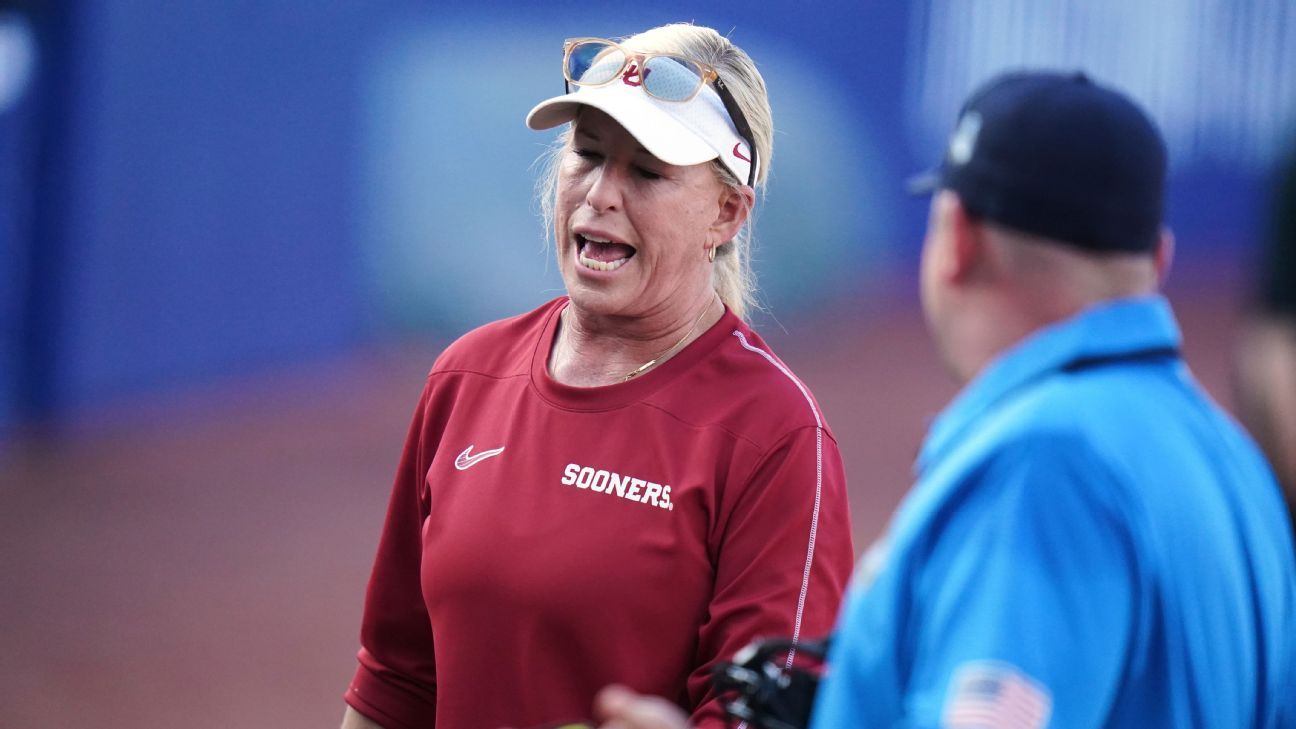
There are no new teams in this week’s poll, and the top three squads held their places. After a week of blowout wins (that we will get to below), Oklahoma jumped Nebraska for the No. 4 ranking. Alabama and UCLA also edged closer to the top of the table. For now, there hasn’t been much of a shakeup, but with still-undefeated Tennessee playing also-ranked LSU in a three-game series, perhaps this week could be a chaotic one for the best team in the nation.
Player to watch
Kendall Wells, C, Oklahoma
Oklahoma’s offense, as we’ll get to below, has been on fire this season, and Wells has been just as responsible for its performance as anybody. The catcher already has a whopping 15 home runs on the season. For reference, Oklahoma’s next opponent, North Texas, has 19 home runs on the season…as a team.
Top moment
WHAT A NIGHT 🤩
The Sooners scored 21 runs in a singular inning!#NCAASoftball x 🎥 SECN+ / @OU_Softball pic.twitter.com/80cT5DjQZz
— NCAA Softball (@NCAASoftball) March 1, 2026
In the third inning of a 29-6 win over Alabama State on Saturday, Oklahoma drove in a stunning 21 runs, the second-highest single-inning run total in NCAA softball history. The historic frame included two grand slams and 24 plate appearances.
Game to watch
No. 1 Tennessee vs. No. 16 LSU
6 p.m. on Friday (SEC Network+)
Undefeated Tennessee has already notched five wins against ranked opponents this season and will look to continue that streak in a three-game series against LSU that begins on Friday. The Tigers, on the other hand, have lost their only two ranked matchups–in a tight loss to Duke and a shutout against UCLA. Can they get a statement win against the Lady Vols?
How to watch
Everything college softball on ESPN, ESPN2, ESPNU, SEC Network, ACC Network, Big 12 Now on ESPN+, ESPN3, ESPN+, SEC Network+ and ACCNX is accessible here, in addition to being available on the ESPN App.
What’s the full schedule?
You can check out the complete scoreboard here to stay up to date this spring.
Subscribe to ESPN | Stream college softball on ESPN
Week 4 Top 25
Here is the ESPN.com/USA Softball Collegiate Top 25 ranking, plus each team’s record and next game.
All times Eastern.

1. Tennessee
Previous rank: 1
Record: 19-0
Next game: Tuesday vs. Belmont, 5 p.m., SEC Network+

2. Texas Tech
Previous rank: 2
Record: 22-1
Next game: Friday at Houston, 7 p.m., ESPN+

3. Texas
Previous rank: 3
Record: 19-1
Next game: Friday at South Carolina, 6 p.m.

4. Oklahoma
Previous rank: 5
Record: 19-2
Next game: Tuesday at North Texas, 7 p.m., ESPN+

5. Nebraska
Previous rank: 4
Record: 14-5
Next game: Thursday vs. South Dakota State, 5 p.m., Big Ten Plus

6. Alabama
Previous rank: 7
Record: 20-0
Next game: Friday at Ole Miss, 7 p.m., SEC Network+

7. UCLA
Previous rank: 9
Record: 18-3
Next game: Friday vs. Wisconsin, 10 p.m.

8. Florida
Previous rank: 6
Record: 23-1
Next game: Saturday vs. Missouri, 1 p.m., SEC Network+

9. Arkansas
Previous rank: 8
Record: 19-1
Next game: Friday vs. Georgia, 7 p.m., SEC Network+

10. Florida State
Previous rank: 10
Record: 17-4
Next game: Wednesday vs. Jacksonville University, 4 p.m.

11. Virginia Tech
Previous rank: 12
Record: 16-2
Next game: Thursday vs. Michigan, 6:30 p.m.

T12. Georgia
Previous rank: 11
Record: 17-5
Next game: Wednesday vs. Georgia State, 6 p.m., SEC Network+

T12. Oklahoma State
Previous rank: 16
Record: 15-5
Next game: Tuesday vs. Missouri State, 7 p.m., ESPN+

14. Arizona
Previous rank: 14
Record: 17-5
Next game: Thursday vs. BYU, 8 p.m., ESPN+

15. Texas A&M
Previous rank: 15
Record: 15-7
Next game: Wednesday vs. Louisiana Tech, 7 p.m., SEC Network+

16. LSU
Previous rank: T17
Record: 17-4
Next game: Friday at Tennessee, 6 p.m., SEC Network+

17. Mississippi State
Previous rank: 19
Record: 18-2
Next game: Wednesday at UAB, 6 p.m., ESPN+

18. Oregon
Previous rank: T17
Record: 13-6
Next game: Wednesday at Oregon State, 9 p.m., ESPN+

19. Stanford
Previous rank: 13
Record: 11-6
Next game: Friday vs. Pitt, 9 p.m.

20. Virginia
Previous rank: 21
Record: 19-1
Next game: Tuesday at Radford, 2 p.m., ESPN+

21. Arizona State
Previous rank: 23
Record: 19-3
Next game: Friday vs. Utah, 8 p.m., ESPN+

22. Washington
Previous rank: 24
Record: 15-6
Next game: Tuesday vs. Seattle, 9:30 p.m., Big Ten Plus

23. Grand Canyon
Previous rank: 25
Record: 22-0
Next game: Thursday vs. Wisconsin, 5 p.m.

24. South Carolina
Previous rank: 22
Record: 15-6
Next game: Friday vs. Texas, 6 p.m.

25. Duke
Previous rank: 20
Record: 12-9
Next game: Friday at Cal, 5 p.m.
- Coach Hesson, Aqib Javed interfered in selection matters: sources.
- Dar complains 20 players selected, but captain, coach chose wrong 15.
- Salman Agha showed no resistance on selection matter, says Dar
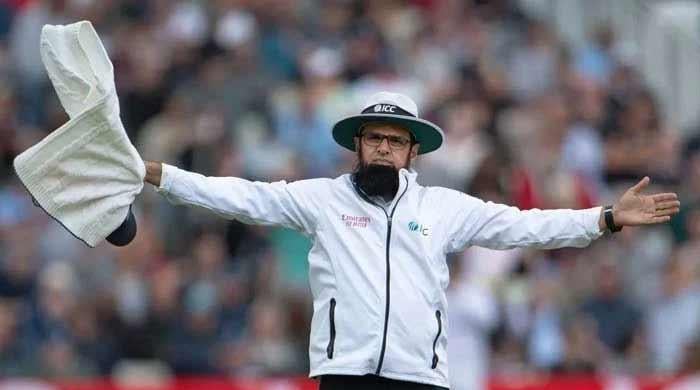
KARACHI: Following Pakistan’s poor performance in the Super Four stage of the ICC Men’s T20 World Cup and the team’s exit from the event, a member of the national selection committee, Aleem Dar, has decided to resign.
According to highly reliable sources, the ICC Elite Panel umpire stepped down due to extraordinary interference in selection matters by head coach Mike Hesson and the silence of the influential selection committee member Aaqib Javed.
Aleem Dar complains that selectors had announced Pakistan’s best 20 players, but then the captain and coach chose the wrong 15, followed by incorrect selections in the playing XI. As a result, selectors are left only to face criticism.
During the ICC Men’s T20 World Cup, Aleem Dar had expressed reservations over the inclusion of former captain Babar Azam and all-rounder Shadab Khan in the squad despite their lack of performance. However, Captain Salman Ali Agha, who, according to Aleem Dar, did not even merit a place in the squad as captain along with Aaqib Javed, showed no resistance. Coach Mike Hesson openly had the final say in selection matters.
Aleem Dar had also proposed that experienced wicketkeeper Mohammad Rizwan should be played at number six instead of wicketkeeper Usman Khan. His stance was that if Shadab and Babar could be part of the team despite their underperformance, then Mohammad Rizwan also deserved another opportunity.
In the current circumstances, Aleem Dar’s resignation is being viewed as a principled decision. He believes that Allah has granted him great respect through cricket, and he does not wish to work as a puppet; therefore, it is better for him to step down.
Premier League soccer is stuck.
The last time the league felt stuck like this was about a decade ago. Despite TV revenues that were lapping the rest of Europe, the best Premier League teams — how can I put this? — stunk.
The league offered nothing unique from a tactical or talent perspective. The best soccer was being played in Germany, Spain, and even Italy. The likes of Bayern Munich, Real Madrid, Barcelona, and Juventus were, inarguably, better than anyone in England. As if to prove the point, Leicester City went out and won the Premier League in 2016.
The following season was the first with Jürgen Klopp and Pep Guardiola in England, and all the problems were almost immediately solved. Liverpool and Manchester City quickly became two of the best teams in the world, and they both did it through compelling risk-forward soccer: Man City by attempting to dominate possession to a degree we’d never seen outside of continental Europe, Liverpool through their vertical, high-pressing “heavy metal football.”
Everyone else was forced to adapt or die, and the next 10 years may have been the peak of English soccer: an era that married technical and physical skill with on-field results. The teams were great — and they were great to watch.
The solution to the Premier League’s rut isn’t as clear this time around, though. Back then, Premier League teams were rich, and all they had to do was hire the guys who built the better soccer that was being played elsewhere in Europe. Now, though, the Premier League teams are rich — and, as we’ve seen in the Champions League, they’re better than everyone else in Europe. And the game has been overwhelmed with set plays in a way I didn’t envision happening — even when I warned about it back in October.
Through 28 weeks, Premier League teams have combined for 505 open-play goals — the fewest since the 2020-21 pandemic season. And if we remove that one season in the history of England’s top flight when there were no fans in the stands, then this is the lowest-scoring season from open play since 2009-10.
Teams have only put 1,659 open-play shots on target so far this season — by far the lowest in Opta’s 17-season dataset, and 300-plus shots fewer than in either of the past two seasons.
Prefer pretty passing to goalmouth action? Well, you’ve been bored to death this year, too: teams have completed 48,248 open-play passes in the attacking third. That’s the lowest since 2011-12 and nearly 10,000 fewer than we saw either last year or the year before.
The best soccer teams in the world have landed on a style of soccer that eschews most of the things most people love about the sport: risky, intricate passing patterns and shots on goal.
Fixing this — and it needs to be fixed, unless you think soccer is the most popular sport in the world because “watching a lot of corner kicks” is our universal language — will require rule changes and new modes of on-field enforcement. But it will also require a coach or a club willing to do something that might break the sport free of its current stalemate.
To any prospective trailblazer out there, I have a suggestion: Do something no one else is doing right now and fully embrace the back three.
– Top 50 USMNT players of 2026, ranked by club form
– Do Premier League summer transfers need more patience?
– Premier League Power Rankings: Chelsea up, Liverpool down
Why nobody plays a back three
Wait, wait — where are you going?
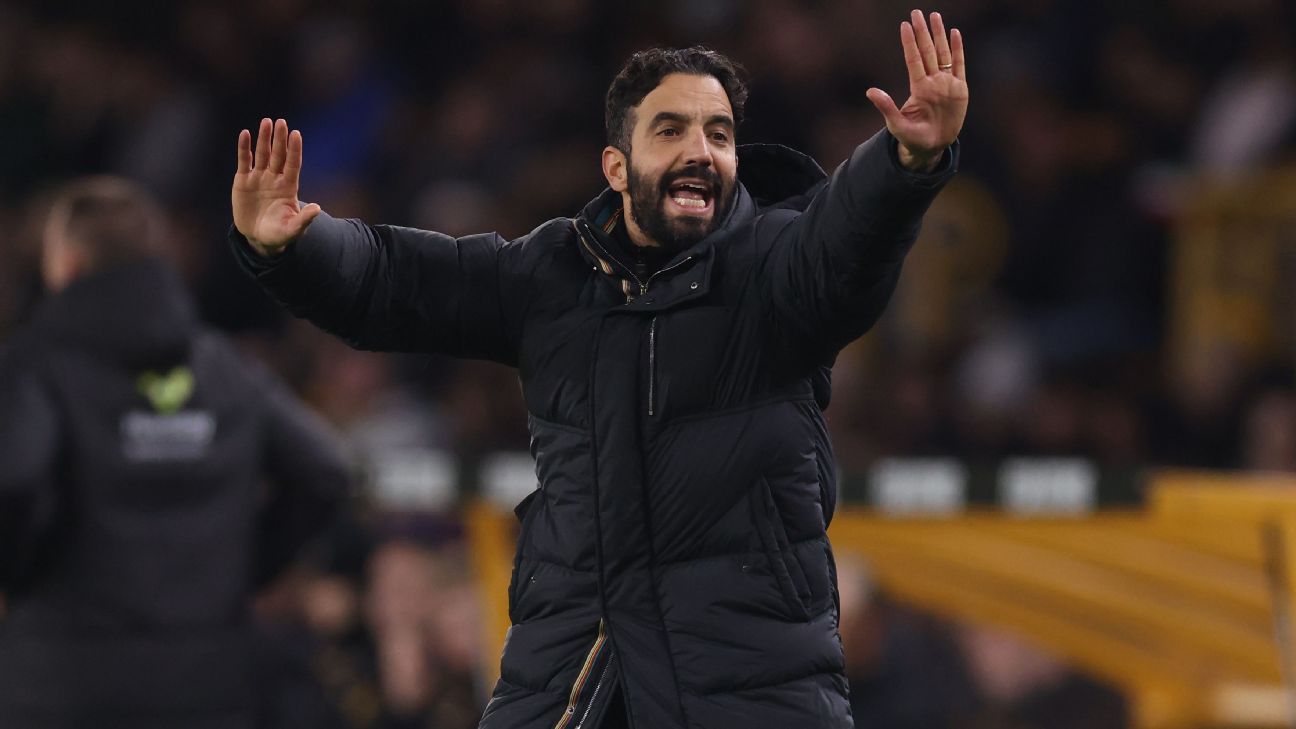
“Um, your big idea is that more coaches and clubs should do what, uh, Ruben Amorim was doing before he got fired? Have you seen Manchester United’s record since they stopped playing with a back three?”
First off, Amorim had the team in sixth place when he got fired. Plus, I’d argue that Manchester United were the one team in the league that was actually playing risk-taking, wide-open soccer. Their matches featured a ton of shots — at both ends of the field. It’s not like he got fired because the team wasn’t doing well. He got fired because he was a pain to work with, as his pre-firing news conference made clear.
“Well, he was a pain to work with because he refused to play anything other than his stupid back three!”
That brings us to the main problem with quantifying the effect of playing with a back three: so many people have given it a bad reputation.
Back in 2022, soccer data analysts Pascal Bauer, Gabriel Anzer, and Laurie Shaw wrote a fantastic paper titled “Putting team formations in association football into context” for the Journal of Sports Analytics. Bauer works for the German FA, Anzer with RB Leipzig, and Shaw recently joined Liverpool after leaving City. These are three of the more accomplished and refined analysts in the sport, and it’s obvious in the paper.
Formation notations, of course, are largely meaningless. Games are dynamic, player movement is fluid and unpredictable. “No 4-4-2s are created equal” and all that. So, to define a team’s formation, the trio looked at how a team positioned their players in the buildup phase — once they’ve settled possession, the opposition has settled into its defensive shape, and the challenge becomes: “How do we move the ball up the field?”
By using tracking data from seven Bundesliga seasons, they identified that most teams tend to build up with either two or three defenders as the deepest line of players — the former indicating a back four, the latter indicating a back three. Most teams also defended the buildup phase with either a back four or a back three. They compared the success of the various formations against each other by looking at the average expected goals created in each matchup.
“The conclusion is that the three-defender build-up formation appears to be more easily countered than the two-defender formation while showing less of an upside benefit against other formations,” they wrote. “Building up with two defenders is significantly more popular amongst Bundesliga teams than building with three defenders; our results indicate that the latter does indeed appear to be a weaker option.”
The one caveat to their findings, the authors note, is that if there were a preference among stronger or weaker teams to favor a certain buildup structure. The paper was published in March 2023, and the back four was the formation of choice at Bayern Munich, who would win their 11th-straight title just a few months later.
And a year after that, the Bundesliga winner could go undefeated for the first time ever — except, this time, it wasn’t Bayern Munich. It was Xabi Alonso’s Bayer Leverkusen, and they played with a back three.
Want to overachieve? Play a back three
Over the past 10 or 15 years, if a team has overachieved, they were probably playing back three.
Who has been the biggest overachiever in the Champions League over the past five years? Inter Milan’s annual revenues usually make them the 13th or 14th richest team in the world, and they’ve made it to two of the past three finals in the European cup — something no other team in the world can say.
The most surprising Champions League winner of the past 10 years? Frankly, the only surprising Champions League winner of the past 10 years? That would be Chelsea in 2021 — the same season they fired Frank Lampard and finished in fourth place in the Premier League. When Thomas Tuchel was brought in to replace Lampard midseason, what did he do? He switched to a back three. Oh, and the last time Chelsea won the Premier League, in 2017? They played a back three.
When RB Leipzig made a run to the Champions League semifinals in 2020, they were playing a back three. Remember how Atalanta used to flirt with Serie A titles every season? For most of that time, they played a back three.
How about when Sheffield United finished in ninth place a season after being promoted? A back three. Heck, remember when Tottenham Hotspur used to challenge for Champions League places instead of fending off a place in the Championship? The last time they finished top four, they were playing a back three.
But it’s not only upstarts catching everyone else off guard. Juventus used to win Serie A every year and make deep runs in the Champions League. And while their recent decline has much more to do with blatant corruption and club mismanagement than the formation they play, they’ve also moved away from the back three that brought them so much success.
And what about maybe the best team we’ve ever seen, the 2022-23 Manchester City side that won the treble? They caught Arsenal and everyone else once Guardiola shifted into something like a back three, where they’d play four defenders — Rúben Dias, Nathan Aké, one of Manuel Akanji and Kyle Walker, and John Stones — and then Stones would step into the midfield in possession. The outside backs would then pinch in, rather than running forward.
Here’s what their pass map looked like in the first half of the Champions League final against Inter Milan:
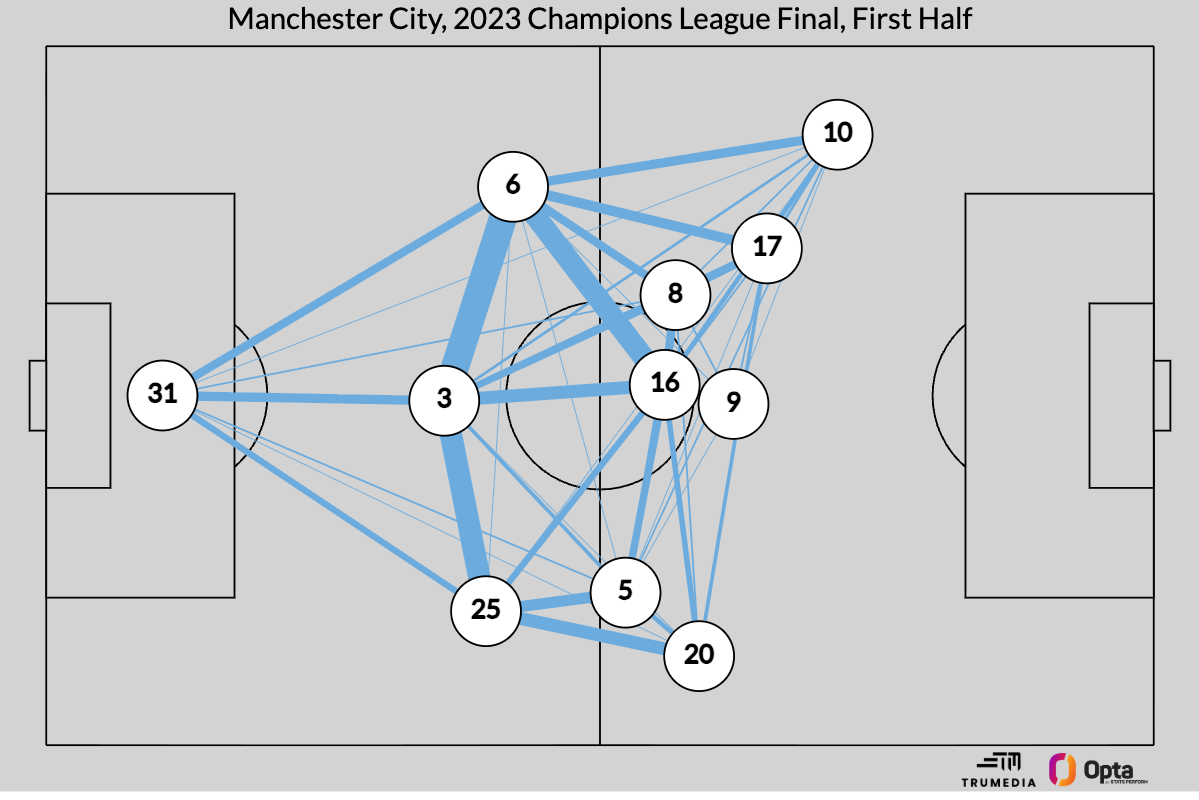
It’s been good enough to win the treble, make multiple Champions League finals, and go undefeated in the Bundesliga, but it’s still not good enough for anyone in the Premier League … yet.
Why it’s time for the Premier League to embrace the back three
Per Opta’s designations, here’s the frequency with which every formation has been used in the league since 2009:
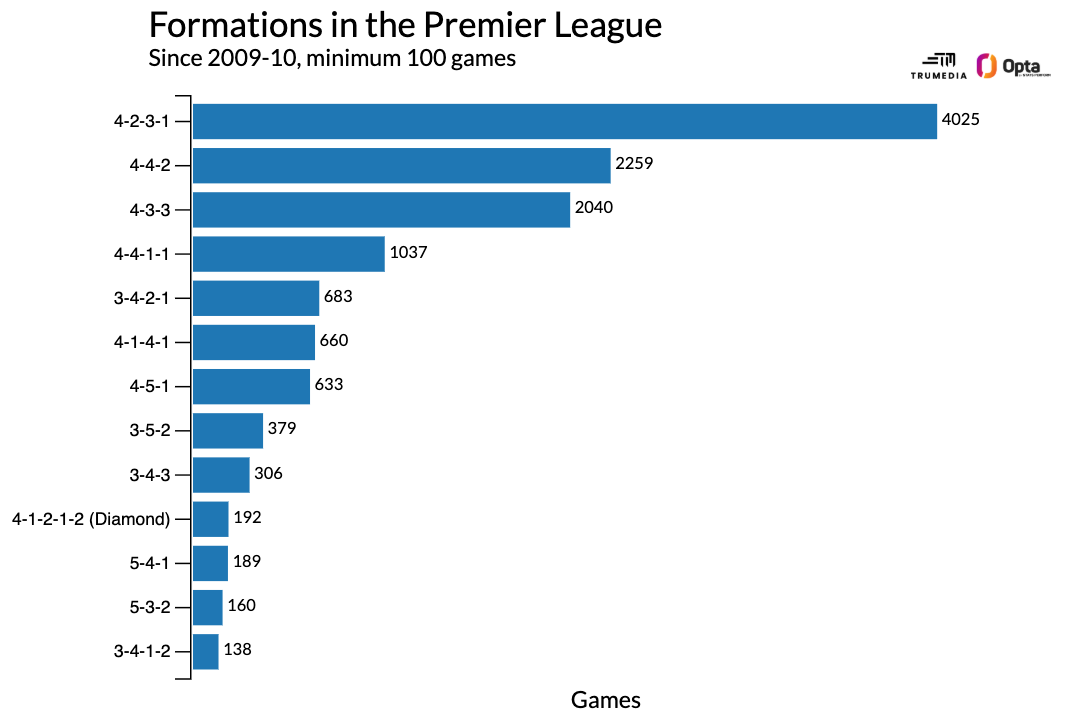
Formations are fluid and not all built the same, so plenty of caveats apply, but it’s clear that the back four, in its three different guises — first the 4-4-2, then the 4-2-3-1, followed by the 4-3-3, and now back to the 4-2-3-1 — is king.
And, well, the results would seem to support these choices. Here’s the collective goal differentials of all of those formations:
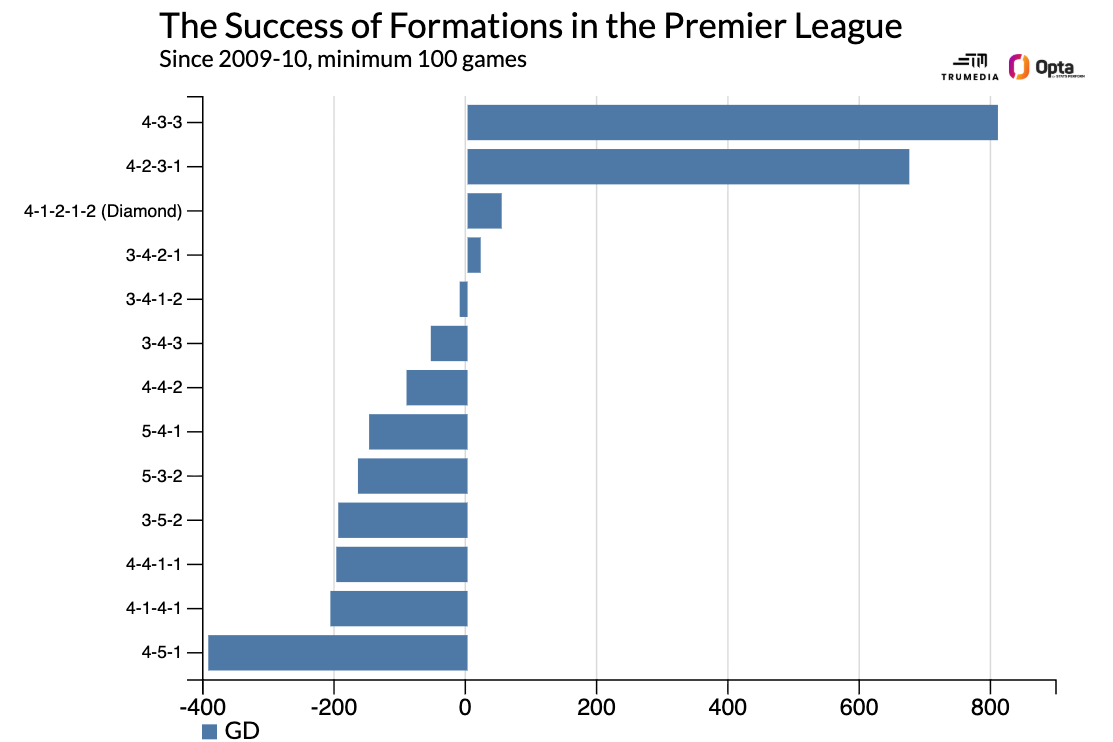
But as the authors of the Bundesliga study asked, how much of that is because of the true efficacy of the back four and how much of that is simply because the best teams in the Premier League happen to play with a back four?
Now, I think we should give the likes of Guardiola and Klopp some credit — that they, and other top managers, favored back fours because it was a more effective base arrangement to build from. And I think it probably was. If you were able to pin the ball high up the field, circulate possession up, back, around, and through your opponent, and only have to occasionally snuff out counter-attacks, then it made sense for you to only have two nominal centerbacks on the field.
To be an utterly dominant team like Manchester City and Liverpool were — or Bayern Munich are — then the back four is probably the optimal arrangement. Why? Simply because it puts more attack-first players on the field and asks fewer players to cover the areas you’ll occasionally need to defend.
But the Premier League has changed. Guardiola complains about it every week: everyone is more athletic and everyone can man-to-man mark your players now. The best clubs don’t necessarily have more elite talent than they had five or seven years ago, but the rest of the Premier League is gobbling up the types of players who would’ve played for Borussia Dortmund and AC Milan back then.
As such, these teams can’t be pressed off the field as easily as they were in the past. (Plus, the top teams are playing so many games that Klopp-style gegenpressing might be a physical impossibility anyway.) And when they do get pinned back, the quality of the players who are “parking the bus” is way higher than it used to be, as is the quality of the players who will launch the occasional counter-attack out of the deep block.
That all leads to where we are now: the ball rarely ends up near the goal, and the only way you can consistently score goals is from set pieces. Liverpool’s season was on the brink of falling apart, then they fired their set piece coach, scored seven set piece goals in a row, and now they’re three points back of third. This is just how it works right now — and it’s not fun.
The game is screaming out for someone to try something different — and to me, that’s where the value of a top team switching to a back three lies: it’s different. It may not have been the optimal approach when you needed 90 points to win the league, but it seems clear that the league has figured out how to negate the front-foot 4-3-3 or 4-2-3-1 style that the best teams in the Premier League have favored over the past decade. At the very least, the back-three base would create new angles that the rest of the league isn’t used to seeing.
Doing something different, too, would create all kinds of advantages in team-building.
These are the four hardest roles to fill in the sport: (1) a ball-playing centerback who is athletic enough to play in a high line but also big enough to dominate in the air, (2) a technically skilled fullback with the physical capacity to cover an entire sideline, (3) a defensive midfielder who can cover all the space behind the attackers and help progress the ball up the field, (4) and a goal-scoring, ball-dominant winger. They’re cheat codes for a back-four system. And at a given moment, there might be five of each of these players in the world.
To acquire one of these guys, you have to get really lucky and, say, happen to have a stadium in the same town that Trent Alexander-Arnold was born in, or you have to spend hundreds of millions of dollars in transfer fees just for the chance of acquiring one of them.
But what if you could play in a way where you didn’t have to chase any of those player types? Wouldn’t that be a massive advantage on the transfer market?
In, say, a base 3-5-2 system, none of those roles are really necessary. With three center backs, you’re not asking one or two guys to cover an entire half of the field by themselves. The wingbacks don’t have quite the same defensive responsibilities as top-level fullbacks. The midfielders need not be as rangy since there’s more defensive support behind them. And the attacking onus shifts more toward strikers and attacking midfielders, rather than wide forwards.
(In case you’re wondering: yes, Liverpool’s current and future personnel feel particularly suited for this approach.)
While Amorim’s devotion to the back three made it seem like the least flexible formation in the world, it should be way more flexible than the way we’re used to seeing top teams play. When you have those skeleton-key type roles, then you need to have those players on the field, playing those roles. But the 3-5-2 should be infinitely customizable, and it seems like it would better fit the new mold of front-office-driven team building, where some clubs try to identify undervalued players and then task the manager with figuring out how to piece it all together.
If you’re playing a top team, then maybe one of the front two is an attacking midfielder, and that allows you to clog the middle of the field and control the ball. Against lesser opposition, you can drop the midfielder into the midfield three and play with two actual strikers. The same goes for wingbacks. If you’re chasing the game or are expected to have lots of possession, you can just play an actual winger in that role.
Need more solidity? Then throw in a more traditional fullback. It’s true with the center backs, too. Three bigger center backs can solidify the defense, but you can play around by dropping a midfielder or a fullback into one of the outside centre-back slots. Different players will interpret the roles differently and change the overall dynamic.
Formations are just telephone numbers, as Guardiola has said. Picking your starting formation isn’t coaching or tactics — developing a style of approach, a relationship between your players, and an overall appetite for risk is what matters. Regardless of the formation you play, soccer will always be about creating space, controlling space, and exploiting space.
At least for now, though, there just isn’t much space in the Premier League, save for the moments when a guy can launch a long throw-in with his hands from the sideline or whip in a cross from the corner flag. It won’t last forever, but if it’s going to change, somebody is going to have to start doing something different.
Somebody, please, try winning some games by playing a back three.


Jurickson Profar suspended for 162 games after failing drug test for second time

A Possible US Government iPhone-Hacking Toolkit Is Now in the Hands of Foreign Spies and Criminals

College softball rankings: 2026 NCAA Week 4 Top 25 poll

-

 Politics6 days ago
US arrests ex-Air Force pilot for ‘training’ Chinese military
-
 Business7 days ago
Households set for lower energy bills amid price cap shake-up
-

 Politics5 days ago
What are Iran’s ballistic missile capabilities?
-

 Sports6 days ago
Sri Lanka’s Shanaka says constant criticism has affected players’ mental health
-
 Business7 days ago
Lucid widely misses earnings expectations, forecasts continued EV growth in 2026
-

 Sports1 week ago
Top 50 USMNT players of 2026, ranked by club form: USMNT Player Performance Index returns
-

 Fashion7 days ago
New Zealand’s apparel imports steady at $1.2 bn in 2025
-

 Fashion5 days ago
Policy easing drives Argentina’s garment import surge in 2025