

Entertainment
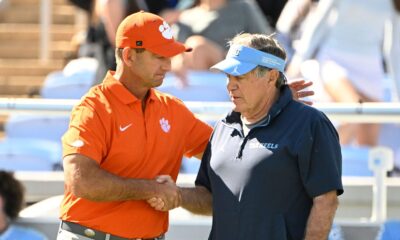
Bill Belichick’s college coaching debut one to forget as North Carolina is pummeled by TCU

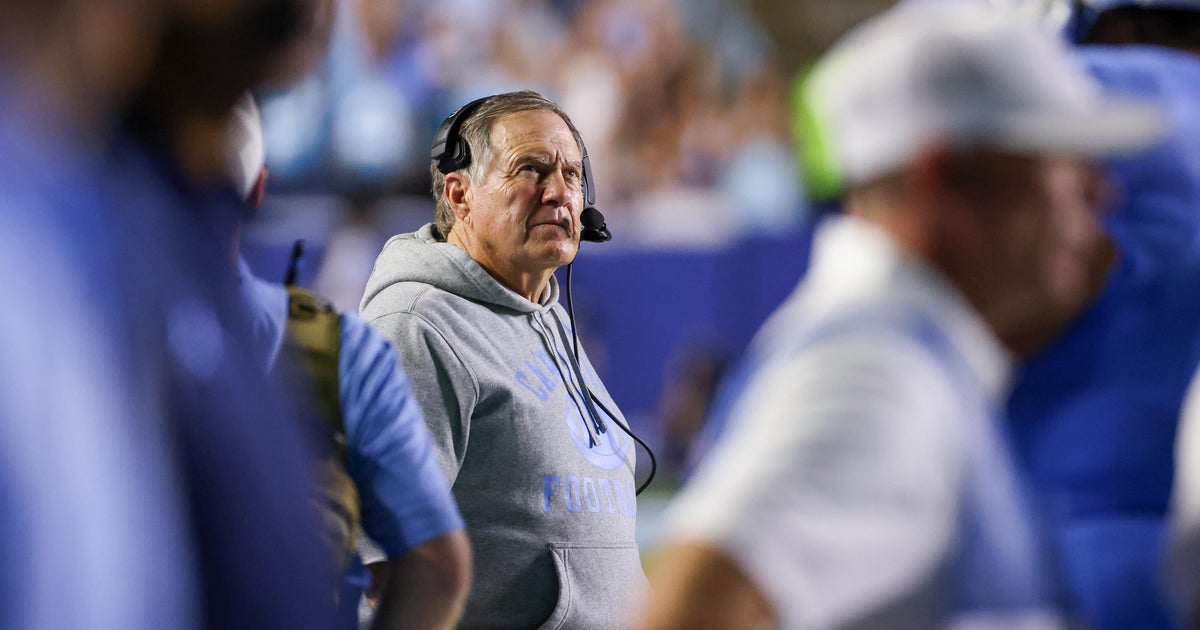
Chapel Hill, N.C. — North Carolina’s high-point moment in its first game under coach Bill Belichick came early.
A festive pregame atmosphere led to a roar from the crowd at kickoff. And a season-opening drive moved at a crisp pace to the end zone.
After that, well, Monday night’s hyped-up debut turned into a romp by TCU – along with a reminder that even an NFL icon with six Super Bowl titles as a head coach can’t just magically turn the Tar Heels into winners after decades of also-ran status.
“We played competitively but then just couldn’t sustain it,” Belichick said in the familiar low tone from his NFL news conferences after the 48-14 loss. “Obviously, we have a lot of work to do. We need to do a better job all the way around – coaching, playing, all three phases of the game.”
Nicholas Faulkner / Icon Sportswire via Getty Images
CBSSports.com’s Shehan Jeyarajah points out that, “The NFL is generally a defensive league where teams are close to evenly matched. At the college level, Belichick will come to understand just how big the talent differentials are between the good and bad teams — and he was on the wrong end.”
The blowout put a major damper on a night buzzing with optimism for the 73-year-old Belichick’s college debut, only to see the Horned Frogs dominate so thoroughly they drove UNC fans to the Kenan Stadium exits by midway through the third quarter.
“It was a great environment tonight,” Belichick said. “I mean, the fans were awesome. There was great energy in the stadium. We just didn’t do enough to keep it going. We’ve got to play better for the energy to be sustainable.”
By the end of the game, Kenan was a ghost town and the Tar Heels had given up more points than in any previous opener in their history, according to Sportradar.
It was a jarring result, even amid uncertainty as to exactly what to expect from UNC with roughly 70 new players between transfers and incoming recruits. There were few highlights after that opening drive beyond Kaleb Cost’s athletic reeling in of a deflected ball for an interception and quarterback Max Johnson returning in relief from a serious leg injury sustained in last year’s opener at Minnesota.
“We’re just moving forward, just moving forward,” said Cost, offering an unintentional callback to Belichick’s famous “We’re on to Cincinnati” response to reporters’ questions after a blowout loss to the Kansas City Chiefs in 2014.
UNC was picked to finish eighth in the 17-team Atlantic Coast Conference, though that seemed almost entirely predicated on Belichick’s mere presence. This is a man, after all, who teamed with legendary quarterback Tom Brady to win six world titles in his 24-year run with the New England Patriots. Someone who won more regular-season and playoff games in the NFL (333) than anyone other than Don Shula.
So there was spectacle to Belichick’s debut as he took the field sporting a familiar look from the pro sideline with a gray hoodie – only this one bearing the name “Carolina Football” in that distinctive shade of light blue.
An estimated 5,000 fans packed onto a main campus quad for a pregame concert and throngs lined the team’s walk to Kenan, where UNC has sold out all its season tickets – at an elevated price with Belichick’s arrival – and single-game seats for the season. The game attracted ESPN to hold a pregame studio show from the sideline with a crew that included former Alabama coach Nick Saban, with Belichick popping over briefly to say hello.
There were notable former UNC athletes from years past, including NBA legend Michael Jordan – who won a national championship under Dean Smith here in 1982 – and former UNC star linebacker Lawrence Taylor, who played under Belichick when he was an assistant and eventually defensive coordinator with the New York Giants during the 1980s.
And it wasn’t hard to spot Jordon Hudson – Belichick’s 24-year-old girlfriend who has generated her own tabloid-level curiosity – as she walked the pregame sideline sporting Carolina blue pants shimmering with sequins-like additions on the legs.
Jared C. Tilton / Getty Images 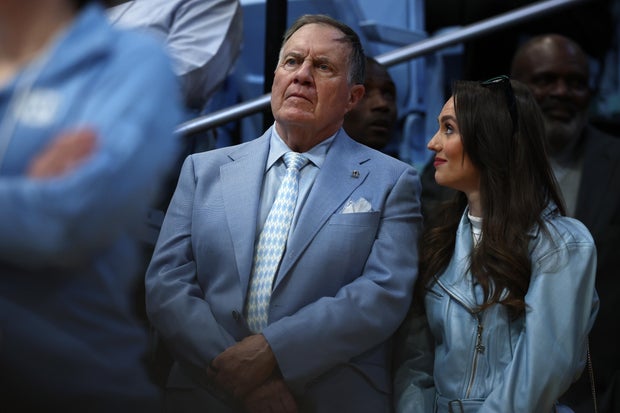
Belichick roamed the field during pregame warmups for the better part of a half-hour. At one point, he stood on the UNC end of the field with general manager Michael Lombardi, then shared a quick handshake with ACC commissioner Jim Phillips as he made his way toward midfield.
Once there, Belichick shook hands with members of the officiating crew and watched the Horned Frogs warm up.
The Tar Heels got off to a sprint of a start with an 83-yard drive that ended with Caleb Hood scoring through the right side from 8 yards out, followed by forcing a quick punt. But things soon started getting away.
TCU – which lost in a similar scenario as the “other” team in Deion Sanders’ debut at Colorado two years ago – never looked rattled or thrown. Bud Clark provided a highlight by jumping Gio Lopez’s sideline throw for an easy 25-yard pick-six as TCU took a 20-7 lead into the break.
It quickly got worse after halftime. Kevorian Barnes sprinted through the right side and down the sideline for a 75-yard touchdown on the first snap. Trent Battle added his own big run, slipping through the left side untouched and going 28 yards for a TD.
And finally, Devean Deal had a 37-yard scoop-and-score on Lopez’s fumble to make it 41-7 and start the Kenan exodus.
By the end, UNC had just 222 total yards, 320 fewer than TCU, and a short week to fix problems before visiting Charlotte on Saturday.
“They were clearly the better team tonight,” Belichick said. “They deserved to win and they did it decisively.”



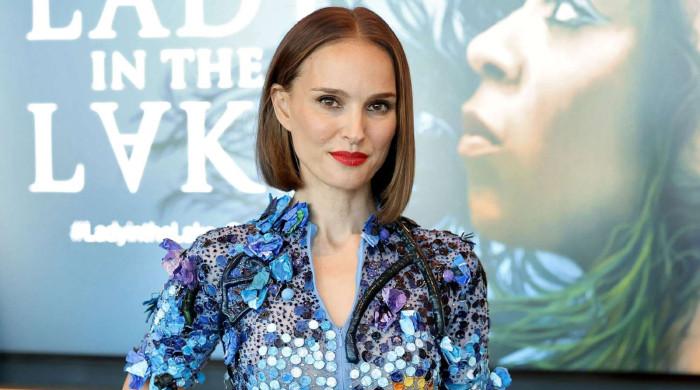
Natalie Portman has carried her monthly book club into 2026, with the same goal she started with – to cultivate empathy and understand different perspectives of people from different parts of the world.
The 44-year-old actress launched her book club, named Nat’s Book Club, in 2021 and readers from all walks of life, including fellow A-listers ,join her in reading literary masterpieces every month.
The Black Swan star has revealed her first book pick of 2026, which is a horror mystery called Strange Pictures by YouTuber Uketsu. The book has an experimental format with interconnected pictures which readers are free to interpret to form a story as they like.
The reading group’s past picks include memoirs like Malala Yousafzai’s Finding My Way and Amanda Nguyen’s Saving Five, as well as Crying in H Mart by Michelle Zauner and novels like Claire Keegan’s Foster, and Kaveh Akbar’s Martyr!.
Speaking about starting the initiative, Portman previously noted, “I believe that reading books is one of the first ways we start practicing empathy. We feel for characters in stories as we might for ourselves or our own friends. Whenever we imagine someone else’s life — their hopes and fears, their feelings and thoughts — we are practicing empathy.”
Besides the V for Vendetta star’s book club, this year has started with her nomination as the Worst Actress of the year, for her role in the action adventure film Fountain Of Youth, in the parodic award ceremony, Razzies or the Golden Raspberry Awards.
Entertainment
Sundance Film Festival 2026 opens for its final year in Park City, Utah. Here are some of the highlights.

The Sundance Film Festival, America’s leading showcase for independent narrative and documentary films from the United States and around the world, opens its 2026 edition on Thursday. This year’s festivai presents nearly 100 features through Feb. 1, in-person in Utah and online.
This year’s program includes dramatic films with stars including Natalie Portman, Channing Tatum, Dustin Hoffman, Seth Rogen, Olivia Wilde, Chris Pine, Ethan Hawke, Keegan Michael-Key, and Charli XCX. There’s also a lineup of documentaries whose subjects include singers Courtney Love and Marianne Faithfull, tennis legend Billie Jean King, author Salman Rushdie, and topics like artificial intelligence, summitting K2, and children competing to sell the most Girl Scout cookies.
The festival’s screenings will be held in-person in Park City and Salt Lake City, Utah, while online screenings will be accessible for audiences across the country beginning Jan. 29. There will also be short film programs, experimental and episodic works, and conversations and panel discussions with filmmakers and Sundance alumni. [Click here for ticket information.]
This year’s Sundance Film Festival is the last to be held in Park City. The festival — which originated in 1978 as the United States Film Festival, before being taken over by the Sundance Institute — has outgrown its location and will be held next year in Boulder, Colorado.
This also marks the first festival to be held since the passing of Robert Redford, who helped shape the festival into a champion for independent filmmakers and creatives from marginalized communities.
Amanda Kelso, acting CEO of the Sundance Institute, said, “The 2026 Sundance Film Festival will be a truly pivotal and memorable moment as we celebrate artists and their visionary works, honor our Sundance Institute founder, Robert Redford, and his transformative vision, and show our gratitude to Utah by commemorating our collective journey.”
Part of that commemoration is through retrospective screenings of some of the biggest hits to have come out of Sundance, from “Little Miss Sunshine” to “Half Nelson,” starring Ryan Gosling.
As a sign of how far the festival has come, this year’s program was selected from more than 16,200 submissions, including 4,255 feature-length films, from 164 countries or territories. Jury prizes will be awarded in the categories of domestic and international narrative and non-fiction films, shorts, and the NEXT sidebar (which promotes innovative approaches to storytelling).
There are also Audience Awards, which in the past have gone to such films as “sex, lies and videotape,” “Hoop Dreams,” “Whale Rider,” “Hustle & Flow,” “Once,” “Searching for Sugar Man,” “Fruitvale Station,” “Whiplash,” “CODA,” and “20 Days in Mariupol.”
The following is a small selection of the festival’s offerings, most of which are premieres, and many of which are still seeking theatrical distribution.
Documentaries
Among the nonfiction offerings at Sundance this year are profiles of author Salman Rushdie, and how he survived a 2022 assassination attempt (“Knife: The Attempted Murder of Salman Rushdie”); singer, songwriter and actress Courtney Love, who prepares for her first new music release in a decade, in “Antiheroine”; chess prodigy Judit Polgár (“Queen of Chess”); and centenarians and the always-changing titleholder of “The Oldest Person in the World.”
“Broken English” is a genre-twisting tribute to Marianne Faithfull, who died a year ago, and features Tilda Swinton, George MacKay, Nick Cave, Suki Waterhouse and others painting a portrait of the singer-songwriter.
Justice, civil rights and equality are the themes of “Who Killed Alex Odeh?” about the search for truth in the 1985 California bombing that killed a prominent Palestinian American activist; “Everybody to Kenmure Street,” in which hundreds of residents in a Scottish neighborhood fight off a deportation raid affecting their neighbors; “Soul Patrol,” a history of the first Black special operations team of the Vietnam War; and “Sentient,” an investigation into laboratory research on primates.
Sundance Film Festival
“Troublemaker” draws on recordings of Nelson Mandela to recount the struggle against apartheid in South Africa. In “When a Witness Recants,” author Ta-Nehisi Coates revisits a 1983 Baltimore murder case and discovers that three teenagers were wrongfully convicted. In “American Doctor,” three doctors from the U.S. enter Gaza and are caught between medicine and politics. International human rights lawyer Jennifer Robinson fights the use of defamation laws to silence survivors of sexual abuse in “Silenced.”
“Ghost in the Machine” examines the origins of artificial intelligence. In “The AI Doc: Or How I Became an Apocaloptimist,” co-directors Charlie Tyrell and Daniel Roher (the Oscar-winning director of “Navalny”) explore the existential dangers and promised benefits of artificial intelligence.
Environmental stories include “The Lake,” about a looming toxic catastrophe emerging from Utah’s Great Salt Lake; and “Nuisance Bear,” about a polar bear whose habitat is threatened by human expansion. In “Time and Water,” Iceland’s disappearing glaciers are but one measure of family history, memory and the elements for Icelandic writer Andri Snær Magnason.
In “To Hold a Mountain,” a single mother and her teenaged daughter, shepherds in Montenegro, fight to protect their ancestral home from becoming a NATO military training ground, while also adjusting to changing dynamics in their relationship. Shot over 10 years, Itab Azzam and Jack MacInnes’ “One in a Million” follows a girl navigating war and heartbreak as she travels from Syria to Germany, and later returns to Aleppo.
Art and media are the focus of several films: “Public Access” traces the history of the development of public access television, as it grew from a legally-required offering on New York City cable TV in the early 1970s, to a controversial battleground for free speech. “Seized” recounts the story of a newspaper in the small town of Marion, Kansas, that was raided by police, unearthing a deeper story about abuse of power, community journalism, and the fact that “deleted” text messages aren’t necessarily gone forever.
“Once Upon a Time in Harlem” brings to life footage captured by the late filmmaker William Greaves when he documented a 1972 gathering of the living luminaries of the Harlem Renaissance. Mark Cousins’ “The Story of Documentary Film” looks at the evolution of non-fiction cinema.
There are also profiles of Chicano filmmaker Luis Valdez (“American Pachuco”); pioneering lesbian filmmaker Barbara Hammer (“Barbara Forever”); and comedian Maria Bamford, whose mental health journey became part of her performances (“Paralyzed by Hope: The Maria Bamford Story,” directed by Judd Apatow and Neil Berkeley).
Sports documentaries include profiles of basketball star Brittney Griner in “The Brittney Griner Story,” which also documents her detention in Russia; and tennis great Billie Jean King in “Give Me the Ball!”
“Cookie Queens” follows four Girl Scouts as they embark on their mission: to be the top-seller of Girl Scout cookies.
In the foothills of the Himalayas, a wire on a cable car snaps, leaving eight passengers, including several schoolchildren, dangling 900 feet above a ravine awaiting rescue before the remaining cable fails. “Hanging by a Wire” captures the rush to save them. “The Last First: Winter K2” traces the fatal outcome of a race to climb the world’s second-highest mountain at the worst possible time of year.
And under less-deadly circumstances, John Wilson (the dryly satirical voice behind HBO’s “How To with John Wilson”) goes through the process of trying to sell a documentary about building materials in “The History of Concrete.”
Narrative features
Pixar veteran Andrew Stanton (“WALL-E”) directs the live-action “In The Blink of an Eye,” a trilogy of stories spanning thousands of years, from the lives of cave dwellers, to an astronaut light-years from Earth. With Rashida Jones, Kate McKinnon, Daveed Diggs, Jorge Vargas and Tanaya Beatty.
In Stephanie Ahn’s “Bedford Park,” two first-generation Korean Americans (Moon Choi, Son Sukku) develop a tender relationship while maneuvering their messy and constricting family dynamics. Chris Pine stars in “Carousel,” about a divorced doctor who is reunited with a past love.
Sundance Film Festival 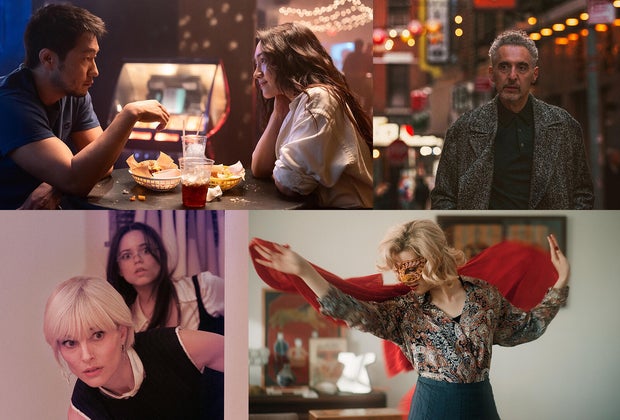
Natalie Portman, Zach Galifianakis and Da’Vine Joy Randolph star in the art world satire “The Gallerist.” In Gregg Araki’s “I Want Your Sex,” Cooper Hoffman takes a job as an assistant to provocative artist Olivia Wilde. With Chase Sui Wonders, Daveed Diggs, and Charli XCX (who also stars in “The Moment,” a mockumentary about an up-and-coming pop star preparing for her first big arena tour).
In “The Friend’s House Is Here” (which was filmed in Iran and then smuggled out of the country), two young women protect each other as they enter Tehran’s underground art scene and become targets. In “Josephine,” an 8-year-old girl (Mason Reeves) witnesses a crime in Golden Gate Park, and her parents (Channing Tatum and Gemma Chan) must help her overcome her fear and trauma.
“Chasing Summer,” from director Josephine Decker (“Madeline’s Madeline”), stars Iliza Shlesinger as a millennial who returns to her Texas hometown to reassess herself after losing both her boyfriend and her job. With Lola Tung (“The Summer I Turned Pretty”) and Garrett Wareing (“The Long Walk”).
In the comedy “The Incomer,” siblings on a remote Scottish island find an official (Domhnall Gleeson) who has come from the mainland to relocate them. Will Brill, Gillian Jacobs and Rob Lowe star in “The Musical,” about a playwright-schoolteacher who seeks revenge when his ex begins dating his school’s principal. In “Wicker,” adapted from an Ursula Wills short story, a fisherwoman (Olivia Colman) asked a basket maker (Alexander Skarsgård) to weave her a mate.
Seth Rogen, Olivia Wilde (who also directs), Penélope Cruz and Edward Norton star in “The Invite,” about a dinner party that goes south. Director David Wain (“Wet Hot American Summer”) returns with “Gail Daughtry and the Celebrity Sex Pass,” an L.A caper in which a bride-to-be looks to cash in on her “free celebrity pass” once she learns her fiancé has already claimed theirs. With Zoey Deutch, Jon Hamm and John Slattery.
Coming-of-age stories include, from the U.K., “Extra Geography,” in which two girls at a boarding school challenge themselves to fall in love with a teacher; and “Big Girls Don’t Cry,” from New Zealand, in which a 14-year-old girl undergoes a transformation of self-awareness during one summer. In “Hold Onto Me,” the debut feature from Cypriot filmmaker Myrsini Aristidou, an 11-year-old girl seeks to reconnect with her estranged father. A teenager stages a musical representing her worst high school memory in “Run Amok,” with Alyssa Marvin, Patrick Wilson, Margaret Cho and Molly Ringwald.
The criminal underworld is the setting for “The Only Living Pickpocket in New York” (starring John Turturro as a nimble-fingered hustler finding it harder to make do in a cashless world), and “The Tuner,” (starring Dustin Hoffman and Leo Woodall), in which a piano tuner discovers his auditory gifts come in handy cracking safes. In “The Weight,” starring Ethan Hawke, a prisoner at a work camp in 1930s Oregon is offered early release if he agrees to smuggle gold.
Will Poulter stars in “Union County,” about the difficulty of recovery in the midst of rural Ohio’s opioid epidemic. In the psychosexual thriller “Night Nurse,” a new caregiver at a luxury retirement community discovers some unsettling behaviors there. In “Zi,” a cross between science fiction and the supernatural from Hong Kong filmmaker Kogonada, a young woman’s life is transformed by her encounter with a mysterious stranger.
Based on true events, “The Huntress (La Cazadora)” stars Adriana Paz (“Emilia Perez”) as a woman fighting for justice in Juárez, Mexico. In Lagos, a female taxi driver develops a sisterhood with sex workers, leading to her own transformation, in “Lady.”
Midnight
The festival’s Midnight sidebar of genre films includes “Buddy,” a horror film in which a young girl and her friends try to escape a children’s television show. ‘Nuff said? How about a cast featuring Keegan-Michael Key, Michael Shannon and Patton Oswalt?
Sundance Film Festival 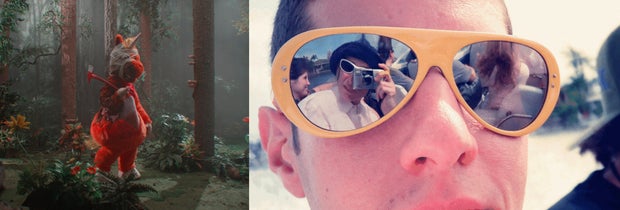
The title of “Mum, I’m Alien Pregnant” pretty much tells you what’s in store from the New Zealand directing pair of Sean Wallace and Jordan Mark Windsor (a.k.a. THUNDERLIPS). Natalie Erika James (“Relic”) directs the body horror flick “Saccharine.”
While evacuating the Palisades Fire last year, Tamra Davis uncovered recorded footage she’s made of a 1995 rock festival in Australia called Summersault, featuring such artists as Beastie Boys, the Foo Fighters, Sonic Youth, Bikini Kill and Beck. “The Best Summer” captures the performances and backstage drama of that time.
Events
Among partner events are panel discussions on such topics as “The New McCarthyism: Why Authoritarians Fear Storytellers” (Jan. 22); “Reimagining Rural America Through Storytelling” (Jan. 23); “After the Pitch – A Look Inside Developing a Studio Project” (Jan. 23); “The Future of Environmental Film” (Jan. 23); “The Art of Casting for Independent Film” (Jan. 23); and “How AI Is Evolving Storytelling with Flow from Google” (Jan. 23).
The festival also includes retrospective screenings and restored presentations of movies, many of which first found their audience at Sundance, including “Little Miss Sunshine”; “Half Nelson,” with Ryan Gosling; “Cronos” (followed by an extended Q&A with director Guillermo del Toro); Barbara Kopple’s “American Dream”; Reginald Hudlin’s “House Party”; and Gregg Araki’s “Mysterious Skin.” Sundance will also present an archival print of one of Robert Redford’s earliest hits, “Downhill Racer” (co-starring another legend we lost last year, Gene Hackman).
More
Visit the Sundance Film Festival site at festival.sundance.org for more information about additional features, short films and other events, as well as purchasing in-person or online tickets.

The nominees for the 98th annual Academy Awards are being announced Thursday morning, with “One Battle After Another,” “Sinners,” “Marty Supreme,” “Frankenstein” and “Hamnet” each expected to potentially earn double-digit Oscar nominations.
Pundits are keeping eyes on whether “One Battle After Another” and “Sinners,” in particular — which have dominated precursor awards this season — can tie or even potentially break the record for the most overall nominations for a single film.
Currently the record stands at 14 nominations, which “Titanic,” “All About Eve” and “La La Land” all received. However, this year the Academy is also launching a new category for best casting, which should make exeeding the existing record one step easier.
When are the 2026 Oscar nominations announced?
The live Oscar nominations announcement will begin at 5:30 a.m. Pacific Time, or 8:30 a.m. Eastern.
As the AMPAS has done before, some of the categories will be revealed at 5:30 a.m. straight-up, and the remaining ones will be announced after a short break.
Who is announcing the 2026 Oscar nominations?
Actors Danielle Brooks and Lewis Pullman will host the live announcement.
Brooks was nominated for best supporting actress two years ago for the musical “The Color Purple.” Pullman, who is the son of actor Bill Pullman, previously starred in the best picture nominee “Top Gun: Maverick.”
What else could be nominated?
While the final nominations remain up in the air until the official announcement, in December, the Academy of Motion Picture Arts and Sciences issued its finalist shortlists for a dozen categories, including best documentary feature and best international feature. The latter category is expected to include a number of titles that prognosticators believe will factor into a number of top races, following the Academy’s active recruitment of international industry representatives to diversify ranks.
Many of the international movies some believe will fill out the best picture category are largely the same titles picked up by distributor Neon at last year’s Cannes Film Festival: the Palme d’Or-winning “It Was Just an Accident,” the Golden Globe-winning “The Secret Agent,” the Norwegian drama “Sentimental Value” (which many expect to also earn multiple acting nominations), and possibly also Park Chan-wook’s South Korean hit “No Other Choice” or Oliver Laxe’s “Sirāt,” the latter of which was shortlisted an eyebrow-raising five times last month.
When is the Oscar awards ceremony?
The Oscars are scheduled to be handed out on March 15 at the Dolby Theatre in Hollywood. Conan O’Brien is on deck to return as the show’s host after assuming the role for the first time ever during last year’s ceremony, at which “Anora” took home top honors, winning best picture, best director (Sean Baker), best actress (Mikey Madison), best screenplay and best editing.


Switzerland’s Richemont closes Q3 FY26 strong as sales rise 11%

Vietnam tightens grip on Canada apparel & home textile imports

President Trump formally announces Gaza Peace Board, 20 world leaders sign charter with US President

-
 Entertainment1 week ago
X (formerly Twitter) recovers after brief global outage affects thousands
-

 Politics5 days ago
Saudi King Salman leaves hospital after medical tests
-
 Sports1 week ago
Pak-Australia T20 series tickets sale to begin tomorrow – SUCH TV
-
 Business6 days ago
Trump’s proposed ban on buying single-family homes introduces uncertainty for family offices
-

 Fashion5 days ago
Bangladesh, Nepal agree to fast-track proposed PTA
-

 Tech7 days ago
Meta’s Layoffs Leave Supernatural Fitness Users in Mourning
-

 Tech1 week ago
Two Thinking Machines Lab Cofounders Are Leaving to Rejoin OpenAI
-

 Tech5 days ago
Petlibro Offers: Cat Automatic Feeders, Water Fountains and Smart Pet Care Deals