

Business
Brain implants, falling Tesla sales and a $1tn deal: A year in the life of Elon Musk


Elon Musk is rarely out of the spotlight. But, even by his standards, 2025 has been a full-on year.
Over the past 12 months, the entrepreneur-turned-government adviser has reached massive business milestones and suffered serious setbacks. He was also knocked off the top spot as the world’s richest man – and is now further out in front than ever before.
All that amid a backdrop of an increasingly challenging economic environment, both across the US and globally – and without factoring in private life developments, which included the announcement of a reported 13th child being born months earlier.
But business wise, Musk has been all-action, all year – just not all of it as smooth as he might have wished. Here, The Independent takes a look at a year in the life of Elon Musk.
Doge – and Donald Trump
It feels a long time ago but the Department of Government Efficiency (Doge) only came into being in January 2025, with Musk appointed as a special government employee, effectively giving him a 130-day stint overseeing cuts to the US federal budget, slashing public sector jobs and planning cuts to the US foreign aid programme to the tune of almost $10bn. Naturally, plenty of this drew plenty of ire, with Bill Gates one of those to accuse “the world’s richest man [of] killing the world’s poorest children”.
While it might have been expected that he at least had the backing of the person who appointed him to the role during that spell – President Trump – the relationship proved to be fractious and volatile, descending into all-out personal attacks strewn over social media at one point.
In June, Musk called Trump’s “Big Beautiful Bill” an “abomination” and soon after suggested on X that “the really big bomb [was] Trump is in the Epstein files”. For his part, the president lambasted Musk as a disappointment. The petty squabbles continued as Trump said the administration would be looking at the subsidies paid to Musk’s companies, around potentially ending them – though noting it had “to be fair” to the nation and to the entrepreneur alike. Suggesting he’d “take a look” at deporting Musk was hardly “first buddy” material, either.
Musk officially ended his Doge tenure in May, weeks after telling Tesla shareholders that he would be spending “far more time” back to focusing on the EV firm, amid a falling share price and questions over product launches.
Business ups and downs
It would of course be remiss to not detail the successes and milestones that Musk has seen across the year around his many businesses.
Though – as is often the case in industry and especially where pushing new boundaries is concerned – many ups can be followed by a down, Musk’s companies do continue to produce.
Tesla, for example, launched their long-range Cybertruck variant partway through the year to much acclaim from fans – but a massive recall to tens of thousands of earlier models over parts concerns was a misstep.
Neuralink, Musk’s firm which is developing brain implants to be placed within human skulls to aid people with limited movement to be able control devices using their thoughts, has held multiple clinical trials. He says there’s a backlog of 10,000 people who are signed up for it, with the potential for positive reach here undeniable, yet there has also been criticism over possible animal treatment and for filing as a “small disadvantaged business” in the US despite a valuation of $9bn.
Elsewhere Grok 4 was launched in July as a new AI model, SpaceX performed a successful controlled splashdown landing with one of its Starship rockets and The Boring Company showed progress with its ZPIT (Zero People In Tunnel) approach: digging tunnels, moving earth and installing concrete wall segments with no humans inside, improving safety and efficiency along the way.
Tesla
But it’s impossible to separate Musk from one company in particular, and that one has had more downs than ups across 2025: Tesla.
The share price, as ever, tells its own story: from a high of around $480 near Trump’s vote victory last winter, it sunk to about $220 by April, decimated by public perception of its CEO, falling sales, widespread economic uncertainty over tariffs and questions over the company’s valuation.
If investing in Tesla – and investing in individual companies in general – has always been a bit of a rollercoaster, 2025 has perhaps marked the part of the ride with loops, turnbacks and rapid accelerations, heading quickly towards the highest peak as we race toward the end of the calendar year. Beyond it? As with any funfair ride, you never know until you get there – that’s the thrill and the fear of it.
Tesla showrooms faced vandalism, while Musk himself faced protests aplenty – collections of people, bus stop posters, even a car smashed to pieces.

Some came in the face of his Doge work, while others were furious at a perceived insulting salute gesture at Trump’s inauguration. Yet more came as comments emerged from the car maker’s chief executive seemingly trying to entangle himself in other nations’ politics or policies.
The upshot was simple enough: falling sales.
In Europe in particular, the drop-off has been spectacular – summer data showed Tesla sales fell by 40 per cent as competition from Chinese manufacturers, reputational damage and a lack of new models all played a part in BYD overtaking it as the dominant emerging EV brand on the continent. Tesla’s market share had fallen to below 1 per cent by that time, and sales are down year-on-year despite EV sales as a whole being up by more than a quarter.
Weak sales in India, China and the US add further worries, despite a pickup in September domestically, driven by buyers beating the expiration of tax credits.
In Norway, a similar effect gave a recent boost in Europe: Tesla broke records for sales by a single manufacturer in a month in November, but rather than this being a sustainable trend, it appears to have been spurred on by planned increases to taxes on buying EVs which come into effect next year.
But Musk has long felt that car sales are not the only, or the biggest, ace up Tesla’s long-term sleeves.
Self-driving cars, robotics, AI and data – all these factors are what many investors point to as future revenue prospects for the firm. And those inside and outside the company seem to feel the same way, given the recent events.
World’s richest person
Musk is already the world’s richest person and has been for some time – aside from a few hours when he very briefly lost top spot to Oracle’s Larry Ellison.
Since then, however, Musk has opened up a huge gap again and, at the start of December, had a net worth of $450bn (£340bn) per Bloomberg’s Billionaires Index.
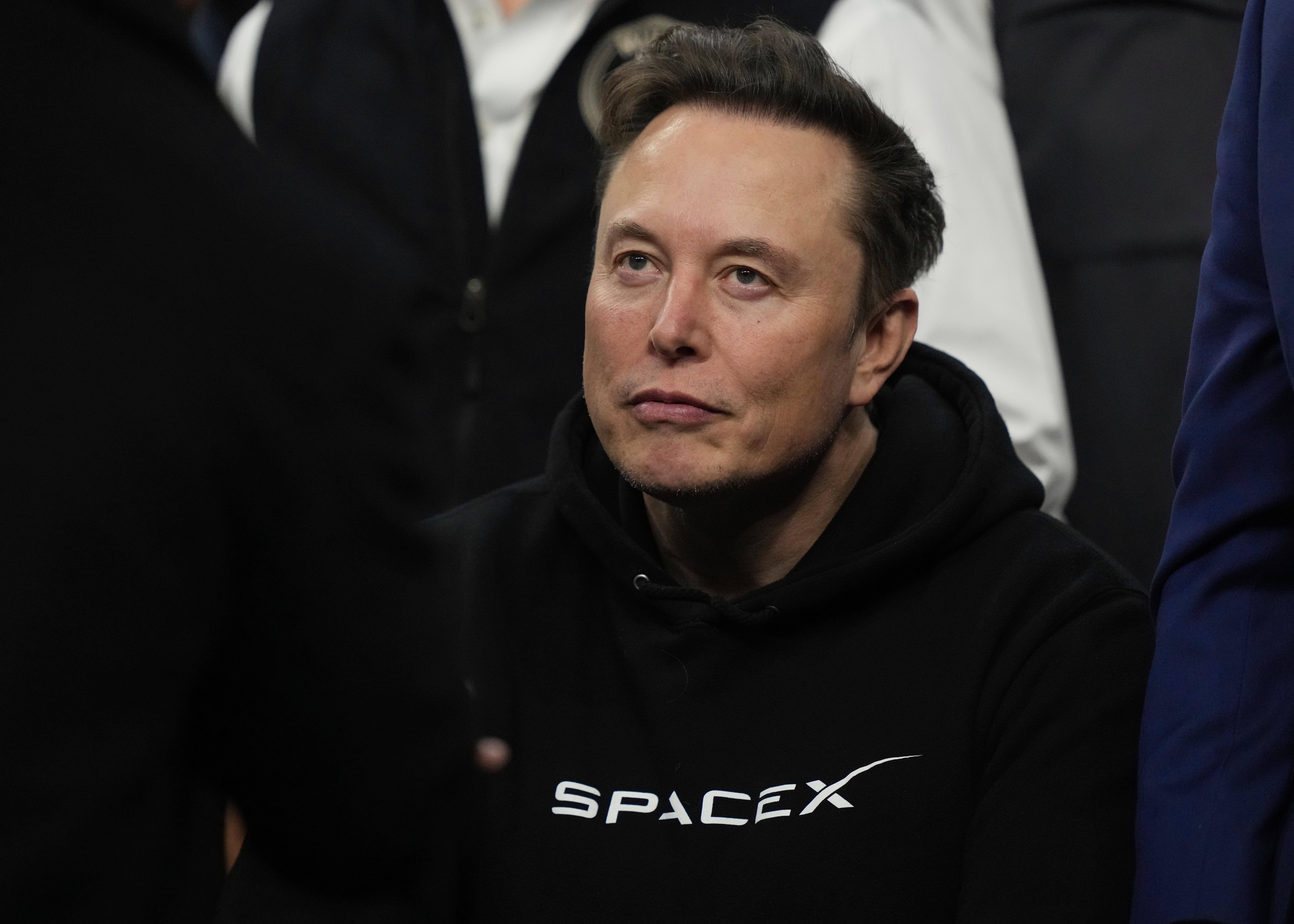
That places him a full $180bn (£136bn) ahead of now-second-placed Larry Page, of Alphabet. Musk’s net worth has grown by almost $17.5bn (£13.2bn) across the course of 2025 and he did become the first person to hit the $500bn mark for a short period. Yet it’s a figure way beyond even those riches where Musk’s year finishes in the spotlight.
Close to a full trillion dollars is at stake in his new Tesla pay package, voted for and approved by more than three-quarters of shareholders just last month. He’ll earn $878bn (£665bn) across a decade if he continues to lead the growth of the company to significant production and valuation milestones, the last of which would leave Tesla worth $8.5tn (£6.4tn) – the precise combined market capitalisation value of the world’s two biggest public companies right now as it happens, Nvidia and Apple.
The path to those riches is not just a “new chapter […] but a whole new book,” Musk declared after that pay packet was approved.
Whatever pages 2026 writes for Musk and his many projects, he’s unlikely to ever be far from dramatic progress, fervent criticism or eye-catching headlines – and the money milestones keep piling up too.

But Spencer says his business is being squeezed from every angle – as well as minimum wage, he has had increases in business rates, national insurance, and statutory sick pay. He also expects energy bills to go up because of the war in the Middle East.

Visa Inc. signage on the floor of the New York Stock Exchange (NYSE) in New York, US, on Wednesday, Jan. 28, 2026.
Michael Nagle | Bloomberg | Getty Images
Visa is launching six new tools using artificial intelligence to modernize the process of disputing credit card charges, the company told CNBC exclusively.
The digital payments company said the tools are designed to reduce the costs and frustration of “outdated” dispute processes for multiple entities involved in the payments process: merchants, issuers and acquirers.
“Some of the challenges are these back-office systems are still largely manual,” Andrew Torre, Visa’s president of value-added services, told CNBC. “We really had to think differently about how we approach this at scale.”
In 2025, Torre said, Visa processed more than 103 million charge disputes globally, marking a 35% increase since 2019.
“Our goal is to streamline this as much as possible,” Torre said. “We’d love to be able to see that growth rate come down.”
Visa’s new tools are part of a larger push by major banks and financial institutions to incorporate AI into their businesses — both internally and in consumer-facing applications. JPMorgan Chase and Goldman Sachs have both said they’re already using AI to hire fewer people. BNY spent $3.8 billion on technology in 2025, or about 19% of its revenue.
Visa said three of its six new tools focus on merchants, allowing them to address potential disputes before they escalate, managing disputes with generative AI responses and providing a deeper level of detail on order insights to manage confusion over unfamiliar charges.
For example, Torre said, many disputes are borne out of cardholders not recognizing a specific charge on their statements. With the new tool, Visa will be able to provide further details to financial institutions to show cardholders that data at a deeper level, according to the company.
The other three tools are built for issuers and acquirers, using predictive AI models to aid in case-by-case analysis, analyzing documents for summaries and auto fill and establishing an AI-powered dispute platform to manage the entire process in one location, Visa said.
“We’ll be able to get them insights and data so they can move from being reactive to proactive,” Torre said.
Torre said Visa’s new AI tools are part of a broader host of solutions for consumers, including a subscription manager announced last week that allows cardholders to cancel unnecessary subscriptions directly on the manager.
The automation will save time, money and unnecessary confusion for both parties, he added. Most of the tools will be generally available later this year, the company said.
“We really believe that disputes in this solution makes it much easier to manage and resolve,” Torre said. “We think it has better outcomes for everyone.”
Business
Stock market today (April 1, 2026): Which are the top gainers and losers in Nifty50 and BSE Sensex today? Check list – The Times of India

Benchmark equity indices Sensex and Nifty ended nearly 2 per cent higher on Wednesday, starting the new financial year on a firm footing as global markets rallied on hopes of a potential de-escalation in the ongoing West Asia conflict.The 30-share BSE Sensex jumped 1,186.77 points or 1.65 per cent to settle at 73,134.32. During intra-day trade, it surged 2,017.03 points or 2.80 per cent to 73,964.58.The broader NSE Nifty rose 348 points or 1.56 per cent to close at 22,679.40. A decline in crude oil prices also supported investor sentiment.
Nifty50 top gainers
- Trent (+7.00%)
- InterGlobe Aviation (+6.02%)
- Kwality Wall’s (+5.79%)
- Adani Ports SEZ (+5.55%)
- BEL (+4.51%)
- SBI (+3.93%)
- Eicher Motors (+3.64%)
- Jio Financial Services (+3.50%)
- Eternal (+3.30%)
Nifty50 top losers
- Dr Reddy’s (-3.61%)
- HDFC Life (-2.99%)
- Cipla (-2.32%)
- Sun Pharma (-1.64%)
- NTPC (-1.62%)
- Apollo Hospitals (-1.53%)
- Power Grid (-1.12%)
- Max Healthcare (-0.36%)
- UltraTech Cement (-0.29%)
Sensex top gainers
- Trent (+7.00%)
- InterGlobe Aviation (+6.02%)
- Adani Ports SEZ (+5.55%)
- BEL (+4.51%)
- SBI (+3.93%)
- Eternal (+3.30%)
- L&T (+2.96%)
- Titan Company (+2.89%)
Sensex top losers
- Sun Pharma (-1.64%)
- NTPC (-1.62%)
- Power Grid (-1.12%)
- UltraTech Cement (-0.29%)
- Bharti Airtel (-0.03%)
“Indian equity markets opened the new financial year on a positive note, with stocks soaring on fresh optimism surrounding a potential de-escalation of the Middle East conflict and easing of energy supply disruptions,” said Ponmudi R, CEO of Enrich Money.He added that US President Donald Trump’s remarks suggesting the US could withdraw from Iran “whether we have a deal or not” within the next two to three weeks provided the trigger for a broad rally in global risk assets.“Indian equity markets opened FY27 on a strong note, driven by improving risk appetite following US President Donald Trump’s remarks hinting at a potential resolution to the West Asia conflict,” said Vinod Nair, Head of Research at Geojit Investments Limited.In the US, markets ended significantly higher on Tuesday, with the Nasdaq Composite surging 3.83 per cent, the S&P 500 rising 2.91 per cent and the Dow Jones Industrial Average gaining 2.49 per cent.Brent crude, the global oil benchmark, declined 0.22 per cent to USD 103.7 per barrel.Stock markets were closed on Tuesday on account of Shri Mahavir Jayanti.Foreign Institutional Investors (FIIs) offloaded equities worth Rs 11,163.06 crore on Monday, while Domestic Institutional Investors (DIIs) bought shares worth Rs 14,894.72 crore, according to exchange data.


Taylor Swift, Travis Kelce wedding planning comes to life: Details

Lulus expands wholesale reach with Amazon, Victoria’s Secret
Minimum wage rises to £12.71 an hour as firms warn of impact

-

 Politics1 week ago
Afghanistan announces release of detained US citizen
-

 Tech1 week ago
Can a Home Appliance Fix the Problem of Soft-Plastic Waste?
-

 Sports1 week ago
Broadcast industry CEO says consolidation is ‘essential’ to compete for NFL soaring media rights prices
-
 Business1 week ago
Property Play: Home flippers see smallest profits since the Great Recession, real estate data firm says
-

 Entertainment1 week ago
UN warns migratory freshwater fish numbers are spiralling
-
 Business1 week ago
Gold prices soar in Pakistan – SUCH TV
-

 Fashion1 week ago
ICE cotton slips on weaker crude, profit booking
-
 Business1 week ago
More women are entering wealth management, but few are in advisory roles, study finds