

Sports
Bring back the bison: How an on-campus movement resurrected Indiana’s mascot after 50 years

What, exactly, is a hoosier?
It’s a riddle pondered by many. The simplest answer is the strongest: It’s a person from Indiana. The specifics, though, get more difficult.
There have been dozens of theories and explanations over the years. A bill filed to the Indiana House of Representatives in 2023 cited Harry Hoosier, a former slave-turned-Methodist preacher who passed away in 1806, as the origin of the nickname. The Indiana Historical Bureau notes a number of possible written origins for the word on its website, including references to a poem and a boat from the 19th century.
This uncertainty has long put Indiana University athletics, whose squads have been nicknamed the Hoosiers for well over a century, in a strange spot. There’s little doubt Indiana’s teams play under a fitting moniker. But what sort of image represents a hoosier? What type of mascot should cheer on the teams?
A number of proposed mascots, official and unofficial, vied for the hearts of the Hoosier faithful throughout the 20th century. A goat, collie and bulldog were among the options that made bids, as well as the infamous 1979 reign of “Mr. Hoosier Pride,” a bizarre cowboy-like figure described in one letter to the editor of the Indiana Daily Student as “the most asinine and ridiculous-looking character anyone could have ever dreamed up to be IU’s mascot.”
But none of Indiana’s assorted short-lived forays into mascot-ery caught the attention of students and alumni quite like the bison.
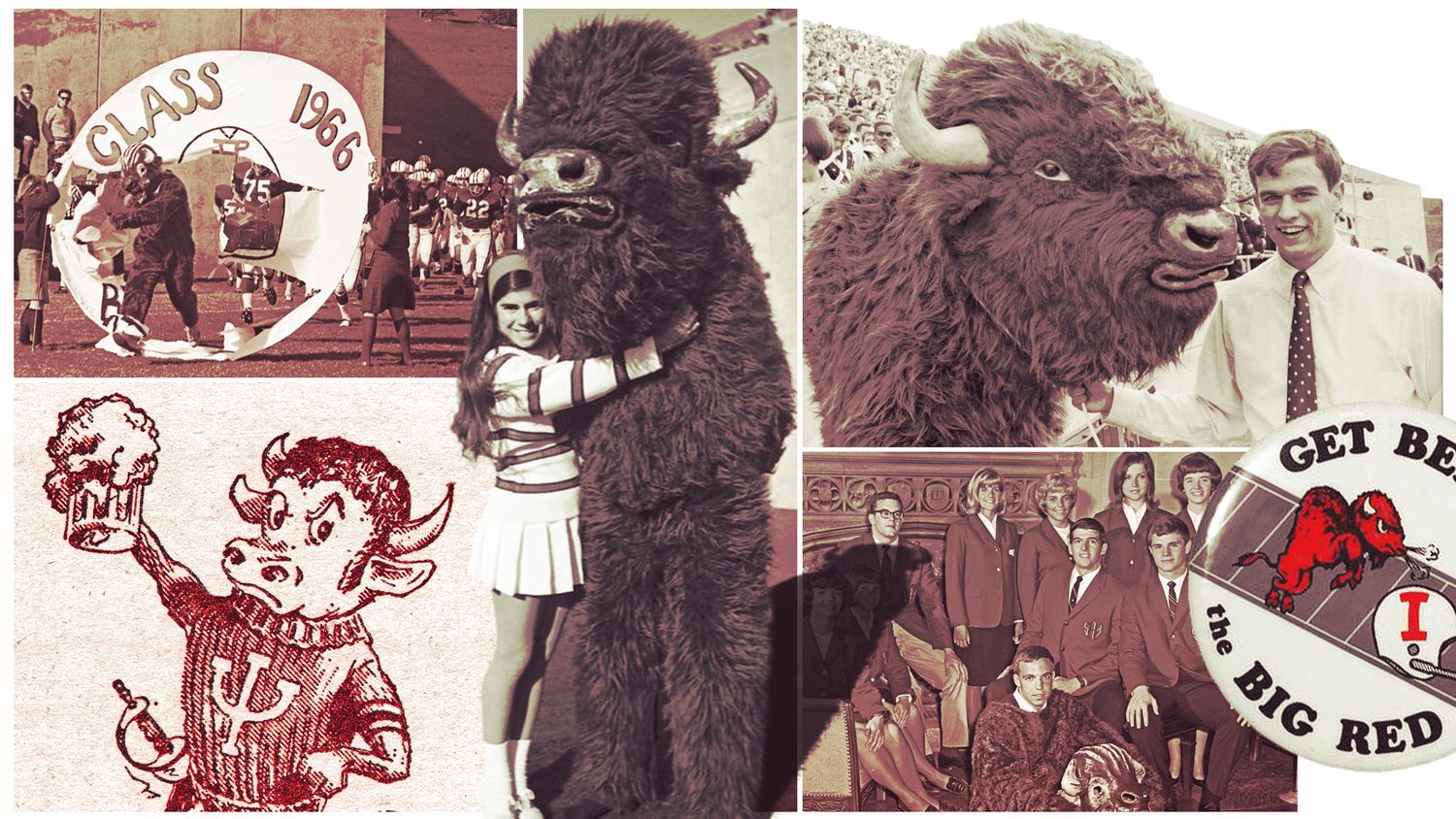
In October 1965, Indiana adopted the bison as the school’s new mascot, based on the animal’s former migration history in the region and representation on the state seal. A month later, a bison mascot was officially unveiled ahead of the school’s football game with rival Purdue.
And yet, within a decade, the bovine project had been scuttled.
Despite different iterations of the costume, the bison suit was consistently a comedy of frustrations. Most notably, the oversized bovine head limited the wearer’s range of motion. One version required a cheerleader to lead the mascot onto the field with a rope leash. And regardless of suit design or setup, there was also plain reality: Furry bovine suits are inherently uncomfortable on a hot day.
The mascot was also, truth be told, a tad terrifying. In 1969, around the time of the costume’s retirement, the Indiana Daily Student newspaper quoted assistant athletic director Bob Dro as saying “the main criticism seems to be, ‘It’s a beautiful head but it looks like the devil with a cheerleader in it.'”
Not helping matters was the fact that the bison’s brief run coincided with a general down period for Indiana football. There was the magical run to the 1967 Rose Bowl, but a backslide to losing seasons began shortly thereafter.
With results lagging, there wasn’t a ton of affection around campus for the bulky bison suit. As the Kokomo Tribune bluntly noted in 1969: “the bison has been relegated to a storeroom for lack of interest.”
And just like that, the mascot was lost to history.
Or at least it might have been.
But legends — and oversized furry mascots — never truly die. So, 50 years after Indiana officially retired the bison, it is ready to make a return to the sidelines of Memorial Stadium thanks to a tale that includes a college bar, determined professors, a bike race and more.
Phase I: “Dick was always a visionary”
The initial disappearance of the original bison suit wasn’t permanent.
Although 1969 is the consensus accepted retirement date for the mascot’s first stint, Indiana University’s archives show the oversized costume making at least two appearances in 1973 during Lee Corso’s first year as the Hoosiers coach. Archives of the Bloomington Herald-Times also show a photo of the mascot during a 1974 contest.
More importantly, though, the bison remained a campus fixture.
The animal appears on the school’s coat of arms, and the school’s ROTC unit has long been known as the Bison Battalion. Football players under coach Bill Mallory donned bison-themed helmet stickers in the 1980s and ’90s, and a pregame package shown on the Memorial Stadium video board in the 2010s featured a bison stampede.
Just a block away from campus is the most notable example of the bovine in Bloomington — the locally famous bar and restaurant Nick’s English Hut, where the bison has long served as the establishment’s own mascot.
Walk off East Kirkwood Avenue and into Nick’s and it’s impossible to miss the bison imagery. The logo on the front door. The shot glasses behind the bar. And, most glaringly, a bison head mounted on the wall just a few paces away from the entrance.
“I still to this day don’t know if it’s real or not,” said Julian Davila, a former graduate student at Indiana and security guard-turned-bartender at Nick’s since 2023. “But I like it because it’s very unique. You don’t see bisons just off the wall like that typically.”
According to Nick’s current owner, Gregg “Rags” Rago, the bison was adopted by his predecessor, Dick Barnes, around the same time the school made its original effort to institute the animal as the official mascot.
“Dick was always a visionary,” Rago told ESPN. “So when IU started using the bison then … He kind of accepted it as part of the mascot for Nick’s English Hut.”
Although Indiana’s bison petered out, the animal became nearly synonymous with Nick’s — Davila noted one of his friends even has a tattoo of Nick’s bison — which has long been considered one of Bloomington’s must-visit locales.
“Over the years we developed and put it on different parts of our T-shirts, hats, whatever,” Rago said of the bison. “So many people have our T-shirts, our hats … they’re all over the world. There’s IU alum[ni] all over the world. And most IU alums have been at Nick’s at one time or another.”
Schools don’t just restore failed mascots for no reason, though. Although the bison might have always had a presence, the movement to bring it back officially was far from organized.
But as the original bison’s retirement approached its 50-year anniversary five years ago, the threads of a more distinct movement began to form.
Phase II: “Bring back the bison”
Paul Gutjahr looked up at the IU coat of arms and saw an opportunity.
It was 2020, and the COVID-19 pandemic was drastically altering the student experience at colleges all over the country. Gutjahr, an Indiana humanities professor who was also serving as an associate dean, was looking for messages that could inspire persistence and community in his students.
He remembered a saying from his time living in Colorado: “Be the buffalo.” As the story goes, when stormy weather arrives, while cattle will simply meander as the conditions persist, buffalo will charge into the storm to get through it faster.
Already a supporter of bringing back the former mascot, Gutjahr now saw a potential means of rallying his students behind the movement. As students prepared to come back to school, he connected the prospective return of the bison mascot with the ongoing return of the campus community.
“I thought, this is really good. Because what this allows me to do is leverage the bison stuff, the cohere community, the end of the storm story, with bringing something back. Getting students excited about bringing something back,” Gutjahr recalled.
Gutjahr’s message about bringing back the bison quickly took hold among students, so he leaned into the idea further. He had ordered a pair of bison mascot costumes, which began making impromptu appearances around the school. He had also been designing bison-themed shirts (often printed with glow-in-the-dark ink for an additional popularity boost), and added magnets and hats. His merchandise soon became in vogue on campus as he further expanded his portfolio of bisonwear.
“We never sold the shirts. We only gave them away,” Gutjahr said. “And when word got out that I was giving them away and I would have a new design out … I got mobbed.”
In fellow associate dean Galen Clavio, the director of Indiana’s sports media program, Gutjahr found both another distribution network for his merchandise (which also included pens, car magnets and more) and a partner in crime for grassroots bison revival messaging.
A fourth-generation Hoosiers alum, Clavio’s Indiana bison memory dates back to his childhood. His parents owned a crocheted crimson-and-cream rug that featured the bovine motif and the phrase “Hurryin’ Hoosiers,” a term used to describe legendary basketball coach Branch McCracken’s squads.
Clavio saw the mascot as an underused means of potentially expanding Indiana’s brand. He connected with Gutjahr and would hand shirts out to his own media school students, noticing similar enthusiasm around campus for the project.
He expanded the movement to a digital front as well. If Gutjahr’s shirts put the bison in front of students all over campus, Clavio ensured that it entered the airwaves as well. He began punctuating each episode he hosted on his podcast, “CrimsonCast,” with “Bring back the bison.”
Slowly but surely, the campaign picked up steam. “Bring back the bison” took hold as a popular rallying cry among students and alumni on social media. Bison merchandise no longer was an exclusive sign that you had taken a class with Professor Gutjahr or Professor Clavio, but simply an established part of the local fashion scene.
“I’ll drive around Bloomington, I’ll be on campus, I’ll be in my neighborhood — I live on the southeast side of town — and I’ll see people walking through the neighborhood with the shirts that Paul made,” Clavio said. “I didn’t hand them out to those people.”
But as charming as the idea of a student and professor T-shirt revolution single-handedly bringing back the bison might be, support from more established forces was needed. Thankfully, a local company was on hand to offer just that.
What started as a side project for 2016 IU graduate Connor Hitchcock is now Homefield Apparel, a company with a combined social media following of over 150,000 and licensing deals with 200 schools.
Homefield sells shirts, hats, sweaters, joggers and more. Yet, even as Homefield’s profile grew, it was one of Hitchcock’s first designs that continued to stand out above the rest in terms of sales.
“Myself and my co-founder Christa put the bison on a shirt. And it went nuts,” Hitchcock said. “And when the side project became Homefield and it became our full-time jobs in 2018, that was still our No. 1-selling IU design. And still to this day, across all pieces of merchandise, that is our No. 1-selling design.”
And then the bison movement got a boost from an unlikely source.
Phase III: “Haven’t got a cease and desist …”
Bearing the lofty nickname of “The World’s Greatest College Weekend,” the Little 500 carries no small weight when it comes to Indiana’s campus lore. Twenty-five thousand fans flock annually to Bloomington for the nearly 75-year-old bike race, which is put on by the Indiana University Student Foundation.
Aware of the bison and its history, then-director of the IUSF Trent McGee had an idea — since the Indiana University Student Foundation is a separate entity from the university itself, why couldn’t the 2024 edition of the Little 500 have its own bison mascot? Gutjahr had a bison costume available on campus and was more than happy to loan it out to advance the cause. The logic was sound.
What was not guaranteed, however, was positive reception from the school’s administration.
Planning for Little 500’s bovine mascot was done silently. There was a secret committee — nicknamed “the Herd” — of students who discussed what sort of role the bison would play. McGee quietly gave a heads-up to his bosses in a secret meeting and said he’d accept blame if the school was upset.
Eventually, the aptly named Ryder was born. Soon enough, the moment of truth came. It was April 19, 2024, the opening day of the 73rd Little 500. Would Ryder’s unveiling be celebrated like the return of a prodigal son? Would university officials immediately shut things down?
The most immediately recognizable emotion of Ryder’s debut was … confusion. The Little 500 organizers had tried their best to hint at the mascot’s comeback on social media, but it was hard to generate much awareness without being more overt about their plan.
“Even the winners” — who received miniature plush bisons as trophies for their team’s victory — “were like, ‘why am I receiving this?'” McGee recalled.
But once the air of mild bewilderment was lifted from Bill Armstrong Stadium, the kids in attendance loved Ryder, and so did their families.
“Honestly, I thought that the kids would be scared. I mean, I’m like 5-9, so it’s like a 5-foot-9 bison standing over you,” Mehar Parmar — who with Herd leader Conrad FitzSimmons was one of the committee members to don the bison suit — told ESPN. “These little children were so excited, and their parents were equally excited. There were generations of grandparents that had gone to IU … they were telling us ‘we went to school when this was a thing, we’re so excited to see you again.'”
More notable for the cause, though, was the fact that school officials weren’t upset. In fact, to McGee’s surprise, they were willing to chat and take photos with the bison mascot.
Seeing university administrators actively engage with the mascot was the sign to McGee that the movement to bring back the bison was on firmer ground than had been perceived.
“Haven’t got a cease and desist from General Counsel yet,” McGee perhaps-not-entirely-jokingly texted Clavio after the bison mascot rode in the parade that precedes the women’s race. “So good sign?”
Phase IV: “We could have done something bigger”
Six months after the 73rd Little 500, and 51 years after a bison was last seen sharing a sideline with Corso, a packed crowd was at a fever pitch minutes before kickoff on a picturesque fall Saturday in Bloomington.
It had been a party all morning in Monroe County, with the undefeated Hoosiers football team as the guests of honor. “College GameDay” was in town for just its second trip to Memorial Stadium, bringing Corso back to the school where he spent the majority of his head coaching career.
“It’s obvious who I’m picking,” Corso admitted as he set up what was destined to be a particularly meaningful edition of his iconic weekly mascot headgear pick.
Corso reached down and grabbed … an Indiana baseball cap. There was no mascot head for him to don.
It didn’t take away from the hype, as Memorial Stadium still let out a hearty cheer (and the Hoosiers went on to win 31-17), but senior associate athletic director Jeremy Gray saw a missed opportunity.
“We saw it as kind of a moment where maybe we could have done something bigger and better,” Gray recalled.
Corso’s headgear pick that wasn’t was one of a number of key points in a memorable Indiana football season where the real possibility of bringing back the bison emerged. As the Hoosiers steamrolled their way to an 11-win season — the first double-digit-win campaign in program history — and a College Football Playoff appearance, fan enthusiasm skyrocketed.
Indiana had been looking into ways to revamp the Memorial Stadium experience. What better way to build on the momentum generated in coach first-year football coach Curt Cignetti’s debut campaign than to actually, finally, bring back the bison?
By December, the bison return movement was unstoppable.
Then-student government president Cooper Tinsley, looking for something to unify the student body, had proposed action. Eventually, the Bring Back the Bison Act of 2024 was born.
Debate within student government over whether the resolution should be passed was intense. Skeptics questioned whether there was actually as much of a pro-bison student groundswell as had been suggested. But the bill’s supporters had evidence at the ready: a poll that ran on the student government Instagram account.
Seventy-two percent of votes on the poll were in support of the bison’s return. The act passed.
“[It] might seem funny, but these were, like, genuine debates that were going on for over an hour,” Tinsley recalled.
With overwhelming student support both clear and now legislatively codified, the school’s athletic department got to work on logistics. Only one element about the bison’s return was certain: It wasn’t going to be quiet.
Phase V: “The thing’s got to be fun”
The mascot’s unveiling offered Gray, an Indiana alumnus and longtime advocate for the bison’s return, a chance to blend several of his passions into one project.
“I’m a huge, huge movie fan” Gray told ESPN. “And so I really just took tropes from some of my favorite movies from 1975 to about 2005.”
In total, Indiana athletics rolled out five videos over a stretch of nearly two weeks to hint at, and later reveal, Hoosier the bison. Guest stars and cameos included a who’s who of Indiana athletics figures (Cignetti, basketball coach Darian DeVries), athletic administrators (Gray), and figures in the movement to bring back the bison (Clavio, Gutjahr).
The videos include nods to “Pulp Fiction,” “Jurassic Park,” “E.T.” and “more.
The fifth and final video uses a “Star Wars”-style introduction text to set up a reenactment of the Bring Back the Bison Act’s ratification. The video then segues to a nod to, in the words of Gray, “the best non-religious comeback story in the history of the world”: Michael Jordan’s return to the NBA. Hoosier’s costume then finally comes into view.
“The thing’s got to be fun,” Gray remarked. “Successful mascots are fun mascots.”
Finally unleashed. 🦬
Welcome back home, @HoosiertheBison. pic.twitter.com/hMotSXeF0A
— Indiana Hoosiers (@IUHoosiers) May 27, 2025
What’s the actual plan for the role Hoosier will play in its debut campaign this fall? Indiana is keeping those details a closely guarded secret. But if Gray’s logic is any indication, the unveiling’s reception might make the usual mascot antics a little more bold.
“At first, it’s like, you know, let’s make sure that it’s successful,” Gray said. “It’s like a rookie quarter[back]. Put it in a position where it can succeed, run the plays that it can remember, you know, all that kind of stuff.
But after years of hard work to bring the bison back from the abyss, why not go big?
“Now, it’s like, ‘You know what? People are pretty fired up about this. What if we get this thing a car?'”
After a massive night of high-flying moments and title changes on Night 1, the WrestleMania 42 action continues on Night 2 at Allegiant Stadium in Las Vegas.
Two of the biggest superstars on the roster, literally, square off in the first match of the night, as “The Ruler” Oba Femi attempts to slay “The Beast” Brock Lesnar. Also on the card is a six-man ladder match for the men’s Intercontinental Championship, and a pair of singles matches for the United States Championship and the WWE Women’s Championship.
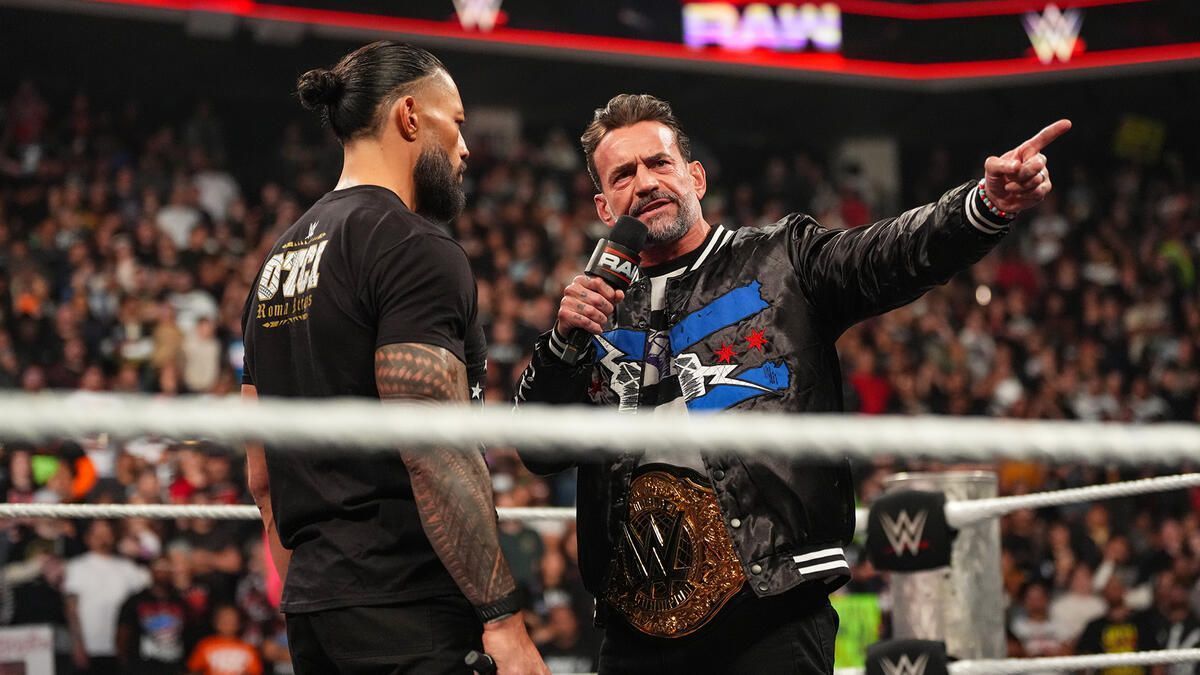
In the main event, CM Punk puts the World Heavyweight Championship on the line against Roman Reigns.
Follow along with every moment of WrestleMania Night 2.
Sports
Chuck Schumer calls on FIFA to cover $150 NJ Transit fares for World Cup fans heading to MetLife Stadium
NEWYou can now listen to Fox News articles!
Sen. Chuck Schumer, D-N.Y., has called for FIFA to cover the full rail cost for New Yorkers attending the World Cup, as NJ Transit train ticket prices are set for $150 to get to MetLife Stadium for matches.
Schumer released a statement on Sunday, calling on FIFA to pay the full fair, which is astronomically higher than the regular cost to travel from Penn Station to the Meadowlands, while understanding that “FIFA is set to rake in approximately $11 billion in revenue off the tournament while New York fans are being hit with $150 NJ Transit round-trip tickets to get to the game.”
MetLife Stadium in East Rutherford, New Jersey, will host eight matches during the World Cup, including the final on July 19. The usual price is $12.90 for the Meadowlands train from Penn Station, but it will rise to $150 beginning June 13 and ending July 19. There will also be shuttles available worth $80.
CLICK HERE FOR MORE SPORTS COVERAGE ON FOXNEWS.COM
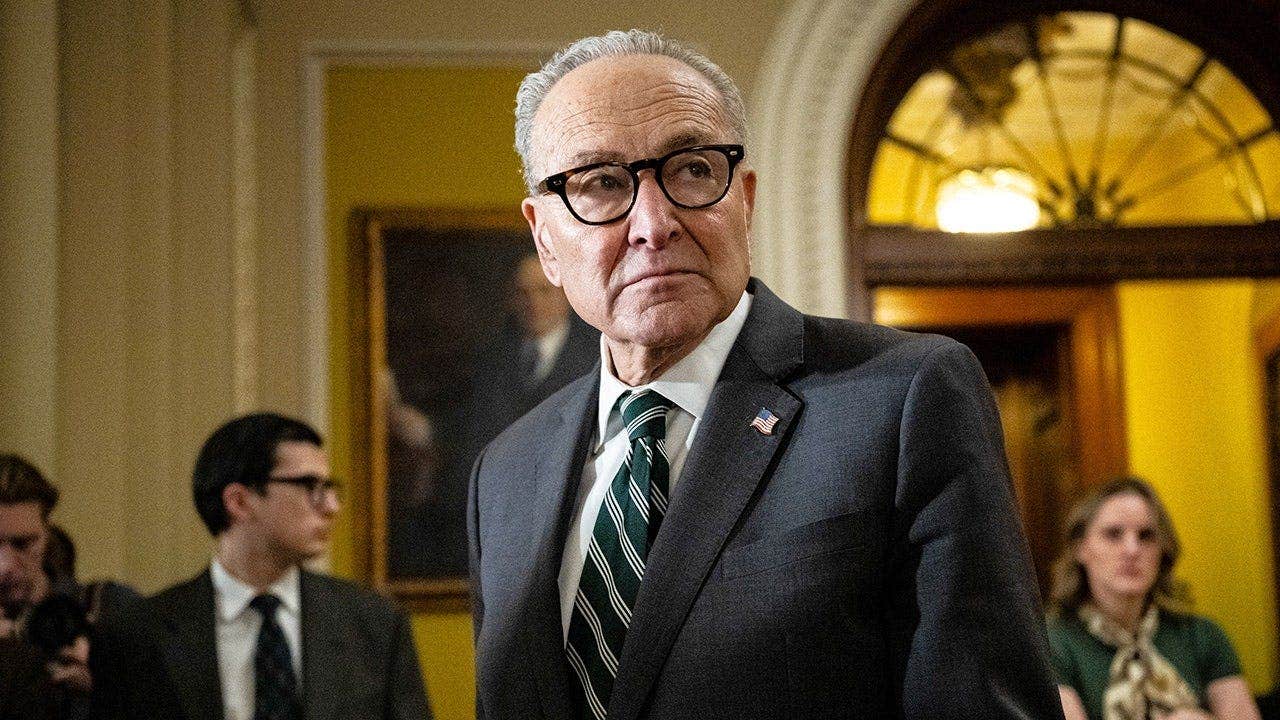
Senate Minority Leader Chuck Schumer, a Democrat from New York, during a news conference following the weekly Senate Democrat policy luncheon at the US Capitol in Washington, DC, US, on Tuesday, March 17, 2026. (Graeme Sloan/Bloomberg via Getty Images)
NJ Transit CEO Kirs Kolluri defended the fare hikes on Friday, saying the ultimate cost to the company shouldn’t burden New Jersey commuters.
“It is an exciting moment for New Jersey to showcase New Jersey’s diversity as well as its economic standing in the country and in the world. Equally important, (Gov. Mikie Sherrill) has said that New Jersey commuters cannot and will not subsidize the movement of fans going to the game, because that would not be fair,” Kolluri said, reiterating that the tournament will cost NJ Transit $48 million.
Penn Station is also scheduled to be partially closed for up to four hours before each World Cup match, which will obviously disrupt regular commuters and travelers eight times during the tournament.
Schumer argues it’s unfair for New Yorkers to have to deal with the price hike, especially considering FIFA is eliminating parking at MetLife Stadium. Also, parking at nearby American Dream mall is approximately $225, while walking access is being prohibited as well.
In turn, mass transit is “effectively the only way in or out of the stadium on match days,” Schumer’s statement read. But Schumer isn’t lambasting NJ Transit — he understands the financials the company has to deal with.
It’s FIFA he’s pointing the finger at for not helping with the cost.
“The total NJ Transit operation to move fans to and from MetLife is projected to cost $62 million, with approximately $11 million dedicated to security alone. The federal government is contributing $10.6 million and the NY/NJ Host Committee is contributing just over $3 million, leaving NJ Transit to foot a $48 million bill with zero financial contribution from FIFA.
“Meanwhile, FIFA has told other host cities they can offer fans mass rail for as little as $2.50 round trip, a fraction of what New York fans are being charged.”
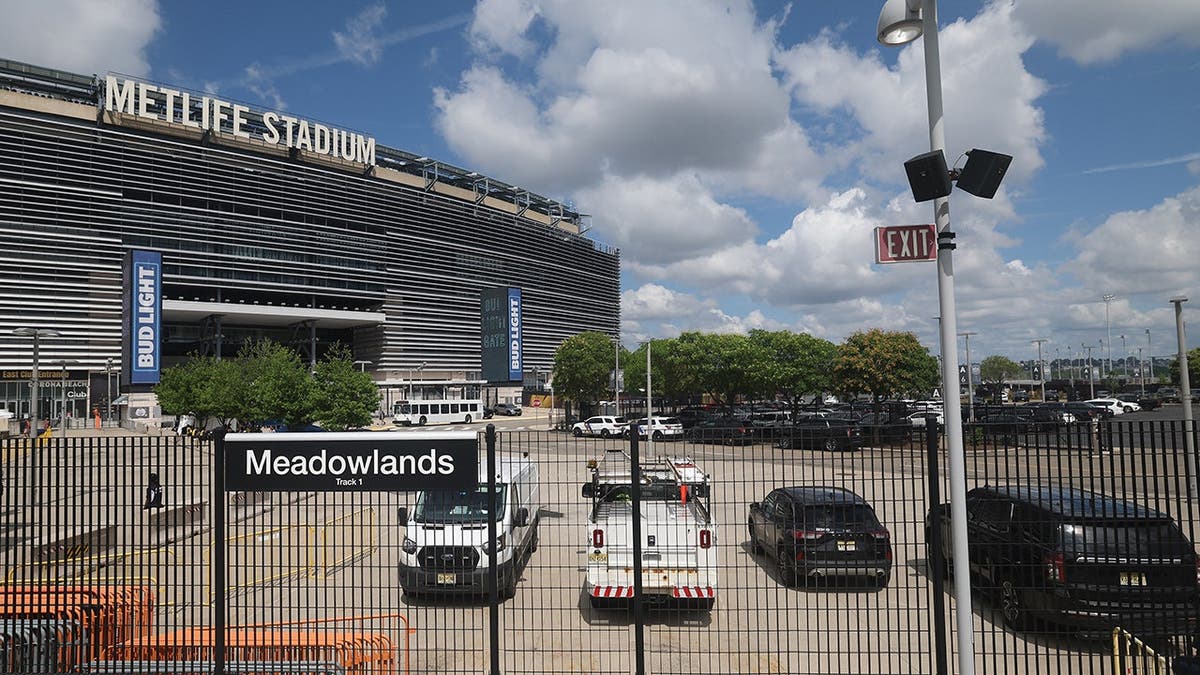
A general view of MetLife Stadium and the Meadowlands Train Station is seen from a NJ Transit train before the FIFA Club World Cup 2025 semi-final match between Paris Saint-Germain and Real Madrid at MetLife Stadium in East Rutherford, New Jersey, on July 9, 2025. (Luke Hales/Getty Images)
Schumer added that, “Charging more than eleven times the normal fare for a train ride is a ripoff, plain and simple.”
FIFA’s budgeted revenue for the 2023 to 2026 cycle is approximately $11 billion, which marks a 71% increase over the previous cycle. It also marks the most lucrative World Cup in the tournament’s history.
Schumer’s statement also pointed out ticket prices for match-goers are around $700 for the group stage, and the final at MetLife Stadium is as high as $10,000 to get into the door under FIFA’s dynamic pricing model.
“We are carrying more fans, more riders, and more disruption than any other region in this tournament,” Schumer added. “FIFA needs to step up accordingly. Past practice does not cut it when you are eliminating parking, shutting down Penn Station, and forcing every fan onto one transit system. FIFA should cover the ride, not stick New York fans with the bill.”
FIFA may not have historically contributed to public transportation costs in previous tournaments, but Schumer argues New York and New Jersey isn’t every other host region. It’s the most densely populated area in the country, and it will be host to eight matches.
Kolluri also noted that, if the regular $12.90 fare were to stay in place, the $48 million bill for NJ Transit would be subsidized for commuters by 92%.
“No one that I have spoken to thinks that’s fair or reasonable. Commuters in New Jersey should not carry the cost years into the future for a wonderful event, no doubt. But the fans going to the games should burden the cost. That’s all we’re trying to say,” Kolluri said.
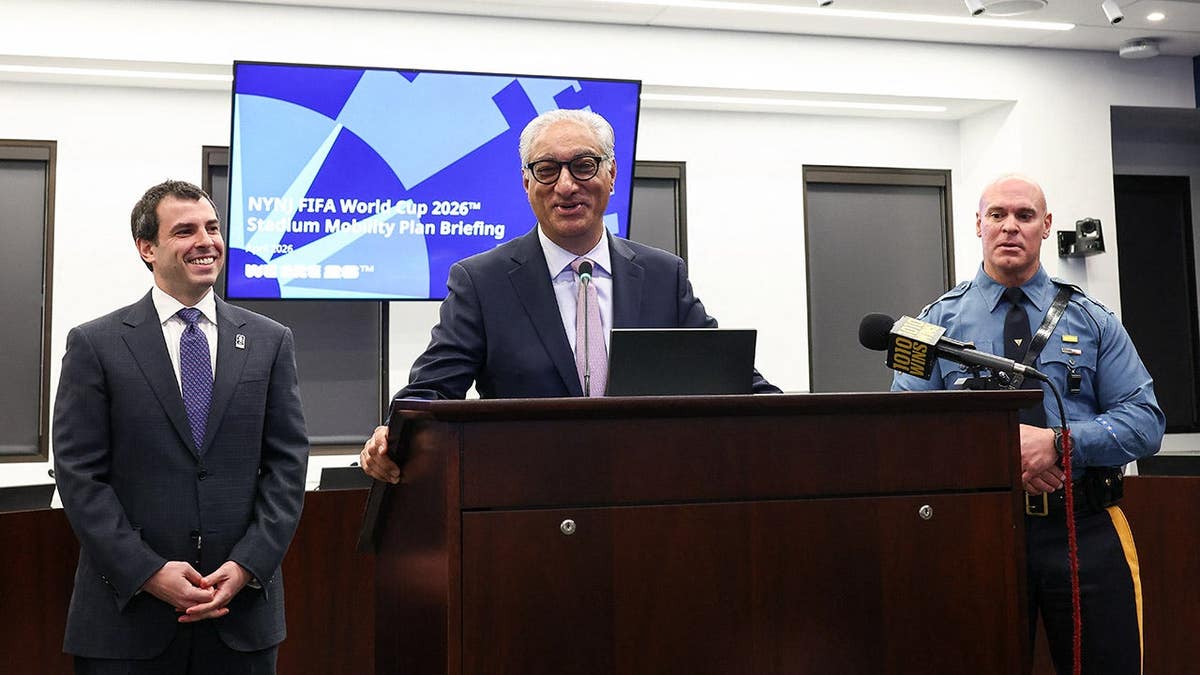
NJ Transit CEO Kris Kolluri and Alex Lasry, CEO of the 2026 FIFA World Cup New York New Jersey Host Committee, speak during a press briefing on the regional mobility plan for the World Cup in Newark, New Jersey, on April 17, 2026. (Charly Triballeau/AFP via Getty Images)
CLICK HERE TO DOWNLOAD THE FOX NEWS APP
With the plan now officially in place, FIFA World Cup COO Heimo Schirgi issued the following statement to Fox News Digital:
“Ever since the host city agreements were signed in 2018, FIFA has worked in collaboration with the Host Committees and their partners to develop a transportation plan that provides efficient and accessible mass transit options for ticketed fans attending the eight matches at NY NJ Stadium. The goal is to minimize congestion, reduce reliance on private vehicles, and ensure the fan experience is positive and memorable, defined by the action on pitch, not delays on the roads.
“The NJ Transit current pricing model will have a chilling effect. Elevated fares inevitably push fans toward alternative transportation options. This increases concerns of congestion, late arrivals, and creates broader ripple effects that ultimately diminish the economic benefit and lasting legacy the entire region stands to gain from hosting the World Cup.”
Fox News’ Ryan Morik contributed to this report.
Follow Fox News Digital’s sports coverage on X and subscribe to the Fox News Sports Huddle newsletter.
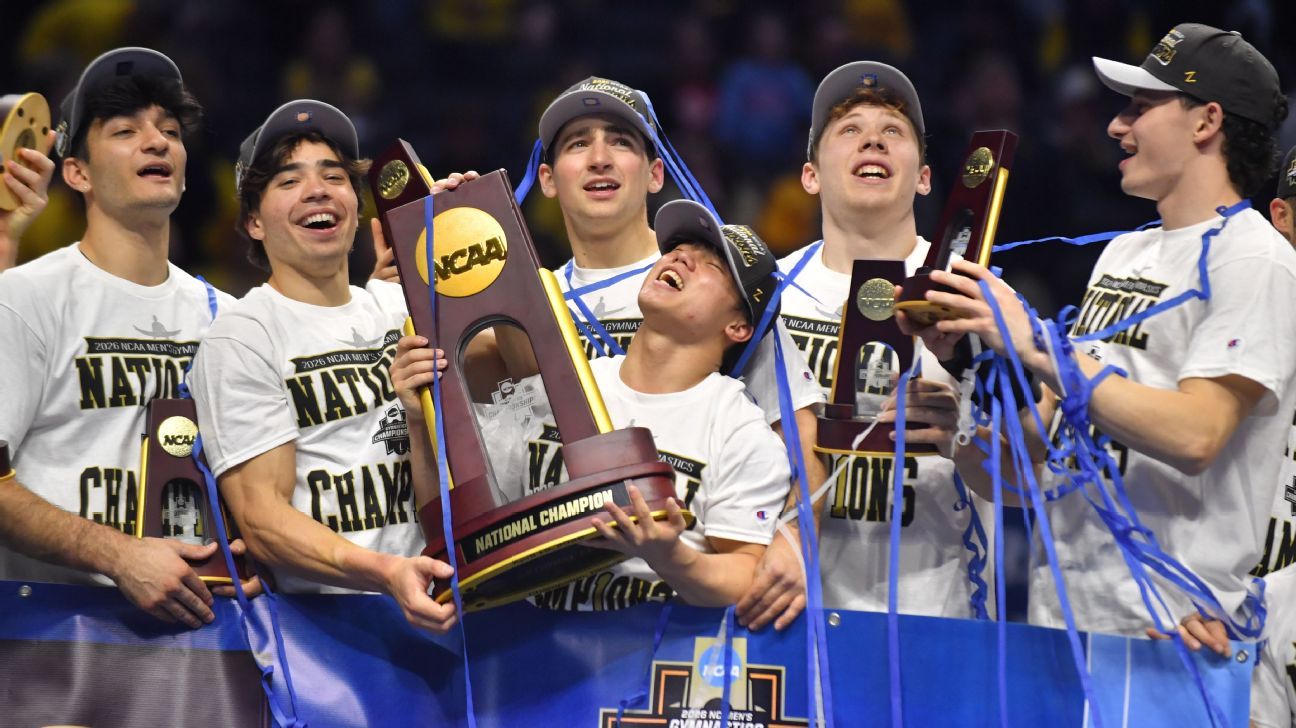
Stanford emerged victorious in the 2026 NCAA men’s gymnastics championships, taking home their tenth program title.
Penn State and Oklahoma share the record for the most NCAA men’s gymnastics championships, with 12 apiece.
Here’s a look at every national champion in NCAA men’s gymnastics:
-
2015: Oklahoma
-
2014: Michigan
-
2013: Michigan
-
2012: Illinois
-
2011: Stanford
-
2010: Michigan
-
2009: Stanford
-
2008: Oklahoma
-
2007: Penn State
-
2006: Oklahoma
-
2005: Oklahoma
-
2004: Penn State
-
2003: Oklahoma
-
2002: Oklahoma
-
2001: Ohio State
-
2000: Penn State
-
1999: Michigan
-
1998: California
-
1997: California
-
1996: Ohio State
-
1995: Stanford
-
1994: Nebraska
-
1993: Stanford
-
1992: Stanford
-
1991: Oklahoma
-
1990: Nebraska
-
1989: Illinois
-
1988: Nebraska
-
1987: UCLA
-
1986: Arizona State
-
1985: Ohio State
-
1984: UCLA
-
1983: Nebraska
-
1982: Nebraska
-
1981: Nebraska
-
1980: Nebraska
-
1979: Nebraska
-
1978: Oklahoma
-
1977: Indiana State/Oklahoma
-
1976: Penn State
-
1975: California
-
1974: Iowa State
-
1973: Iowa State
-
1972: Southern Illinois
-
1971: Iowa State
-
1970: Michigan
-
1969: Iowa
-
1968: California
-
1967: Southern Illinois
-
1966: Southern Illinois
-
1965: Penn State
-
1964: Southern Illinois
-
1963: Michigan
-
1962: Southern California
-
1961: Penn State
-
1960: Penn State
-
1959: Penn State
-
1958: Michigan State/Illinois
-
1957: Penn State
-
1956: Illinois
-
1955: Illinois
-
1954: Penn State
-
1953: Penn State
-
1952: Florida State
-
1951: Florida State
-
1950: Illinois
-
1949: Temple
-
1948: Penn State
-
1942: Illinois
-
1941: Illinois
-
1940: Illinois
-
1939: Illinois
-
1938: Chicago
Check out the ESPN college sports page for the latest news on your favorite NCAA athletes and events.


WWE WrestleMania 42 Night 2: Live match results and analysis

NCAA men’s gymnastics championship: All-time winners list

Ryan Reynolds praises Blake Lively on handling Justin Baldoni lawsuit

-

 Entertainment7 days ago
Palace left in shock as Prince William cancels grand ceremony
-

 Sports7 days ago
The case for Man United’s Fernandes as Premier League’s best
-

 Fashion4 days ago
France’s LVMH Q1 revenue falls 6%, shows resilience amid Iran war
-
 Business1 week ago
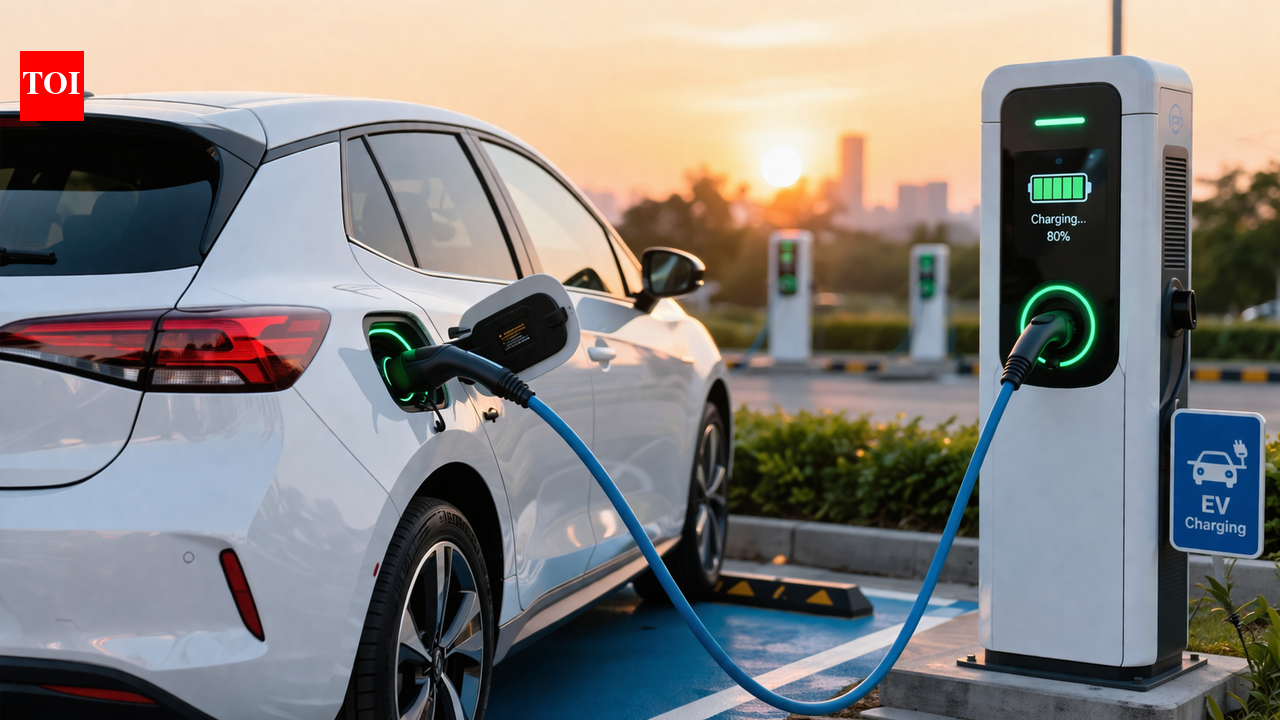
100% road tax waiver for electric cars, new rules for 2, 3 and 4 wheelers – what Delhi govt’s draft EV policy says – The Times of India
-
 Business7 days ago
UK could adopt EU single market rules under new legislation
-
 Entertainment1 week ago
Dua Lipa hits major career high ahead of wedding with Callum Turner
-
 Sports1 week ago
Lamar Jackson hits back at critics with faithful message on social media
-

 Fashion7 days ago
Energy emerges as biggest cost driver in textile margins