

Business
Budget 2026 Should Support MSMEs, Critical Minerals For Boosting Trade Resilience: Deloitte


Last Updated:
Deloitte India urges FY27 Budget to boost MSME support and critical mineral security, job protection and advancing India’s global manufacturing and clean energy goals.



Budget 2026 Expectations.
Budget 2026: Deloitte India has pitched a sharper focus on MSME support and critical mineral security in the FY27 Union Budget, arguing that these measures are essential to strengthen India’s trade resilience and reduce external vulnerabilities amid rising global uncertainty.
In its Budget expectations note, Deloitte India said micro, small and medium enterprises play a pivotal role in the economy, accounting for nearly 46% of India’s exports and emerging as the second-largest employer after agriculture. According to the firm, easing financial and compliance-related pressures on MSMEs would help them cope with global volatility, sustain production and remain competitive in overseas markets.
The Union Budget 2026-27 will be tabled on Sunday, February 1.
“Strengthening MSMEs will safeguard jobs and drive inclusive economic growth, boost rural incomes and support India’s ambition to become a global manufacturing hub,” Deloitte said.
The firm recommended measures such as enhanced export credit availability, concessional financing and simplified digital compliance systems to reduce the regulatory burden on small businesses. It also called for comprehensive training programmes to improve last-mile competitiveness of MSMEs, particularly those linked to global value chains.
Deloitte further suggested targeted export incentives or enhanced duty drawback support for tariff-sensitive sectors such as ready-made garments, gems and jewellery, and leather, which are more vulnerable to global trade disruptions.
Highlighting the risks from an increasingly protectionist global environment, Deloitte Economist Rumki Majumdar said rising uncertainty from tariff hikes, changes in rules of origin and non-tariff barriers could disproportionately affect Indian exporters. While the direct impact of global trade frictions on GDP growth may be limited to 40-80 basis points, the spillover effects on MSMEs and employment could be far more severe.
“MSMEs contribute 30.1 per cent to GDP, account for 45.79 per cent of India’s exports and employ nearly 290 million people; disruptions in export markets or tightening trade rules pose serious risks to jobs and income stability,” Majumdar said.
Beyond MSMEs, Deloitte emphasised the need for a strategic push on critical minerals to secure supply chains and support India’s clean energy transition. It proposed setting up a dedicated critical minerals fund to finance overseas acquisitions and technology partnerships, ensuring long-term access to essential resources.
The firm also recommended deeper global collaboration with regions such as Africa, Australia and Latin America to secure upstream access to minerals, alongside joint research and development in mineral processing and recycling. In addition, it called for incentives to promote investments in renewable energy, green hydrogen and grid-scale energy storage.
Deloitte said expanded funding for exploration, extraction and processing of key critical minerals, including lithium, cobalt and rare earth magnets, would be crucial to reduce import dependence and strengthen India’s strategic and economic security in the years ahead.
 Click here to add News18 as your preferred news source on Google.
January 16, 2026, 15:02 IST
Read More



KARACHI: The Pakistan Stock Exchange rallied on Thursday after Saudi Arabia assured Pakistan of facilitating crude oil shipments through the Red Sea port of Yanbu Port, easing concerns over potential fuel supply disruptions.
The benchmark KSE-100 Index climbed sharply during the trading session, rising 4,439.93 points (2.85%) to reach an intraday high of 160,217.14 points.
Market Recovery
Analysts attributed the market rebound to renewed institutional buying and improving investor sentiment after Saudi assurances on oil supplies.
Market expert Ahsan Mehanti, CEO of Arif Habib Commodities, said easing fuel supply concerns played a key role in the recovery.
He added that rising global crude prices, expectations of a new International Monetary Fund loan tranche for Pakistan, and positive economic indicators also boosted investor confidence.
Alternative Oil Route
Pakistan sought an alternative supply route after Iran announced the closure of the Strait of Hormuz, a crucial global oil transit corridor.
Federal Petroleum Minister Ali Pervaiz Malik held talks with Nawaf bin Said Al-Malki, requesting Saudi support for uninterrupted energy supplies.
Saudi authorities reportedly assured Pakistan that oil shipments could be routed through Yanbu, and one crude vessel has already been prepared for dispatch.
Global Oil Market Impact
Oil prices continued to rise amid tensions in the Middle East conflict involving Iran, Israel and the United States.
Brent crude: up 3.26% to $83.99 per barrel
West Texas Intermediate (WTI): up 3.70% to $77.42 per barrel
Energy markets remain volatile as shipping disruptions threaten supply through the Strait of Hormuz, a route that handles nearly 20% of global oil trade.
Analysts say the Saudi assurance helped calm fears about Pakistan’s energy supply chain, contributing to the strong recovery at the PSX.
Business
Asian stocks today: Markets inch higher mirroring Wall Street gains; Kospi jumps 10%, Nikkei up 1,400 points – The Times of India

Asian stocks inched higher on Thursday, after days of trading in red amid ongoing Middle East tensions. This comes as equities were lifted by a rebound on Wall Street as oil prices paused their recent spike and economic updates painted a more positive picture of the American economy. In South Korea, Kospi hit a pause on its downward rally to add a whopping 10% or 513 points, to reach 5,606. Japan’s Nikkei 225 also climbed 2.7% to 55,713. Hong Kong’s HSI also traded in green, rising 353 points to 25,603 as of 9:10 am. Shanghai and Shenzhen added 0.9% and 1.7% respectively. Gains elsewhere in the region were more modest. Australia’s S&P/ASX 200 added 0.3% to 8,927.20, while New Zealand’s benchmark index moved 0.9% higher. In contrast, US futures indicated a subdued start ahead. Futures linked to the Dow Jones Industrial Average were almost unchanged, while S&P 500 futures ticked up 0.2%. The S&P 500 advanced 0.8% on Wednesday, clawing back much of the decline seen since the onset of the Iran conflict. The Dow Jones Industrial Average rose 0.5%, and the Nasdaq Composite outperformed with a 1.3% gain. Globally, market sentiment has remained sensitive to developments in the Middle East, with oil price swings continuing to steer trading direction. Crude prices eased during Wednesday’s session. Brent crude briefly moved above $84 a barrel before settling at $81.40, roughly matching the previous day’s level. US benchmark crude edged up 0.1% to finish at $74.66 per barrel. By early Thursday, however, oil was on the rise again. Brent crude climbed 2.4% to $83.32 per barrel, while U.S. benchmark crude jumped 2.5% to $76.53 per barrel.
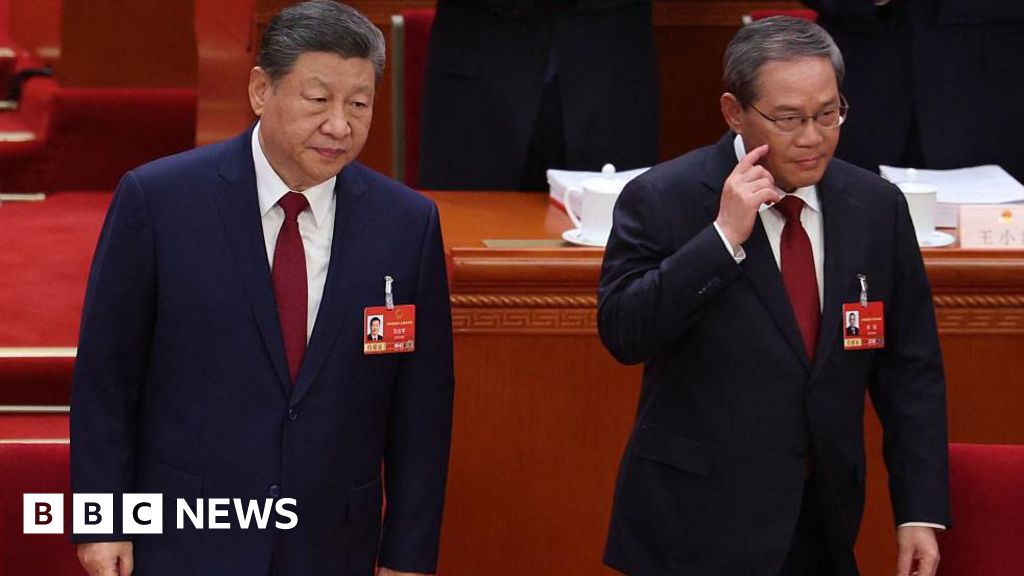
It is also the first time the target has been lowered since it was cut to “around 5%” in 2023.
Source link


US’ Wolverine Worldwide 2025 revenue rises 6.8% on Active Group growth

Brooklyn Beckham finally reacts to special birthday wish

Extreme heat threatens health, jobs in Indian textile sector: Report

India Us Trade Deal: Fresh look at India-US trade deal? May be ‘rebalanced’ if circumstances change, says Piyush Goyal – The Times of India

What are Iran’s ballistic missile capabilities?

Attock Cement’s acquisition approved | The Express Tribune

-
Business6 days ago
India Us Trade Deal: Fresh look at India-US trade deal? May be ‘rebalanced’ if circumstances change, says Piyush Goyal – The Times of India
-
 Politics7 days ago
What are Iran’s ballistic missile capabilities?
-
Business7 days ago
Attock Cement’s acquisition approved | The Express Tribune
-
 Business1 week ago
Households set for lower energy bills amid price cap shake-up
-

 Politics1 week ago
US arrests ex-Air Force pilot for ‘training’ Chinese military
-
 Fashion1 week ago
OECD GDP growth slows to 0.3% in Q4 amid mixed trends
-

 Fashion7 days ago
Policy easing drives Argentina’s garment import surge in 2025
-

 Sports6 days ago
LPGA legend shares her feelings about US women’s Olympic wins: ‘Gets me really emotional’