

Fashion
Calais-Caudry Lace aims to secure European Geographical Indication status


Published
October 18, 2025
Recognised as a protected geographical indication in France, Dentelle de Calais-Caudry says it has begun the process of becoming a European geographical indication to better protect its identity against low-grade counterfeits.
From December 1, the European Union will introduce a simplified procedure under Regulation 2024/1143, which now governs geographical indications and protected designations of origin across its Member States.
Crucially, Europe is now extending a protection regime to artisanal, manufactured, and industrial products, which was previously reserved for agricultural produce, foodstuffs, and spirits.
“The Dentelliers de Calais-Caudry have already applied to the INPI, which is responsible for forwarding their application to the EUIPO (European Union Intellectual Property Office), so that their geographical indication can be recognised throughout the European Union”, say the Calais and Caudry lacemakers.
Dentelle de Calais-Caudry became a regulated geographical indication in France at the beginning of 2024. It took the local industry’s representatives five years to achieve this goal, which aims to distinguish and protect know-how that is more than two centuries old, and relies on the use of imposing, complex Leavers looms, which lend their name to the lace they produce. In 1958, the “Dentelle de Calais” label was launched, and in 2015 it became “Dentelle de Calais-Caudry”, to include manufacturers from the Caudry area.

“Regularly confronted with very poor-quality counterfeits that damage their image and sales, the lacemakers of Calais-Caudry will, by obtaining this European geographical indication, benefit from legal protection across the 27 countries of the Union”, says the label, which hopes that “this guarantee of authenticity and quality, which will reassure all designers, stylists and lovers of Calais-Caudry lace, will help safeguard this know-how, these ‘passion’ trades, and accelerate international development.”
Today, Calais-Caudry lace is produced in Calais by Codentel, Cosetex, Noyon (Darquer), and Sophie Hallette / Riechers Marescot, which also operates in Caudry. The town is also home to Beauvillain Davoine, Darquer & Méry, Dentelles André Laude, Dentelles MC, Jean Bracq, and Solstiss.
This article is an automatic translation.
Click here to read the original article.
Copyright © 2025 FashionNetwork.com All rights reserved.












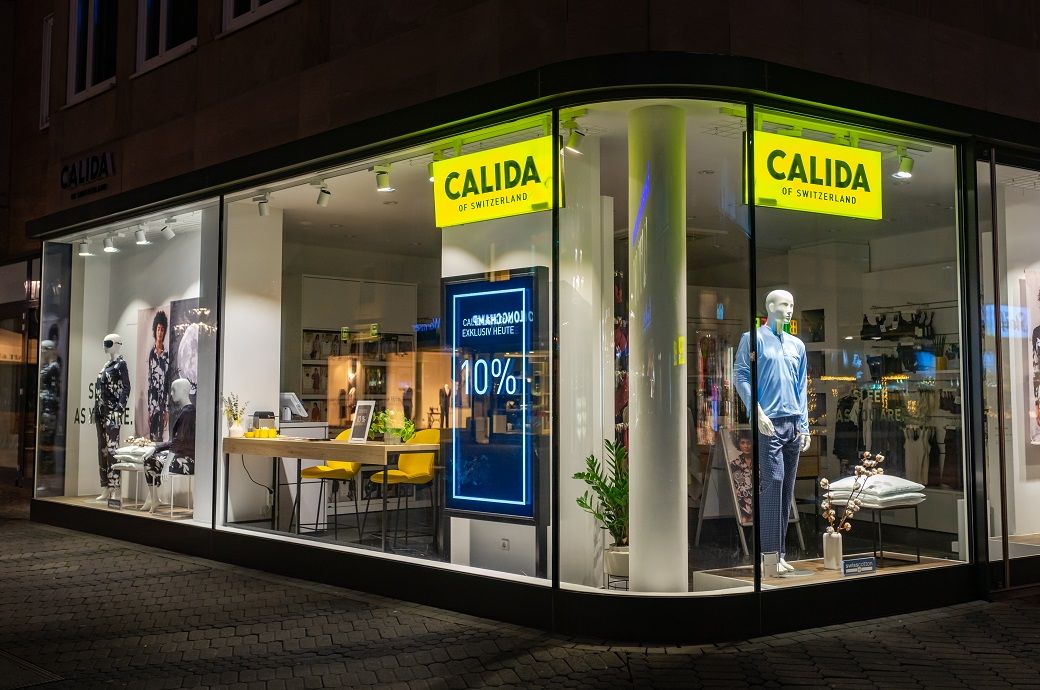
The group recorded an operating result (EBIT) of CHF 9 million (~$11.6 million) compared with CHF 4 million in the previous year, lifting the EBIT margin to 4.2 per cent from 1.7 per cent. Excluding Cosabella, the combined EBIT margin of Calida and Aubade reached 6.7 per cent, approaching the company’s medium-term target range. Operating net profit improved significantly to CHF 7.6 million (~$9.8 million) from CHF 0.5 million a year earlier, Calida Group said in a press release.
Calida Group has reported net sales of CHF 215.9 million (~$278.5 million) in 2025, down 5 per cent YoY.
EBIT rose to CHF 9 million (~$11.6 million) and net profit to CHF 7.6 million (~$9.8 million), supported by strong Calida and Aubade performance.
The group maintained solid liquidity and continued Cosabella repositioning while targeting future profitability improvement.
The group maintained a solid financial base with net liquidity of CHF 25.1 million and an adjusted equity ratio of 67.9 per cent, while free cash flow reached CHF 9.8 million. The board proposed a cash dividend of CHF 0.25 per share, corresponding to a payout ratio of 23 per cent in line with its long-term dividend policy.
“After a challenging first half of 2025, the Calida Group developed positively in the second half and achieved operational improvements on sales and profitability. By deliberately and systematically forgoing discount-driven growth and strategically positioning Calida and Aubade in the premium segment, the brands were strengthened in the long-term. Overall, 2025 was another year defined by a persistently challenging market environment,” said Thomas Stocklin, CEO of the Calida Group.
“Geopolitical uncertainty, US trade and tariff policies, and muted consumer sentiment in our core markets impacted the entire industry. In this environment, the Calida Group has demonstrated strategic discipline and, step by step, is evolving in the desired direction. Today, our group is more agile and efficient. Combined with our financial strength, this positions the Calida Group to pursue well-considered organic as well as external growth opportunities, allowing us to look to the future with confidence,” added Stocklin.
Operationally, the company continued implementing its efficiency-focused strategy by reintegrating functions into individual brands, streamlining group management structures and strengthening capabilities across product management, marketing, operations and sales.
Brand-wise, Calida generated sales of CHF 145.1 million, declining modestly as store traffic softened, although e-commerce growth and a strong Christmas season supported second-half performance. The brand improved its operating contribution margin through higher gross margins and ongoing cost optimisation while reinforcing its premium market positioning.
Aubade recorded sales of CHF 58 million amid weak consumer sentiment in France and the strategic withdrawal from unprofitable channels following the pandemic-driven demand surge. Nevertheless, margin performance strengthened through strict cost management, ongoing rebranding initiatives and progress in expanding export markets, particularly in the United States.
Cosabella reported sales of CHF 12.8 million, extending its negative growth trajectory and contributing higher losses as the brand remains in an intensive repositioning phase under strategic review. The group is targeting a turnaround towards operational break-even in 2026.
Overall, the group indicated that organisational restructuring, inventory optimisation and disciplined channel management enhanced agility and cost efficiency, positioning the company for future growth while aiming to improve group profitability further as Cosabella’s performance stabilises.
Fibre2Fashion News Desk (SG)


The gross margin expanded to 47.3 per cent and diluted earnings per share more than doubled to $1.14 from $0.55.
Wolverine Worldwide has reported revenue of $1.874 billion in 2025, up 6.8 per cent, led by Active Group growth and strong Saucony performance.
Margins and earnings improved, while cash rose and debt declined.
Fourth-quarter revenue increased 4.6 per cent.
CEO Hufnagel highlighted brand momentum and transformation progress.
The company expects 2026 revenue growth with steady margins.
The company strengthened its balance sheet during the year, ending with cash of $206 million, up 35.6 per cent, and net debt reduced 16.2 per cent to $415 million. Inventory increased 10.7 per cent to $274 million, Wolverine Worldwide said in a press release.
The fourth quarter (Q4) revenue rose 4.6 per cent YoY to $517.5 million, supported by strong Active Group growth, particularly Saucony and Merrell. Active Group revenue increased 12.4 per cent to $372.7 million, while Work Group declined 11.3 per cent to $134 million. Gross margin improved to 47 per cent from 43.6 per cent, reflecting product cost savings, favourable mix and price increases, partly offset by higher US tariffs. Diluted earnings per share climbed to $0.38 from $0.28.
“We exceeded our expectations across all key metrics in the fourth quarter, finishing a solid year for the Company. Our biggest brands are growing around the world, direct-to-consumer (DTC) continues to improve, earnings per share increased meaningfully YoY, and I believe we’re finding our footing where we’ve underperformed,” said Chris Hufnagel, president and chief executive officer of Wolverine Worldwide. “I am pleased with our progress in transforming the company and encouraged by the momentum we have carried into 2026. We’re focused squarely on executing our brand-building model with pace and distinction—building awesome products, telling amazing stories, and driving the business each day.”
Looking ahead, Wolverine Worldwide expects fiscal 2026 revenue of $1.96-1.985 billion, representing growth of 4.6-5.9 per cent YoY. The company anticipates gross margin of about 46 per cent, operating margin of roughly 8.8 per cent and diluted earnings per share between $1.31 and $1.46, signalling continued but measured expansion as brand-driven strategy execution progresses, added the release.
Fibre2Fashion News Desk (SG)


Aviva flags potential for Iran conflict to send claims costs rising

Queen Letizia shows presence and support during difficult day

Need One Pair for Hiking, Traveling, and Working Out? Try Gravel Running Shoes

India Us Trade Deal: Fresh look at India-US trade deal? May be ‘rebalanced’ if circumstances change, says Piyush Goyal – The Times of India

What are Iran’s ballistic missile capabilities?

Attock Cement’s acquisition approved | The Express Tribune

-
 Politics1 week ago
What are Iran’s ballistic missile capabilities?
-
Business6 days ago
India Us Trade Deal: Fresh look at India-US trade deal? May be ‘rebalanced’ if circumstances change, says Piyush Goyal – The Times of India
-
Business7 days ago
Attock Cement’s acquisition approved | The Express Tribune
-
 Business1 week ago
Households set for lower energy bills amid price cap shake-up
-

 Politics1 week ago
US arrests ex-Air Force pilot for ‘training’ Chinese military
-

 Fashion7 days ago
Policy easing drives Argentina’s garment import surge in 2025
-

 Sports6 days ago
LPGA legend shares her feelings about US women’s Olympic wins: ‘Gets me really emotional’
-

 Fashion6 days ago
Texwin Spinning showcasing premium cotton yarn range at VIATT 2026