

Fashion
Calais-Caudry Lace aims to secure European Geographical Indication status


Published
October 18, 2025
Recognised as a protected geographical indication in France, Dentelle de Calais-Caudry says it has begun the process of becoming a European geographical indication to better protect its identity against low-grade counterfeits.
From December 1, the European Union will introduce a simplified procedure under Regulation 2024/1143, which now governs geographical indications and protected designations of origin across its Member States.
Crucially, Europe is now extending a protection regime to artisanal, manufactured, and industrial products, which was previously reserved for agricultural produce, foodstuffs, and spirits.
“The Dentelliers de Calais-Caudry have already applied to the INPI, which is responsible for forwarding their application to the EUIPO (European Union Intellectual Property Office), so that their geographical indication can be recognised throughout the European Union”, say the Calais and Caudry lacemakers.
Dentelle de Calais-Caudry became a regulated geographical indication in France at the beginning of 2024. It took the local industry’s representatives five years to achieve this goal, which aims to distinguish and protect know-how that is more than two centuries old, and relies on the use of imposing, complex Leavers looms, which lend their name to the lace they produce. In 1958, the “Dentelle de Calais” label was launched, and in 2015 it became “Dentelle de Calais-Caudry”, to include manufacturers from the Caudry area.

“Regularly confronted with very poor-quality counterfeits that damage their image and sales, the lacemakers of Calais-Caudry will, by obtaining this European geographical indication, benefit from legal protection across the 27 countries of the Union”, says the label, which hopes that “this guarantee of authenticity and quality, which will reassure all designers, stylists and lovers of Calais-Caudry lace, will help safeguard this know-how, these ‘passion’ trades, and accelerate international development.”
Today, Calais-Caudry lace is produced in Calais by Codentel, Cosetex, Noyon (Darquer), and Sophie Hallette / Riechers Marescot, which also operates in Caudry. The town is also home to Beauvillain Davoine, Darquer & Méry, Dentelles André Laude, Dentelles MC, Jean Bracq, and Solstiss.
This article is an automatic translation.
Click here to read the original article.
Copyright © 2025 FashionNetwork.com All rights reserved.









The report titled ‘Impacts of the Conflict in the Middle East on African Economies’, cautions that African economies, which were slowly recovering from the severe consequences of COVID-19, the Russia-Ukraine war and rising trade tariffs, could be among the most affected by the ongoing conflicts in the Middle East.
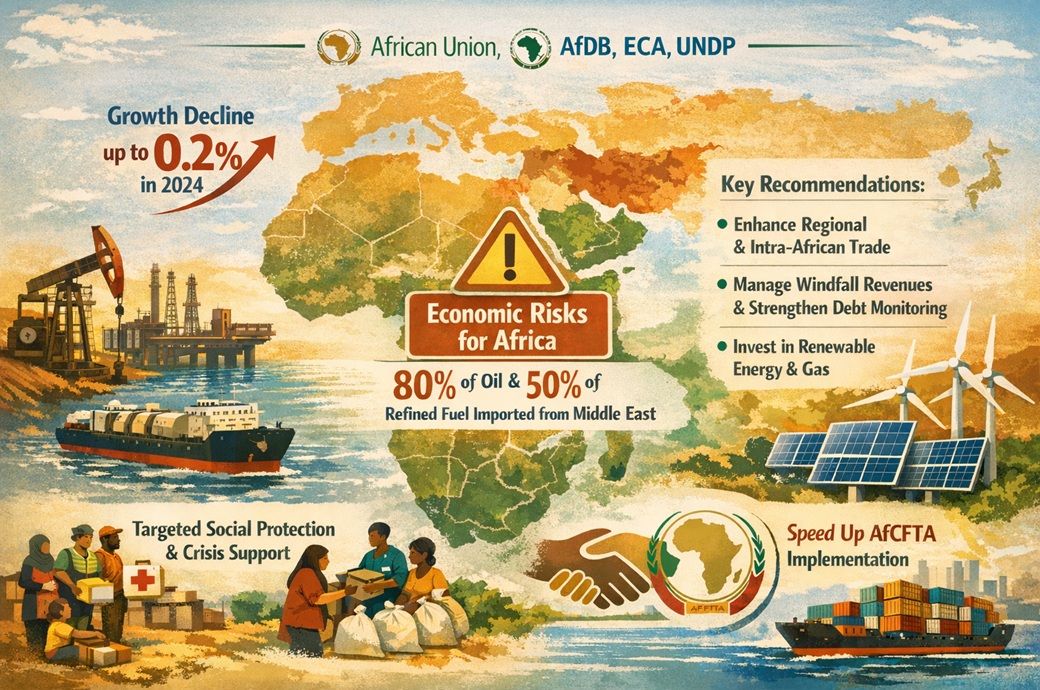
Growth in African countries is projected to decline by up to 0.2 per cent this year due to the Middle East crisis, according to a joint policy document by the African Union Commission, the African Development Bank Group, the UN Economic Commission for Africa and the UN Development Programme.
The main effects of the conflicts on Africa include surging prices of hydrocarbons, food products and fertilisers.
Kevin Urama, chief economist and vice president for economic governance and knowledge management at AfDB who presented the report on the sidelines of the Spring Meetings of the International Monetary Fund and the World Bank in Washington, DC, recently, urged African governments not to panic or take hasty decisions that could harm their fiscal balances.
The main effects of Middle Eastern conflicts on African economies include surging prices of hydrocarbons, food products and fertilisers, noted the report.
“Eighty per cent of the oil imported into Africa comes from this region, as well as 50 per cent of refined petroleum,” said ECA executive secretary Claver Gatete.
The report recommends, in particular, strategic inflation management to ensure short-term price stability expectations. It cautions oil-exporting countries to adopt strict fiscal discipline by managing windfall revenues prudently, while strengthening debt-monitoring, and using energy reserves strategically.
Where fiscal space allows, it advises that temporary and targeted social protection measures be deployed to shield the most vulnerable populations from the crisis, added the report.
However, the report urged governments to avoid broad-based subsidies that could worsen long-term fiscal deficits, and to diversify sources of energy, inputs and food supplies.
It also recommends that African governments strengthen regional and intra-African trade in oil and fertiliser markets to enhance resilience; and ensure smooth inter-institutional coordination to harmonise strategic monetary and fiscal policies.
At the same time, the report calls upon development partners, multilateral banks and development finance institutions to provide emergency support to African countries through crisis response measures and technical assistance.
It also recommends a speedy operationalisation of the African Continental Free Trade Area (AfCFTA), while strengthening large-scale domestic capital mobilisation.
The report also suggested Africa to diversify its energy mix by accelerating investments in renewable energy and the gas sector.
Fibre2Fashion News Desk (DS)
The measures aimed at improving turnaround time, enabling early approvals and enhancing transparency and predictability under the Advance Authorisation (AA) scheme.
The Indian Ministry of Commerce & Industry has undertaken a series of targeted reforms to strengthen the functioning of norms committees under the Directorate General of Foreign Trade, it recently said.
The measures—aimed at improving turnaround time, enabling early approvals and enhancing transparency and predictability under the Advance Authorisation scheme—have resulted in improved outcomes.
DGFT administers the AA scheme and the Duty-Free Import Authorisation (DFIA) scheme under the Foreign Trade Policy. These schemes allow duty-free import of inputs that are physically incorporated in export products.
Authorisations are generally issued against notified standard input-output norms (SION). In cases where SION is not available, authorisations are issued based on self-declared input-output norms by applicants, which are subsequently examined and finalised by sector-specific NCs.
At present, seven NCs are operational under DGFT, covering a range of export sectors. These comprise technical authorities and domain experts from relevant ministries and departments. They are responsible for fixation of SION and ad-hoc norms, recommending SION notifications and facilitating issuance of authorisations in accordance with the Foreign Trade Policy and handbook of procedures.
The functioning of NCs had been affected by capacity constraints due to a limited number of technical authorities. As of early February 2026, only twelve technical members were associated with the committees, including five serving government officers, resulting in increasing pendency due to overlapping responsibilities.
To address these challenges, a series of reforms have been introduced. These include strengthening of governance and processes; augmentation of technical capacity; and a special disposal drive for expeditious disposal of pending applications.
Detailed guidelines have been issued to ensure uniformity and consistency in the functioning of NCs. These include institutionalised scheduling of meetings on a fixed fortnightly cycle, prioritisation of long-pending cases, time-bound finalisation of meeting minutes and systematic monitoring of pendency and case ageing.
Efforts have also been made to identify recurring cases for conversion into SION to reduce repetitive approvals.
Line ministries have been requested to nominate additional technical officers to the committees to enhance sectoral expertise and reduce dependence on a limited pool of members.
As part of capacity augmentation, ten additional technical members have been nominated from various ministries, increasing the total number of technical authorities from 12 to 22.
The reforms have resulted in improved outcomes, a release from the ministry said. Between January 2026 and 7 April 2026, a total of 38 NC meetings were held, in which 3,925 cases were taken up and 1,770 cases were disposed of.
Fibre2Fashion News Desk (DS)
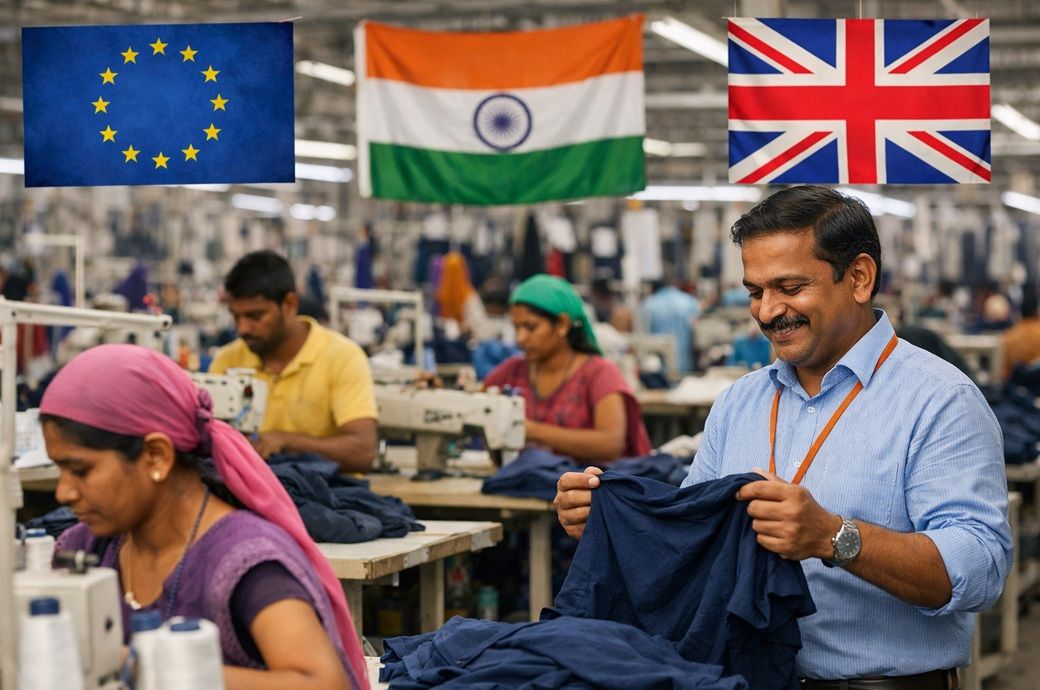
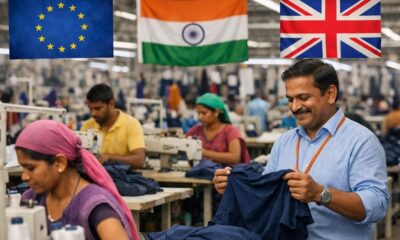
In February, Fibre*Fashion reported, citing an Investment Information and Credit Rating Agency report, that the India–EU FTA pushes for eliminating the duties on shipments from India and giving the country a competitive edge against competitors such as Bangladesh and Vietnam, who have so far enjoyed free entry into the EU region.
The FTA between India and the EU is expected to come into effect sometime in early January and with the United Kingdom in June or July this year. CEO of The Synerg, Karthikeyan Shanmugam, said in an interview with Fibre*Fashion that the future is quite good for India’s textile industry as the FTAs come into place.


2026 growth in Africa to drop by up to 0.2% due to Iran war: Report

Indian reforms strengthen DGFT norms committees’ functioning: Ministry

The Weird, Twisting Tale of How China Spied on Alysa Liu and Her Dad

-

 Fashion4 days ago
France’s LVMH Q1 revenue falls 6%, shows resilience amid Iran war
-

 Sports1 week ago
The case for Man United’s Fernandes as Premier League’s best
-

 Entertainment1 week ago
Palace left in shock as Prince William cancels grand ceremony
-
 Business1 week ago
UK could adopt EU single market rules under new legislation
-

 Entertainment5 days ago
Is Claude down? Here’s why users are seeing errors
-

 Sports1 week ago
Lamar Jackson hits back at critics with faithful message on social media
-

 Fashion1 week ago
Energy emerges as biggest cost driver in textile margins
-

 Tech1 week ago
A Lot of Shops Won’t Fix Electric Bikes. Here’s Why