

Business
Can the plastic recycling industry be saved?


MaryLou CostaTechnology Reporter
 Getty Images
In the plastic recycling industry, the casualties keep coming.
Waste management company Biffa’s Sunderland plant closed in February after opening in 2022 at a cost of £7m, while rival Viridor closed its Avonmouth plant in 2022, Skelmersdale in 2023 and confirmed this summer that its Rochester plant would close, too.
Like falling dominoes, plastic recycling plant closures have been endemic across Europe too: another big name, Veolia, will close its two German operations this year, while seven plastic recyclers closed in the Netherlands last year.
Meanwhile, companies Borealis, Dow and Nester have all dropped plans to construct new plastic recycling plants in Europe.
Industry body Plastic Recyclers Europe equates this to the loss of nearly one million tonnes of plastic recycling capacity since 2023.
“Without decisive political action, Europe will replace its recycling industry with dependency on unsustainable imports and growing volumes of waste, undermining both its economic resilience and its climate leadership,” the organisation told the BBC in a statement.
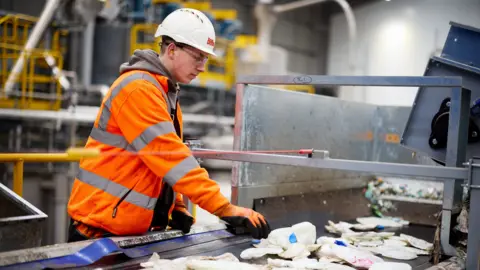
And more closures are likely, warns James McLeary, managing director for Biffa’s polymers division, as the industry here and in Europe faces its most challenging year yet. High energy and labour costs here are two factors, in parallel with the fact that sourcing virgin and recycled plastic from Asia is currently cheaper than buying European recycled plastic.
Plastic recycling plant closures are affecting the US as well, also prompted by the low price of virgin plastic, causing the country to miss its recycled content targets, as S&P Global reports.
“There’s a big global dependence building on Asian plants, and we then have the situation where (plant operators in the UK and Europe) are going to make very tough decisions. Either they run their plants at a point where they’re literally not making anything, or they decide to close,” explains Mr McLeary, who is based in County Durham.

 Getty Images
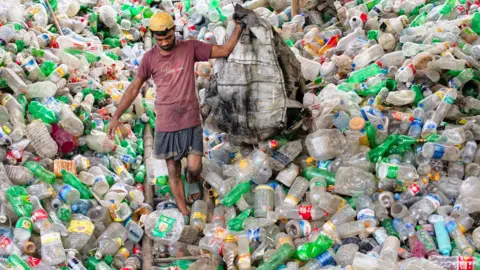
A dependence on exporting plastic waste also hasn’t helped. The UK exported around 600,000 tonnes of plastic waste last year, according to environmental analysts at ENDS Report – 5% more than in 2023.
Loopholes in current UK legislation mean plastic waste collectors are inadvertently incentivised to export rather than process domestically. Meanwhile, manufacturers using plastic packaging are still inclined to use cheaper virgin plastic from abroad, and stomach being taxed for it.
Ahmed Detta, CEO and founder of plastic waste recycler Enviroo, is frustrated by the flaws and contradictions that he feels are plaguing the industry and disrupting the goal of creating a circular economy that keeps materials in use for as long as possible.
“For me, a circular economy is a win-win. Every single person in that journey has to have some benefit, and that’s not working,” says Mr Detta, who is based in London.
“Brands aren’t aligning with the circular economy. They’re saying, ‘why should I buy recycled material when it’s cheaper for me to pay the fine for the plastics packaging tax, than actually pay for recycled materials? No one is saying, ‘let’s unite’.”
 Biffa
BiffaSo concerned is RECOUP, a UK-based plastic recycling independent authority, that its head of policy and infrastructure, Steve Morgan, warns: “We are almost witnessing the demise of plastic recycling as we know it, unless we have some interventions. There’s no way a lot of recyclers in the UK can compete.”
UK regulations have benefited foreign markets more than they have the UK, and serious reform is needed, Mr Morgan argues.
“There are an awful lot of fantastic technologies developing. But it’s a scale up of those and how they can actually make money, to continue to exist and then also thrive, is the secondary thing,” says Mr Morgan, who is based in Peterborough.
“The commercial viability long term is just not there at the moment. There are some really good people producing technologies that we couldn’t even dream of 10 years ago. But I just feel we’re not going to see any real change in the next two to three years without some intervention.”
RECOUP is urging the UK government to introduce a single plastic recycling certification scheme aimed at reducing the export of plastic waste and making more companies more inclined to use recycled packaging.
Mr Morgan is optimistic that a UK government consultation this year will seriously consider what changes should be implemented to save the plastic recycling industry.
 Plastics Europe
Packaging reforms are indeed being implemented, alongside £10bn of investment in new plastic sorting and processing facilities, according to a spokesperson from the UK Department for Environment, Food and Rural Affairs (DEFRA).
They also say the Deposit Return Scheme, launching in October 2027, will create higher quality material for recycling, as consumers will be encouraged to return drinks bottles and cans to collection points to collect the small deposit they will have paid on purchase. The government has also convened a Circular Economy Taskforce.
“Our collection and packaging reforms will support UK-based recycling, meaning we can reduce our dependency on exports of plastic waste,” says the spokesperson. “The export of waste is subject to strict controls set out in UK legislation.”
Over in Brussels, Virginia Janssens is the managing director at Plastics Europe, which represents plastic producers, including those with recycling operations and that use recycled materials. She’s concerned that the plastic recycling industry is set to flourish outside Europe.
“Business will go where it makes sense and where it’s cheapest to build. If those big production plans are built somewhere else, with huge investments of billions, they’re not all of a sudden then going to decide to go back and build one in Europe,” says Ms Janssens.
“It will have a huge effect on our value chain. It would set us back to 20 years ago, when we would have to incinerate or use landfill more, and that would be a real shame. Nobody wants this.”
But there are some bright spots in an otherwise struggling industry.
Biffa, for example, has recently acquired bottle manufacturer Esterform, which uses recycled PET.
Meanwhile, Enviroo recently secured £58m to build a new recycling facility in the north-west of England, specialising in converting PET drink bottles into a recycled granulate that can be used in food packaging.
Due to be operational by 2026, the plant is expected to process up to 35,000 tonnes of plastic annually.
Mr Detta believes being a specialist in an industry of generalists, and going back to the fundamentals of plastic recycling, will be his key to success.
“I’m not here to tell you I’ve got the most innovative technology. No – I’ve looked at the real, hardcore problems and said, ‘What is it that I need to resolve?”
Plastic Energy, meanwhile, is successfully converting plastic waste into pyrolysis oil that can be used to make food and medical grade plastic. Headquartered in London, the company has plants in Spain, France and the Netherlands.
CEO Ian Temperton is preparing to benefit from an anticipated under supply of recycled plastic as recycled content targets kick in across Europe: by 2040, plastic drinks bottles must contain at least 65% recycled content.
“We’re about developing and continuing to enhance the technology that deals with waste plastics. Having partners commit to new investments over the next couple of years is going to be a bit harder, but it’s very clear the market will be very significantly under-supplied against any version of the targets,” says Mr Temperton.
“So I will keep my team focused on the best technology for when that comes.”
Trump said on Saturday that an agreement would include the reopening of the Strait of Hormuz, without giving further details.
Source link

UK high streets and shopping destinations are showing signs of recovery as more than 13 retail stores opened each week over the past year, according to new figures.
However, England and Wales have still seen more than 6,000 retail premises vanish from local communities over the past five years.
Analysis of Valuation Office Agency data by tax firm Ryan, found that there were 507,810 retail premises across England and Wales at the end of 2025.
It said the figures showed that a recent contraction across the sector has appeared to stabilise, with a 723 net increase in the number of retail stores compared with a year earlier.
Property numbers increased across every region of England and Wales, with the exception of the North West, which saw a decline of 41.
It suggests that parts of the sector are now beginning to rebalance following significant structural contraction seen since the pandemic.
The creation of new retail units also comes as many retail real estate firms, such as Hammerson, have turned empty large units, often former department stores, into a greater number of smaller units.
Other retail groups, such as John Lewis, have moved away from ambitions to transform some retail property for other uses such as rental accommodation.
Nevertheless, the retail sector is still facing pressure from higher business rates for many firms, increased labour costs and concerns over consumer sentiment.
The data also shows that there has also been significant decline over the past few years, with a net reduction of 6,045 retail properties since the end of 2020.
London recorded the largest five-year regional reduction, with 1,266 retail premises disappearing over the period, followed by the South East (-1,191), North West (-719) and North East (-672).
The figures show retail premises which have permanently disappeared from communities altogether, having either been demolished or converted for alternative use.
The figures come as Ryan’s 2026 annual business rates review highlighted that the retail sector saw a 9.3% increase in rateable values at the 2026 business rates revaluation despite the major shift in the retail landscape since the pandemic.
Alex Probyn, practice leader for Europe and Asia-Pacific property tax at Ryan, said: “The pandemic accelerated structural changes that were already emerging across the retail sector, including changing consumer behaviour, hybrid working patterns and a reduced reliance on traditional retail floorspace in many locations.
“Many locations were arguably over-retailed before Covid and high streets have evolved towards more mixed-use environments, with retail space being rebalanced alongside growing demand for residential, leisure, hospitality and service-led uses.
“The revaluation outcome does suggest a large proportion of retail premises have seen bigger increases in their assessments than underlying market conditions and rental evidence would have led occupiers to expect.
“Retailers should therefore carefully review and, where appropriate, challenge their assessments.”

Indians sharply cut back on overseas travel spending in March, with remittances for foreign trips dropping by more than $212 million from the previous month, according to Reserve Bank of India data. The fall in outbound travel expenditure came amid rising oil prices linked to the Middle East conflict and persistent pressure on rupee, even as travel remained the single largest component of outward remittances under the Liberalised Remittance Scheme (LRS).In March, travel-related remittances fell to $1.09 billion from $1.3 billion in February and $1.65 billion in January. The decline came at a time when the West Asia conflict pushed oil prices higher and weakened rupee to record lows. Amid the situation, Prime Minister Narendra Modi urged citizens to cut down on foreign travel and adopt measures such as carpooling. Lower overseas travel spending could reduce foreign exchange outflows and help ease pressure on rupee.According to the RBI’s data on outward remittances by resident individuals, travel continued to account for the largest share of money sent abroad under the LRS in March. Total remittances during the month stood at $2.59 billion.The RBI tracks overseas spending across categories including travel, studies abroad, maintenance of close relatives, overseas investments, and property purchases. Under the LRS framework, resident individuals, including minors, can remit up to $250,000 in a financial year for permitted current or capital account transactions.Within the travel segment, the biggest component remained the ‘other travel’ category, which covers holiday spending and international credit card settlements. Indians spent $623.05 million under this category in March, accounting for nearly 57 per cent of total travel-related remittances during the month.Expenditure linked to education travel, including hostel and fee payments, stood at $450.16 million. Business travel, pilgrimage, and overseas medical treatment together accounted for $21.39 million.The data also showed a rise in remittances meant for the maintenance of close relatives abroad. Such transfers increased to $389.78 million in March from $266.18 million in February.At the same time, spending under the ‘studies abroad’ category declined. This category includes payments made for educational services accessed remotely without travelling overseas, such as correspondence courses. Remittances under this head stood at $151.71 million in March, compared to $175.68 million in February and $267.42 million in January.For the financial year 2024-25, Indians remitted a total of $29.56 billion under the LRS. Travel made up the largest portion of this amount at $16.96 billion.The RBI figures further showed that investments by Indians in overseas equity and debt instruments rose significantly to $440.22 million in March from $265.99 million in February.Meanwhile, outward remittances for the purchase of immovable property overseas declined to $38.68 million in March, down from $51.36 million a month earlier.


How Bangladesh turned denim into enviable success story

A Probe Took Incredible Pictures of Mars on Its Way to a Far-Off Asteroid

Tiruppur’s synthetic bet meets the oil wall

-

 Entertainment1 week ago
Where Pete Davidson, Elsie Hewitt stand after breakup: Details revealed
-

 Politics1 week ago
Rising diesel costs from Iran war strain US school budgets
-

 Tech1 week ago
Why Is Your Grill So Dumb? The Best Grills Set Temp Like an Oven
-

 Tech1 week ago
This Solar-Powered Smart Sprinkler Keeps My Lawn Watered Without Any Power Cables
-

 Fashion6 days ago
Nigeria Kwara Garment Factory, KWS Garment Production Village ink pact
-

 Fashion1 week ago
India’s Pearl Global’s FY26 revenue crosses $521 mn milestone
-

 Fashion4 days ago
ICE cotton sees mixed trend as rain forecasts weaken sentiment
-

 Fashion7 days ago
Turkiye’s current account deficit expected to widen in 2026: Minister