

Business
Carney: Canada is ready to pick up trade talks when US is ready

Osmond Chia,Business reporter, and
Maia Davies
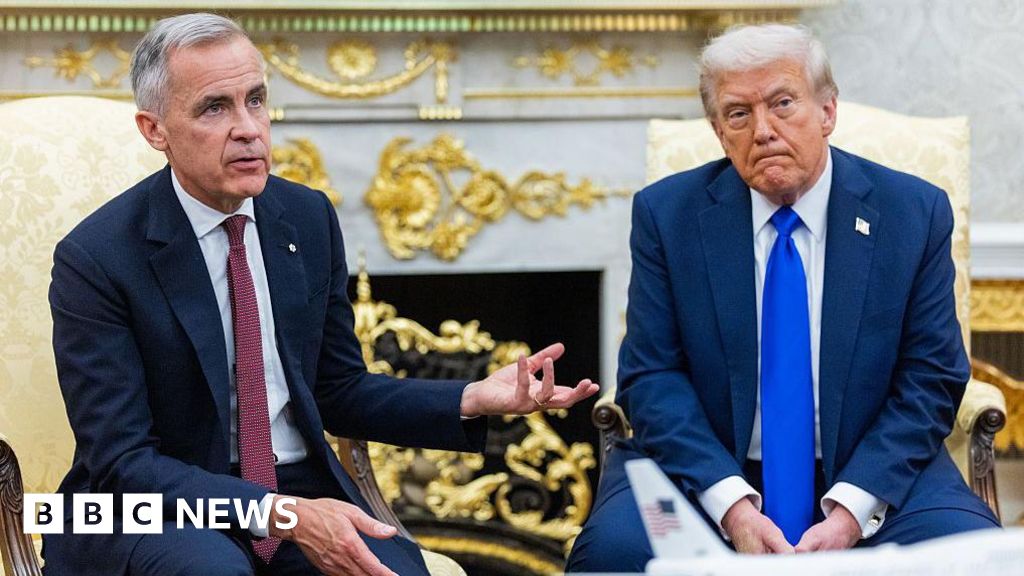
Canadian Prime Minister Mark Carney said his country is prepared to resume trade talks with the US “when the Americans are ready.”
His remarks come after US President Donald Trump announced an immediate end to all trade negotiations with Canada over an advert critical of the tariffs he has imposed on the nation.
The advert, sponsored by the Canadian province of Ontario, quotes former US President Ronald Reagan, a Republican and icon of US conservatism, saying tariffs “hurt every American”.
Trump wrote on social media that the advert was “FAKE” and “egregious”, adding that trade talks were “HEREBY TERMINATED”.
 Getty Images
The Trump administration has imposed a 35% levy on many Canadian imports, as well as individual tariffs targeting particular industries like car and steel manufacturing. Ontario has been particularly hard-hit by these.
Trump has allowed exemptions for goods that fall under a free trade agreement with Mexico and Canada, negotiated during his first term.
But since his election earlier this year, Canada’s Carney has attempted to strike a deal that would ease the tariffs. Three-quarters of Canadian exports are sold to the US, making its economy particularly vulnerable.
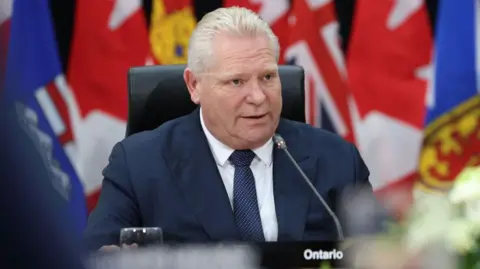
This effort has been complicated by Ontario Premier Doug Ford, who is one of the most vocal critics of the taxes levied on US firms buying Canadian products.
In the minute-long advert published last week, Reagan’s voice can be heard narrating over images that include the New York Stock Exchange and cranes adorned with both US and Canadian flags.
The video excerpts from a 1987 national radio address by Reagan that focuses on foreign trade.
“When someone says, ‘let’s impose tariffs on foreign imports’, it looks like they’re doing the patriotic thing by protecting American products and jobs. And sometimes, for a short while, it works – but only for a short time,” Reagan says in the advert.
“Over the long run, such trade barriers hurt every American, worker and consumer.
“High tariffs inevitably lead to retaliation by foreign countries and the triggering of fierce trade wars… Markets shrink and collapse, businesses and industries shut down and millions of people lose their jobs.”
The Ronald Reagan Foundation – which is charged with preserving his legacy – released a statement on Thursday saying the advert had used “selective” audio and video of the former president’s remarks.
It said the advert “misrepresents” the former president’s address, without specifying why, and accused the Ontario government of not seeking permission to use and edit the remarks.
The foundation said it was “reviewing its legal options”.
Trump referenced this statement, and said the video was designed to “interfere with” the US Supreme Court’s upcoming decision in November on whether Washington’s sweeping tariffs on many nations’ products are legal.
The court’s decision represents the biggest test of Trump’s presidential authority and signature economic policy, potentially forcing the US to refund billions collected in tariffs.
Prime Minister Carney did not address the advertisement in his remarks early on Friday. He said that Canada has made “a lot of progress” in trade talks with the US, but is also focused on “developing new partnerships” with other countries, including Asia.
He spoke as he was departing Canada for the ASEAN summit in Kuala Lumpur. Trump is also expected to attend.
Ford, meanwhile, posted the full Reagan speech on X and wrote: “Canada and the United States are friends, neighbours and allies. President Ronald Reagan knew that we are stronger together.”
While it only includes excerpts from the original, five-minute-long address, it does not alter Reagan’s words.
The order in which he makes the comments has been changed. The advert’s penultimate sentence is taken from near the beginning of his speech, and a phrase that features about halfway through the advert is likewise taken from an earlier point in the address.
The original address – titled Address to the Nation on Free and Fair Trade – is regarding a specific set of tariffs the Reagan administration had at the time imposed on some Japanese goods.
Reagan seeks to use the speech to explain why he introduced the tariffs in this “special case” despite his belief that “imposing such tariffs or trade barriers and restrictions of any kind are steps that I am loath to take”.
He makes clear that he wants to lift them as soon as possible “to promote the prosperity and economic development that only free trade can bring” – a position he stresses throughout the speech.
Trump later doubled down on his criticism of the advert, writing that “Ronald Reagan did not like Tariffs, when actually he LOVED TARIFFS FOR OUR COUNTRY, AND ITS NATIONAL SECURITY”.
Speaking to White House reporters on Friday morning, US National Economic Council Director Kevin Hassett said that “frustration has built up over time” with Canada.
“The Canadians have been very difficult,” he said.
A few minutes earlier, he told Fox Business that “sometimes when you’re frustrated, a time-out is the right call.”
“It’s probably a good time to take a break.”

 Getty Images
The advert was run as part of a campaign worth $75m Canadian dollars (£40m; $54m) on mainstream TV channels in the US.
In a post accompanying the advert last week, Ford wrote that “we’ll never stop making the case against American tariffs on Canada”.
China’s embassy in Washington also used a similar Reagan clip in a post on X to cast doubt on Trump’s global tariffs earlier this year.
Ontario is Canada’s most populous province and its largest regional economy, and has suffered the most as a result of the US tariffs.
Ford hit back at Trump’s earlier tariff threat against Canada by saying he was willing to cut off power supply to the US.
He had also described Washington’s trade policies against Canada as having pulled a knife and “yanked it into us“, and called on US lawmakers to put pressure on Trump.
Trump’s sector-specific levies on Canadian goods include a 50% levy on metals and 25% on automobiles.
The White House’s global tariffs – particularly on steel, aluminium and cars – have hit Canada hard, forcing job losses and putting pressure on businesses.
It is the second time Trump has said he was ceasing trade talks with Canada, after Ottawa announced it would impose a digital services tax on US technology firms earlier this year.
When Canada rescinded the tax, the White House said Carney had “caved” to pressure from Trump.

The UK’s competition watchdog says it is looking at five firms in its investigation into misleading online reviews.
Source link
Business
Gold price today (March 25, 2026): How much 24K and 22K gold cost in Delhi, Mumbai & more- Check rates – The Times of India
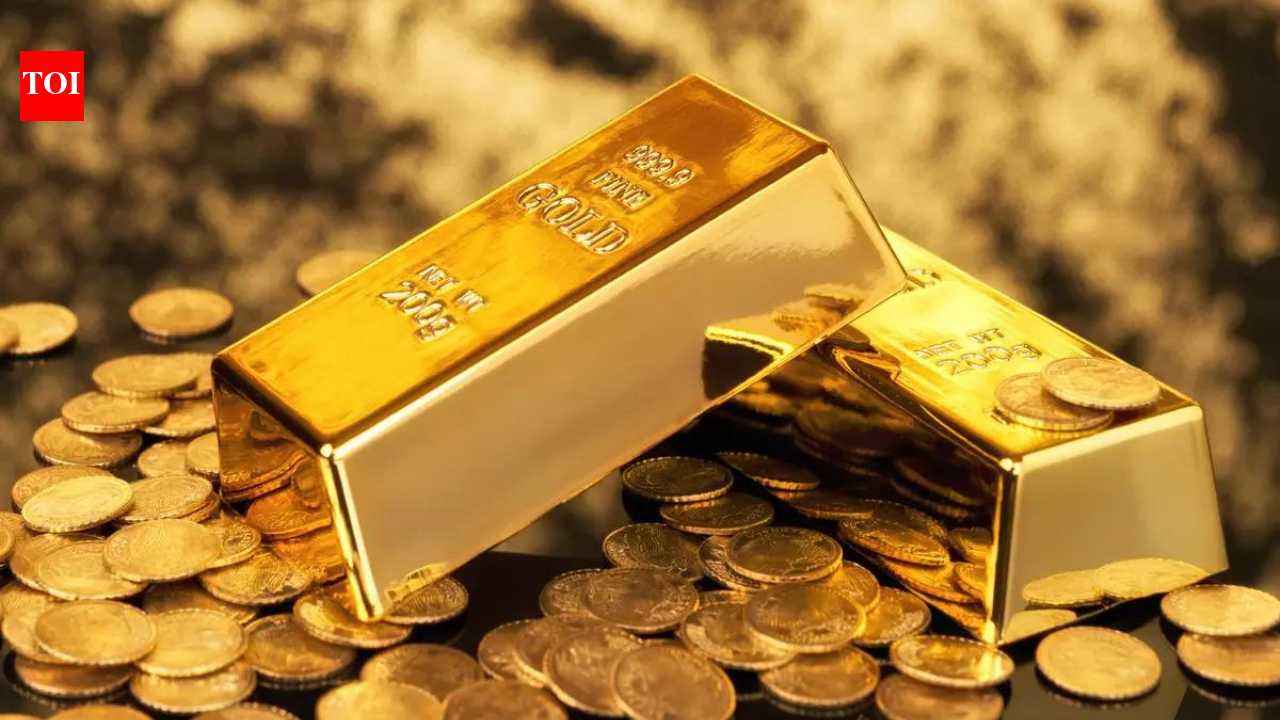
Gold futures traded higher on the Multi Commodity Exchange (MCX) on Friday with key contracts registering gains of up to 1.6 per cent amid firm buying interest and supportive global cues.The April 2026 gold contract rose by Rs 2,290, or 1.64 per cent, to trade at Rs 1,41,783 per 10 grams. The contract moved between an intraday low of Rs 1,40,287 and a high of Rs 1,42,800. The June 2026 contract, which saw higher trading activity, gained Rs 1,921, or 1.35 per cent, to Rs 1,44,435 per 10 grams. During the session, it touched a low of Rs 1,43,652 and a high of Rs 1,45,773. Meanwhile, the August 2026 contract advanced by Rs 1,480, or 1.02 per cent, to Rs 1,47,100 per 10 grams, with an intraday range of Rs 1,47,040 to Rs 1,48,600.Here is how gold prices stand across major cities today:
Gold price in Delhi today
Gold prices in the national capital declined, with 24K gold quoted at Rs 14,486 per gram, down Rs 218, while 22K gold slipped Rs 200 to Rs 13,280 per gram.
Gold price in Mumbai today
Mumbai bullion markets also saw a drop, with 24K gold priced at Rs 14,471 per gram, down Rs 218, and 22K gold at Rs 13,265 per gram, lower by Rs 200.
Gold price in Chennai today
Chennai recorded a sharper decline, with 24K gold selling at Rs 14,651 per gram, down Rs 262, while 22K gold dropped Rs 240 to Rs 13,430 per gram.
Gold price in Kolkata today
In Kolkata, 24K gold was quoted at Rs 14,471 per gram, down Rs 218, while 22K gold stood at Rs 13,265 per gram, lower by Rs 200.
Gold price in Hyderabad today
Hyderabad markets reflected a similar trend, with 24K gold priced at Rs 14,471 per gram, down Rs 218, and 22K gold at Rs 13,265 per gram, slipping Rs 200.
Gold price in Bangalore today
In Bangalore, 24K gold was quoted at Rs 14,471 per gram, down Rs 218, while 22K gold was selling at Rs 13,265 per gram, lower by Rs 200.
Gold price in Ahmedabad today
Ahmedabad bullion markets showed declines, with 24K gold at Rs 14,476 per gram, down Rs 218, while 22K gold fell Rs 200 to Rs 13,270 per gram.
Gold price in Lucknow today
In Lucknow, 24K gold was priced at Rs 14,486 per gram, down Rs 218, while 22K gold moved lower by Rs 200 to Rs 13,280 per gram.
Gold price in Patna today
Patna markets also recorded weaker rates, with 24K gold quoted at Rs 14,476 per gram, down Rs 218, and 22K gold at Rs 13,270 per gram, lower by Rs 200.
Gold price in Jaipur today
In Jaipur, 24K gold was quoted at Rs 14,486 per gram, down Rs 218, while 22K gold stood at Rs 13,280 per gram, down Rs 200.

A key survey indicates growing doubt among shoppers over prospects for the UK economy in the next year.
Source link


NCAA men’s tournament: Rick Pitino’s case for best men’s college basketball coach ever
Gold price today (March 25, 2026): How much 24K and 22K gold cost in Delhi, Mumbai & more- Check rates – The Times of India
JustEat and Autotrader among firms investigated in fake reviews probe

-

 Entertainment1 week ago
Val Kilmer revived 1 year after death through AI
-

 Fashion1 week ago
US’ G-III Apparel’s FY26 sales fall 7% to $2.96 bn
-

 Sports1 week ago
March Madness 2026 – How to watch in SA, start time, schedule, TV channel for NCAA championship basketball tournament
-
 Business1 week ago
Brits cashing in jewellery as gold price hits record high
-

 Fashion6 days ago
China’s textile & apparel exports surge 17% to $50 bn in Jan-Feb 2026
-
 Business6 days ago
Flipkart group CFO to leave co amid IPO plans – The Times of India
-
 Business1 week ago
Video: The Effects of High Oil Prices
-

 Sports7 days ago
Rating Adidas’ 2026 World Cup away shirts: Argentina, Spain, Mexico and more